

A fast A–B–C identification method for BCBA questions, with setting events, four-term distinctions, and a next-step checklist. In a 3 term contingency ABA question, your first job is not to guess the function. Your first job is to identify the three parts in order: the event that immediately precedes the response, the observable behavior, and what immediately follows it. That A–B–C sequence helps you read a vignette accurately, choose the right measurement, and decide what evidence is still missing.
Table of Contents
- What is the 3 term contingency in ABA?
- Read the sequence before you interpret it
- Separate an immediate antecedent from a setting event
- Write the B so another observer can code it
- Describe the consequence without calling it reinforcement
- Know when the question is really four-term
- Use the ABC checklist on an exam vignette
- Practice three short examples
- Connect the three-term contingency to design logic
- Avoid the common three-term contingency mistakes
- Turn the keyword into exam practice
- 3 term contingency ABA FAQ
- The bottom line
- Sources to study and recheck
- Quick Review Checklist
- Take the Free BCBA Mock Exam
This is a focused exam-reading guide. It does not replace the broader three-term contingency overview. Here, the goal is to prevent sequence errors: labeling a setting event as the immediate antecedent, treating an inferred function as the consequence, or calling one observation proof of a maintaining contingency.
What is the 3 term contingency in ABA?
The three-term contingency describes a relation among an antecedent, a behavior, and a consequence. In shorthand, it is A → B → C. The antecedent occurs before the response, the behavior is the response you can observe and measure, and the consequence follows the response. The sequence is temporal and descriptive; it is not, by itself, a complete functional analysis.
| Term | Ask this | Do not write this instead |
|---|---|---|
| Antecedent (A) | What event was present immediately before the response? | A broad background condition that happened earlier. |
| Behavior (B) | What observable response occurred, and how will it be measured? | A label such as “noncompliance” or “attention seeking.” |
| Consequence (C) | What changed immediately after the response? | A guessed function such as “escape” or “attention.” |
Read the sequence before you interpret it
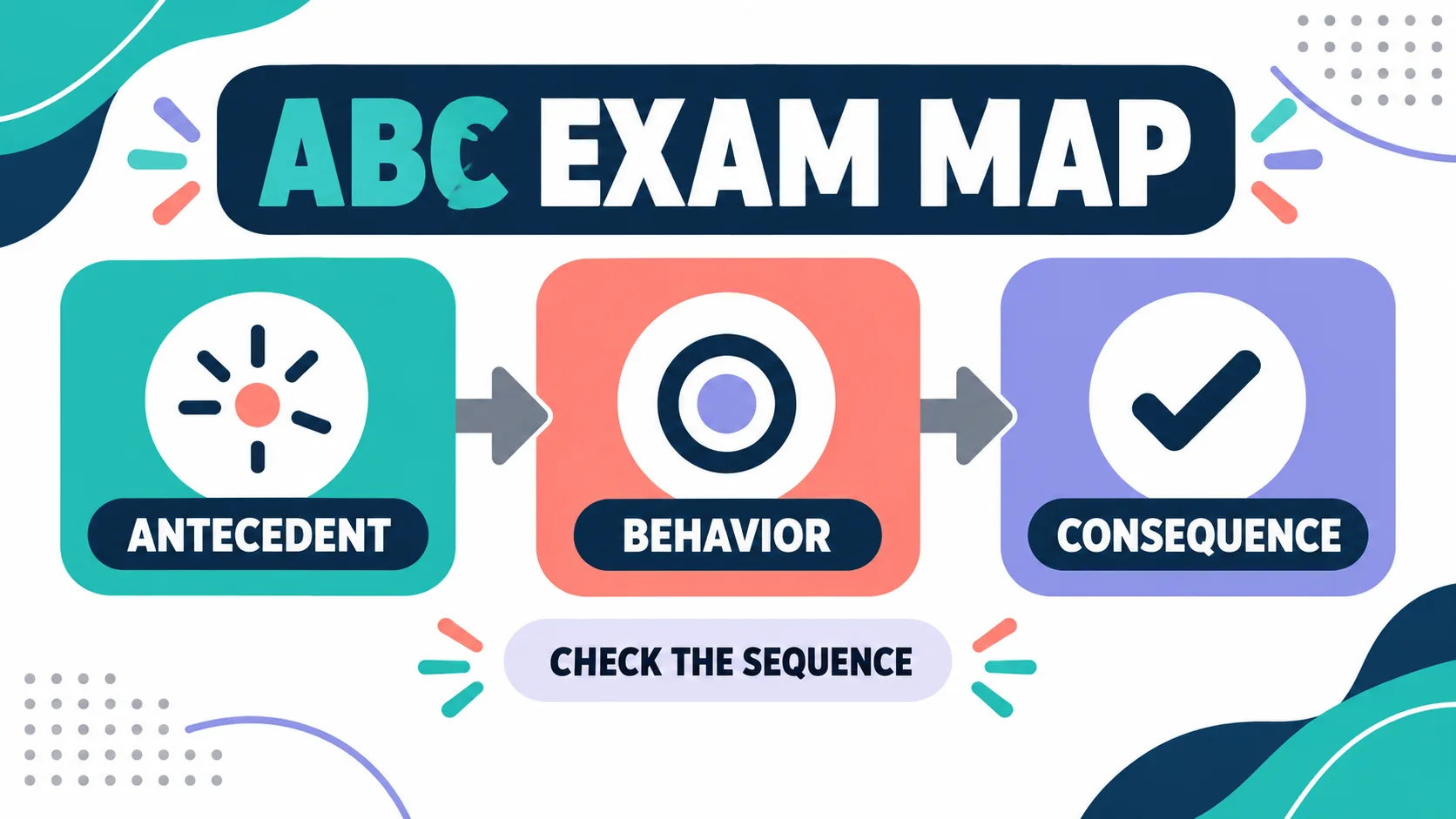
Use the visual map as a sentence-completion routine. First complete “Right before the response, ___ happened.” Then complete “The observable response was ___.” Finally complete “Right after the response, ___ changed.” If a detail does not fit one of those three time positions, place it in a context or setting-event note rather than forcing it into A, B, or C.
For example, a learner slept poorly, arrived late, received a difficult worksheet, pushed it away, and the worksheet was removed. Poor sleep may be relevant context. The worksheet presentation is the immediate antecedent. Pushing the worksheet is the behavior. Removing the worksheet is the immediate consequence. The ABC note can suggest a hypothesis about escape, but the word “escape” is not a literal description of what happened after the response.
Separate an immediate antecedent from a setting event
A setting event is a prior condition that changes the value or effect of an antecedent or consequence. It can help explain why the same instruction produces different responding at different times, but it is not automatically the immediate A in a three-term contingency question. The exam may include both details on purpose.
| Vignette detail | Likely role | Why it matters |
|---|---|---|
| Poor sleep earlier that night | Setting event or context | May alter motivation or response probability without immediately preceding the response. |
| Teacher presents a math problem | Immediate antecedent | It is the event directly before the response in the example. |
| Learner tears the paper | Behavior | It must be defined in observable terms before it can be measured. |
| Teacher removes the problem | Immediate consequence | It may support an escape hypothesis, but the outcome is not proof of function. |
Write the B so another observer can code it
The behavior term should describe what the person did, not why you think the person did it. “Refused because the task was hard” mixes an observable response with a causal explanation. “Pushed the worksheet to the floor within 10 seconds of presentation and turned away for at least 5 seconds” gives an observer a start point, form, and possible measurement rule.
Choose a measurement dimension that fits the question. Count may be useful for discrete responses, duration for behavior that persists, latency for time to begin after an instruction, and rate when observation opportunities differ. A three-term contingency does not prescribe one measurement; the target and decision determine the measure.
Describe the consequence without calling it reinforcement
In an ABC record, the C is an event that follows the behavior. Reinforcement is a functional effect: the consequence increases future responding under relevant conditions. You cannot label every pleasant event, break, item, or adult interaction as reinforcement from one observation. Use descriptive language first, then use repeated data or a suitable assessment to evaluate the function.
| If the vignette says… | Write the C as… | Then ask… |
|---|---|---|
| The demand was removed. | Demand removal immediately followed the response. | Does this pattern repeat, and does the design test the escape hypothesis? |
| The teacher spoke to the learner. | Adult interaction immediately followed the response. | Was the interaction contingent, and does attention increase future responding? |
| A preferred item was delivered. | The item was delivered immediately after the response. | Is the item functioning as reinforcement under these conditions? |
Know when the question is really four-term
Some ABA questions include a motivating operation or abolishing operation in addition to the three-term sequence. In that case, the prompt may be testing a four-term contingency: a motivating variable changes the value of a consequence and evokes or abates behavior; the antecedent then occurs; the behavior happens; and the consequence follows. Do not force every earlier event into the immediate antecedent slot.
A useful shortcut is to ask whether the detail changes the value or effectiveness of a consequence. If yes, it may be an establishing or abolishing operation. If it is a stimulus that signals the availability of reinforcement for a response, it may be an SD. If it simply happened earlier without that demonstrated role, call it context until the evidence supports a more specific label.
Use the ABC checklist on an exam vignette
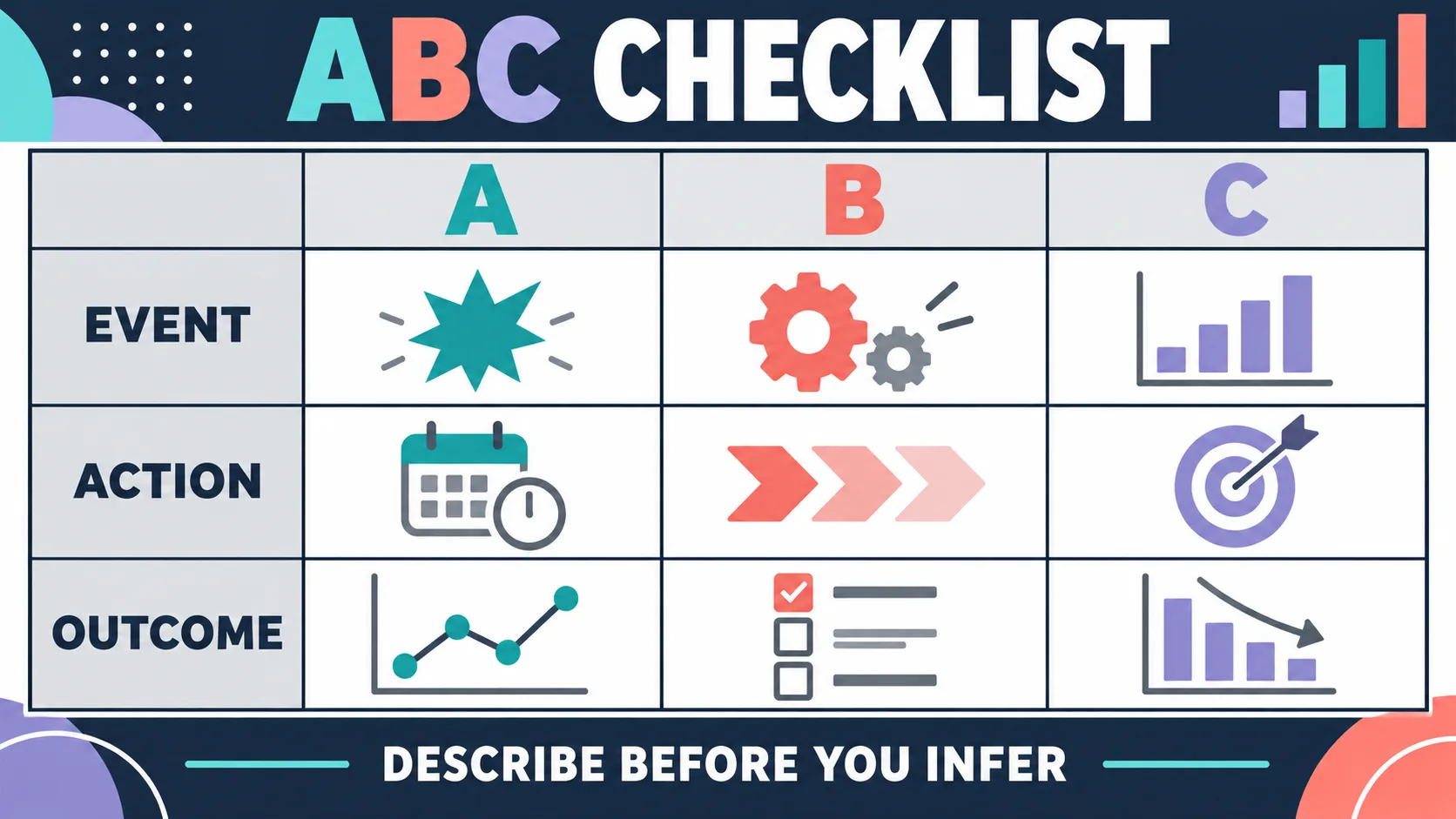
The checklist is designed for speed. Mark the three columns before you read the answer choices. If the question asks for the antecedent, choose the event immediately before the defined behavior—not the setting event, the consequence, or the inferred function. If it asks for the consequence, choose what changed after the response. If it asks for the function, move to the repeated pattern and assessment evidence instead of simply repeating the C label.
- Circle the response: find the exact observable behavior in the stem.
- Bracket A: identify the event immediately before that response.
- Underline C: identify what immediately changed afterward.
- Move earlier details aside: label them context, setting event, or motivating variable only when the stem supports it.
- Check the question verb: identify, define, infer, assess, and demonstrate require different levels of evidence.
Practice three short examples
| Example | A → B → C | Best next thought |
|---|---|---|
| A timer sounds; the learner drops the materials; the instructor gives a break. | Timer → drops materials → break. | Record the sequence repeatedly before calling the break escape reinforcement. |
| A peer asks a question; the learner raises a hand; the teacher calls on the learner. | Peer question → raises hand → teacher calls on learner. | Define the response and track opportunities if evaluating rate or latency. |
| The room is noisy; a work demand appears; the learner covers ears; staff reduce the demand. | Work demand → covers ears → demand reduction. | Noise may be context; the immediate A is the demand if it directly preceded the response. |
Connect the three-term contingency to design logic
One ABC observation is descriptive. To make a stronger claim about a functional relation, collect repeated observations or use an appropriate assessment or single-case design. The current BACB BCBA TCO includes identifying dependent and independent variables, threats to internal validity, single-case designs, and interpreting graphed data. Those tasks build on the same sequence but ask for more than locating A, B, and C. On an exam, distinguish these prompts:
- “Which is the antecedent?” asks for the immediately preceding event.
- “Which consequence followed?” asks for the immediate outcome, stated descriptively.
- “What is the likely function?” asks you to use repeated pattern evidence, not just name the C.
- “Which design demonstrates control?” asks how the intervention and comparison conditions are arranged.
Avoid the common three-term contingency mistakes
Calling a function the consequence: “attention” is a hypothesis; “teacher spoke” is the observed C. Calling every earlier event A: only the event immediately before B occupies the basic antecedent slot. Using a mentalistic behavior label: define what the observer can see and measure. Assuming one ABC note proves function: descriptive data guide the next assessment. Ignoring the question verb: identifying a component and demonstrating a functional relation require different evidence.
Turn the keyword into exam practice
After studying the sequence, take a short set of BCBA questions and label every miss as A, B, C, context, function, or design. Then write the correct time order in one line. This is more useful than rereading the same definition because it tests discrimination under a changing vignette. Use the Free BCBA Mock Exam as a diagnostic, not an official BACB result. Review the rationale and identify whether the miss came from time order, operational definition, function inference, or design logic.
3 term contingency ABA FAQ
What are the three terms in ABA?: The three terms are the antecedent, behavior, and consequence. The antecedent immediately precedes the response, the behavior is the observable response, and the consequence immediately follows it. Is the consequence the same as the function?: No. The consequence is what happened immediately after the behavior. The function is a hypothesis about why that consequence may maintain future responding, supported by repeated pattern or assessment evidence.
What is the difference between a setting event and an antecedent?: A setting event is an earlier context that can alter the value or effect of an antecedent or consequence. The immediate antecedent is the event directly before the behavior in the described sequence. Is ABC data a functional analysis?: No. ABC data are descriptive observations. They can suggest a functional hypothesis, while a functional analysis or other systematic assessment tests conditions under appropriate professional and safety safeguards.
Why does the BCBA exam ask about A, B, and C?: The sequence tests whether you can read behavior in context, define a measurable response, distinguish observed events from interpretations, and choose the next assessment or design step.
The bottom line
For a 3 term contingency ABA question, keep the order visible: antecedent before behavior, consequence after behavior. Describe what occurred before naming a function, separate context from the immediate A, and use repeated data or design logic before claiming a functional relation. That simple discipline prevents most ABC exam traps.
Sources to study and recheck
- BACB BCBA Test Content Outline, 6th edition
- Baer, Wolf, and Risley (1968), Some Current Dimensions of Applied Behavior Analysis
- Original article full text in PubMed Central
- BACB test content outline index
- Existing broad three-term-contingency guide
For targeted review, use our 3 term contingency aba practice questions to apply the concept in exam-style scenarios.
Quick Review Checklist
Use this final checklist to turn 3 term contingency aba into exam-ready reasoning. The goal is not to memorize a label in isolation; it is to identify the relevant evidence and explain why the best answer fits the scenario. Key ideas to review:
- State the central definition or decision point for 3 term contingency aba in your own words.
- Identify the detail that makes 3 term contingency aba different from its closest related ABA term.
- Separate the observable facts in a scenario from assumptions that are not supported by the facts.
- Write one example and one nonexample so you can recognize the concept in a new setting.
Exam application checks:
- Ask what the question is actually requesting before comparing the answer choices.
- Mark the antecedent, response, consequence, or other evidence that supports the selected answer.
- Look for a distractor that describes a related process but does not answer the specific question.
Final self-check:
- Explain how you would verify the interpretation with clear observations or data.
- Change one detail in the scenario and decide whether your answer should change.
- Give a one-sentence rationale that a supervisor or study partner could evaluate.
Take the Free BCBA Mock Exam
A useful next step is to apply this idea in a fresh set of BCBA-style practice questions and review the feedback. Take the Free BCBA Mock Exam



