
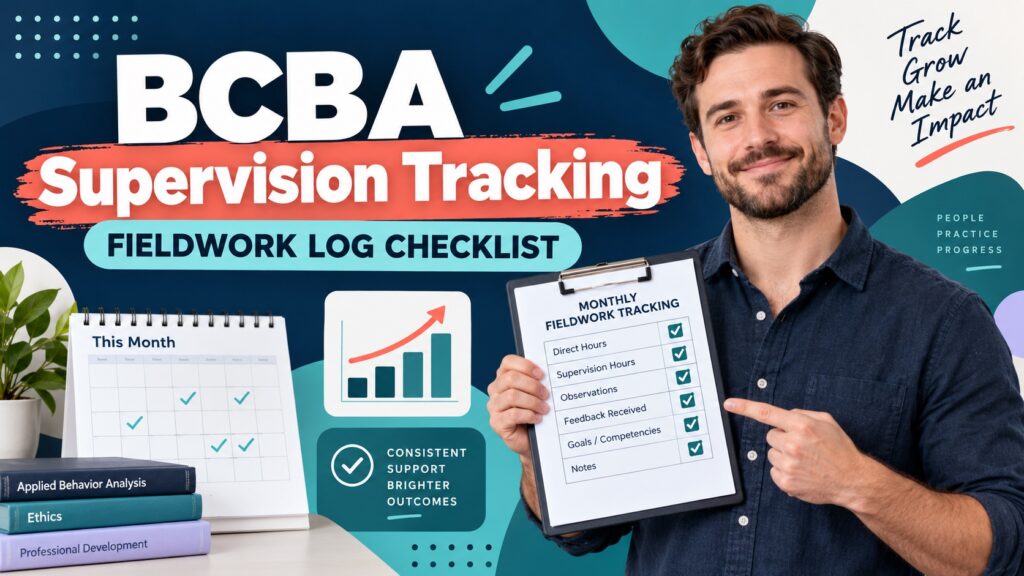
BCBA fieldwork documentation and monthly review If you are building a BCBA supervision tracking system, the goal is not simply to count hours. A useful tracker helps you and your supervisor see whether the month contains the right kind of fieldwork, enough supervision, required observations, clear feedback, and records that can be explained later. The tracker is a working tool; the current BACB handbook and fieldwork forms remain the authority.
Table of Contents
- BCBA Supervision Tracking: What to Record Each Month
- The Fields a BCBA Supervision Tracker Should Capture
- Choose a System Your Supervisor Can Review
- Monthly Tracking Decision Matrix
- How the 2027 Transition Changes Your Tracking Plan
- A Five-Step Monthly Review Routine
- Common BCBA Supervision Tracking Mistakes
- Connect Fieldwork Tracking to Exam Preparation
- BCBA Supervision Tracking FAQ
- Take the Free BCBA Mock Exam
The BACB has also published 2027 fieldwork guidance. Because the requirements and verification forms depend on when you apply, a candidate who is near the transition should compare the current 2027 BCBA requirements, the BACB fieldwork resources, and the official transition guide before locking a spreadsheet or app into a single rule set.
BCBA Supervision Tracking: What to Record Each Month
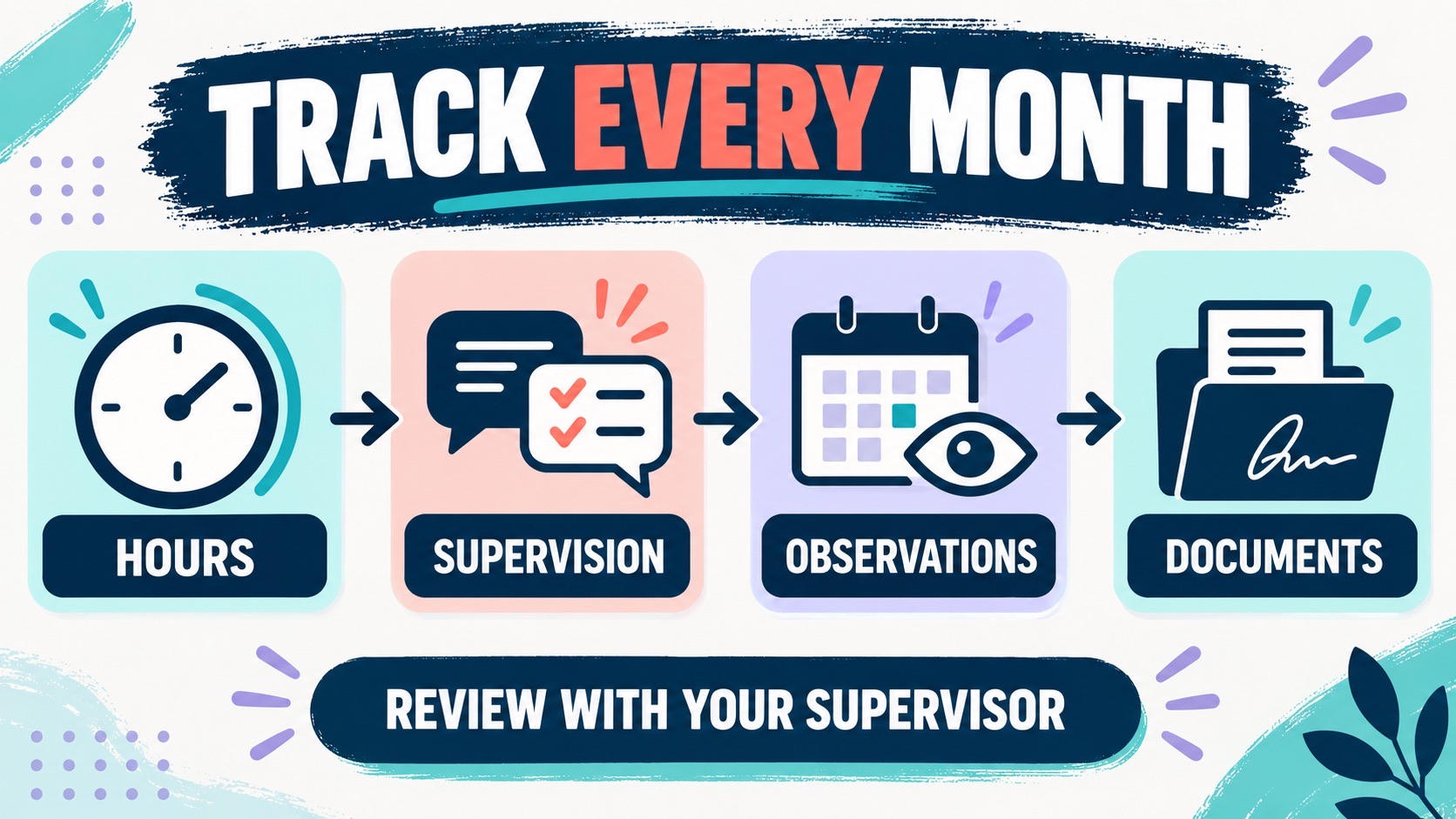
At minimum, your monthly record should make five questions easy to answer: How many fieldwork hours did I accrue? How much supervision occurred? Which activities were unrestricted? What observation and feedback occurred? Where are the supporting documents and signatures? If you cannot answer those questions without reconstructing the month from memory, the system is too light.
- Hours: date, setting, activity category, direct or indirect status, and the period total.
- Supervision: meeting date, duration, individual or group format, topics, feedback, and supervisor confirmation.
- Observations: client observation details required by the applicable rule set, including duration or contact information where relevant.
- Competencies: skills discussed, practice opportunities, corrective feedback, and the next action.
- Documents: signed monthly forms, contracts, logs, notes, and a clear file name or storage location.
A tracker should support a conversation, not replace one. Your supervisor still evaluates the quality and appropriateness of activities. A green cell or automatic total cannot prove that an activity was unrestricted, that feedback was meaningful, or that a form matches the requirements under which you will apply.
The Fields a BCBA Supervision Tracker Should Capture
Start with a row for each work session or activity block rather than entering only one monthly total. A detailed row lets you filter by client, setting, activity type, or supervisor and helps you find an inconsistency before the month is closed. Keep personally identifiable information to the minimum needed for your training records and follow your employer’s privacy rules.
Useful columns include the date, start and end time, total hours, activity description, unrestricted or restricted classification, client or project code, supervisor contact, and notes about feedback. Add a separate supervision tab for meeting duration, individual or group status, observation minutes or contacts, topics reviewed, and signatures. A final summary tab can calculate totals, but it should point back to the underlying entries.
- Entry layer: record the activity while the details are still fresh.
- Review layer: let the supervisor see exceptions, questions, and feedback.
- Archive layer: preserve the signed form and the records behind each monthly total.
Use consistent labels. If one week uses “case review,” another uses “program design,” and a third uses “indirect,” you may not be able to explain how the activities were classified. Create a short legend and have your supervisor confirm that the categories make sense for the current BACB requirements. Do not copy a category from a template just because the template looks official.
Choose a System Your Supervisor Can Review
A spreadsheet, secure form, or paper log can work if it preserves the required information and your supervisor can review it regularly. The best system is usually the one that you will update after each activity and that your supervisor can understand without a tutorial. Convenience matters because missing entries become harder to reconstruct as the month gets busy. Build a simple control panel with four checks:
- Completeness: every activity row has a date, duration, description, and classification.
- Supervision: the month has the amount and format of supervision required by the applicable pathway and fieldwork type.
- Observation: the observation entry contains the information needed under the rule set you plan to use.
- Evidence: forms, contracts, signatures, and supporting notes are stored in a dated folder.
Protect the file like a professional record. Use versioned filenames, restrict access, back up securely, and do not store identifiable client details in a consumer app without checking your organization’s policy. If your tracker changes a formula, keep a dated copy so you can explain how a total was calculated.
Monthly Tracking Decision Matrix
Use this matrix when designing or auditing a tracker. It separates the question you are asking from the evidence that answers it.
| Question | Tracker evidence | Review action |
|---|---|---|
| Did I record the full month? | Dated rows, duration, activity description, and reconciled totals. | Compare the tracker with your calendar and payroll or placement records. |
| Did supervision meet the applicable standard? | Meeting duration, format, topics, feedback, and signed confirmation. | Review with the supervisor before signing the monthly form. |
| Can I explain observations? | Date, duration or contact details, setting, and supervisor note. | Check the current handbook and transition guide for the rule set that applies. |
| Could an auditor follow the record? | Organized forms, contracts, logs, notes, and version history. | Archive the month and keep records according to current BACB guidance. |
How the 2027 Transition Changes Your Tracking Plan
The BACB’s 2027 materials describe changes to fieldwork tracking, including the monthly maximum, observation measurement, and concentrated fieldwork supervision percentage. The transition guide explains that the form set must match the requirements under which you apply. That means your tracker should not hide the underlying detail behind a single total.
For example, the transition guidance discusses tracking both the number of client observations and the duration in minutes when a candidate is planning for flexibility between requirement sets. It also explains that candidates who are unsure whether they will apply before or after January 1, 2027, may choose to complete and retain both the 2022 and 2027 Monthly Fieldwork Verification Forms with their supervisor. Read the live BACB document before acting because the applicable form depends on your application plan.
Keep a transition note in your tracker with three fields: anticipated application window, requirement set being used, and source last verified. If your plan changes, do not silently overwrite the old assumption. Add a new dated note and ask your supervisor which forms and totals should be used going forward.
The transition guide also says that fieldwork documentation, including monthly forms, should be retained and provided to the BACB upon request. Your storage practice therefore matters as much as the calculation. A tracker that totals correctly but loses the underlying forms is not a complete record system.
A Five-Step Monthly Review Routine
Set a recurring review date near the end of every supervisory period. Use the same order each time:
- Reconcile each row with your calendar, placement schedule, and activity notes.
- Separate restricted and unrestricted activities using the current definitions and your supervisor’s review.
- Check supervision, individual or group format, observations, and feedback against the applicable requirement set.
- Export or save the monthly form and supporting records with a consistent filename.
- Ask your supervisor to review the exceptions before you finalize the month.
Do not wait until the end of your entire fieldwork period to discover that a formula counted the wrong column. A monthly review is a quality-control loop: it catches missing signatures, unclear activity descriptions, and impossible totals while the people and events are still easy to identify.
Common BCBA Supervision Tracking Mistakes
- Counting only total hours: totals do not explain supervision, observations, activity type, or feedback.
- Using a template without checking its date: a tracker can outlive the requirements it was designed for.
- Editing a signed month silently: preserve the original and document any correction.
- Leaving classifications until application time: ask the supervisor while the activity is fresh.
- Storing everything in one unstructured folder: use dated names and keep forms with their supporting records.
A tracker is not a certification guarantee and a supervisor’s signature does not turn an inaccurate entry into a compliant one. Use the tool to make review easier, and use the current BACB handbook and forms to decide which requirements apply.
Connect Fieldwork Tracking to Exam Preparation
Good documentation also creates study material. When a supervision meeting exposes uncertainty about measurement, ethics, assessment, or intervention design, turn that uncertainty into a short study task. Write the question in plain language, review the relevant current content outline or source, and then test your understanding with a scenario.
When you want an exam-focused checkpoint, try the free practice for bcba supervision tracking and BCBA exam preparation. Use it to identify concepts that need review; do not treat a mock score as proof that your fieldwork documentation or certification application is complete. Keep the two goals connected but separate.
BCBA Supervision Tracking FAQ
Is a spreadsheet an official BACB fieldwork form?: No. A spreadsheet or app is a personal tracking tool. Use the current BACB monthly and final verification forms when they apply, and keep the underlying log and supporting records in an organized, secure system.
How often should I review my supervision tracker?: Review it during each supervisory period and complete a formal monthly close when your applicable form is due. Reviewing regularly makes it easier to correct missing dates, unclear classifications, and signature problems before they accumulate.
Should I track both 2022 and 2027 forms?: If your application timing is close to the transition and you are unsure which requirement set will apply, read the current BACB transition guidance and discuss the documentation plan with your supervisor. The official guide explains when retaining both form sets can help preserve flexibility.
Take the Free BCBA Mock Exam
When you are ready to apply the idea, use the free practice resource below for additional feedback. Take the Free BCBA Mock Exam



