

Short answer: rapport ABA refers to the working relationship that helps a learner, caregiver, supervisee, or other stakeholder experience safety, respect, shared purpose, and meaningful participation. It is more than being liked. A BCBA studies rapport by looking at communication, assent, collaboration, goals, and the person’s observable response to the interaction. Rapport is a context for ethical and effective work, not a stand-alone intervention or a promise of a particular outcome.
Table of Contents
- What is rapport in ABA?
- How is rapport different from pairing, assent, and therapeutic alliance?
- What does rapport look like in observable practice?
- How can a BCBA build rapport without turning it into compliance?
- What ethical safeguards belong in rapport-building?
- How does rapport connect to BCBA exam questions?
- What rapport ABA mistakes should candidates avoid?
- What is a 15-minute rapport study method?
- Rapport ABA FAQ
- Take the Free BCBA Mock Exam
For exam preparation, keep four ideas separate: pairing is a behavior-analytic process that can help establish positive interactions or conditioned reinforcement; assent is the learner’s ongoing indication of willingness to participate; rapport describes the quality and function of the working relationship; and therapeutic alliance is a broader relationship construct often discussed through goals, tasks, and the affective bond. The terms can overlap in practice, but they are not interchangeable. Table of Contents
What is rapport in ABA?
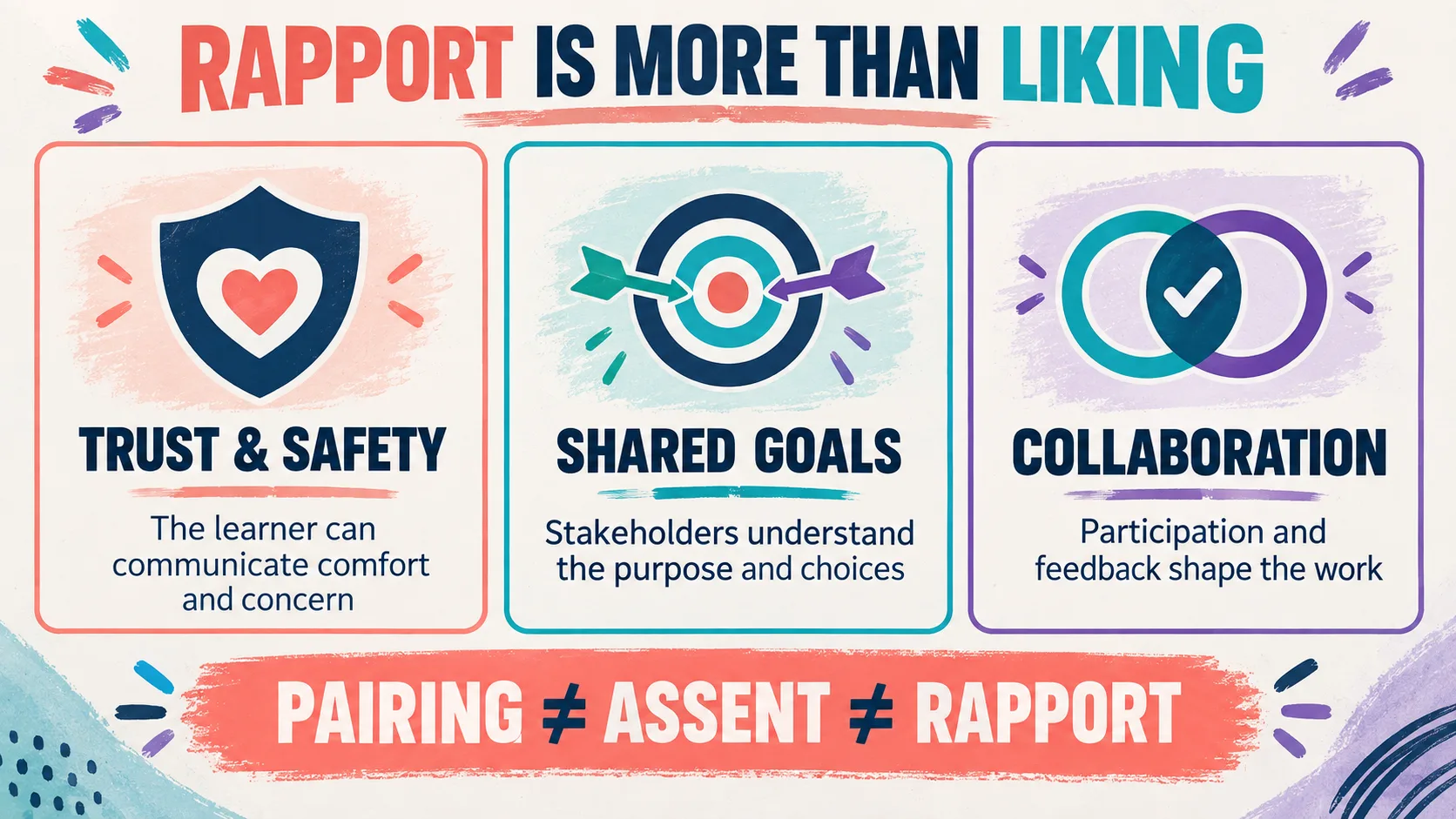
In applied behavior analysis, rapport is best understood as a functional, respectful working relationship rather than a personality trait. The relationship can involve trust and safety, agreement about meaningful goals, a workable understanding of what will happen next, and an affective bond that supports communication. A recent review of therapeutic relationships in ABA describes these dimensions through agreement on goals, agreement on interventions or tasks, and the affective bond between the people involved. That framing is useful because it prevents a common mistake: defining rapport as “the learner likes the therapist.”
Rapport is also relational and contextual. The same practitioner may have strong rapport with one learner, an emerging relationship with another, and a damaged relationship after a difficult interaction. The correct question is not whether the practitioner is naturally warm. It is whether the interaction is producing observable signs of safety, communication, participation, and shared understanding for this person in this context. One practical definition is:
- Relationship: the interaction has a recognizable history and pattern.
- Safety and dignity: the person can communicate comfort, concern, refusal, or a need for support without being shamed.
- Shared purpose: the people involved understand, in an accessible way, what they are working toward.
- Responsiveness: feedback and behavior change what happens next when ethically and clinically appropriate.
How is rapport different from pairing, assent, and therapeutic alliance?
These terms often appear together because they describe connected parts of ethical practice. They answer different questions, however. Pairing asks how a practitioner’s presence and interaction become associated with reinforcement or preferred experiences. Assent asks whether the learner is indicating willingness to participate and whether that willingness continues. Rapport asks what kind of working relationship is developing. Therapeutic alliance is a broader clinical relationship construct that commonly includes agreement about goals, agreement about tasks, and the emotional or relational bond.
| Term | Main question | What to observe | Common confusion |
|---|---|---|---|
| Pairing | What happens when the practitioner’s presence is repeatedly associated with preferred or reinforcing events? | Approach, engagement, interaction patterns, and changes across repeated sessions | Assuming pairing automatically creates trust, assent, or a complete relationship |
| Assent | Is the learner communicating willingness to participate right now, and can that willingness change? | Vocal or nonvocal acceptance, refusal, withdrawal, approach, avoidance, and requests for change | Treating quiet compliance as proof of assent or ignoring withdrawal |
| Rapport | What quality of working relationship is being established and maintained? | Safety, communication, responsiveness, shared understanding, and relationship repair | Reducing rapport to being liked, entertaining, or never receiving disagreement |
| Therapeutic alliance | Do the people share workable goals, tasks, and a relational bond? | Agreement, collaboration, empathy, communication, and repair after rupture | Using a broader psychotherapy construct as if it were a single ABA procedure |
The distinctions matter because a practitioner can pair successfully while still failing to respect assent. A learner may approach a practitioner because the interaction has a history of reinforcement, yet still communicate “not now” when a particular task is introduced. Likewise, rapport can be present even when the learner disagrees or asks for a break. Disagreement is not automatically relationship failure; the response to disagreement is important data.
What does rapport look like in observable practice?
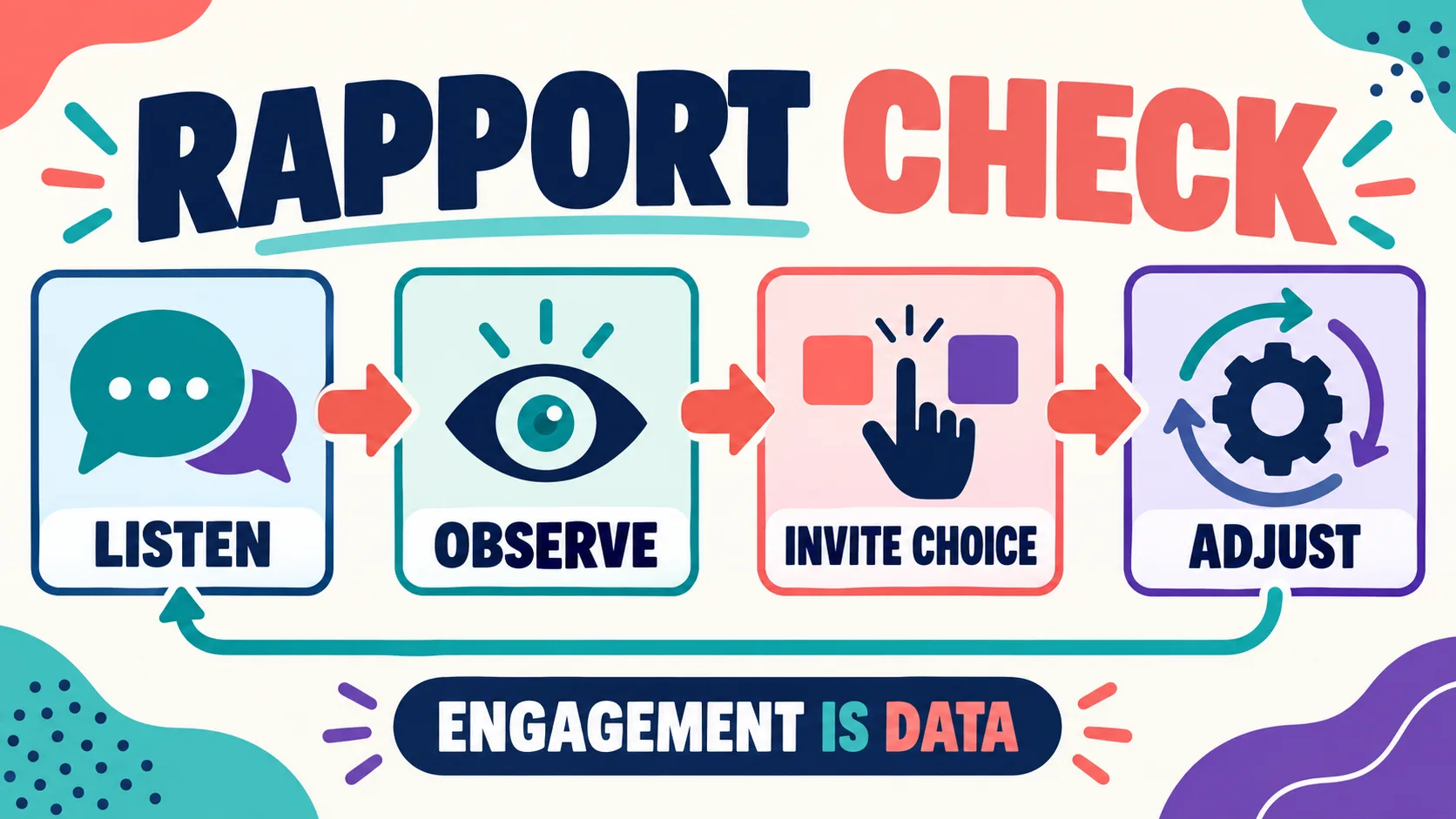
“Build rapport” is too vague to guide observation by itself. Translate it into behaviors and interaction outcomes that can be described without guessing private feelings. Depending on the person’s communication mode and preferences, indicators may include:
- The practitioner gives the person enough time to respond and does not fill every pause with prompts.
- The person has a meaningful way to accept, decline, pause, or request a change.
- The practitioner follows through on reasonable agreements and explains unavoidable changes.
- Goals and procedures are explained in language, visuals, or other forms the stakeholder can understand.
- Feedback changes the pace, materials, task arrangement, or communication strategy when appropriate.
- Caregivers and team members are treated as partners with relevant knowledge, not as obstacles to compliance.
- After a difficult interaction, the practitioner repairs the relationship instead of pretending that nothing happened.
These examples are not a universal checklist. A person may communicate rapport through eye contact, but eye contact is not required for rapport. A person may show engagement through speech, gestures, a device, movement, orientation, or a preferred routine. The observation should be individualized and should not impose a neurotypical style of “good participation.” The peer-reviewed discussion of therapeutic relationships in ABA is useful here because it connects relationship quality with communication, empathy, reflections, affirmations, open-ended questions, and shared goals rather than a single topography.
For a BCBA, the strongest documentation describes what happened before, during, and after the interaction. For example: “After the practitioner offered two activity choices and stated that a break was available, the learner selected the first activity, remained engaged for four minutes, and independently requested a pause.” That sentence is more useful than “the learner had good rapport,” because another professional can understand the observable context and response.
How can a BCBA build rapport without turning it into compliance?
Rapport grows through repeated interactions in which the person’s communication matters. Start with information about preferences, routines, sensory variables, communication, prior experiences, and what makes an interaction feel predictable. Offer choices that are real rather than decorative. If every option leads to the same demand at the same pace, the choice may not function as meaningful control.
Use a gradual approach. A practitioner can begin with lower-pressure interaction, follow the person’s interests, describe what is happening, and reinforce communication without immediately turning every enjoyable moment into a demand sequence. This does not mean avoiding teaching or allowing unsafe behavior to continue. It means arranging instruction so that the person can understand, participate, communicate discomfort, and contact meaningful reinforcement.
Pairing can be part of this process, but it should not become a shortcut. If a practitioner brings preferred items only to secure immediate compliance, the interaction may look pleasant while still teaching that the person’s access depends on surrendering control. Pairing, choice, assent, and rapport should be analyzed together and kept conceptually distinct.
What ethical safeguards belong in rapport-building?
Rapport-building is subject to the same ethical responsibilities as other behavior-analytic work. The BACB Ethics Code for Behavior Analysts emphasizes dignity, respect, informed consent, culturally responsive practice, and protecting clients from harm. Rapport does not permit a practitioner to blur professional boundaries, promise outcomes, or substitute personal charm for competent service.
Assent deserves special attention. Recent behavior-analytic discussions describe assent as an ongoing process and caution against treating participation as a one-time yes. A learner’s refusal, withdrawal, or change in behavior should prompt the team to investigate what the person is communicating and whether the arrangement can be changed. Assent does not erase the need for legally or ethically required consent, and it does not mean that every difficult moment can be resolved by offering an unlimited menu of options. It does mean that the person’s communication is not irrelevant. Use these safeguards:
- Explain the activity and expected demands in an accessible form.
- Teach and honor a functional way to request a break, help, a change, or stopping when feasible.
- Monitor patterns of avoidance, distress, and participation instead of selecting only convenient data.
- Review power differences and avoid using rapport to obtain personal disclosure or unnecessary compliance.
- Seek supervision and revise the plan when the relationship is repeatedly deteriorating.
The goal is not to eliminate all refusal. A relationship that can safely contain “no,” “not yet,” and “I need help” is often more informative than one that produces quiet agreement at any cost.
How does rapport connect to BCBA exam questions?
The current BCBA Test Content Outline is the official reference for exam content. It should determine what you study for the examination; a research keyword should not be presented as a BACB requirement merely because it appears in the literature. Rapport is most useful as a reasoning lens for scenarios involving client dignity, stakeholder collaboration, treatment acceptability, assent, communication, generalization, and ethical decision-making. When a question mentions rapport, ask four questions:
- Whose relationship? Identify the learner, caregiver, supervisee, or other stakeholder involved.
- What is observable? Separate behavior and context from an unsupported claim about feelings.
- Does participation remain voluntary and informed? Look for assent, choice, refusal, and the ability to communicate.
- What action protects both effectiveness and ethics? Prefer a response that gathers information, collaborates, and adjusts appropriately rather than forcing immediate compliance.
For neighboring study topics, the site’s neurodiversity-friendly ABA discussion and client dignity and ethics exam guide can provide additional context. Keep the canonical focus of this page on rapport ABA, however; do not turn every related ethics phrase into a second target keyword.
What rapport ABA mistakes should candidates avoid?
- “The learner smiled, so rapport is established.” One response does not establish a relationship or explain its history.
- “Pairing and rapport are the same.” Pairing describes an arrangement or learning process; rapport describes a broader working relationship.
- “Compliance equals assent.” Quiet or rapid responding may reflect many variables, including limited communication or escape history.
- “Rapport means the practitioner never presents demands.” Ethical instruction can include demands; the issue is how they are explained, arranged, and adjusted.
- “A preferred item fixes a damaged relationship.” Reinforcement may change behavior without repairing trust, predictability, or communication.
- “Eye contact proves engagement.” Do not impose one social topography as the universal measure of relationship quality.
- “Rapport guarantees treatment success.” Relationship quality matters, but outcomes also depend on assessment, intervention quality, implementation, context, and many other variables.
- “It is an official certification requirement.” Use current BACB documents for rules and the research literature for conceptual understanding.
What is a 15-minute rapport study method?
Take one short scenario and make a four-column note: context, observable communication, practitioner response, and ethical interpretation. In the first column, record who is involved and what happened before the interaction. In the second, write what the learner or stakeholder did to accept, decline, pause, ask for help, or participate. In the third, describe whether the practitioner listened, offered a meaningful choice, changed the arrangement, or ignored the signal. In the fourth, state what additional information is needed before making a conclusion. Then write two contrast sentences:
- “This may be pairing because the evidence shows an association with preferred events, but it does not yet prove rapport or assent.”
- “This may support rapport because the interaction includes shared understanding, responsiveness, and a way to communicate refusal; it is not proof that the person always agrees.”
Finish by checking the official outline and ethics source rather than relying on a memorized social-media definition. If you want timed practice after studying the concept, use the site’s free BCBA mock exam. It is an independent study resource, not an official BACB examination or a guarantee of a passing result.
Bottom line: Rapport ABA is a respectful, observable, and evolving working relationship. Pairing may help create positive interaction, assent protects participation and communication, and therapeutic alliance offers a broader relationship framework. Keep the concepts distinct, document what you can observe, and treat refusal or feedback as information rather than as a problem to erase.
Rapport ABA FAQ
What does rapport mean in ABA? It means the quality of the working relationship among the people involved in behavior-analytic services. It can include safety, trust, shared goals, communication, responsiveness, and a relational bond. It is not simply whether a learner likes a practitioner.
Is rapport the same as pairing? No. Pairing is a behavior-analytic process or arrangement in which a practitioner’s presence may become associated with preferred or reinforcing events. Rapport is a broader relationship concept. Pairing can support interaction, but it does not automatically establish assent or trust.
How can a BCBA measure rapport? Avoid pretending that one universal score captures the relationship. Define relevant observable indicators for the person and context, such as communication of choice, approach or participation, responsiveness to feedback, predictable follow-through, and repair after difficult interactions. Interpret those observations with stakeholder input and appropriate supervision.
Does assent mean the learner can refuse every intervention? Assent means the learner’s communication about willingness to participate matters and can change. It does not replace legally required consent or eliminate professional responsibility for safety. It does require the team to respond thoughtfully to refusal, withdrawal, distress, and requests for change.
Is rapport on the BCBA exam? The keyword “rapport ABA” is not, by itself, an official credentialing requirement. Study current BACB documents for exam scope and ethics rules, then use rapport as a way to reason through questions involving dignity, collaboration, assent, communication, and treatment acceptability.
Can rapport exist when a learner disagrees? Yes. Healthy rapport does not require constant agreement. A person can disagree, request a break, or communicate concern while still experiencing the professional as predictable, respectful, and responsive. The practitioner’s response to disagreement is often more informative than the absence of disagreement.
Take the Free BCBA Mock Exam
When you are ready to apply the idea, use the free practice resource below for additional feedback. Take the Free BCBA Mock Exam



