
Short answer: Functional behavior goals are observable, measurable statements describing a meaningful change in what a person does, under what conditions, and to what standard. “Improve communication” is a broad outcome. “When a preferred item is visible and the communication partner pauses, the learner will independently request the item using a spoken word, sign, or AAC selection in 4 of 5 opportunities across three sessions” is closer to a usable behavior goal because another person can observe, measure, and review it.
Table of Contents
- What are functional behavior goals?
- Why are vague goals difficult to measure?
- What four parts make a goal measurable?
- Functional behavior goal examples
- How assessment informs the goal
- How to measure progress
- How to check social validity and context
- Common BCBA exam traps
- Quick review and practice question
- Functional behavior goals FAQ
- Take the Free BCBA Mock Exam
A strong goal is not simply a positive-sounding sentence. It connects the learner’s priorities and context to a response that can be defined, measured, taught, and evaluated. Assessment results help identify what should change and why; the goal then states the target in terms that support data-based decisions. The current BACB Test Content Outline specifically includes developing intervention goals in observable and measurable terms, but it does not prescribe one universal template for every client or setting. Table of Contents
What are functional behavior goals?
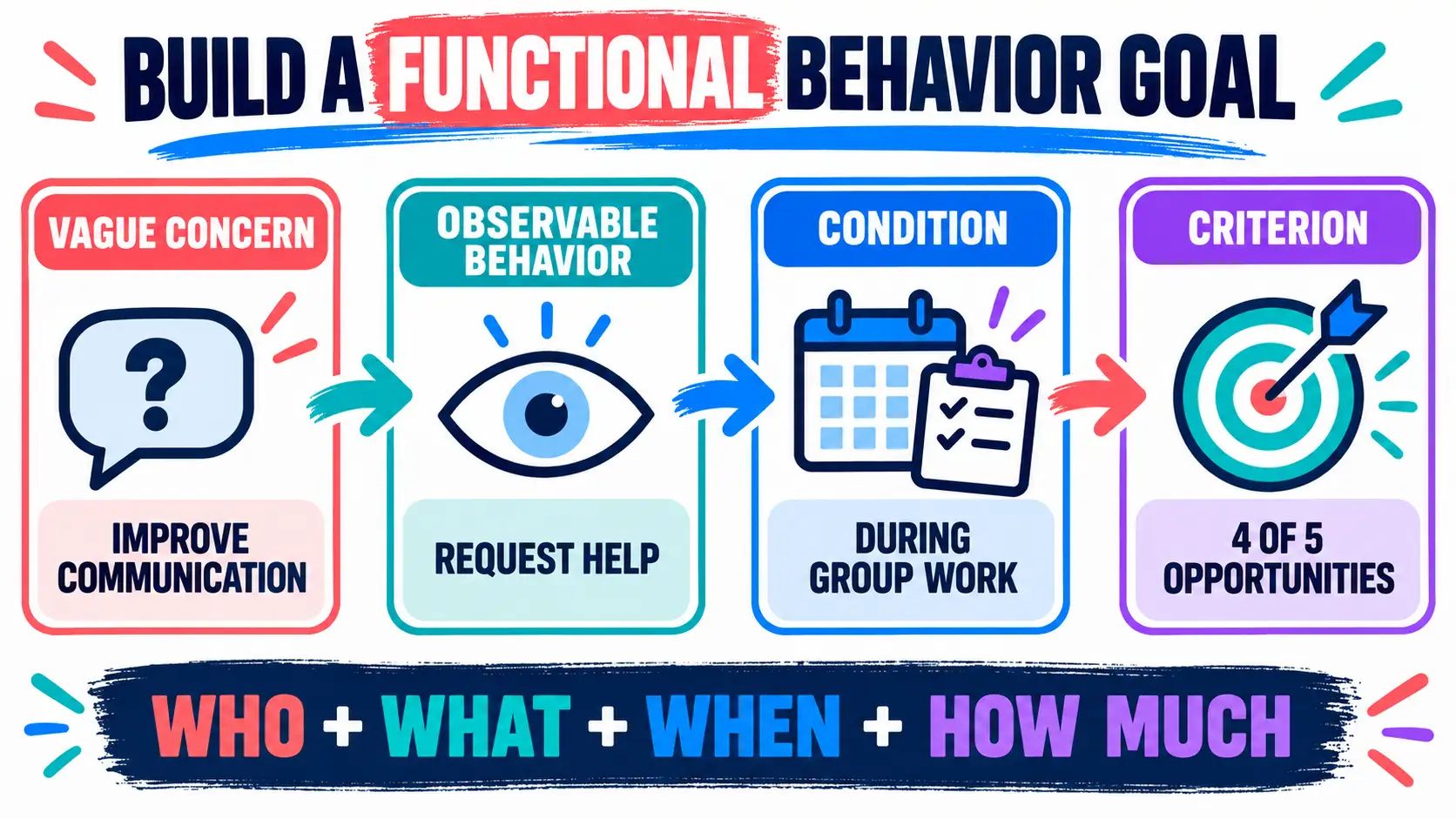
A functional behavior goal describes a meaningful response or skill in terms that allow a team to observe and evaluate change. “Functional” does not mean that every goal must be a behavior-reduction goal or that the goal must use the word function. It means the target matters in the person’s real environment and is connected to a practical need, participation opportunity, communication outcome, safety concern, or quality-of-life priority.
For example, “reduce challenging behavior” is not a complete goal. It does not specify which behavior, how it will be counted, when it occurs, what alternative behavior matters, or what level of change would count as progress. A more useful plan may define the target response, identify the context in which it occurs, teach a socially valid alternative, and state how the team will evaluate both the target and the replacement behavior.
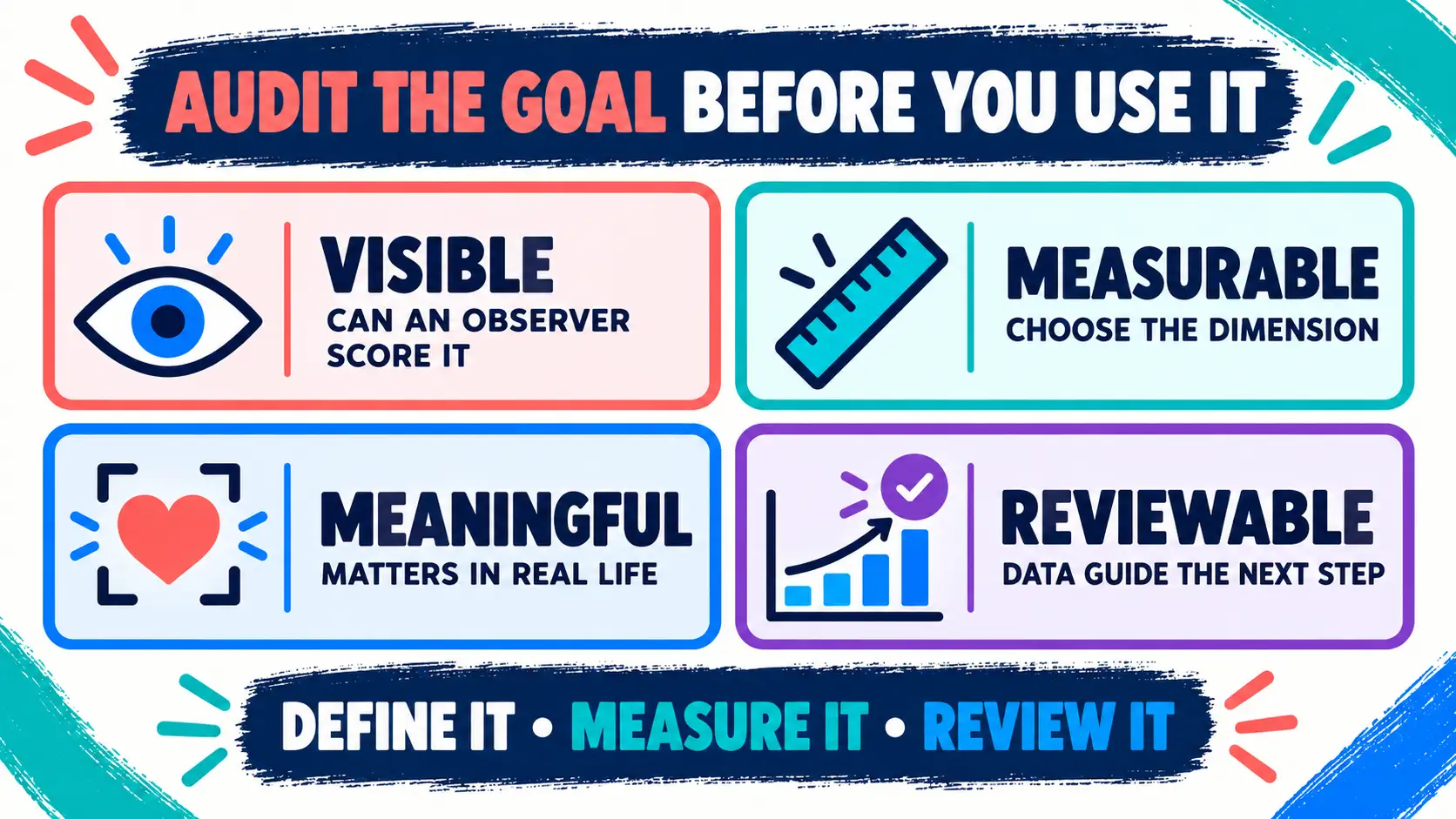
- Observable: another trained observer can see, hear, or otherwise detect the response.
- Measurable: the team can select a dimension such as frequency, rate, duration, latency, percentage, or permanent product.
- Meaningful: the change matters to the learner and relevant stakeholders in the actual context.
- Reviewable: the criterion allows the team to decide whether to continue, modify, generalize, or fade support.
Why are vague goals difficult to measure?
Vague goals often use labels for private events, broad traits, or desired outcomes without specifying the behavior that would demonstrate progress. Words such as “understand,” “improve,” “be appropriate,” “increase independence,” and “have better social skills” may be useful conversation starters, but they are not sufficient measurement definitions by themselves.
| Broad wording | What is missing? | More measurable direction |
|---|---|---|
| Improve communication | Response form, opportunity, prompt level, and criterion. | Define the request, context, communication mode, and independent-response standard. |
| Decrease aggression | Operational definition, measurement dimension, replacement response, and safety context. | Define the observable response and pair reduction with a meaningful alternative when appropriate. |
| Be more independent | Task steps, assistance level, setting, and mastery criterion. | Specify the routine and the number or percentage of steps completed without the defined prompt. |
The correction is not to make the sentence longer for its own sake. The correction is to identify the behavior and the decision the data must support. If two observers could reasonably score the same trial in different ways, the goal or operational definition needs more precision.
What four parts make a goal measurable?
A practical writing formula is context + observable behavior + measurement criterion + review boundary. Many teams also name the learner or group. Some educational and clinical goal-writing frameworks describe similar components as learner, condition, behavior, and criterion. The exact order can vary, but the reader should be able to answer four questions.
- Who and where? Identify the learner, routine, setting, communication partner, materials, or relevant context.
- What response? Use an action that can be observed, heard, counted, timed, or scored from a permanent product.
- How much change? Select the dimension and criterion: for example, 80% of opportunities, a rate below a defined level, or completion of 8 of 10 steps.
- Over what review period? State the sessions, opportunities, settings, or time window used to evaluate whether the criterion is stable enough to guide a decision.
Be careful with criteria that sound precise but hide ambiguity. “In 80% of opportunities” is incomplete if the team has not defined an opportunity. “Independently” is incomplete if the team has not defined what prompts are allowed. “Across three sessions” is incomplete if session length and the number of opportunities vary so widely that percentages are misleading.
Functional behavior goal examples
The following examples are writing models, not universal targets. A real goal should be based on assessment, client and stakeholder priorities, cultural and contextual variables, available resources, and the skills needed in the person’s actual environment.
Skill-acquisition and communication goals: Example: During a snack routine, when the selected item is visible but not immediately available, the learner will independently request the item using the agreed communication mode within 5 seconds in at least 4 of 5 opportunities across three consecutive sessions.
This example identifies the context, the response form, the response interval, the independence criterion, and the review period. It does not assume that speech is the only valid communication mode. If the learner uses AAC, sign, a picture, or a reliable approximation, the goal should state the response that is meaningful and authorized in the plan.
Behavior-reduction and replacement goals: Example: During a defined transition routine, the learner will use the agreed break request or transition response before leaving the instructional area in at least 80% of observed transition opportunities, while the operationally defined leaving behavior is measured separately.
Notice the difference between a reduction target and a replacement target. Counting only the decrease can hide whether the learner gained a useful alternative. Counting only the replacement can hide whether the original response remains unsafe or disruptive. The measurement plan should state which data are collected and how the team will protect dignity, access, safety, and choice.
Independence and maintenance goals: Example: Given the same visual task cue used in the learner’s daily routine, the learner will complete the defined handwashing sequence with no more than one planned prompt in 4 of 5 opportunities across two settings for two consecutive review periods.
A maintenance or generalization goal should name the relevant people, settings, materials, or conditions rather than assume that performance in one teaching arrangement transfers automatically. A goal can be technically measurable and still be weak if it measures a skill that is not useful to the learner or cannot reasonably be practiced in the environment.
How assessment informs the goal
Goal writing follows a reason for assessment; it does not replace assessment. Descriptive data, skill assessments, preference information, interviews, direct observation, and other appropriate sources can help clarify the current repertoire, environmental variables, barriers, strengths, and stakeholder priorities. A functional behavior assessment may inform a behavior-reduction or replacement goal, but “write a goal” is not the same task as “conduct an FBA.” Use assessment information to ask:
- Is the target behavior defined well enough to measure reliably?
- Does the goal address a meaningful need rather than an observer’s preference for a particular appearance?
- Is there an observable alternative or skill that should be taught?
- Does the proposed condition match the environment where the skill is needed?
- Does the criterion reflect a useful level of performance rather than an arbitrary number?
- What data would tell the team to continue, modify, generalize, or fade support?
The current BACB outline places goal development alongside assessment-informed intervention selection, client preferences, contextual fit, and data-based evaluation. That is why a strong exam answer rarely chooses a goal solely because it sounds ambitious. The goal must fit the assessment evidence and the person’s context.
How to measure progress
Choose the measurement dimension that matches the response. Frequency may be useful for discrete responses, rate may be needed when observation time varies, duration may fit behavior that lasts over time, latency may fit how long it takes to begin, and percentage or trial-by-trial scoring may fit opportunities with a clear denominator. Permanent products can be useful when the product reliably represents the behavior of interest.
| Goal focus | Possible dimension | Question to check |
|---|---|---|
| Requests during opportunities | Percentage or count per opportunity | Is the opportunity defined consistently? |
| Episodes of a discrete response | Frequency or rate | Is observation time stable, or should rate be used? |
| Sustained engagement | Duration or percentage of intervals | Does the dimension reflect meaningful participation? |
| Starting a routine | Latency | When does timing begin and end? |
Also separate independent responding from prompted responding when independence is part of the goal. A higher percentage of correct responses after intensive prompts may not represent the same change as a lower percentage with more independent responding. Record enough detail to know whether the intervention is producing the intended change.
How to check social validity and context
A technically precise goal can still be a poor goal if it prioritizes convenience, compliance, or an adult’s preferred appearance over meaningful participation and choice. Ask whether the goal improves access, communication, safety, learning, autonomy, relationships, or another outcome the learner and relevant stakeholders value. Consider cultural variables, sensory and communication needs, environmental resources, and whether the criterion is realistic in the actual setting.
- Use the learner’s available communication mode rather than requiring a form that is not necessary for the outcome.
- Teach a meaningful alternative when reducing a response that currently serves a communication or access function.
- Check whether the goal can generalize to the people, materials, and settings that matter.
- Review assent, dignity, risk, and stakeholder feedback throughout the process.
- Modify the goal when new data show that the condition, criterion, or response definition is not appropriate.
Common BCBA exam traps
Goal-writing questions often include several options that sound positive. Use the following checks:
- Vague outcome: “Improve self-esteem” or “understand emotions” does not identify an observable response.
- Missing condition: “Will request independently” does not say when an opportunity is presented or what counts as a chance to respond.
- Missing criterion: “Will complete the task” does not say how many steps, how accurately, how often, or for how long.
- Prompt confusion: “Independently” is not demonstrated if the definition allows an unreported prompt.
- Arbitrary target: A number is not automatically meaningful because it is easy to graph.
- Assessment shortcut: A goal does not replace the assessment needed to understand the behavior or skill.
- Reduction only: A decrease goal may be incomplete when a safe, functional replacement response should also be taught and measured.
Quick review and practice question
Quick rule: a functional behavior goal should tell you who or what context is involved, what observable response matters, how it will be measured, and what criterion will guide the next decision. Then check whether the target is meaningful and supported by assessment. Mini question: Which goal is most observable and measurable?
- The learner will improve social skills.
- The learner will understand how to ask for help.
- During group work, the learner will use the agreed help request within 10 seconds in 4 of 5 opportunities across three sessions.
- The learner will become more independent.
Answer: 3. It identifies the context, observable response, response interval, percentage criterion, and review period. A real plan would still define the help request, the opportunity, the prompt rule, and whether the target is meaningful for this learner.
For additional scenario practice, review the functional behavior BCBA exam guide for the broader assessment and intervention context, then try the free BCBA mock exam. It is a study resource and does not claim to reproduce official BACB questions.
Functional behavior goals FAQ
What is the difference between a functional behavior goal and a behavior-reduction goal? A functional goal is a broader idea: it describes a meaningful behavior change that can be observed and evaluated. A behavior-reduction goal focuses on decreasing a defined response. A complete plan may include reduction, replacement, acquisition, maintenance, and generalization goals.
Do all functional behavior goals need to use frequency? No. The measurement dimension should match the response and decision. Frequency, rate, duration, latency, percentage, interval measures, and permanent products can each be appropriate in different circumstances. Can a goal say “independent”? Yes, if independence is operationally defined. State what prompts are allowed, what response interval applies, and how independent performance is separated from prompted performance.
Does an FBA automatically produce the goal? No. Assessment information can guide goal selection, but the team still has to choose a meaningful response, define the context, select a measurement dimension, and set a defensible criterion.
Should a goal focus only on reducing challenging behavior? Not necessarily. When a response is being reduced, consider whether a socially valid alternative or communication response should be taught and measured as well. The exact plan must fit the learner, assessment, context, and ethical requirements.
Source note: This guide uses the current BACB Test Content Outline for exam-scope context and peer-reviewed discussions of observable, measurable, meaningful behavioral goals. Sources support concept learning; they do not replace individualized assessment, supervision, or the current official BACB handbook.
Take the Free BCBA Mock Exam
When you are ready to apply the idea, use the free practice resource below for additional feedback. Take the Free BCBA Mock Exam



