
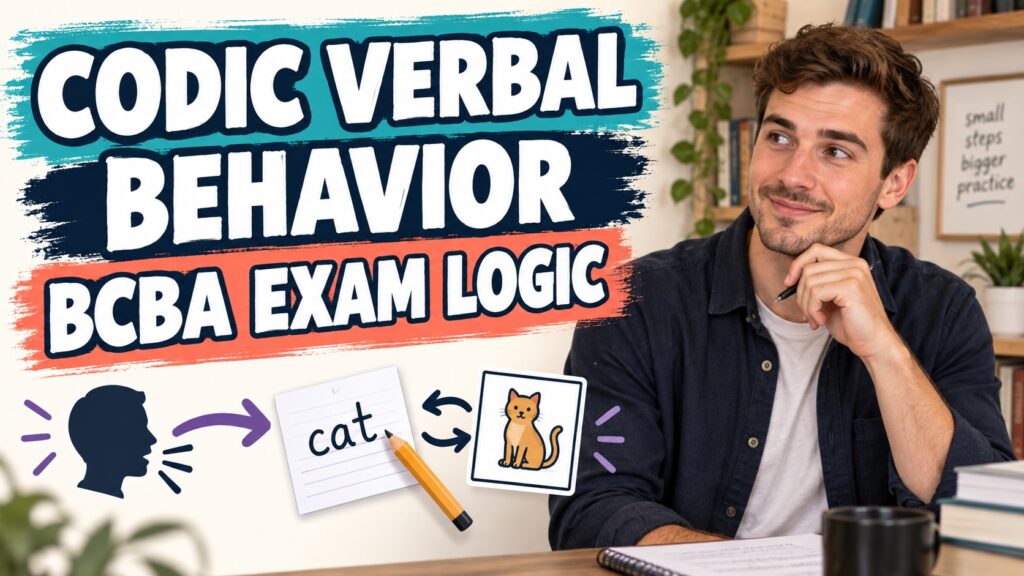
Short answer: Codic verbal behavior is a verbal operant controlled by a verbal stimulus that has point-to-point correspondence with the response but does not have formal similarity to the response product. In plain language, parts of the stimulus control corresponding parts of the response, while the stimulus and response are not in the same form or sense mode. Reading printed words aloud and writing words that someone says are common examples.
Table of Contents
- What is codic verbal behavior?
- How is a codic verbal operant classified?
- What are examples of codic behavior in ABA?
- How is codic different from other verbal operants?
- How do you identify codic behavior on the BCBA exam?
- What are common codic exam traps?
- Codic verbal behavior quick review
- Codic verbal behavior FAQ
- Take the Free BCBA Mock Exam
Codic verbal behavior can feel obscure because many study resources emphasize the more familiar mand, tact, echoic, and intraverbal. The BCBA exam, however, may test the smaller clues that separate codic relations from duplic relations, textual behavior, echoics, or intraverbals. The safest method is to analyze the controlling verbal stimulus, the correspondence between its parts and the response, and whether the stimulus and response product share formal similarity.
This guide explains the codic verbal behavior definition, shows original ABA examples, compares codic with nearby verbal operants, and gives a repeatable exam decision rule. The term codic verbal operant is used as a secondary phrase because it describes the same concept; it is not a reason to create a separate page. Table of Contents
What is codic verbal behavior?
Codic verbal behavior is a verbal response evoked by a verbal discriminative stimulus (SD) when two conditions are present: the stimulus and response have point-to-point correspondence, but they do not have formal similarity. The response is verbal because its reinforcement is mediated by another person, not because it must be spoken. A written, signed, typed, or vocal response can be part of a verbal relation when it functions through a listener-mediated consequence.
Point-to-point correspondence means that parts of the antecedent correspond to parts of the response. For example, the printed word blue controls the spoken sounds in “blue” in a way that preserves an element-by-element relation. The letters or segments of the stimulus map onto corresponding parts of the response. It is more precise than merely saying that the response is “about” the stimulus.
Formal similarity means that the stimulus and response product share the same form or sense mode and resemble one another in the relevant way. A spoken word followed by the same spoken word has formal similarity because both are vocal products. A printed word followed by a written copy also has formal similarity because both are visual products. A printed word followed by a vocal response does not share formal similarity, even when the parts correspond. That combination gives the core rule:
- The controlling antecedent is verbal.
- There is point-to-point correspondence between stimulus parts and response parts.
- There is no formal similarity between the stimulus and response product.
- The consequence is mediated by a listener or another person.
The fourth point keeps the analysis functional. A person can produce the same sounds or write the same letters for many reasons. The topography alone does not determine the operant. Ask what verbal stimulus controlled the response, what relation exists between stimulus and response, and what consequence maintained the behavior.
How is a codic verbal operant classified?
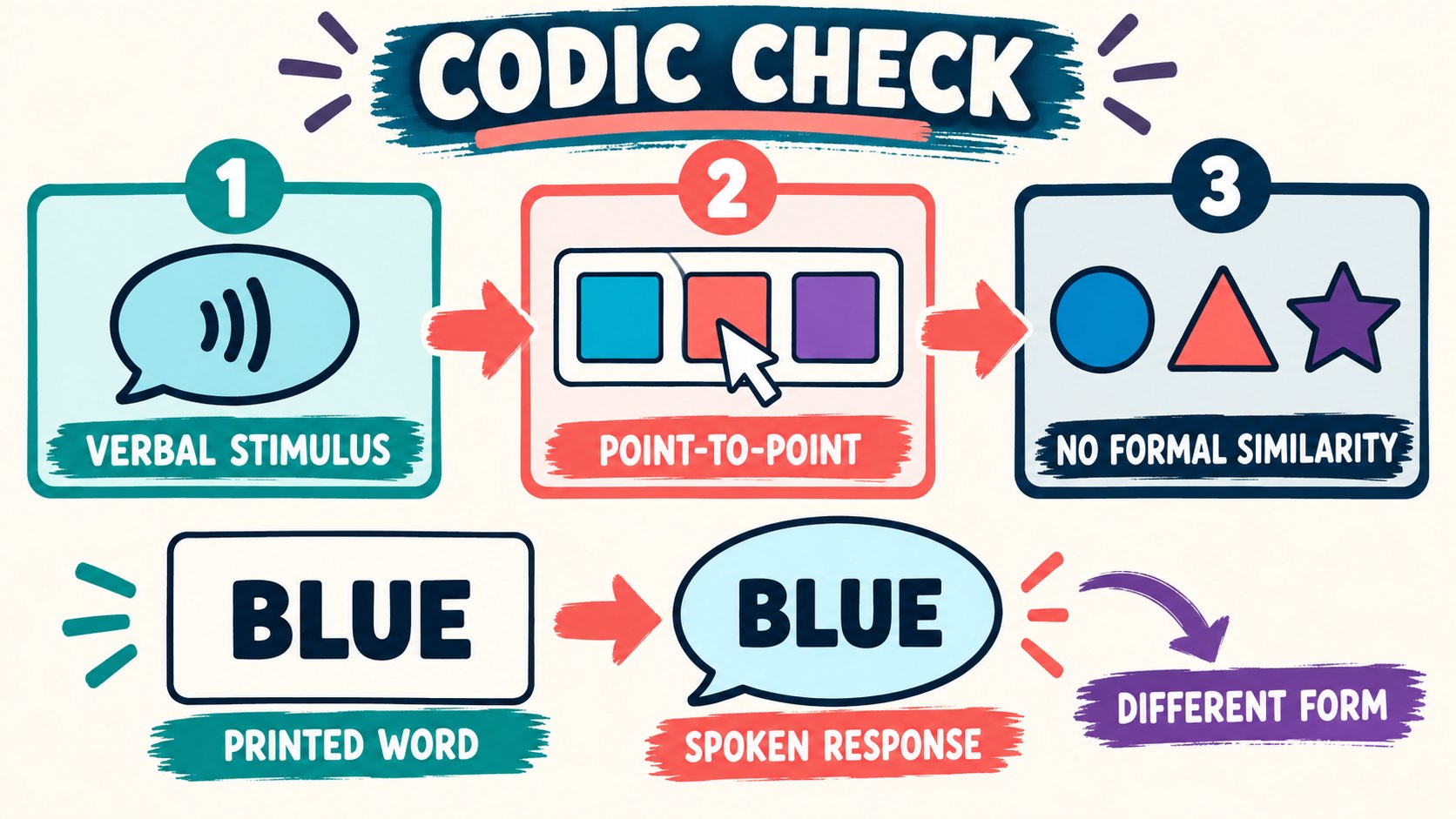
A useful way to classify a possible codic is to move through the verbal-operant decision in order. First, identify the response being analyzed. Then identify the immediate controlling variable rather than guessing from the word or sentence. Finally, examine the formal properties of the stimulus and response product.
| Question | Codic answer | Why it matters |
|---|---|---|
| What evokes the response? | A verbal stimulus | A nonverbal object or event points toward a tact instead. |
| Do stimulus parts correspond to response parts? | Yes, point-to-point correspondence is present. | Without this relation, the response may be an intraverbal rather than a codic. |
| Do stimulus and response product share formal similarity? | No | If yes, the relation is more consistent with a duplic, such as an echoic or copying. |
| How is the consequence delivered? | Through a listener or another person | This helps distinguish verbal behavior from a purely automatic response. |
Do not treat “codic” as a synonym for every response involving reading or writing. A student may read a word aloud under the control of printed text, write a dictated word, copy a written word, answer a question, or label a picture. The response form can look similar across these situations while the functional classification changes. The antecedent and the stimulus-response relation do the analytical work.
The codic concept explanation associated with Jack Michael’s verbal-behavior materials describes the defining combination as verbal control, point-to-point correspondence, and the absence of formal similarity. The terminology is technical, but the study strategy is practical: mark each clue in the stem before selecting an answer.
What are examples of codic behavior in ABA?
Consider the following examples as functional analyses rather than labels attached to the response topography. In each case, another person has arranged the relevant consequence, and the verbal stimulus controls corresponding parts of the response without sharing formal similarity with the response product.
Reading printed words aloud: A teacher presents the printed word window and asks the learner to read it. The learner says “window,” and the teacher provides praise or access to the next activity. The printed stimulus is visual, while the response product is vocal. The letters in the printed word correspond to the parts of the spoken response, but the visual print and vocal response are not formally similar. If the learner instead sees a picture of a window and says “window,” the analysis is more consistent with a tact because the picture is a nonverbal stimulus.
Taking dictation: An instructor says “calendar,” and the learner writes the word. The vocal stimulus controls the sequence of written letters. The spoken stimulus and written response are in different sense modes, so formal similarity is absent, while the letter-by-letter relation supplies point-to-point correspondence. This is a classic codic-style example. If the instructor displays the written word and the learner copies it, the visual stimulus and visual response product share formal similarity, so the classification changes. Converting a typed message into a spoken response:
A learner sees the typed phrase good morning on a communication device and says the phrase to a staff member. The screen is a verbal visual stimulus, and the vocal response corresponds to the words on the screen. The response is not a request merely because it is directed to someone, and it is not an echoic because the antecedent was not a vocal model. The functional details support a codic analysis when the listener-mediated consequence is included.
These examples also show why context matters. “Reading” and “writing” describe activities, not complete functional classifications. A stem can include a prompt, an instruction, a motivating operation, a picture, or a verbal model. Identify the variable that immediately controls the response being tested, and do not let a later consequence distract you from the antecedent relation.
How is codic different from other verbal operants?
The fastest way to prevent confusion is to compare the relevant dimensions instead of memorizing isolated examples. Codic, duplic, echoic, textual, tact, and intraverbal can all involve language, but their controlling relations are not interchangeable.
| Operant or relation | Typical controlling relation | Point-to-point | Formal similarity |
|---|---|---|---|
| Codic | Verbal stimulus; different response form | Yes | No |
| Echoic | Vocal verbal model followed by vocal response | Yes | Yes |
| Textual | Written verbal stimulus controls a vocal response | Yes | No |
| Duplic or copying | Verbal stimulus controls a response in the same relevant form | Yes | Yes |
| Intraverbal | Verbal stimulus without point-to-point correspondence | No | Usually not the defining issue |
| Tact | Nonverbal stimulus and generalized reinforcement | Not the defining criterion | Not the defining criterion |
Textual behavior deserves a careful note. In many BCBA study contexts, reading printed words aloud is taught as textual behavior and also fits the broader codic relation because the printed verbal stimulus controls a corresponding vocal response without formal similarity. The practical lesson is not to force mutually exclusive labels when a framework uses a nested classification. First answer the level of analysis the question asks for: a specific verbal operant such as textual, or the broader codic relation defined by point-to-point correspondence and no formal similarity.
Codic and duplic are especially easy to confuse. Both can have point-to-point correspondence. The deciding question is formal similarity. Spoken word to spoken repetition and written word to written copy preserve the same relevant form; printed word to spoken word and spoken word to written word do not.
How do you identify codic behavior on the BCBA exam?
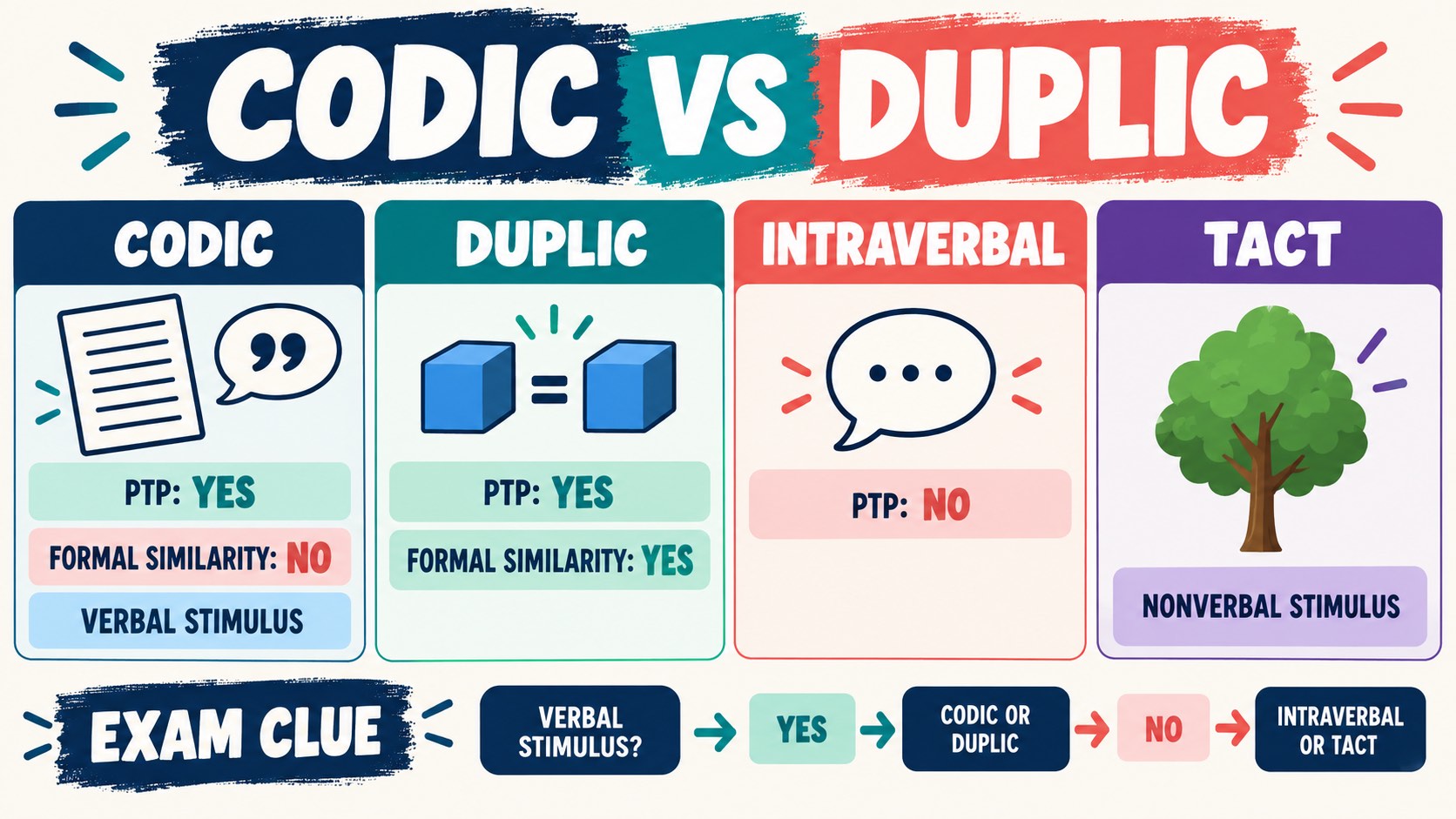
The BACB BCBA Test Content Outline (6th ed.) includes the task “identify and distinguish among verbal operants.” It does not make an exact promise that every named subtype will appear in a particular form, so use the outline as a content framework rather than a prediction of a specific question. A codic question is likely to reward relational analysis, not recognition of a favorite example. Use this five-step method when a stem describes reading, copying, dictation, signing, typing, or another language response:
- Circle the response. Analyze the exact behavior the question asks you to classify, not an earlier prompt or a later action.
- Identify the immediate verbal stimulus. Decide whether the controlling event was spoken, written, signed, typed, or instead nonverbal.
- Check point-to-point correspondence. Ask whether parts of the stimulus control corresponding parts of the response.
- Check formal similarity. If the stimulus and response product share the same relevant form, think duplic; if they do not, codic becomes plausible.
- Check the consequence and distractors. Make sure the consequence is socially mediated and reject answers that describe only the topography.
For example, a learner hears “write dog,” writes dog, and receives praise. The spoken instruction may contain multiple components, so analyze the response and the controlling verbal stimulus specified in the stem. If the question emphasizes the spoken word “dog” controlling the written letters, the cross-modal correspondence and lack of formal similarity support codic. If it emphasizes a written model that the learner copies, duplic is the better answer.
What are common codic exam traps?
- “It involves words, so it is codic.” Verbal content alone is not enough; the stimulus-response relation must include point-to-point correspondence without formal similarity.
- “Reading is always textual.” Reading printed words aloud can be described as textual at a specific level and as a codic relation at a broader level. Follow the classification requested by the stem.
- “Copying and taking dictation are the same.” Copying a visual model has formal similarity; taking spoken dictation into writing does not.
- “A question and answer must be codic.” Many question-answer exchanges are intraverbal because the verbal stimulus does not map point-to-point onto the response.
- “The consequence determines the operant by itself.” Praise can follow several verbal operants. Identify the antecedent relation first.
- “The word form settles the answer.” The same response can function differently under a picture, a verbal model, a written word, or a motivating operation.
Codic verbal behavior quick review
Before moving to the next practice item, keep this compact rule available:
- Codic is verbal behavior controlled by a verbal stimulus.
- Point-to-point correspondence is present.
- Formal similarity is absent.
- Reading aloud and taking dictation are useful examples, but the function still controls the classification.
- Duplic has both point-to-point correspondence and formal similarity.
- Intraverbal lacks point-to-point correspondence between the verbal stimulus and response.
A good final check is to rewrite the stem as a relation: “This verbal stimulus controlled these corresponding response parts, but the response product was in a different form.” If that sentence accurately describes the case, codic is a strong candidate. If you cannot identify the verbal stimulus or the correspondence, do not choose codic merely because the learner is speaking or writing.
Codic verbal behavior FAQ
What is the simplest codic verbal behavior definition?: It is verbal behavior controlled by a verbal stimulus with point-to-point correspondence but without formal similarity between the stimulus and response product. Is taking dictation an example of codic?: Yes, when a spoken verbal stimulus controls a corresponding written response and the consequence is socially mediated. The vocal stimulus and written response do not share formal similarity.
Is copying text codic?: Usually the relevant relation is duplic because the written stimulus and written response product share formal similarity. The distinction is not that one activity is “writing”; it is the relation between stimulus and response.
How does codic differ from intraverbal behavior?: Codic includes point-to-point correspondence between parts of the verbal stimulus and response. Intraverbal behavior is controlled by a verbal stimulus without that point-to-point relation, such as answering a question with a related but not structurally corresponding response.
Bottom line: classify codic verbal behavior by the controlling verbal stimulus, point-to-point correspondence, and absence of formal similarity—not by whether the learner reads, writes, speaks, or uses an AAC system. For targeted practice, try the free BCBA mock exam. It is an independent practice resource, not an official BACB exam, and it does not guarantee certification or a passing result.
Take the Free BCBA Mock Exam
When you are ready to apply the idea, use the free practice resource below for additional feedback. Take the Free BCBA Mock Exam



