
Why Measurement Mastery Is Critical for BCBA® Exam Success
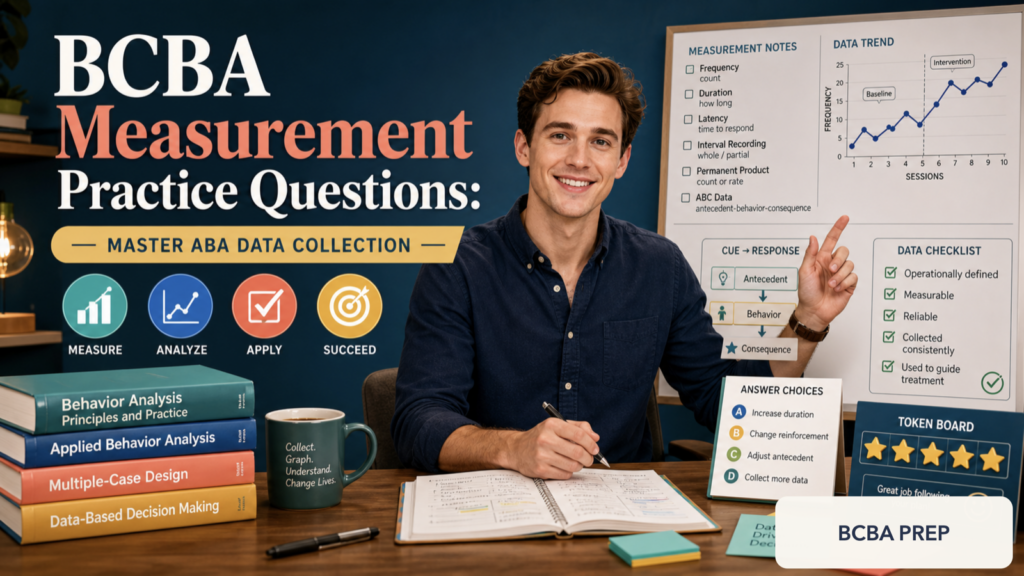
Measurement is the backbone of behavior analysis. Without accurate data collection, you cannot demonstrate functional relations or make data-driven decisions. These five scenario-based questions will test your ability to identify measurement procedures, detect threats to accuracy, and apply operational definitions—just as the BCBA® exam will.
Table of Contents
- Why Measurement Mastery Is Critical for BCBA® Exam Success
- BCBA Measurement Practice Questions
- Common Measurement Traps on the BCBA Exam
- Measurement Must-Know Checklist for BCBA Exam Day
- Ready for a Full‐Length BCBA Mock Exam?
- Frequently Asked Questions
- References
Each question includes a detailed rationale for the correct answer and common traps. Use these to sharpen your measurement skills and avoid losing points on exam day.

BCBA Measurement Practice Questions
Read each scenario carefully, then select the best measurement option.
Question 1: Choosing Between Event and Time Sampling
Scenario: A BCBA is collecting data on a child’s hand‐flapping during a 30‐minute classroom observation. The behavior occurs rapidly and briefly, with many occurrences in a short time.
Prompt: Which measurement procedure is MOST appropriate?
- A. Partial‐interval recording
- B. Event recording (frequency)
- C. Duration recording
- D. Momentary time sampling
Correct Answer: B
Why This Answer Is Correct: Event recording captures each discrete instance of a behavior. Hand‐flapping is discrete and has a clear beginning and end, so frequency (count per observation period) is the best choice.
Why the Other Options Are Wrong:
- Partial‐interval recording would overestimate the rate if the behavior occurs briefly each time, because it requires only that the behavior occur at any time during the interval.
- Duration recording measures how long the behavior lasts, not how many times it occurs.
- Momentary time sampling (recording at the end of intervals) would likely miss many occurrences because the behavior is brief.
Exam Trap: The question says ‘rapidly and briefly.’ Many test takers choose partial‐interval because they think it’s good for high‐rate behavior, but it inflates duration estimates and is better for estimating occurrence than count.
Question 2: Detecting Observer Drift in IOA
Scenario: Two observers independently record instances of a client’s self‐injury using frequency within 10‐minute sessions. After ten sessions, the BCBA calculates IOA at 85% but notices that one observer’s tallies have gradually increased while the other’s have stayed consistent.
Prompt: This pattern suggests which threat to measurement?
- A. Observer drift
- B. Observer reactivity
- C. Instrument decay
- D. Measurement bias
Correct Answer: A
Why This Answer Is Correct: Observer drift occurs when an observer’s interpretation of a behavior changes over time, leading to systematic changes in data. The gradual increase in one observer’s tallies without change in the other’s indicates drift.
Why the Other Options Are Wrong:
- Observer reactivity is a change in behavior due to being observed, not a change in the observer’s recording.
- Instrument decay refers to a mechanical device wearing out, not human observation.
- Measurement bias is a broad term; observer drift is a specific subtype.
Exam Trap: Do not confuse observer drift with observer reactivity. Reactivity changes the participant’s behavior; drift changes the observer’s measurement.
Question 3: Measuring a Behavior with No Clear Start or End
Scenario: A client frequently engages in screaming episodes that last several minutes. The behavior does not have a discrete onset—the volume gradually increases and decreases.
Prompt: Which measurement is BEST to capture the severity or intensity of the screaming?
- A. Rate (responses per minute)
- B. Latency
- C. Magnitude (intensity)
- D. Interresponse time (IRT)
Correct Answer: C
Why This Answer Is Correct: Magnitude (or intensity) measures the force or severity of a behavior. For a behavior without clear boundaries, such as screaming that waxes and wanes, intensity (e.g., using a decibel meter or rating scale) is appropriate.
Why the Other Options Are Wrong:
- Rate counts occurrences per unit time, but this behavior has no clear discrete occurrence.
- Latency measures the time from prompt to initiation, not severity.
- IRT measures the time between two consecutive responses; not suitable for a continuous episode.
Exam Trap: Look for keywords like ‘severity’ or ‘intensity’ to guide you to magnitude. If the scenario says ‘no clear start or end,’ avoid frequency or duration.
Question 4: Identifying When Discontinuous Measurement Is Acceptable
Scenario: A BCBA needs to estimate the percentage of intervals in which a student is off‐task during a 60‐minute class. Due to staff constraints, only one observation of 20 minutes is feasible, and the observer cannot watch continuously.
Prompt: Which discontinuous method provides the BEST estimate of off‐task behavior?
- A. Momentary time sampling with 5‐minute intervals
- B. Whole‐interval recording with 30‐second intervals
- C. Partial‐interval recording with 1‐minute intervals
- D. Event recording with a tally counter
Correct Answer: A
Why This Answer Is Correct: Momentary time sampling (MTS) is efficient and less prone to under‐ or overestimation for continuous behaviors like off‐task. With a 5‐minute interval in a 20‐minute observation, you get four samples. MTS correlates well with the true proportion of time engaged.
Why the Other Options Are Wrong:
- Whole‐interval recording is extremely stringent (requires behavior throughout the interval) and would underestimate off‐task behavior.
- Partial‐interval recording would overestimate because any off‐task in the interval counts.
- Event recording is frequency‐based, not proportion‐based; it doesn’t estimate percentage of time.
Exam Trap: The question asks for ‘estimate’ of percentage of time. Discontinuous methods like MTS are acceptable when continuous measurement is impossible, but you must know which one best approximates duration.
Question 5: Selecting a Measure for a Behavior That Lacks a Discrete Beginning
Scenario: A child engages in tantrum behavior that includes crying, whining, and flopping to the floor. The behavior seems to have no clear start; staff often disagree on when it ‘begins.’ The BCBA wants to track how many times it occurs per day.
Prompt: What is the MOST appropriate solution?
- A. Use event recording and only count when the child flops.
- B. Operationally define the behavior with a specific, observable start (e.g., vocalizations above conversational level).
- C. Use duration recording instead of frequency.
- D. Use partial‐interval recording with a 30‐second interval.
Correct Answer: B
Why This Answer Is Correct: Before selecting any measurement, you need a clear operational definition with an observable beginning. Once defined (e.g., loud vocalizations plus flopping), you can count occurrences reliably.
Why the Other Options Are Wrong:
- Counting only flopping might miss other instances; the behavior includes multiple topographies.
- Duration recording is affected by the same definitional problem.
- Partial‐interval recording also requires a defined start; it doesn’t solve the definition issue.
Exam Trap: The question emphasizes ‘no clear start.’ The BCBA should first refine the definition, not jump to a measurement type. Many students answer partial‐interval because they think it handles ill‐defined behaviors, but operational definition must come first.
Common Measurement Traps on the BCBA Exam
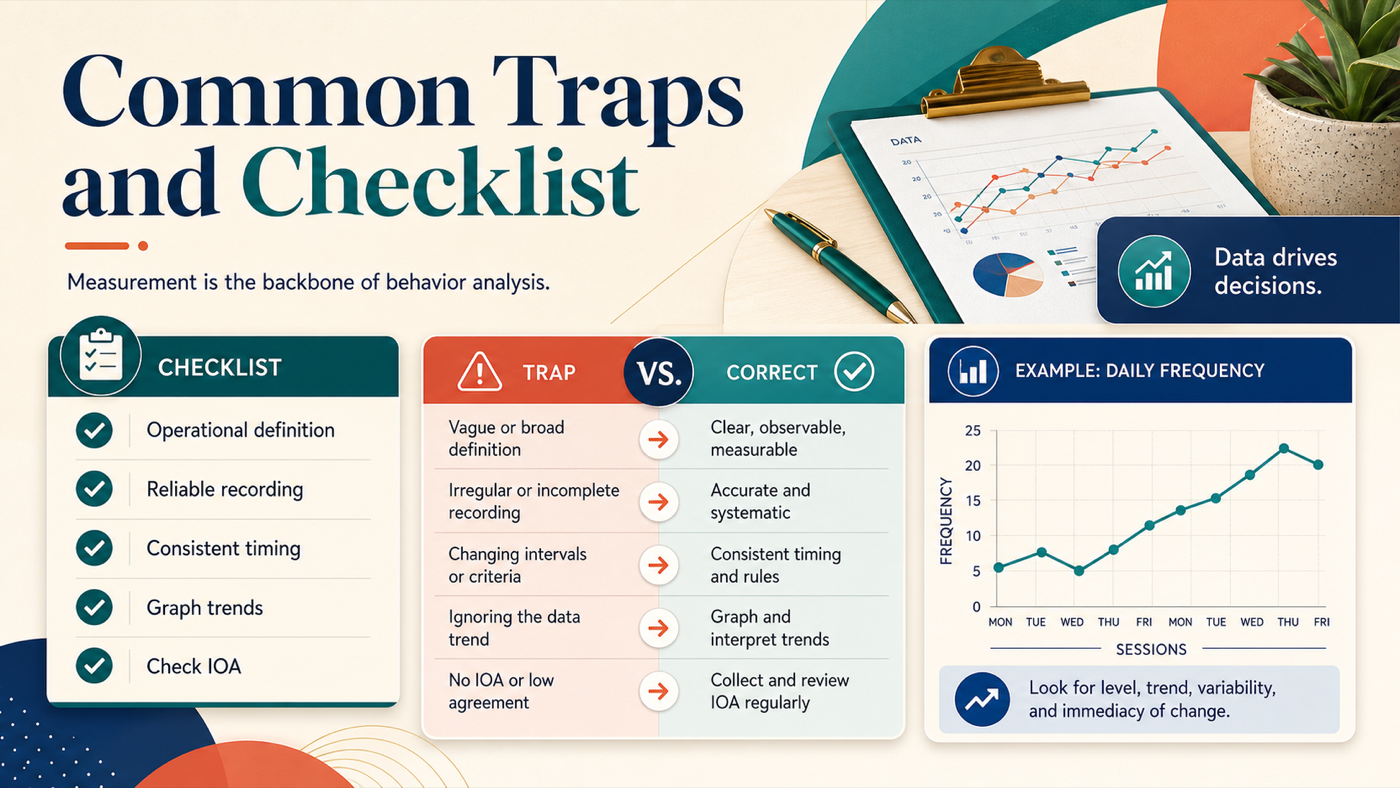
Watch out for these pitfalls that frequently trip up test-takers in measurement questions:
- Confusing observer drift (change in observer) with observer reactivity (change in participant).
- Choosing partial‐interval recording for high‐rate brief behaviors when event recording is better for exact count.
- Using discontinuous measurement when continuous measurement is feasible (e.g., using time sampling when you can tally each occurrence).
- Selecting latency or IRT when the question asks about how often or how long.
- Forgetting that operational definitions must precede measurement selection—if it’s not defined, you can’t measure.
Measurement Must-Know Checklist for BCBA Exam Day
- Distinguish between continuous (event, duration, latency, IRT) and discontinuous (interval, time sampling) measurement.
- Know the strengths and weaknesses of partial‐interval, whole‐interval, and momentary time sampling.
- Identify threats to measurement: observer drift, reactivity, instrument decay, and measurement bias.
- Calculate IOA using total count, partial agreement, exact count, and interval‐by‐interval methods.
- Understand when to use rate vs. frequency (rate standardizes by time) and when to use percentage.
Ready for a Full‐Length BCBA Mock Exam?
You’ve practiced measurement—now test your knowledge across all content areas with our free BCBA mock exam. It includes 120 scenario‐based questions exactly like the real BACB® test.
Take the Free BCBA Mock Exam
Download the Free BCBA Mock Exam now and get instant feedback with detailed explanations. Perfect your timing, identify weak areas, and build exam confidence.
Frequently Asked Questions
Q: Is it okay to use partial‐interval recording for high‐rate behaviors?
A: It can be used, but it tends to overestimate the behavior. For an exact count of discrete behaviors, event recording is preferred.
Q: What if I can’t observe continuously?
A: Use a discontinuous method like momentary time sampling or partial‐interval recording, but recognize the trade‐off in precision.
Q: Do I need to calculate IOA on the exam?
A: Yes. You must know how to compute IOA using various methods and interpret the results to determine measurement reliability.
References
Next step for BCBA exam prep
Turn this topic into exam-day practice
Use this topic as a focused review, then test it in exam-style conditions with a free mock before deciding whether five full-length mocks are the right next step.
Start the Free BCBA Mock Exam
Continue with Five Full-Length Mocks — $99
Review the included materials and access details before ordering. No pass guarantee is implied.



