

Master Experimental Design for the BCBA Exam
Experimental design is a cornerstone of the BCBA exam. This page provides five scenario-based practice questions to test your understanding of single-subject designs, internal validity, and design selection.
Table of Contents
- Master Experimental Design for the BCBA Exam
- BCBA Experimental Design Practice Questions
- Common Exam Traps to Avoid
- Experimental Design Decision Checklist
- Ready to Test Your Skills?
- Frequently Asked Questions
- References
Each question includes a detailed rationale for the correct answer, analysis of common errors, and exam traps to avoid. Use these to sharpen your skills before the big day.

BCBA Experimental Design Practice Questions
Read each scenario carefully and select the best answer. Then review the explanation and trap for each question.
Question 1:
Scenario: A BCBA is measuring the frequency of aggression in a child during a 10-minute play session. They implement a treatment that involves differential reinforcement of alternative behavior (DRA) and want to demonstrate a functional relation.
Prompt: Which single-subject design would be most appropriate to demonstrate a functional relation with the fewest threats to internal validity?
- A. ABAB reversal design
- B. Multiple baseline across participants design
- C. Alternating treatments design
- D. Changing criterion design
Correct Answer: A
Why This Answer Is Correct: The ABAB reversal design allows for repeated demonstration of experimental control by alternating baseline and treatment phases. It directly shows that the behavior changes only when the intervention is introduced and withdrawn, thus establishing a functional relation with strong internal validity.
Why the Other Options Are Wrong:
- Multiple baseline across participants is better for non-reversible behaviors or when withdrawal is unethical, but aggression can be reversed ethically if DRA is temporary; ABAB is the strongest when reversal is possible.
- Alternating treatments design compares two or more interventions rapidly, not intended to demonstrate functional relation of a single treatment.
- Changing criterion design is used for behaviors targeted for gradual change, not for demonstrating functional control of a single intervention.
Exam Trap: Temptation to pick multiple baseline because it avoids reversal issues. However, the question asks for fewest threats to internal validity. ABAB reversal provides the clearest demonstration of experimental control when reversal is feasible.
Question 2:
Scenario: A researcher wants to evaluate the effect of a token economy on on-task behavior in three different classrooms. It is not possible to withdraw the token system once implemented because teachers prefer to keep it in place.
Prompt: Which design should the researcher use to demonstrate a functional relation?
- A. ABAB reversal design
- B. Multiple baseline across settings design
- C. Alternating treatments design
- D. Changing criterion design
Correct Answer: B
Why This Answer Is Correct: Multiple baseline across settings design is ideal when withdrawal is impractical. The intervention is introduced at different times across the three classrooms. If on-task behavior increases only after implementation in each classroom, a functional relation is demonstrated without reversing.
Why the Other Options Are Wrong:
- ABAB requires reversal, which is explicitly not possible in this scenario.
- Alternating treatments compares two treatments; here there is only one intervention.
- Changing criterion is for shaping behavior gradually, not for introducing an intervention across multiple baselines.
Exam Trap: Be careful: the scenario says ‘not possible to withdraw.’ Many choose ABAB because it is classic, but the correct choice is the design that does not require withdrawal.
Question 3:
Scenario: A behavior analyst wants to compare the effectiveness of two different prompting strategies (least-to-most vs. most-to-least) on a child’s ability to complete a 5-step task analysis. Sessions are short, and the behavior is expected to improve with practice.
Prompt: Which design would best control for sequence effects and allow a rapid comparison?
- A. ABAB design
- B. Multiple baseline across behaviors
- C. Alternating treatments design
- D. Changing criterion design
Correct Answer: C
Why This Answer Is Correct: Alternating treatments design quickly alternates between the two prompting strategies across sessions or trials, allowing for a direct comparison while controlling for sequence effects through counterbalancing or randomization. It is efficient for comparing two interventions.
Why the Other Options Are Wrong:
- ABAB is for demonstrating functional relation of one intervention, not comparing two.
- Multiple baseline across behaviors would introduce the interventions sequentially, not allow rapid comparison.
- Changing criterion is for gradual behavior change, not comparison.
Exam Trap: Students may pick multiple baseline because it controls for maturation, but the question asks for a design that allows ‘rapid comparison’ and controls for sequence effects. Alternating treatments excels here.
Question 4:
Scenario: A BCBA is working with a student who engages in self-injurious behavior (SIB). A functional analysis shows the behavior is maintained by escape from demands. The BCBA implements an intervention that involves providing a break contingent on a replacement behavior. The SIB must be kept at a safe level, so the BCBA cannot return to baseline once treatment starts.
Prompt: Which design is most appropriate to demonstrate experimental control?
- A. ABAB reversal
- B. Multiple baseline across participants
- C. Changing criterion design
- D. Nonconcurrent multiple baseline design
Correct Answer: C
Why This Answer Is Correct: Changing criterion design is used when a gradual change in behavior is targeted, and it does not require returning to baseline. The BCBA can set successive criteria for the reduction of SIB (e.g., from 10 episodes to 8, then 6, etc.). If the behavior matches each criterion, experimental control is demonstrated.
Why the Other Options Are Wrong:
- ABAB requires a reversal which is unsafe and unethical for SIB.
- Multiple baseline across participants would require multiple participants, which may not be available.
- Nonconcurrent multiple baseline can demonstrate control but is weaker and often used when concurrent measures are impossible; changing criterion is more direct for a single participant reducing a behavior.
Exam Trap: Some might choose multiple baseline because it does not require reversal, but the question emphasizes ‘gradual’ improvement. Changing criterion directly aligns with stepwise reduction.
Question 5:
Scenario: A school psychologist wants to evaluate a peer-mediated intervention to increase social initiations in three students on the autism spectrum. The intervention is delivered to all three students simultaneously because it involves a group activity. The psychologist cannot stagger the start times.
Prompt: Which design would be the best choice under these constraints?
- A. ABAB reversal
- B. Multiple baseline across behaviors
- C. Alternating treatments design
- D. Withdrawal design (ABA)
Correct Answer: D
Why This Answer Is Correct: A withdrawal design (ABA) can be used when all participants receive the intervention at the same time. The psychologist measures baseline (A), then introduces the intervention (B), then withdraws it (A). If behavior improves during B and returns to baseline levels during the second A, a functional relation is demonstrated. Note: full ABAB may not be feasible if time is limited, but an ABA design provides some evidence.
Why the Other Options Are Wrong:
- Multiple baseline across behaviors would require targeting different behaviors for each student, and the intervention is the same for all—not suitable.
- Alternating treatments compares two interventions, not evaluating one treatment.
- ABAB reversal requires two withdrawals; an ABA (withdrawal) is simpler and fits the scenario.
Exam Trap: The phrase ‘cannot stagger’ rules out multiple baseline. Students may think ABAB is required, but withdrawal (ABA) suffices when the intervention can be removed.
Common Exam Traps to Avoid
Even experienced candidates fall for these distractors. Know them before test day.
- Choosing ABAB reversal when withdrawal is unethical or impossible; remember multiple baseline and changing criterion as alternatives.
- Selecting multiple baseline as a default ‘safe’ design; consider whether staggering is feasible and whether the design answers the research question.
- Mixing up alternating treatments (comparing two interventions) and multielement designs; they are the same but alternating treatments is the preferred term.
- Assuming changing criterion is only for increasing behaviors; it works for decreasing behaviors too (e.g., shaping down).
- Forgetting that internal validity is strongest with reversal designs, but that does not make them always appropriate.
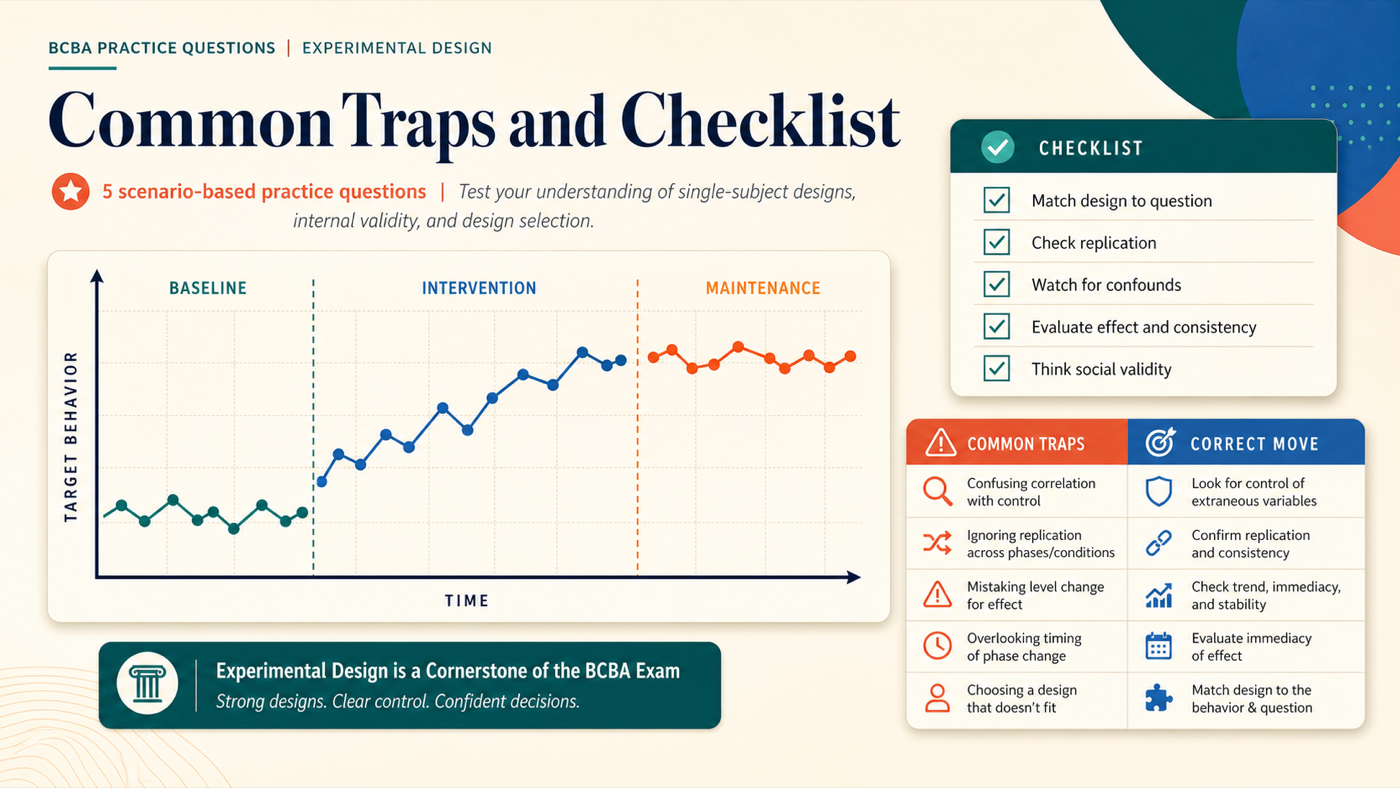
Experimental Design Decision Checklist
- Can the intervention be withdrawn safely and ethically? If yes, consider reversal/withdrawal designs.
- Can two or more interventions be compared rapidly? If yes, consider alternating treatments design.
- Is the behavior expected to change gradually? If yes, consider changing criterion design.
- Can the intervention be introduced at different times across participants, settings, or behaviors? If yes, consider multiple baseline design.
- Is only one intervention evaluated and withdrawal is not possible? If yes, consider multiple probe or nonconcurrent multiple baseline.
Ready to Test Your Skills?
These five questions are just a taste. Our full-length BCBA mock exam includes dozens of experimental design scenarios with detailed feedback.
Take the Free BCBA Mock Exam
Take our free BCBA mock exam now to assess your readiness and identify weak areas.
Frequently Asked Questions
Q: What is the most common experimental design on the BCBA exam?
A: ABAB reversal and multiple baseline designs appear frequently. The key is to identify the constraints of the scenario.
Q: How do I distinguish between a multiple baseline and a changing criterion design?
A: Multiple baseline introduces the intervention across different baselines at different times. Changing criterion sets successive performance criteria within a single baseline.
Q: Why is internal validity highest in reversal designs?
A: Because the reversal demonstrates that the behavior changes only when the intervention is present, ruling out confounding variables.
References
Next step for BCBA exam prep
Turn this topic into exam-day practice
Use this topic as a focused review, then test it in exam-style conditions with a free mock before deciding whether five full-length mocks are the right next step.
Start the Free BCBA Mock Exam
Continue with Five Full-Length Mocks — $99
Review the included materials and access details before ordering. No pass guarantee is implied.



