
BCBA hours tracking works best as a two-part control system: record what happened as close to the activity as possible, then reconcile the supervisory period before the official form is signed. A spreadsheet can make missing observations, category mismatches, or percentage problems visible. It cannot decide whether your fieldwork qualifies, replace a supervisor’s review, or turn itself into an official BACB document.
Table of Contents
- BCBA hours tracking: the short answer
- What your tracker should capture
- The monthly BCBA hours tracking audit
- Use two ledgers, not one overloaded sheet
- How to prepare for the 2027 transition
- What a tracker cannot prove
- Common tracking mistakes
- FAQ
- Sources for Further Study
- Take the Free BCBA Mock Exam
This guide is deliberately practical. It shows what to capture in a daily activity log, what to check in a supervision ledger, and how to handle the 2027 transition without mixing requirement editions. Use the BACB 2027 BCBA Requirements, the current BCBA Handbook, and your qualified supervisor as the authority for your own record.
BCBA hours tracking: the short answer
BCBA hours tracking is the ongoing documentation of fieldwork dates, activities, hours, supervision, observations, supervisor information, and supporting notes. The goal is not to make a spreadsheet look complete. The goal is to preserve a reviewable record that allows the trainee and supervisor to reconstruct each supervisory period accurately.
Think of the process as log → check → verify. First, log actual work and supervision. Next, check totals, categories, observations, contacts, and the percentage required by the applicable rule set. Finally, have the responsible supervisor review and sign the correct official monthly or final form. A tracker supports the last step; it does not replace it.
That distinction matters because a neat total can still hide a problem. For example, a month may contain enough hours overall but lack the required observation, combine group and individual supervision incorrectly, or use a form from the wrong requirement edition. Good BCBA hours tracking exposes those issues before they become a final-form problem.
What your tracker should capture
Start with a row-level activity log. Each row should describe a real event or block of work, not a future estimate. The exact columns can vary by placement, but the record should make it possible to answer four questions: when did the activity occur, what did it involve, how was it classified, and who reviewed it?
- Date and time: record the date, start and end time, or another consistent duration method. Avoid entering a monthly total without a source trail.
- Fieldwork type and requirement edition: identify the pathway or fieldwork category and keep the applicable requirement version visible. Do not let one tab silently combine old and new rules.
- Activity classification: separate restricted and unrestricted work according to the current handbook and supervisor guidance. Add a short description that explains why the category applies.
- Supervision details: identify whether the event was individual or group supervision, the supervisor, the duration, and the feedback or decision documented.
- Observation details: track the client observation separately from a discussion, case review, or group meeting. Record the date, duration, setting, and supervisor review status.
- Supporting record: link or reference a de-identified note, agenda, graph review, training product, or other record when appropriate. Never place protected client information in a public template.
- Status: use a simple state such as logged, needs clarification, supervisor reviewed, or transferred to official form.
The tracker should preserve actual hours. If you use a planning calculation to estimate progress under a concentrated route, keep that calculation in a separate planning field. Do not replace actual hours with an adjusted number in a field that asks for actual hours.
| 2027 checkpoint | Supervised Fieldwork | Concentrated Supervised Fieldwork |
|---|---|---|
| Total hours to qualify | 2,000 hours | 1,500 hours |
| Supervision per supervisory period | 5% of hours | 7.5% of hours |
| Fieldwork per period | Minimum 20 hours; maximum 160 hours | |
| Client observation | 60 minutes cumulative per period | 90 minutes cumulative per period |
| Individual supervision | At least 50% of supervised hours must be individual | |
| Unrestricted activities | At least 60% of total supervised fieldwork hours | |
The table is a high-level planning view of the official 2027 summary, not a substitute for the complete handbook. A trainee may accrue one or both fieldwork types, but the supervisor and the applicable BACB requirements control how the record is evaluated.
The monthly BCBA hours tracking audit
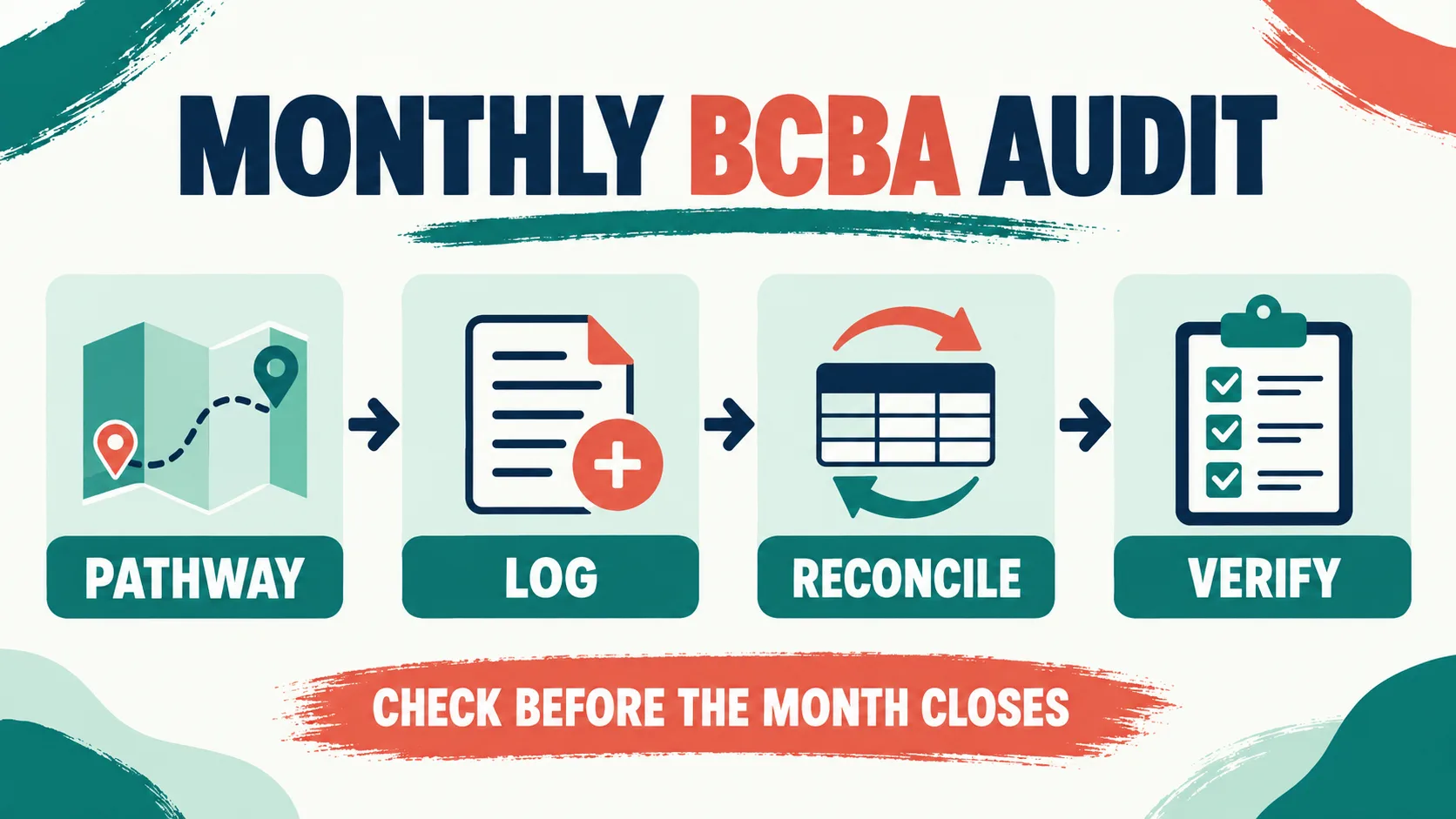
Close each supervisory period with a short audit instead of waiting until the end of the entire fieldwork experience. The audit should be boring, repeatable, and easy for another person to review.
- Lock the period: write the start and end dates, fieldwork type, requirement edition, trainee, and supervisor at the top of the review. If the placement has multiple supervisors, document the organization structure and responsible reviewer.
- Reconcile the source log: add the row-level actual hours and check that every total can be traced back to dated entries. Resolve blank dates, duplicate entries, overlapping times, and unexplained rounding.
- Separate the categories: total fieldwork, restricted work, unrestricted work, individual supervision, group supervision, and client observation independently. A single “supervision” total is too vague to audit.
- Run the requirement checks: compare the period total with the applicable minimum and maximum, calculate the required supervision percentage, check the individual-versus-group mix, and confirm the observation duration.
- Review the evidence: make sure notes describe what happened and that supporting records are de-identified and retrievable. A checkbox saying “observed” is not enough if no date, duration, or reviewer is identifiable.
- Route exceptions before signing: mark a mismatch as unresolved, explain the question, and ask the supervisor what correction or documentation is appropriate. Never edit a number simply to make a formula turn green.
| Audit field | What to compare | If it does not match |
|---|---|---|
| Period total | Dated activity rows versus the period summary | Find missing, overlapping, or duplicated entries |
| Supervision percentage | Actual supervised time versus the applicable requirement | Pause and ask the supervisor; do not backfill unsupported time |
| Individual/group mix | Separate individual and group records for the same trainee | Check attendance, actual participation, and the correct denominator |
| Observation | Date, duration, client context, and supervisor review | Treat it as an open requirement until the supervisor resolves it |
| Form route | Monthly or final; individual supervisor or organization | Verify the current BACB form before transferring totals |
Use two ledgers, not one overloaded sheet
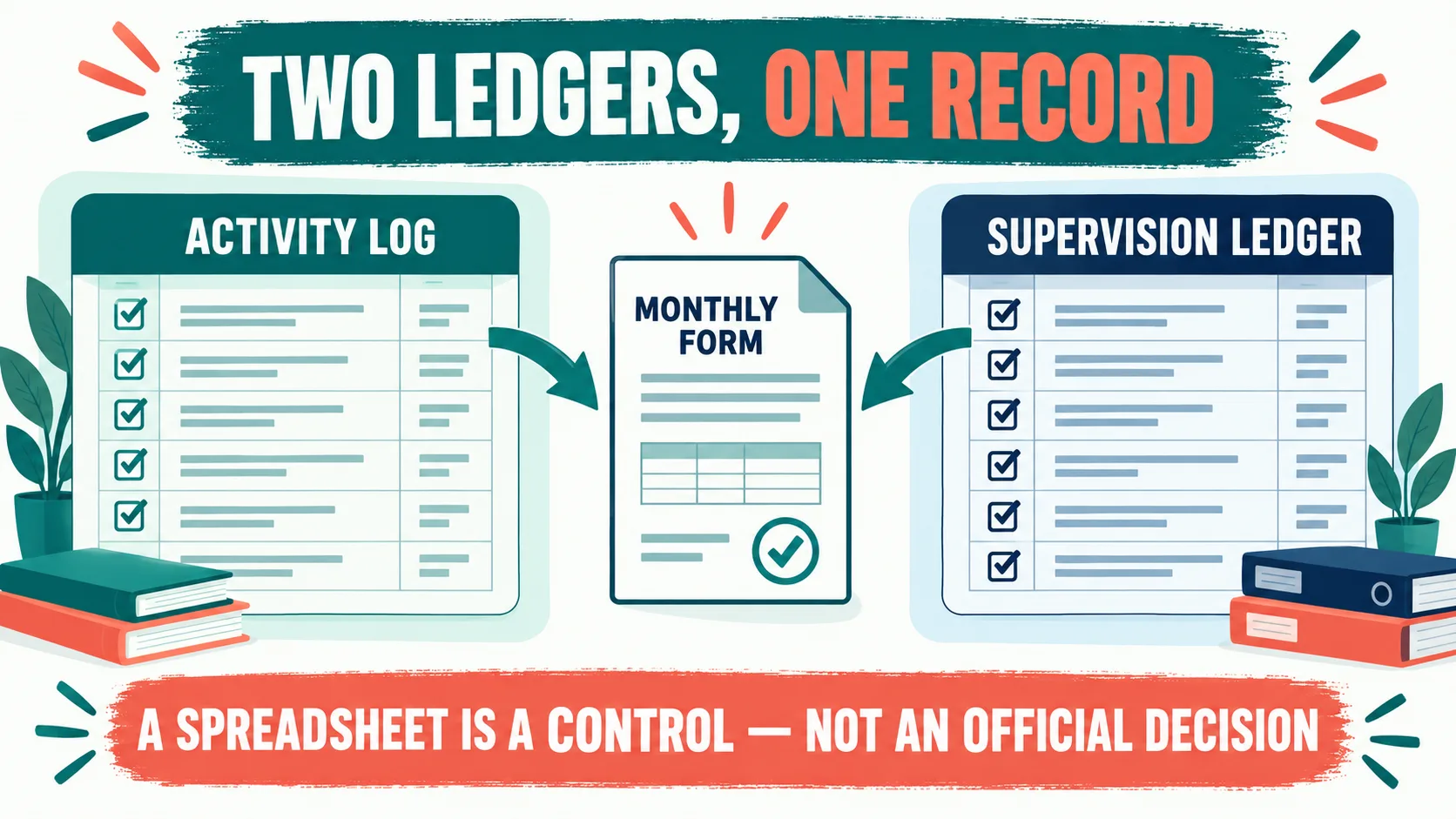
A common tracking error is asking one spreadsheet tab to be a diary, calculator, form, and compliance decision at the same time. A cleaner approach uses two linked ledgers with different jobs. The activity log is chronological. It answers what happened on a particular date. It can include the activity description, duration, category, setting, supervisor, related record, and a note about what needs review. The activity log should remain close to the source evidence and should not silently rewrite history.
The supervision ledger is period-level. It summarizes total hours, supervision percentage, individual and group supervision, observations, unrestricted activity percentage, signatures, and exception status. It is a control view built from the activity log—not a replacement for it.
Link the two with a stable date or record ID. If a total in the supervision ledger changes, you should be able to locate the activity rows that explain the change. If a row is corrected, preserve a dated correction note rather than deleting the original trail.
How to prepare for the 2027 transition
The BACB’s 2027 summary says the new requirements take effect January 1, 2027, and that people applying after that date need the 2027 Monthly and Final Fieldwork Verification Forms. It also distinguishes the supervised and concentrated pathways, including different total-hour, supervision, and observation checkpoints. That is why a tracker should show the requirement edition instead of assuming every month uses the same form.
Do not convert a historical record just because a new template looks cleaner. First identify the application timing, the requirement edition that applies, and the form route. Then ask the supervisor how a transition month should be represented. Keep old source records, signed forms, and transition notes together.
- Label each period with the applicable requirement edition before entering totals.
- Keep actual activity data separate from any planning estimate or pathway comparison.
- Download the current forms from the BACB resource hub when the form stage arrives.
- Do not copy 2027 fields into a historical 2022 record without checking the official transition instructions.
- Save a dated copy of the source log and the signed verification form as a pair.
The BACB’s supervision and training resource page links to fieldwork documentation resources, the BCBA Handbook, and the fieldwork checklist. Use those current materials when a spreadsheet formula or an older study page disagrees with the official instructions.
What a tracker cannot prove
A fieldwork tracker is useful because it makes review easier, but it cannot establish eligibility by itself. It cannot prove that an activity was classified correctly, that a supervisor was qualified, that a meeting met the definition of individual or group supervision, or that an observation was performed in the required way. It also cannot supply a missing signature or turn an unsupported estimate into contemporaneous documentation.
Use the tracker to organize evidence and flag questions. Use the current BACB form to make the required attestation. Use the qualified supervisor’s review to resolve classification and documentation questions. Those roles should stay separate even when one person maintains the spreadsheet.
If you are comparing tools, the existing BACB fieldwork tracker Excel guide can help you think through spreadsheet structure, while the existing BCBA supervision tracking guide covers the broader supervision record. This new page focuses specifically on the monthly audit and two-ledger control.
Common tracking mistakes
- Using one total for everything: total fieldwork, unrestricted activities, supervision, and observations answer different questions and need separate fields.
- Counting a calendar invitation as supervision: record actual attendance, interaction, feedback, and the applicable supervision category.
- Backfilling a missing month: a final spreadsheet total cannot recreate contemporaneous records. Escalate the gap to the supervisor.
- Mixing form editions: write the applicable requirement version into the period header and confirm the current form before signing.
- Changing actual hours into planning hours: keep any multiplier or projection in a separate planning field.
- Deleting corrections: preserve the original entry, add the correction date and reason, and keep the review trail.
- Putting client identifiers in a public template: use de-identified references and follow the placement’s privacy requirements.
FAQ
What is the best way to track BCBA hours?: Use a dated activity log plus a separate supervisory-period ledger. Record actual hours and categories close to the activity, then reconcile totals, supervision, observations, and signatures before the official monthly or final form is completed.
Is a BCBA hours tracker an official BACB form?: No. A tracker is an organizational source record. The current BACB Monthly and Final Fieldwork Verification Forms have their own fields, attestations, and version instructions. Use the current form that matches your requirement edition and supervision structure.
How many hours are required under the 2027 BCBA requirements?: The BACB’s high-level 2027 summary lists 2,000 hours for Supervised Fieldwork and 1,500 hours for Concentrated Supervised Fieldwork. It also lists different supervision and observation checkpoints. Confirm the full handbook and the route that applies to your application.
Can a spreadsheet tell me whether my hours qualify?: No. A spreadsheet can calculate and flag patterns, but qualification depends on the applicable BACB requirements, the accuracy of the source record, supervisor qualifications, documented supervision, official forms, and professional review.
Should I change old records for the 2027 rules?: Do not rewrite historical records simply to match a newer template. Identify the requirement edition and transition instructions that apply to your application, preserve the original records, and ask your supervisor how to document any transition month.
Can a BCBA mock exam verify my fieldwork hours?: No. A mock exam is a study tool. It can help you review fieldwork and supervision concepts, but it does not document hours, provide supervision, approve a form, or guarantee certification. When you are ready to test your exam knowledge, use the Free BCBA Mock Exam as a separate study activity.
Sources for Further Study
- BACB: 2027 BCBA Requirements
- BACB: BCBA Handbook
- BACB: Supervision, Assessment, Training, and Oversight
- Fieldwork ABA: How to Track Your BCBA Fieldwork Hours
- BxFieldwork: BCBA Supervision Tracker
This article is an educational documentation framework, not legal, clinical, or certification advice. Always use the current BACB materials and qualified supervisor review for your own fieldwork record.
Take the Free BCBA Mock Exam
When you are ready to apply the idea, use the free practice resource below for additional feedback. Take the Free BCBA Mock Exam



