
A useful BCBA exam study guide 6th edition should do more than collect definitions. It should help you move from the official blueprint to a specific study decision: which domain to review, which task to practice, what evidence shows a concept is usable, and what to do after you miss a question.
Table of Contents
- BCBA exam study guide 6th edition: the short answer
- Read the TCO as a study blueprint
- Build a task-by-task study map
- Use a 12-week study loop
- Turn practice questions into decisions
- Measure readiness without chasing one score
- Common sixth-edition study-guide mistakes
- FAQ
- Sources for Further Study
The official document is called the BCBA Test Content Outline (6th ed.), or TCO, rather than a separate “sixth-edition task list.” It describes an exam beginning in 2025 with 175 scored questions, 10 unscored pilot questions, 104 tasks, and 9 domains. This page turns that blueprint into a task-by-task study plan. It complements the existing BCBA 6th Edition Quick Study Guide rather than replacing it.
BCBA exam study guide 6th edition: the short answer
The best sixth-edition study guide has four layers:
- Blueprint: the official TCO tells you what knowledge and skills the exam can assess.
- Explanation: a study guide translates a task into definitions, contrasts, examples, and decision rules.
- Retrieval practice: questions make you produce an answer instead of only recognizing a familiar paragraph.
- Feedback: an error log shows whether the problem was terminology, discrimination, calculation, application, or test strategy.
Do not treat a PDF, a vocabulary list, or a single mock score as the whole preparation system. The TCO is the authority for exam content, while a guide and practice set are study tools. The practical question is not “Have I read every page?” It is “Can I identify the relevant task, reason through a new scenario, and explain why the best answer beats the distractors?”
Read the TCO as a study blueprint
The sixth-edition TCO organizes 104 tasks into nine domains and assigns a question count to each domain. The weights do not tell you exactly which item will appear on your exam, but they do prevent a common planning error: spending equal time on unequal exam areas.
| Domain | Official focus | Scored questions | Share |
|---|---|---|---|
| A | Behaviorism and Philosophical Foundations | 8 | 5% |
| B | Concepts and Principles | 24 | 14% |
| C | Measurement, Data Display, and Interpretation | 21 | 12% |
| D | Experimental Design | 13 | 7% |
| E | Ethical and Professional Issues | 22 | 13% |
| F | Behavior Assessment | 23 | 13% |
| G | Behavior-Change Procedures | 25 | 14% |
| H | Selecting and Implementing Interventions | 20 | 11% |
| I | Personnel Supervision and Management | 19 | 11% |
Use the weights to set a starting order, not to ignore smaller domains. Domains B, C, E, F, and G carry substantial exam weight, while A, D, H, and I still contain tasks that can decide scenario questions. A balanced plan revisits every domain and gives extra cycles to the domains where your error log shows a real gap.
Build a task-by-task study map
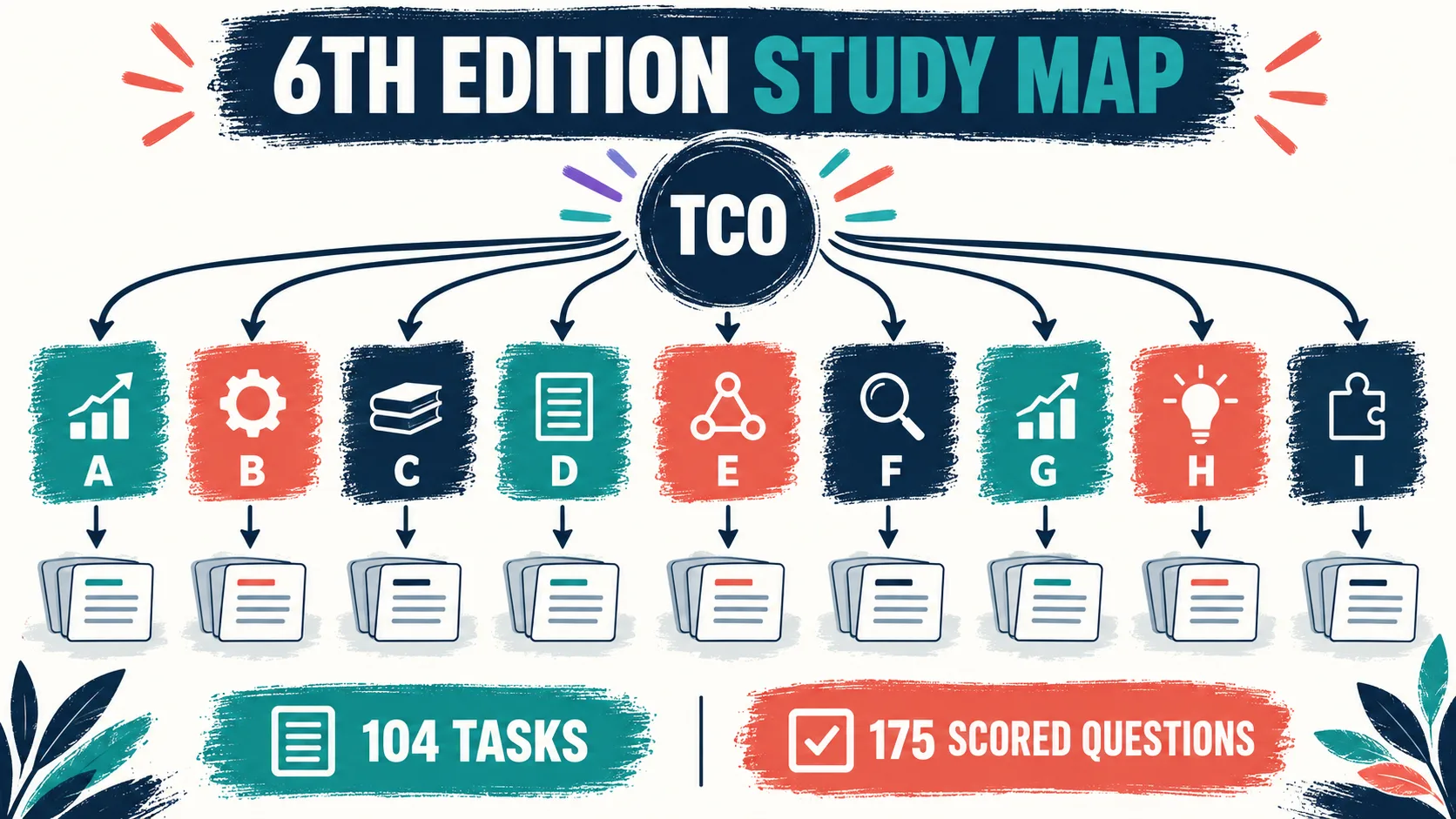
Start by making a copy of the official domain and task structure for personal study. Then add four columns to your own map:
- Plain-English meaning: explain what the task asks without copying a definition you cannot use.
- Discrimination: write the closest concept or procedure it could be confused with and the feature that separates them.
- Applied example: create a short scenario in which the task changes a clinical or supervisory decision.
- Evidence status: mark the task as new, understood, practiced, or unstable. “Read” is not the same as “retrieved.”
For example, a task about measurement should become more than a list of frequency, duration, latency, and interresponse time. Your map should ask which dimension matches the behavior, what observation window is appropriate, how the data might be displayed, and what conclusion the graph supports. A task about intervention selection should connect assessment results, scientific evidence, client preferences, and contextual fit rather than naming a procedure in isolation.
Keep the task map narrower than a textbook. Its job is to expose what you need to retrieve and apply. When a topic needs a deeper explanation, link to the relevant article or lesson, then return to the task map and write the decision rule in your own words.
Use a 12-week study loop
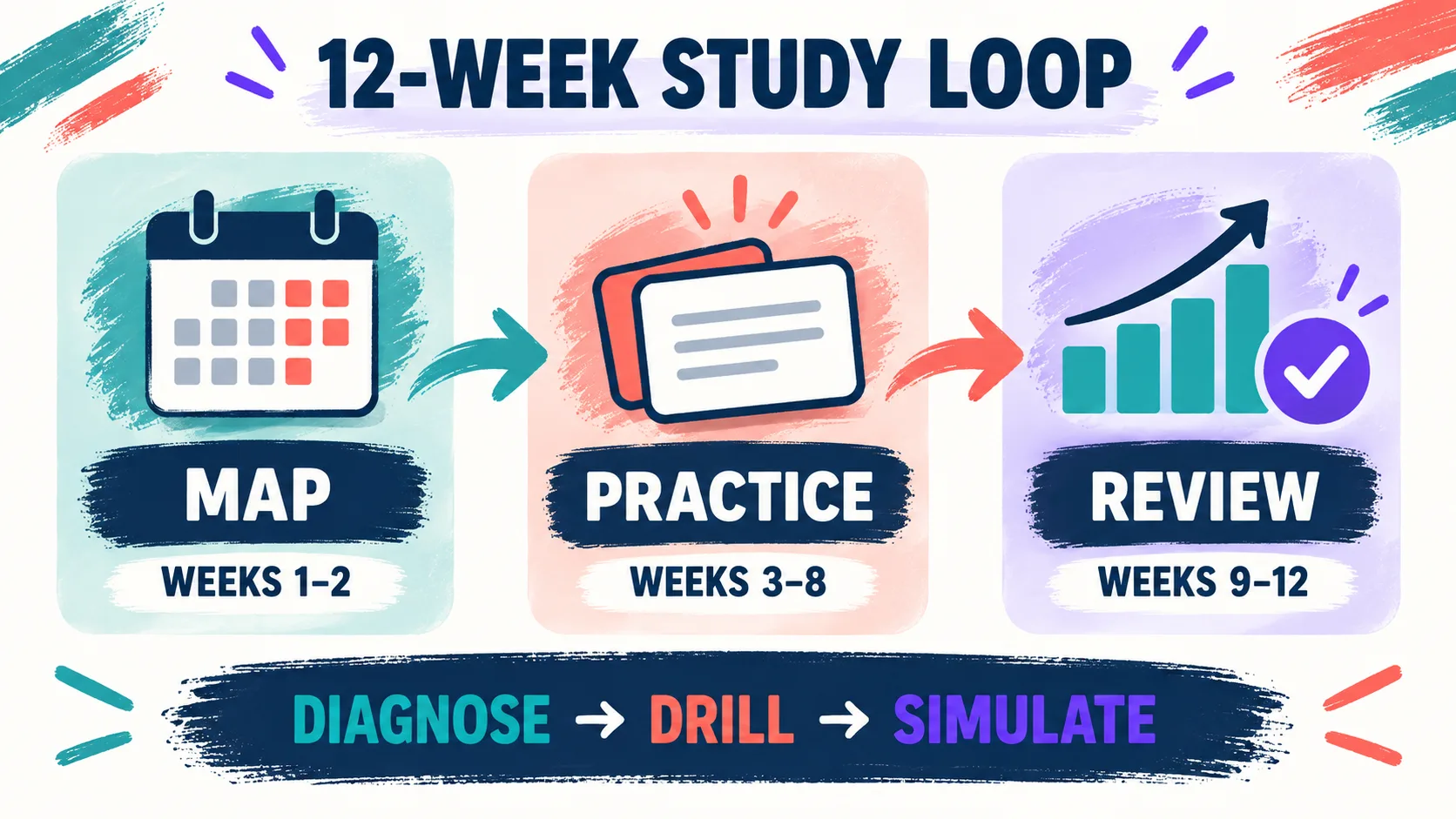
A 12-week schedule is a planning example, not a promise that every candidate needs exactly twelve weeks. Adjust the pace to your exam date, available hours, prior coursework, and practice performance. Keep the sequence: map first, practice throughout, and review the error pattern before choosing the next topic.
| Phase | Weeks | Primary work | Exit check |
|---|---|---|---|
| Map | 1–2 | Build the A–I task map, learn core terms, and take a short diagnostic set | Every domain has a starting status and an error log |
| Practice | 3–8 | Rotate high-weight domains with retrieval sets and scenario application | You can explain missed answers and identify the task behind them |
| Review | 9–12 | Use mixed sets, timed blocks, full simulations, and targeted repair sessions | Accuracy, timing, and explanation quality are stable across mixed domains |
A weekly session can follow the same four-step rhythm: retrieve yesterday’s material, learn one small task cluster, answer applied questions, and update the error log. End by choosing the next session from evidence. If you repeatedly miss one discrimination in Domain B, another full chapter read is unlikely to be the best next move; write a contrast, answer a focused set, and explain the difference aloud.
Turn practice questions into decisions
Practice has value only when it changes what you do next. For every missed or guessed question, record:
- Task: which TCO task or domain did the item test?
- Reason: did you misunderstand a term, miss a measurement detail, misread the function, calculate incorrectly, or choose a familiar but less appropriate procedure?
- Distractor: why was the tempting answer wrong under the facts in the stem?
- Repair: what short explanation, comparison, graph, or new question would test the gap again?
- Transfer: can you solve a new scenario without seeing the original wording?
Use three levels of practice. First, use untimed concept checks to build accurate language. Second, use domain sets to practice discrimination and application. Third, use mixed and timed sets to practice switching between tasks. A full mock exam belongs in the third level; it is a measurement occasion, not a substitute for learning the material.
Do not copy proprietary exam questions or rely on a claim that a practice bank reproduces the live exam. Write original notes, use authorized resources, and focus on the reasoning pattern. The BACB TCO describes content; it does not publish the live item bank.
Measure readiness without chasing one score
A readiness decision should combine at least four signals:
- Accuracy: how often you answer correctly in mixed practice, not only in a familiar topic set.
- Explanation quality: whether you can state why the correct answer fits and why the distractors do not.
- Coverage: whether every domain and task cluster has been retrieved recently.
- Timing and stamina: whether you can maintain careful reading and decision quality across a long, mixed session.
A high score on one easy set can create false confidence; a low score on an unfamiliar mixed set can identify useful work. Track trends and error categories over several sessions. If scores rise but explanations remain vague, keep practicing application. If accuracy is strong but timing collapses, schedule shorter timed blocks before another full simulation.
The exam is not passed by memorizing a page count. It is prepared for by building a defensible chain from task → concept → scenario → decision. Use your mock results to repair that chain, then retest the same skill in a new context.
Common sixth-edition study-guide mistakes
- Using a 5th-edition plan for a 6th-edition exam: check the document title, domains, and effective date before trusting a guide.
- Calling the TCO a separate task list: “6th Edition Task List” is common search language, but the current official BCBA document is the Test Content Outline.
- Studying by page count: a long chapter is not proof of retrieval or application. Map the task and test it.
- Giving every domain equal time: use official weights as a starting point, then let your error data adjust the schedule.
- Taking mocks without an error log: a score alone does not tell you what to repair.
- Memorizing answers: question wording changes. Practice identifying the behavior, context, measurement, function, ethics issue, or procedural feature that controls the decision.
- Confusing certification changes with exam-outline changes: the BACB’s 2027 certification requirements page describes eligibility and fieldwork changes; it does not automatically create a new exam edition. Confirm the current TCO and handbook for your exam date.
For a quick visual review, use the existing free 6th Edition Quick Study Guide. Then use the plan on this page to decide which domain and task to practice next.
FAQ
What is the BCBA 6th Edition study guide?: It is a study resource organized around the current BCBA Test Content Outline (6th ed.), which is the official exam blueprint for exams beginning in 2025. A good guide explains the 104 tasks across 9 domains and connects them to applied practice. It is not the same thing as the BACB’s official outline.
How many questions are on the sixth-edition BCBA exam?: The official TCO lists 175 scored questions and 10 unscored pilot questions. Use the BACB source for current exam information and avoid treating a commercial practice test’s format as a guarantee of the live exam.
Which BCBA 6th Edition domains should I study first?: Begin with the official weights and your diagnostic results. Concepts and Principles and Behavior-Change Procedures each represent 14% in the TCO; Measurement is 12%, Ethics and Behavior Assessment are 13% each, and the remaining domains still need coverage. Give extra repair time to the tasks you miss or cannot explain.
Is the 6th Edition TCO the same as the 6th Edition Task List?: They are commonly used as search synonyms, but the current official BCBA document is titled the Test Content Outline (6th ed.). When a resource says “6th Edition Task List,” verify that it maps to the nine current TCO domains and 104 tasks.
Is a study guide enough to pass the BCBA exam?: No resource can guarantee a result. Use a guide for explanations and structure, then use original practice questions, an error log, mixed sets, and timed simulations to test retrieval and application. Review the current BACB requirements and exam information for your situation.
What should I do after finishing the guide?: Take a diagnostic or mixed practice set, classify your errors by TCO task, repair the most important gaps, and retest them in a new scenario. When you want a separate practice experience, take the Free BCBA Mock Exam and record more than the score: keep the missed-task and timing patterns.
Sources for Further Study
- BACB: BCBA Test Content Outline (6th ed.)
- BACB: Task Lists and Test Content Outlines
- BACB: BCBA Handbook
- BACB: 2027 BCBA Requirements
- Study Bee ABA: Free BCBA Study Guide
This article is an educational study-planning framework. It is not affiliated with or endorsed by the BACB and does not guarantee exam results. Always check the current official BACB materials for your exam date.



