

The generality dimension of ABA asks whether a behavior change is durable, transfers beyond the original teaching conditions, and extends to related behaviors. It is one of the seven dimensions described by Baer, Wolf, and Risley. In a BCBA exam question, generality is rarely tested as a vocabulary-only definition. More often, the stem shows a skill that works in one room, with one person, or with one set of materials and asks what is missing from the plan.
Table of Contents
- Generality dimension of ABA: the short answer
- What the seven-dimension framework is asking
- Generality vs. generalization vs. maintenance
- The generality audit for a BCBA scenario
- How to program for generality
- Three exam cases and the best next move
- Common traps
- FAQ
- Sources for Further Study
- Quick Review Checklist
The key distinction is this: a learner can perform a skill accurately during training while the program is still weak on generality. To evaluate the dimension, define the original training conditions, plan relevant changes in context, and collect follow-up evidence across people, settings, time, stimuli, or related responses. This article turns that idea into a practical exam and programming audit without changing the existing broad Generality in ABA guide.
Generality dimension of ABA: the short answer
Generality means that meaningful behavior change continues to matter outside the exact conditions in which it was taught. The change may persist after supports are reduced, occur with new people or in new settings, or spread to related behaviors. The dimension is not a promise that a response should occur everywhere without discrimination. A good program produces useful transfer while preserving appropriate stimulus control.
For example, a learner may be taught to request a break with a BCBA in a clinic room. Evidence of generality could include using the request with a teacher, using it during a different task, and continuing to use it weeks later when the original prompt is no longer present. The exact probe should match the socially important outcome. A new setting is not automatically better if that setting is irrelevant to the learner’s life.
The original Baer, Wolf, and Risley article introduced the seven-dimension framework. For current BCBA exam preparation, connect the concept to the BACB BCBA Test Content Outline (6th ed.), especially the tasks on promoting stimulus and response generalization and maintaining desired behavior change after intervention.
What the seven-dimension framework is asking
The seven dimensions are applied, behavioral, analytic, technological, conceptually systematic, effective, and generality. They are a quality framework, not seven interchangeable treatment procedures. The generality dimension is the question that comes after a successful-looking session: “Where, when, with whom, and for how long does this change still work?”
| Dimension lens | Question to ask | What it is not |
|---|---|---|
| Applied | Does the target matter to the learner and stakeholders? | Choosing a behavior only because it is easy to count |
| Behavioral | Is the response observable and measurable? | A broad label such as “better attitude” |
| Analytic | Is there evidence that the intervention produced the change? | A data point with no convincing comparison or design |
| Technological | Could a trained implementer follow the written procedure? | A plan that says only “use ABA strategies” |
| Generality | Does the meaningful change persist, transfer, or spread? | Assuming one successful training session proves transfer |
A scenario may contain several dimensions at once. The exam asks you to find the feature most directly supported by the evidence. A detailed plan may be technological but still weak on generality if all data come from one therapist in one room. A large immediate improvement may be effective in the short term but still require maintenance probes and transfer checks.
Generality vs. generalization vs. maintenance
These words overlap in everyday conversation, which is why they are common BCBA exam traps. Use the environmental or temporal change in the scenario to decide which concept is being tested.
| Term | What changes? | Exam clue |
|---|---|---|
| Stimulus generalization | The same response occurs with new stimuli, people, materials, or settings | One response, several relevant cues or contexts |
| Response generalization | Different but functionally equivalent responses occur for the same outcome | Several response forms serve the same purpose |
| Maintenance | The behavior continues over time, often after intervention is reduced | A later probe under the same or similar conditions |
| Generality dimension | The broader quality of durable, transferable, socially meaningful change | The question asks whether the program’s effect survives and spreads appropriately |
These are not mutually exclusive labels. A later probe in a new classroom can show both maintenance over time and stimulus generalization across setting. The wording of the question tells you whether it wants the narrower process or the broader dimension of the applied program.
The generality audit for a BCBA scenario
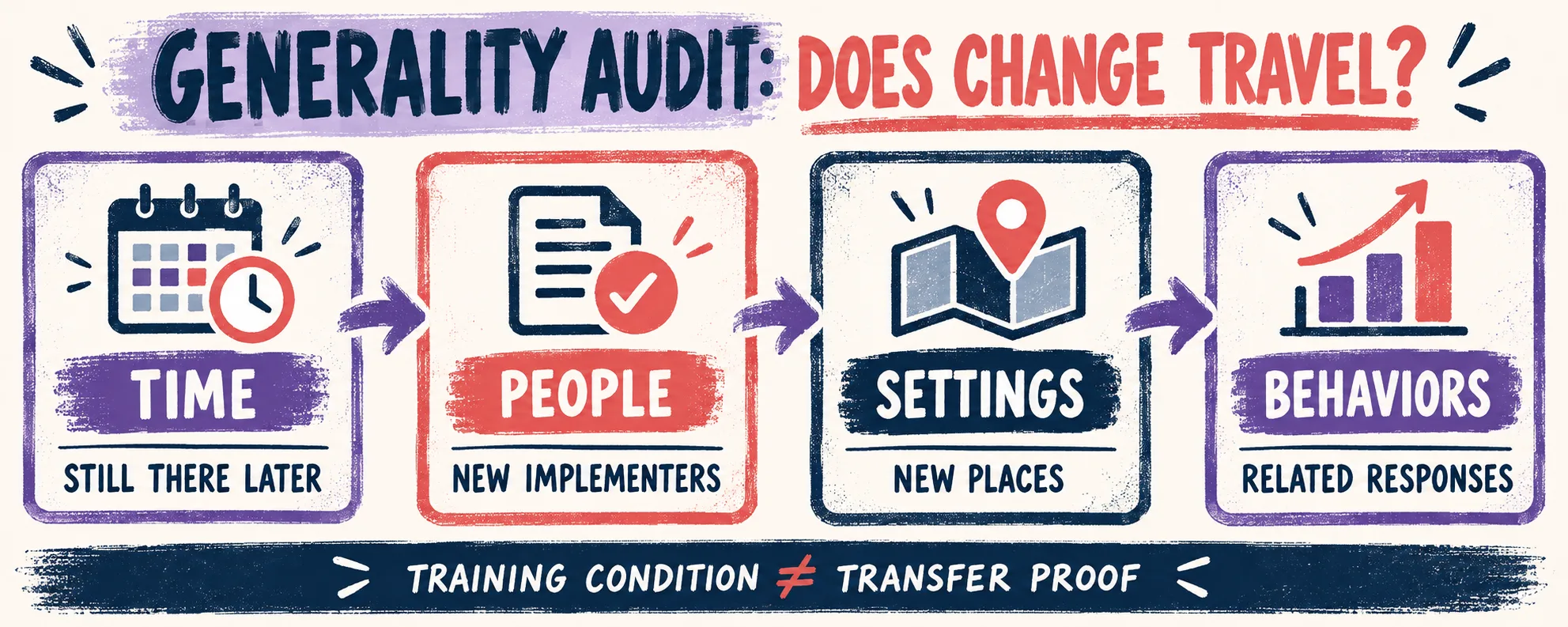
When a question asks whether an intervention demonstrates the generality dimension of ABA, run this audit before looking at the answer choices:
- Define the behavior: What exact response changed? If the behavior is vague, you cannot decide whether it transferred.
- Record the training condition: Who delivered the cue, where did teaching occur, what materials were used, and what consequence followed?
- Name the meaningful change: Which variable is different in the probe—person, setting, materials, time, response form, or related behavior?
- Check for an independent probe: Did the learner respond without simply receiving another teaching trial or an unplanned prompt?
- Check the criterion: Does the response meet the same functional or socially meaningful standard, rather than merely appearing once?
- Check durability: Is there a later measurement point after prompts, dense reinforcement, or direct teaching have been reduced?
A generality claim should be no broader than the evidence. If the team tested one new teacher one time, say that the skill generalized to that probe—not that it generalized across all people. Precise language is both a good exam answer and a better clinical habit.
How to program for generality
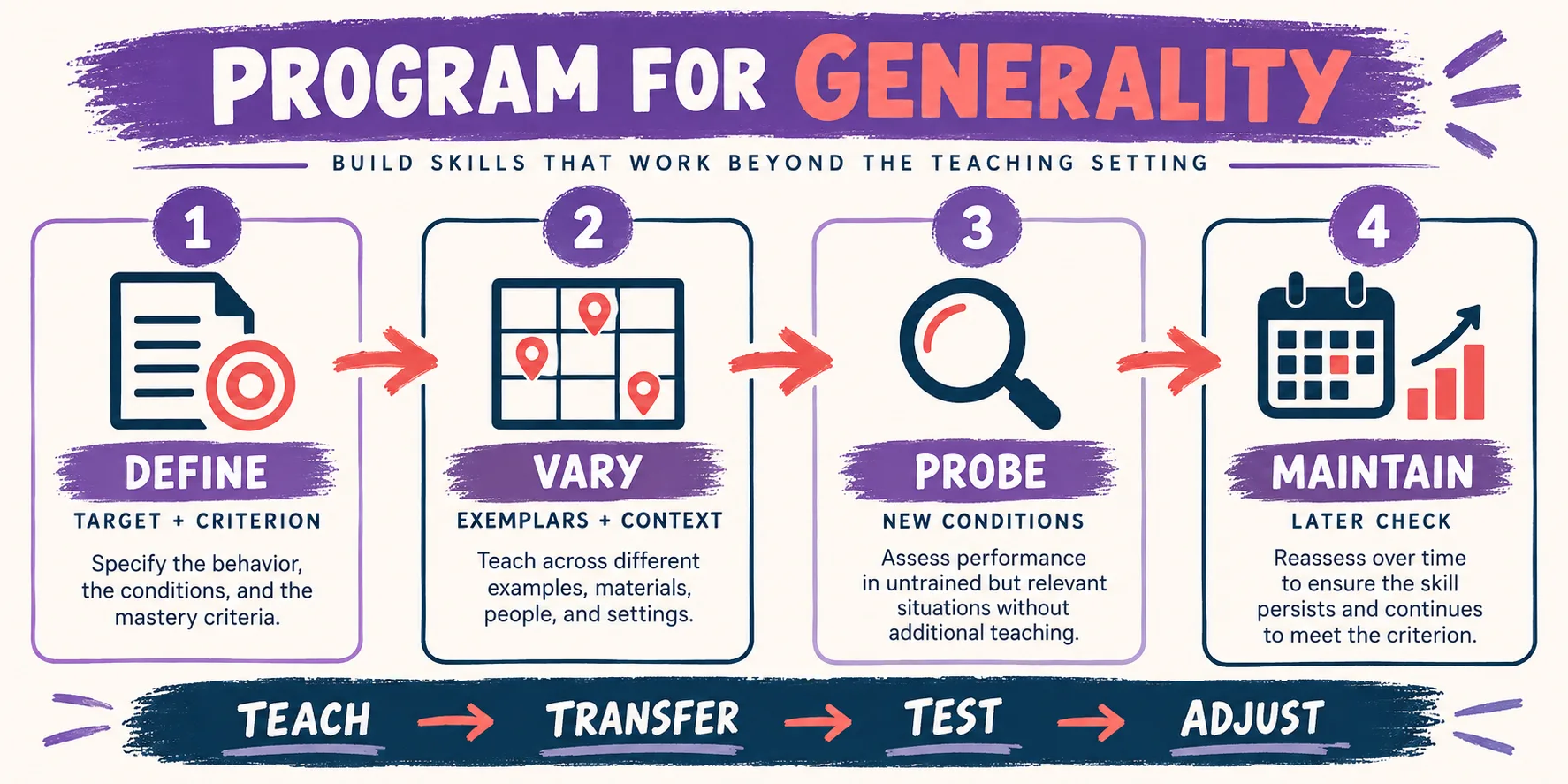
Generality is easier to build when it is part of the program from the beginning. Waiting until the final session to ask whether a skill transfers usually leaves too little time to identify the controlling variables.
- Choose the target for real-life value: define the behavior in terms of the learner’s daily routines, communication, safety, independence, or participation.
- Teach multiple exemplars: vary relevant examples, materials, instructions, and partners so the learner contacts the common features of the skill rather than one narrow stimulus.
- Use common stimuli strategically: carry a useful visual cue, wording, material, or routine feature from teaching into the natural environment when that bridge supports transfer.
- Arrange natural consequences: where appropriate, let the response contact the outcome that makes the skill useful outside the training room. Do not rely only on therapist-delivered rewards.
- Train enough exemplars and people: involve the implementers who matter in the learner’s life and measure their implementation when it affects the outcome.
- Plan maintenance probes: thin prompts or reinforcement according to data, then schedule later observations instead of declaring success immediately after acquisition.
- Protect discrimination: generality does not mean responding indiscriminately. Teach when the skill is relevant and when a different response is appropriate.
The current BACB outline explicitly includes designing and evaluating procedures to promote stimulus and response generalization, as well as maintaining desired behavior change after intervention. That is why a good answer often includes both a transfer plan and a maintenance check rather than a single extra practice trial.
Three exam cases and the best next move
Case 1: Accurate only with the original therapist. A student requests help independently with the BCBA but not with a classroom teacher. The immediate next move is not to label the program ineffective. First, program relevant practice with the teacher, check the cue and consequence in that setting, and measure independent requests without the original therapist’s prompt. This is a missing transfer probe and likely a programming-for-generality issue.
Case 2: The skill remains at the same table six weeks later. The response occurs under the original materials after intervention is reduced. This supports maintenance under those conditions, but it does not by itself demonstrate transfer to new settings or people. If the question asks for the generality dimension broadly, look for evidence of spread beyond the original arrangement.
Case 3: Several ways to ask for the same outcome. A learner uses a speech-generating device, a gesture, or a short vocal request to appropriately obtain assistance. If the forms are functionally equivalent and the relevant context is stable, the pattern illustrates response generalization. It may contribute to generality, but the answer should not automatically call it maintenance or stimulus generalization.
In each case, identify what changed and what was measured. The strongest answer is usually the one that adds a specific, socially relevant probe rather than simply adding more repetitions in the original teaching condition.
Common traps
- “It worked in therapy, so it generalized”: acquisition in the training condition is not transfer evidence.
- “Any new place proves generality”: the new context must be relevant and the behavior must still meet its functional criterion.
- “Generality means no discrimination”: useful transfer includes appropriate stimulus control; indiscriminate responding is not the goal.
- “One later data point proves maintenance”: interpretation depends on the criterion, time gap, support level, and stability of the measurement.
- “More prompts create more generality”: prompts can help teach, but unplanned or excessive prompts can hide whether the natural cue controls the response.
- “Analytic and generality are the same”: analytic evidence addresses whether the intervention caused the change; generality addresses whether meaningful change lasts or spreads.
For a broad review of all seven dimensions, use the existing 7 Dimensions of ABA case guide. For this page, keep the narrower audit question in mind: what evidence would show that the change is durable and appropriately transferable?
FAQ
What is the generality dimension of ABA?: It is the expectation that meaningful behavior change will be durable over time, transfer across relevant conditions, or spread to related behaviors. The exact evidence depends on the target and the learner’s real-life context.
Is generality the same as generalization?: No. Generalization is a narrower process involving transfer across stimuli, people, settings, or response forms. Generality is the broader quality of an applied intervention that includes transfer and durability.
What is the difference between generality and maintenance?: Maintenance refers primarily to the behavior continuing over time, often after support is reduced. Generality can include maintenance, but it also asks whether the change appears under new, relevant conditions or spreads to related behaviors.
How do I identify generality in a BCBA exam question?: Write down the original teaching condition, then look for evidence that the behavior occurs later, with different people, in different settings, with different materials, or in a functionally equivalent form. Check whether the response remains socially meaningful and meets the stated criterion.
Which current BACB tasks relate to generality?: The current 6th Edition TCO includes tasks on designing and evaluating procedures to promote stimulus and response generalization and on maintaining desired behavior change following intervention. Use the current BACB outline for the authoritative wording.
To practice choosing the best next step in scenario-based questions, take the Free BCBA Mock Exam. Review not only whether your answer was correct, but also which evidence in the stem supported transfer, maintenance, analytic control, or another dimension.
Sources for Further Study
- Baer, Wolf, and Risley (1968): Some Current Dimensions of Applied Behavior Analysis
- BACB: BCBA Test Content Outline (6th ed.)
- BCBA Mock Exam: Generality in ABA
- BCBA Mock Exam: Generalization in ABA
- Learning Behavior Analysis: The 7 Dimensions of ABA Quick Guide
This article is an educational study framework. Use current BACB materials, ethical guidance, qualified supervision, and individualized data when making clinical or certification decisions.
Quick Review Checklist
Use this final checklist to turn generality dimension of aba into exam-ready reasoning. The goal is not to memorize a label in isolation; it is to identify the relevant evidence and explain why the best answer fits the scenario. Key ideas to review:
- State the central definition or decision point for generality dimension of aba in your own words.
- Identify the detail that makes generality dimension of aba different from its closest related ABA term.
- Separate the observable facts in a scenario from assumptions that are not supported by the facts.
- Write one example and one nonexample so you can recognize the concept in a new setting.
Exam application checks:
- Ask what the question is actually requesting before comparing the answer choices.
- Mark the antecedent, response, consequence, or other evidence that supports the selected answer.
- Look for a distractor that describes a related process but does not answer the specific question.
Final self-check:
- Explain how you would verify the interpretation with clear observations or data.
- Change one detail in the scenario and decide whether your answer should change.
- Give a one-sentence rationale that a supervisor or study partner could evaluate.



