
If you are searching for a BCBA NPI number, the key point is that an NPI is a provider identifier, not a BCBA certification number. The National Provider Identifier is a unique 10-digit number used in HIPAA standard transactions. It can help a payer, clearinghouse, or organization identify the provider attached to a claim, but it does not prove that the person is certified by the BACB, licensed by a state, credentialed with a health plan, or guaranteed payment.
Table of Contents
- What Is a BCBA NPI Number?
- Does Every BCBA Need an NPI?
- How to Get an NPI Through NPPES
- How to Look Up a BCBA NPI Number
- Taxonomy, Name, and Provider-Record Checks
- NPI vs BACB Certification vs State License
- How Does an NPI Fit Into Billing and Payer Enrollment?
- How to Update or Correct an NPI Record
- Common BCBA NPI Mistakes to Avoid
- BCBA NPI Number FAQs
- Take the Free BCBA Mock Exam
That distinction matters when a newly certified BCBA starts a job, joins a group practice, submits an authorization, updates a payer file, or tries to find a provider record. This guide explains when a BCBA may need an NPI, how to look up the number through the official NPPES Registry, what information to compare, and which credentialing steps must happen separately.
What Is a BCBA NPI Number?
A BCBA NPI number is usually an NPI associated with an individual BCBA or with an organization that employs or bills for BCBAs. The CMS NPI overview describes an NPI as a unique 10-digit identifier for health care providers. The number itself does not encode a state, specialty, license, or certification. It is a stable identifier used to connect a provider record to standard health care transactions.
“BCBA NPI” is therefore a practical phrase, not a separate BCBA-issued number. The BACB issues certification information; CMS and the National Plan and Provider Enumeration System (NPPES) handle NPIs. A payer may ask for both a BCBA certification number and an NPI because the two records serve different purposes.
| Record | Main job | Issuing or controlling system |
|---|---|---|
| NPI | Identify a provider in standard health care transactions. | CMS through NPPES. |
| BACB certification number | Identify a BACB certification record, such as BCBA. | Behavior Analyst Certification Board. |
| State license number | Show state practice authorization and related status. | The applicable state licensing authority. |
Does Every BCBA Need an NPI?
No single answer applies to every BCBA. CMS says health care providers that are HIPAA-covered entities must obtain an NPI, but a person’s actual work arrangement determines whether an individual NPI is required for a particular workflow. A BCBA who works in a setting that does not send covered standard transactions may not use an individual NPI in the same way as a BCBA who submits claims or participates in payer enrollment.
Ask the organization, payer, or billing administrator which provider record the workflow requires. Some arrangements use an individual Type 1 NPI for the rendering or ordering professional. A clinic or group practice may also have a Type 2 organization NPI. The presence of an organization NPI does not automatically tell you whether an individual BCBA also has one, and an individual NPI does not replace the organization’s enrollment obligations. Before applying, clarify four points:
- Is the BCBA acting as an individual provider, or is the claim associated with a group or organization?
- Does the payer require an NPI for the specific service, claim, authorization, or provider enrollment step?
- Which legal name and practice address should appear in the NPPES record?
- Which current taxonomy classification best describes the provider’s role?
How to Get an NPI Through NPPES
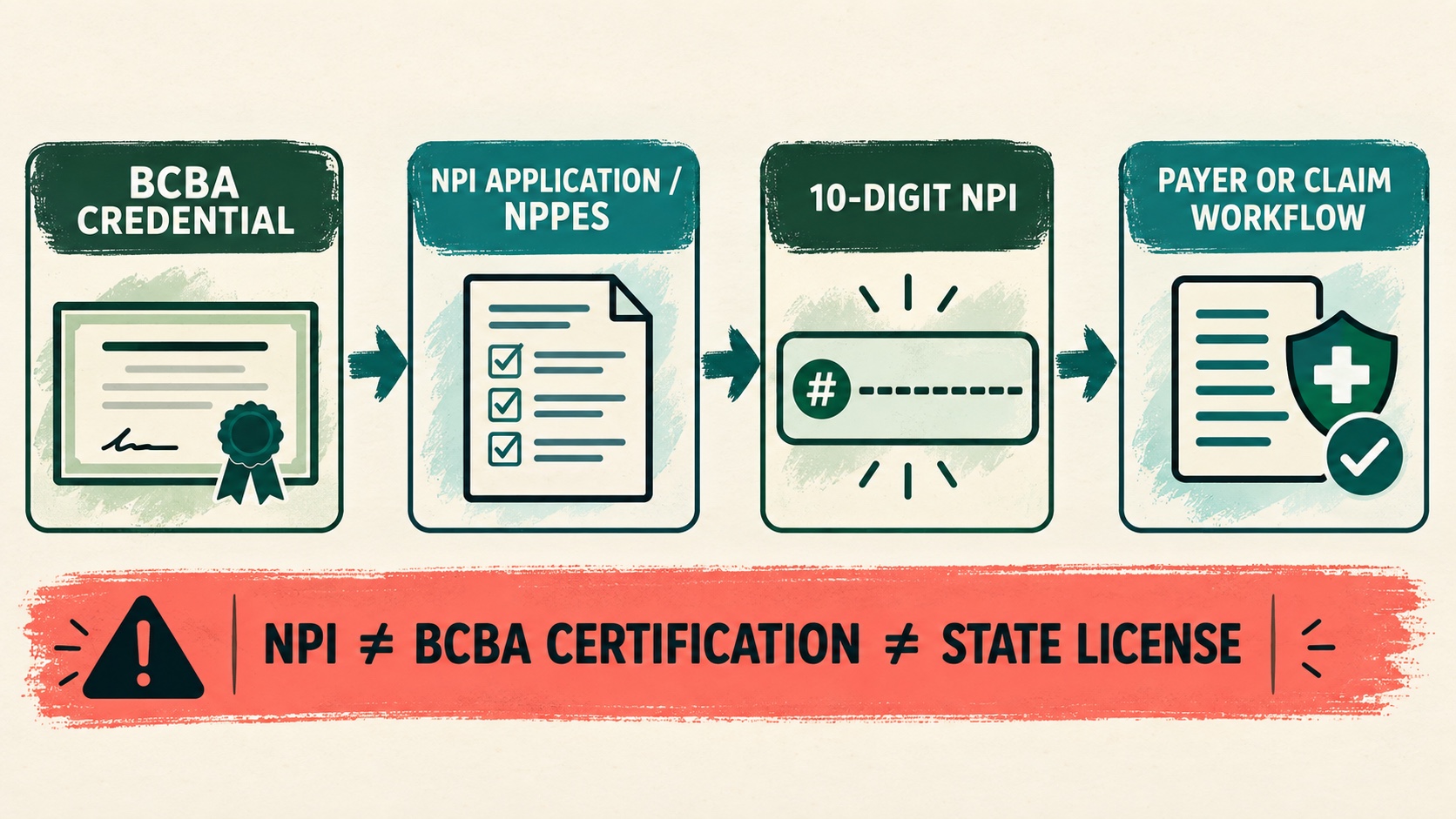
CMS identifies NPPES as the system that assigns NPIs. The official NPPES NPI Registry is a public search tool, while the provider uses the NPPES application and account process to obtain or manage a record. CMS describes three basic application routes: apply through the online NPPES process, authorize an approved organization to submit information through an electronic file interchange arrangement, or submit the paper NPI Application/Update Form.
For an individual BCBA applying for a Type 1 NPI, prepare the information the application requests and use the legal identity that must match the provider record. If a group or company is applying for a Type 2 NPI, the organization’s authorized official and legal business information control the application. Do not create a second organization record simply because an individual provider’s record is difficult to find.
The current application and CMS instructions control the details. NPI procedures, identity checks, taxonomy lists, and online screens can change. Treat a saved blog checklist as preparation notes, not as a substitute for the active NPPES application.
How to Look Up a BCBA NPI Number
Use the official NPPES Registry when you need to find a provider’s public record. CMS says the Registry is a free directory of active NPI records. It can be searched using an NPI, provider name, taxonomy description, location, and other filters. A search result may display the provider’s name, entity type, taxonomy information, and practice address as reported to NPPES.
- Start with the official Registry. Open the CMS NPPES search page instead of relying on a third-party directory as the primary source.
- Choose the correct entity type. Search for an individual when you are looking for a Type 1 provider record; search organization details when you are checking a Type 2 group record.
- Use more than one matching field. Compare the name, state, city, organization, taxonomy, and address. A name-only search can return similar records.
- Check the record date and status. Confirm that the result is active and that the information is recent enough for the payer or authorization request.
- Compare the requested identifier. Make sure the number belongs to the individual or organization named on the form. Do not copy a group NPI into an individual-provider field without confirmation.
- Save a dated verification note. Record the search date, official source, matching details, and the organization or payer that requested the check.
Taxonomy, Name, and Provider-Record Checks
An NPI lookup is only as useful as the record match. CMS’s health care taxonomy guidance explains that a taxonomy code describes a provider’s classification and specialization, and the application requires a taxonomy selection. The current taxonomy data and payer rules control the correct choice; do not select a code only because a third-party directory labels it “BCBA.” If the role or state rules are complicated, ask the payer or credentialing team which classification it expects. Check the record at three levels:
- Identity: Does the individual or organization name match the source document?
- Location: Does the practice address, state, or service location fit the billing workflow?
- Role: Does the taxonomy and credential text make sense for the provider being enrolled?
A public NPI record is not a complete credentialing file. It is a data record reported to NPPES. If a payer asks for a license, board certification, liability policy, CAQH profile, or enrollment approval, provide those items through the payer’s separate process.
NPI vs BACB Certification vs State License
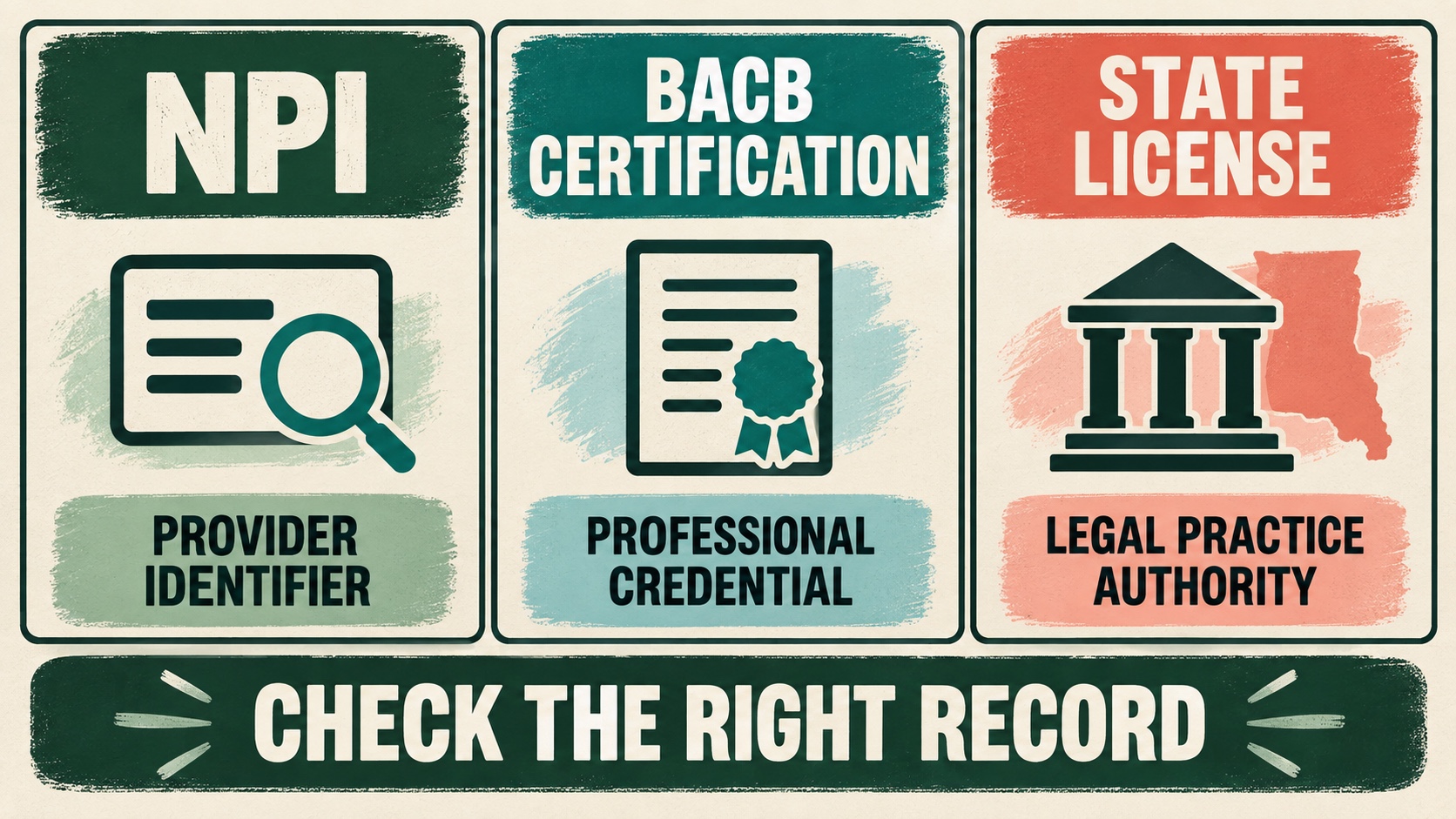
The most common error is treating the NPI as proof that a BCBA is qualified to practice. The CMS NPI fact sheet explicitly warns that obtaining an NPI does not ensure that a provider is licensed or credentialed, guarantee health-plan payment, or enroll the provider in a health plan. The BACB verification page and the state licensing board answer different questions.
| If the form asks… | Use… | Do not substitute… |
|---|---|---|
| NPI or rendering provider identifier | The correct individual or organization NPI from NPPES. | BACB ID, certification number, EIN, or state license number. |
| BCBA certification | BACB certification record and the requested certification number. | NPI alone. |
| State authorization to practice | The relevant state licensing board’s current record. | NPI or BACB Registry result alone. |
| Payer enrollment or participation | The payer’s enrollment confirmation and requested attachments. | A public NPI search result alone. |
How Does an NPI Fit Into Billing and Payer Enrollment?
An NPI helps standard transactions identify the provider connected with a claim, authorization, referral, or other covered transaction. It does not decide whether the service is medically necessary, whether the payer will authorize it, or whether the provider meets the payer’s network criteria. Those decisions belong to the payer and the applicable enrollment rules.
In an ABA organization, billing may involve an individual BCBA NPI, an organization NPI, a supervising provider, a rendering provider, or another arrangement defined by the payer. The claim field names and payer instructions control. Ask the billing team which NPI belongs in each field before submitting a claim or authorization, especially when the BCBA works under a group contract.
If a claim rejects, do not assume the NPI is the only problem. Check the provider’s enrollment status, taxonomy, service location, license, certification, authorization, payer contract, and the exact name spelling used in the payer file. A correct NPI can still be attached to an incomplete or mismatched enrollment record.
How to Update or Correct an NPI Record
NPPES data should match the current information that the provider is responsible for reporting. CMS materials say that covered providers must report changes to the information furnished for the NPI within the applicable update period; the CMS NPI fact sheet states a 30-day update requirement for covered health care providers. Use the current NPPES account process or the official paper update route when a name, address, taxonomy, or other record element changes.
After an update, check the public Registry and the payer’s own file separately. Updating NPPES does not automatically complete every payer enrollment update. A payer may require a separate demographic change, recredentialing, or participation form. Keep confirmation numbers and effective dates in the organization’s controlled record.
Common BCBA NPI Mistakes to Avoid
- Calling the NPI a certification number. The NPI identifies a provider in a transaction; the BACB record identifies certification.
- Assuming every BCBA needs an individual NPI. The work setting, covered transaction, organization, and payer rules matter.
- Using a Type 2 group NPI in an individual field. Confirm whether the form is asking for the rendering professional or the billing organization.
- Treating a public NPPES record as a license check. NPI issuance does not prove licensure or credentialing.
- Choosing a taxonomy from an old screenshot. Use current CMS/NUCC taxonomy guidance and the payer’s instructions.
- Updating NPPES but not the payer file. A payer may require a separate update before the change affects claims.
BCBA NPI Number FAQs
Is an NPI the same as a BCBA certification number?: No. An NPI is a CMS provider identifier used in standard health care transactions. A BCBA certification number belongs to the BACB certification record. A payer may request both.
Where can I look up a BCBA NPI number?: Use the official NPPES NPI Registry. Search by the provider’s name, NPI, location, taxonomy, or organization details, then match multiple fields before copying the number into a form.
Does having an NPI mean a BCBA is licensed?: No. CMS states that NPI issuance does not ensure a provider is licensed or credentialed. Check the BACB certification record and the relevant state licensing board separately.
Can a BCBA have more than one NPI?: An individual provider generally has one Type 1 NPI, while an organization can have a Type 2 NPI. A BCBA who owns or operates an organization may be connected with both an individual record and an organization record, but the application and payer rules determine which one belongs in a given field.
Does an NPI guarantee payment?: No. An NPI is necessary for many standard transactions, but it does not guarantee health-plan payment or complete payer enrollment. Confirm authorization, participation, credentialing, and claim requirements with the payer.
The practical answer to “BCBA NPI number” is: use the official NPPES record for provider identification, the BACB Registry for certification, and the state board for practice authority. If you are preparing for the BCBA exam, the free BCBA mock exam can help you practice exam-style questions. It does not issue an NPI, submit payer enrollment, verify a license, or guarantee certification.
Take the Free BCBA Mock Exam
If you want a low-pressure way to check your recall, use the free practice resource below. Take the Free BCBA Mock Exam



