
BACB group supervision is a real-time, interactive supervision meeting in which two to 10 trainees with similar fieldwork experiences participate. It is not simply a staff meeting, a group therapy session, or a study group. For BCBA fieldwork, the group meeting must fit the applicable BACB requirements, be documented, and be balanced with the individual supervision time that each trainee needs.
Table of Contents
- In This Guide
- BACB Group Supervision: What It Means
- Current BACB Group Supervision Requirements to Check
- How BACB Group Supervision Should Work Across a Month
- Group Supervision Versus Other Meetings
- How to Track Group Supervision Without Losing the Individual Minimum
- What to Recheck for the 2027 Requirements
- Common BACB Group Supervision Errors
- Frequently Asked Questions
- Take the Free BCBA Mock Exam
The practical rule is simple: plan the month before the meeting, make the group discussion interactive, record each trainee’s actual time, and check the group percentage against the current requirement edition. Under the current handbook for the 2022 requirements, group supervision may not exceed 50% of supervised hours in each supervisory period, and at least half of the meeting time must be individual. The 2027 requirements also retain a 50% individual minimum, but other fieldwork numbers and forms change, so do not mix editions.
Use the current BACB supervision and training resources, the applicable handbook, and the correct monthly form as the authority. This guide explains how to organize and audit group supervision; it does not approve a trainee’s eligibility or replace a supervisor’s professional judgment.
In This Guide
BACB Group Supervision: What It Means
Group supervision is an interactive meeting for a small group of trainees who have similar experiences to discuss. The current BCBA Handbook describes a group supervision meeting as involving two to 10 trainees, with non-trainees limited. The meeting should involve active discussion, application, feedback, and problem solving related to fieldwork—not just a presentation that everyone passively watches.
Each trainee still has an individual fieldwork record. A shared agenda can create one learning experience, but it does not make every trainee’s hours, activities, or supervision percentage identical. One trainee may discuss a behavior plan, another may analyze data, and a third may receive feedback on a caregiver-training procedure. The supervisor should document enough detail to show what happened and how each trainee participated.
Group supervision also does not eliminate the need for direct observation. The handbook requires an observation of the trainee with a client during each supervisory period, with one supervisor responsible for observing the trainee. A group meeting may prepare the trainee for that observation, but it is not automatically the observation itself.
Current BACB Group Supervision Requirements to Check
Before calculating a percentage, identify which BACB requirement edition applies to the trainee. For a person following the current 2022 requirements, the current handbook lists several rules that shape group supervision:
- Group supervision is interactive and includes two to 10 trainees with similar experiences.
- At least 50% of supervised hours must be individual supervision; group supervision may not exceed 50% of total supervised hours in each supervisory period.
- At least half of a supervision meeting’s time must be individual, even when a group meeting is scheduled.
- For supervised fieldwork, the trainee has at least four supervisor contacts per month; concentrated supervised fieldwork requires at least six contacts per month.
- Supervision must be at least 5% of supervised fieldwork hours or 10% of concentrated supervised fieldwork hours for each calendar month.
- The current handbook describes a monthly fieldwork range of 20–130 hours for the 2022 pathway; the trainee must still follow the exact current form and handbook language.
These are compliance checkpoints, not a shortcut for deciding eligibility. The current BCBA Handbook controls if a summary, tracker, or old study guide says something different. Keep the requirement edition visible in the fieldwork tracker so a future 2027 form is not accidentally mixed with a 2022 record.
| Checkpoint | What to verify | Why it matters |
|---|---|---|
| Group size | Two to 10 trainees with similar experiences; non-trainees are limited. | A large presentation or open staff meeting may not meet the group-supervision definition. |
| Individual balance | At least half of supervised hours are individual; group hours stay at or below half in each period. | A month can look busy while still failing the required supervision mix. |
| Observation | One supervisor observes the trainee with a client during each supervisory period. | A group discussion does not substitute for the required observation. |
| Record trail | Agenda, attendance, topics, participation, hours, and monthly verification are traceable. | A final total should be reproducible from contemporaneous records. |
How BACB Group Supervision Should Work Across a Month
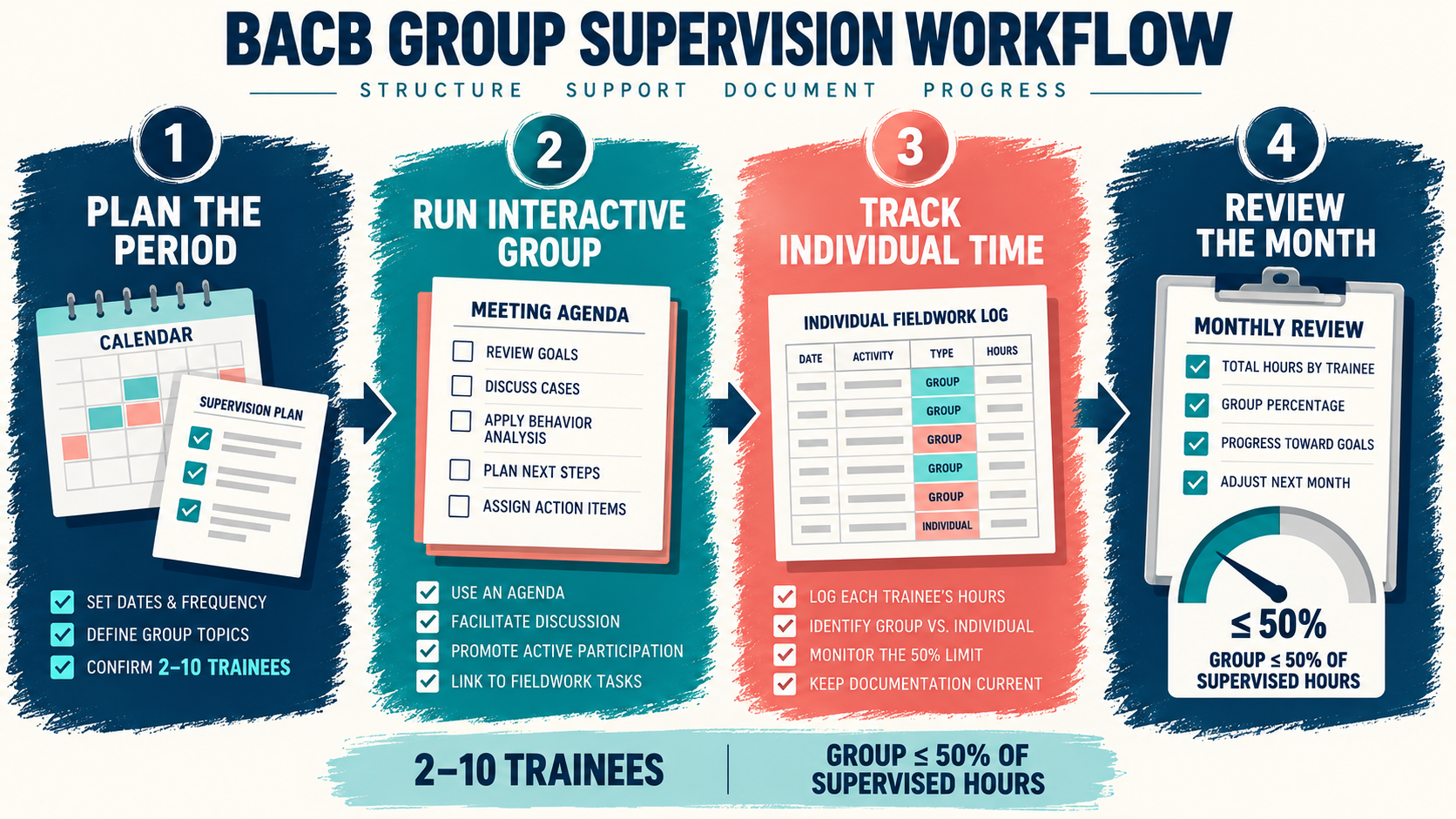
A strong group-supervision process is a sequence, not a single calendar invitation. The supervisor can use the following workflow while adapting the agenda to the trainees’ actual fieldwork.
1. Plan the supervisory period: Start with each trainee’s fieldwork type, expected hours, current goals, and previous feedback. Decide which portion will be individual and which portion can be useful for interactive group discussion. If one trainee’s needs are substantially different, that trainee may need an individual meeting rather than being placed into a group agenda simply to fill a time slot.
2. Set a focused group agenda: Choose a small number of applied topics. For example, the agenda may ask trainees to compare operational definitions, review a de-identified graph, critique a treatment-integrity plan, and explain how they would measure a replacement behavior. The supervisor should prepare prompts that require reasoning and feedback, not just attendance.
3. Run the meeting as an interaction: Record who attended, the start and end time, the applied topics, and each trainee’s substantive participation. A trainee who joins late or leaves early should not automatically receive the full meeting duration. A slide deck can support the meeting, but a lecture alone is not the same as interactive group supervision.
4. Complete individual supervision and observation: Schedule the individual portion for each trainee and document the feedback that is specific to that trainee. Track the required client observation separately. The observation can inform the individual feedback, but the record should make it possible to identify when and how the observation occurred.
5. Reconcile the month before signing: Add each trainee’s total fieldwork hours, individual supervision hours, group supervision hours, and observation information. Check the group percentage using the denominator required by the applicable handbook. Resolve a missing signature, duplicated meeting, or category mismatch before the monthly verification form is signed.
For example, if a trainee records 80 supervised hours in a period, 40 group hours is the maximum under a 50% ceiling, and at least 40 hours must be individual. If the trainee records 46 group hours and 34 individual hours, the total is still 80, but the supervision mix needs review before it is treated as compliant. The arithmetic flags the issue; the supervisor and current handbook determine the correction.
Group Supervision Versus Other Meetings
Similar labels can describe very different activities. Use the purpose, participants, interaction, and record—not the calendar title alone—to classify a meeting.
| Meeting type | What happens | Do not count it automatically as BACB group supervision |
|---|---|---|
| Group supervision | Two to 10 trainees with similar experiences actively discuss fieldwork with a qualified supervisor. | A passive webinar, oversized lecture, or meeting with no trainee-specific participation record. |
| Individual supervision | The supervisor gives feedback and guidance to one trainee, with records specific to that trainee. | A group call where the trainee is only one silent attendee. |
| Staff meeting | An organization coordinates schedules, cases, policies, or operations. | The meeting’s operational purpose does not become supervision just because a BCBA attends. |
| Study group | Peers review concepts or practice questions without the supervision relationship. | Peer discussion alone is not a substitute for documented supervisor-led fieldwork supervision. |
| Group therapy or treatment meeting | The primary purpose is client care, treatment, or family support. | Client-service time is not automatically trainee supervision time. |
How to Track Group Supervision Without Losing the Individual Minimum
Track each trainee separately even when the supervisor uses one shared attendance sheet. A practical tracker has one row for each meeting and columns for date, meeting type, start time, end time, trainee, individual minutes, group minutes, observation status, topic, and supervisor review. Never let a shared group total silently populate every trainee’s record without checking attendance and actual participation.
At the end of the period, run four checks:
- Time check: Compare the attendance record with the actual start and end time for each trainee.
- Mix check: Add individual and group supervised hours separately and compare the result with the applicable 50% rule.
- Coverage check: Confirm required supervisor contacts, the client observation, and the monthly supervision percentage are represented.
- Signature check: Make sure the monthly form and supporting records are reviewed before either person signs.
If the tracker shows 12 hours of group supervision for a trainee, ask what those 12 hours represent. A single 12-hour block would be unusual; several smaller interactive meetings may be reasonable, but the dates, participation, and supervision-period calculation must remain clear. A spreadsheet can identify an outlier, but it should not invent documentation.
What to Recheck for the 2027 Requirements
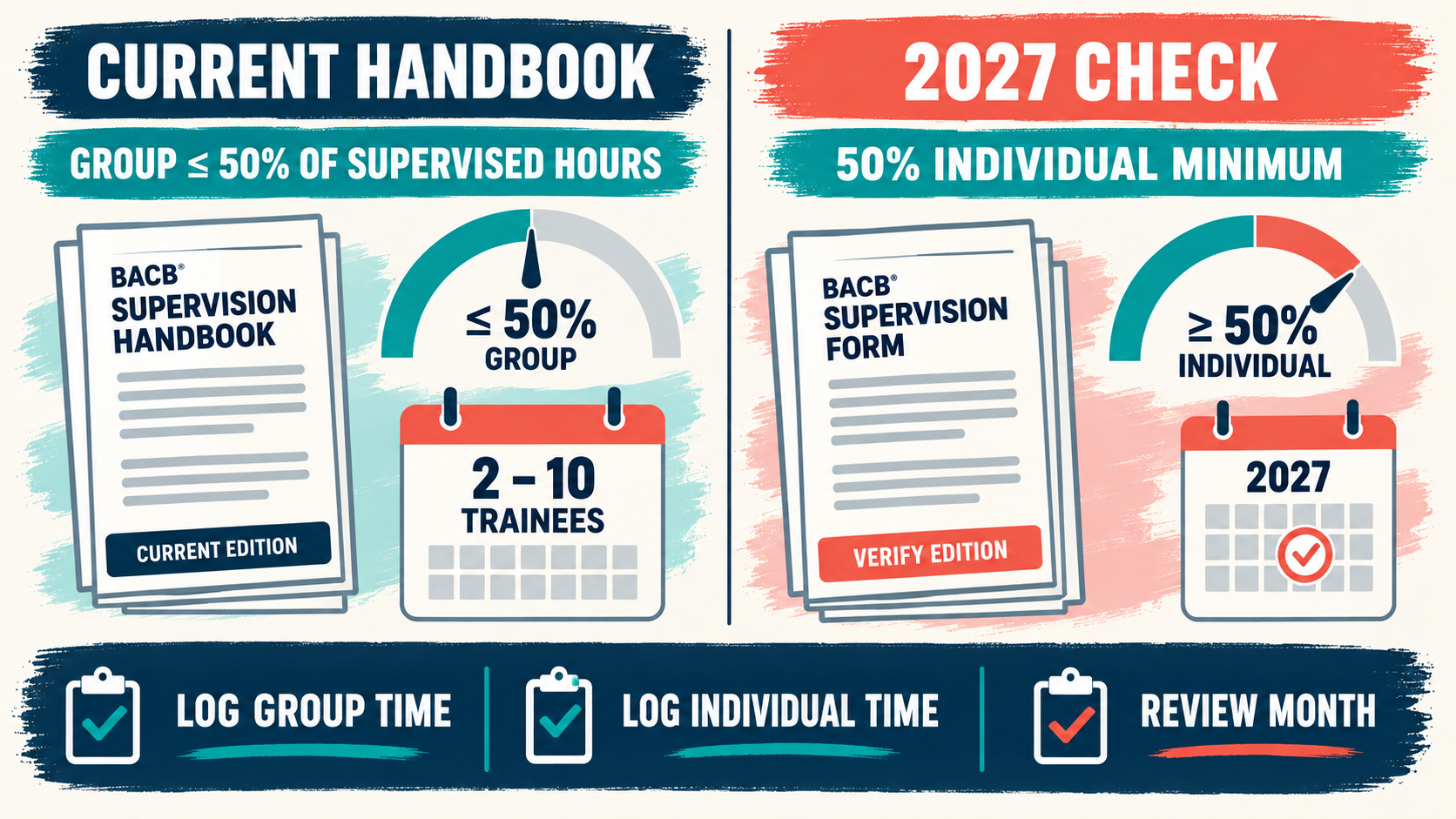
The BACB 2027 requirements page says applicants using the 2027 requirements will use the 2027 monthly and final fieldwork forms. The 2027 materials describe a monthly range of 20–160 hours, a 60- or 90-minute observation requirement depending on the fieldwork path, and at least 50% of supervised hours as individual supervision. Group supervision may not exceed 50% of supervised hours, and the 2027 form set separates individual and organization-supervisor situations. Do not copy the 2022 monthly range or an old form into a 2027 tracker. Instead:
- Record the application and requirement edition before the first 2027 month.
- Download forms from the current BACB fieldwork resource hub.
- Confirm the observation duration and unrestricted-hour requirement for the selected path.
- Preserve the group-versus-individual calculation for every supervisory period.
- Ask the supervisor to resolve any transition month before signing the form.
The transition page is a timing and document-version resource, not evidence that every older fieldwork record should be rewritten. Keep historical records intact and use the current BACB instructions for the application path that applies.
Common BACB Group Supervision Errors
- Calling any group meeting supervision. Classify the purpose and interaction, not just the calendar title.
- Counting the same group minutes for an absent trainee. Use actual attendance and participation records.
- Letting group time exceed half of supervised hours. Check the percentage per trainee and per supervisory period.
- Forgetting the individual minimum. A group agenda can be useful while still leaving an individual-supervision gap.
- Using a group meeting as the client observation. Record the required observation separately.
- Mixing 2022 and 2027 forms. Write the requirement edition on the tracker and verify the current BACB form before signing.
- Writing only “group supervision” in the notes. Record topics, participation, feedback, and the trainee-specific follow-up.
Frequently Asked Questions
How many trainees can participate in BACB group supervision?: The current handbook describes an interactive group supervision meeting with two to 10 trainees who have similar experiences. Non-trainees are limited, so an open training presentation should not automatically be classified as group supervision.
Can group supervision be more than 50% of my fieldwork?: Under the current handbook and the 2027 requirements materials, group supervision may not exceed 50% of supervised hours in the applicable supervisory period. At least half of supervised hours must be individual. Check the requirement edition and the current form before calculating your own record.
Does group supervision replace individual supervision?: No. Group supervision and individual supervision serve different documentation and feedback needs. The individual minimum must be protected, and the supervisor should document trainee-specific feedback rather than treating attendance as the only evidence.
Does group supervision count as the required observation?: Not automatically. The supervisor must document the required observation of the trainee with a client during each supervisory period. A group discussion can prepare or debrief the observation, but it is not the same event.
Can a free BCBA mock exam help me document group supervision?: No. A mock exam is for study practice, not fieldwork approval or supervision documentation. You can use the free BCBA mock exam as a separate study activity, but it does not verify hours, provide supervision, or guarantee certification.
The safest BACB group supervision process is to identify the correct requirement edition, run a genuinely interactive meeting for the right group size, record each trainee’s actual participation, preserve at least the required individual supervision, and reconcile the month before signing. When a tracker exposes a mismatch, pause and review it with the supervisor and current BACB materials rather than adjusting the number to make the spreadsheet balance.
Take the Free BCBA Mock Exam
If you want a low-pressure way to check your recall, use the free practice resource below. Take the Free BCBA Mock Exam



