

Is the BCBA exam hard? It can be demanding because it combines broad behavior-analytic content with applied scenarios, careful wording, and a fixed testing window. A realistic answer depends on preparation, not a dramatic pass-or-fail label.
Table of Contents
- Is the BCBA Exam Hard?
- What Makes the BCBA Exam Feel Difficult?
- What Is the Current BCBA Exam Format?
- Do Pass Rates Prove That the BCBA Exam Is Hard?
- Does a Low Practice Score Mean You Are Not Ready?
- Which Study Behaviors Make the Exam Easier?
- What Should a BCBA Exam Study Plan Include?
- How Should You Practice Scenario Questions?
- How Should You Handle Timing on the BCBA Exam?
- When Should You Decide to Schedule the Exam?
- What Are Common Myths About BCBA Exam Difficulty?
- How Can a Practice Exam Help?
- Final Takeaway
- Take the Free BCBA Mock Exam
Many candidates search this question when they are deciding whether to apply, choosing a study plan, or feeling discouraged by a practice set. The most useful answer is neither “anyone can pass easily” nor “the exam is impossible.” The BCBA exam is a professional certification assessment, so it expects more than memorized definitions. You need to recognize concepts, select the best action in context, and avoid attractive answers that ignore measurement, function, ethics, or the conditions in the question.
The current BACB handbook and examination information should control current eligibility and administration details. This guide explains how to interpret difficulty and prepare; it does not replace the official rules or promise a passing result.
Is the BCBA Exam Hard?
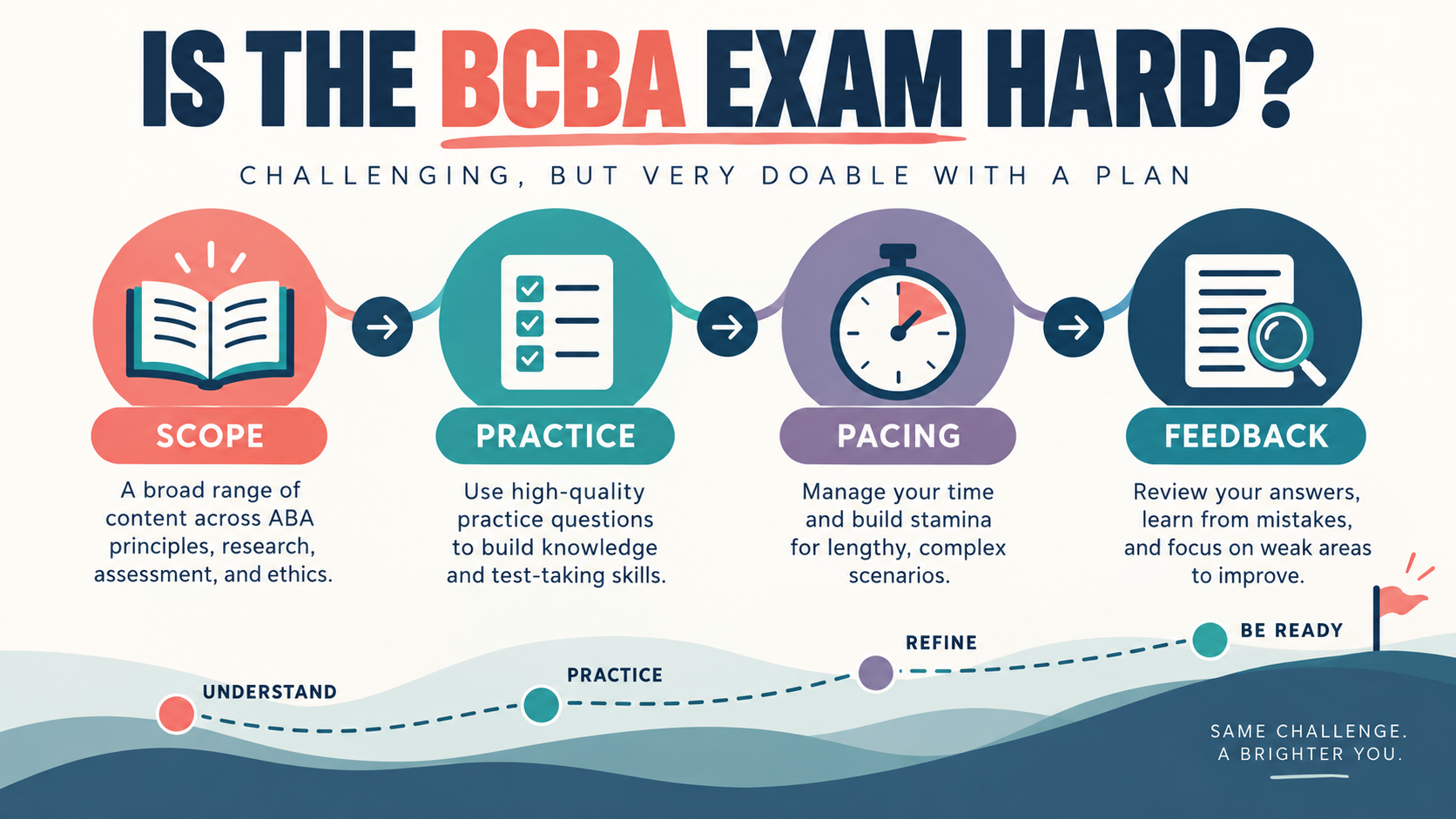
Yes, the BCBA exam can be hard, but “hard” is not one fixed property of the test. Difficulty usually comes from the interaction of four things: the breadth of the task list, the need to apply principles to scenarios, the precision of answer choices, and the pressure of a timed exam. A candidate who knows definitions but has not practiced discrimination may feel the exam is much harder than a candidate who routinely explains why one option is more function-based, measurable, and ethical than another.
That distinction matters. A difficult practice question may reveal a content gap, a reading error, weak pacing, or an unfamiliar application. Those are different problems and require different fixes. Treat the difficulty question as a request for diagnosis: what did the item ask, what did you assume, and which part of the task list supports the best answer?
What Makes the BCBA Exam Feel Difficult?
The exam may feel challenging for reasons that are easy to confuse. Separating them makes preparation more efficient:
- Content breadth: you must move among measurement, assessment, behavior change, skill acquisition, ethics, supervision, and research concepts.
- Applied reasoning: the question may describe a learner, setting, data pattern, or treatment decision instead of naming the concept directly.
- Close alternatives: several options can sound reasonable, but only one best fits the stated function, evidence, or procedural condition.
- Reading precision: words such as “first,” “most appropriate,” “best,” “least,” or “based on the data” change the task.
- Pacing: spending too long on one uncertain item can reduce the time available for items you could answer with a calmer review.
This is why simply increasing the number of flashcards may not solve the problem. Knowledge is necessary, but the exam also tests discrimination and decision-making under constraints.
What Is the Current BCBA Exam Format?
At the time of this article’s review, the official BACB materials describe the current examination structure. Always check the live handbook before scheduling because administrative details can change. The following table is a study orientation, not a substitute for the official candidate rules.
| Feature | What it means for preparation |
|---|---|
| 185 total questions | Practice sustained attention and avoid treating a short quiz as a full simulation. |
| 175 scored and 10 unscored questions | Do not try to identify unscored items while testing; apply the same careful reasoning throughout. |
| Four-hour testing window | Build a pacing plan, practice reading efficiently, and leave time for flagged questions. |
| Current BCBA task-list framework | Use the official outline to organize study instead of relying on an unofficial list of “likely” questions. |
The official BCBA examination resource is the right place to confirm current exam information. Third-party explanations can help you study, but they should not override the BACB handbook.
Do Pass Rates Prove That the BCBA Exam Is Hard?
Pass rates show that candidates and training pathways do not all perform identically, but a pass-rate percentage is not a personal prediction. Results can vary by first attempt versus retake, eligibility pathway, program, cohort, preparation resources, and the period being reported. Peer-reviewed studies have examined program-level and candidate-level factors, but those findings should be read as context rather than as a guarantee about your outcome.
Use official pass-rate information to understand the landscape, then use your own error data to make a decision. A single score can be noisy. A pattern across several mixed-domain, timed sets is more informative when you also review whether your errors came from recall, application, reading, or pacing.
Does a Low Practice Score Mean You Are Not Ready?
Not automatically. A low score tells you that the current combination of content knowledge, question interpretation, and testing conditions is not yet producing enough correct answers. It does not tell you which component needs work until you analyze the missed items. For each incorrect or guessed answer, record four things:
- What was the target concept or task-list area?
- What words in the stem controlled the decision?
- Why was the selected option tempting, and what made it weaker?
- What rule, data pattern, or example would let you answer a similar item next time?
If most misses are vocabulary errors, return to definitions and examples. If you know the terms but choose an intervention before identifying function, practice a slower decision sequence. If you miss late in long sets, work on pacing and endurance. The score is the signal; the error pattern is the diagnosis.
Which Study Behaviors Make the Exam Easier?
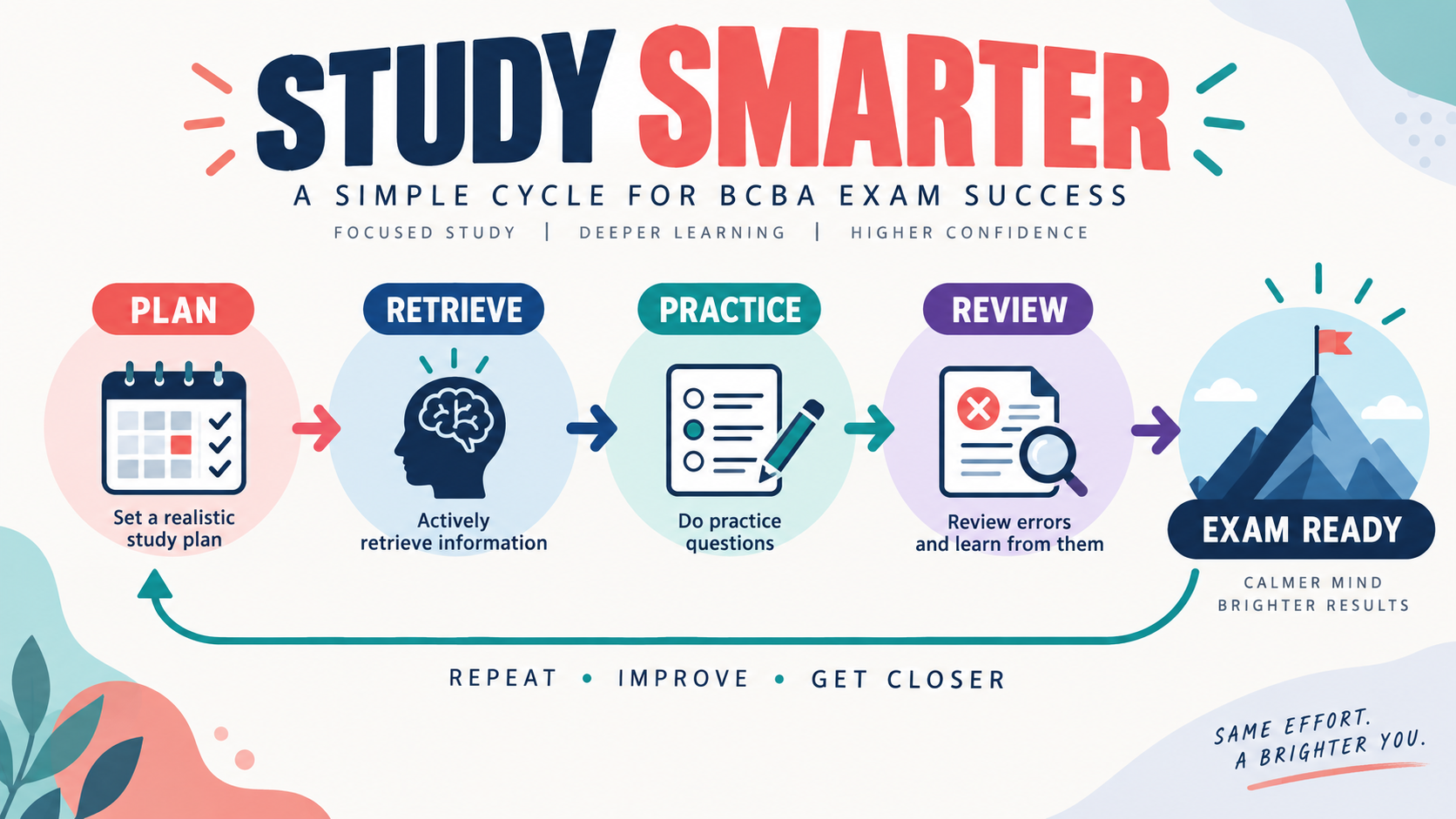
Effective preparation is active and cumulative. Read the task-list area, retrieve the concept without looking, apply it to a short scenario, and then explain why the distractors are less appropriate. Repeating that cycle exposes weak links that passive rereading can hide.
A useful study session has a defined objective. Instead of writing “study assessment,” choose a narrower task such as “distinguish indirect, descriptive, and experimental assessment decisions in short scenarios.” After practice, write a one-sentence rule in your own words and one example that would violate the rule.
What Should a BCBA Exam Study Plan Include?
A balanced plan usually includes five connected parts:
- Task-list mapping: organize resources by the current official content outline.
- Retrieval practice: answer from memory before checking notes.
- Scenario application: practice selecting a decision from data and context, not just naming a term.
- Timed mixed sets: gradually increase length so pacing becomes a practiced behavior.
- Error review: revisit misses after a delay and verify whether the reasoning changed.
Include ethics and supervision throughout the plan rather than leaving them for the final week. Professional decisions often depend on consent, competence, documentation, role boundaries, collaboration, and client welfare. The official BCBA task list and current BACB ethics resources should anchor those reviews.
How Should You Practice Scenario Questions?
Use a consistent reading routine so the wording does not pull you into a rushed answer. First identify the question’s task: definition, measurement choice, assessment decision, intervention selection, ethical response, or supervision action. Next mark the critical conditions: who is acting, what data exist, what has already been tried, and what the question asks you to do first or next.
Then compare options against the case, not against your favorite procedure. Ask whether the option is supported by the available information, whether it changes the target behavior or merely describes it, and whether it respects the stated constraints. If two options still seem plausible, return to the exact qualifier in the stem. “Best” is not the same as “possible,” and “first” is not the same as “eventual.”
How Should You Handle Timing on the BCBA Exam?
Timing is a behavior to train, not a character test. Begin with a simple pacing target for a practice block, notice how long you spend on uncertain items, and rehearse a flag-and-return strategy. The goal is not to read carelessly. It is to prevent one difficult item from consuming the attention needed for several items you could solve.
During a practice session, track whether a wrong answer came after rushing, changing a correct answer without evidence, or spending too long between two options. Those patterns are actionable. You can practice under shorter checkpoints, write a brief reason for your first choice, or set a rule for when to flag and move.
When Should You Decide to Schedule the Exam?
Do not use a single “ready” score as the only criterion. A stronger decision combines stable performance across several timed mixed sets, accurate explanations of missed items, coverage of weaker task-list areas, and a practical plan for the test day. You should be able to show that improvement comes from better reasoning, not from memorizing the same question bank.
If scores remain inconsistent, identify whether the problem is concentrated in one domain or appears across domains. If the problem is content-specific, narrow the review. If it is pacing or reading-specific, add timed mixed practice. If fatigue or anxiety changes performance substantially, rehearse the testing conditions and seek appropriate support through official channels.
What Are Common Myths About BCBA Exam Difficulty?
- “A difficult exam requires memorizing every sentence in a textbook.” Broad reading helps, but the skill is accurate application under the conditions in the question.
- “The hardest-looking answer must be correct.” Technical language does not make an option functionally or ethically appropriate.
- “One bad practice day proves I cannot pass.” One session is evidence to inspect, not a permanent label.
- “A high score on one familiar quiz proves readiness.” Readiness should survive mixed topics, new wording, and timed conditions.
- “The newest rumor about an exam change is a study requirement.” Verify changes with BACB materials before reorganizing your plan.
How Can a Practice Exam Help?
A practice exam is useful when it creates information you can act on. Use it to rehearse pacing, expose discrimination errors, identify under-studied areas, and practice returning to evidence after an incorrect answer. It is less useful when it becomes a source of repeated reassurance without review.
If you want another structured practice session, you can try the free BCBA mock exam. Use the result as one data point, review the rationale for every uncertain item, and keep the official BACB materials as the authority for current exam rules.
Final Takeaway
So, is the BCBA exam hard? It is demanding because it asks you to combine broad knowledge, applied reasoning, precise reading, and sustained pacing. That does not make the outcome predetermined. The most defensible way to prepare is to map the official content, practice unfamiliar scenarios, classify errors, and schedule only when your performance is stable across realistic conditions. Difficulty becomes manageable when it is turned into specific behaviors you can measure and improve.
For targeted review, use our is the BCBA exam hard practice questions to apply the concept in exam-style scenarios.
Take the Free BCBA Mock Exam
If you want a low-pressure way to check your recall, use the free practice resource below. Take the Free BCBA Mock Exam



