
Outcome recording ABA uses an observable result, product, or end state to measure behavior when that result is a defensible proxy for what happened. The key is not the label. The key is whether the product can be defined, scored consistently, and linked to the target behavior.
Table of Contents
- What Does Outcome Recording ABA Mean?
- How Is Outcome Recording Different From Direct Observation?
- When Is Outcome Recording a Good Choice?
- How Do You Write an Operational Definition for the Product?
- What Is a Simple Outcome Recording Example?
- What Are the Limits of Outcome Recording?
- What Does the BCBA Exam Test?
- What Is the Bottom Line?
- Quick Review Checklist
- Take the Free BCBA Mock Exam
Outcome recording ABA is useful when the behavior leaves something that can be inspected after the response occurs. A clinician might count completed worksheets, correct assembled items, or correctly sorted materials. Instead of watching every response, the observer measures the product that remains. Depending on the text or agency, you may also see this described as product recording, permanent-product measurement, or outcome-based measurement.
The measurement is only as good as the connection between the behavior and the result. A finished worksheet may show that some work was completed, but it may not show how many prompts were used, whether an adult corrected errors, or whether the learner completed the work independently. The BCBA Test Content Outline places measurement, validity, and interpretation together for a reason: a convenient product is not automatically a valid measure.
What Does Outcome Recording ABA Mean?
Outcome recording measures a lasting or inspectable outcome produced by behavior. The observer records the product after the behavior or activity, rather than recording each response while it happens. For example, if the target is “writes the assigned word independently,” the product could be scored for correct letters, completeness, or independent completion. If the target is “places all materials in the labeled bin,” the end arrangement may be inspected after the cleanup routine.
Do not use the term “outcome” to hide an unclear target. Start with an operational definition that says what counts, what does not count, and when scoring occurs. “Good handwriting” is too vague. “Each letter has the required shape, appears in the correct space, and is completed without a model after the instruction” gives the observer something observable to score.
How Is Outcome Recording Different From Direct Observation?
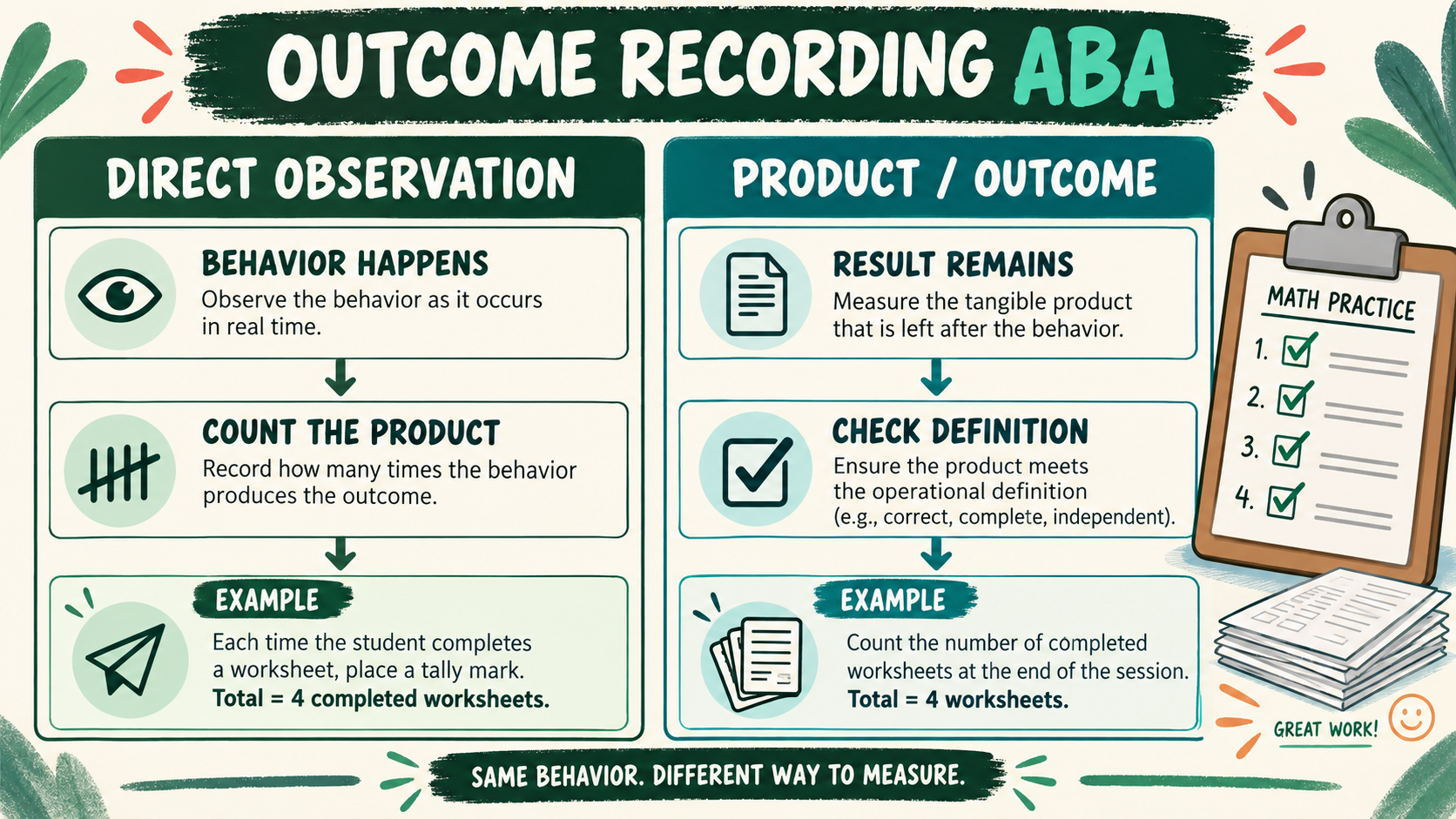
Direct observation records the response as it occurs. Outcome recording inspects a result that remains after the response. The same goal can sometimes be measured either way, but the two methods answer different questions. Direct recording can capture latency, prompt level, response sequence, and errors in the moment. Outcome recording can be efficient when the product is stable and the observer cannot watch every response.
| Question | Direct observation | Outcome or product recording |
|---|---|---|
| What is scored? | The response as it occurs. | A defined result or lasting product. |
| What can it show? | Prompting, sequence, timing, and response form. | Completion, accuracy, or condition of the product. |
| Main risk | Observer misses a response or reacts inconsistently. | The product may not prove how the behavior occurred. |
| Best fit | Behaviors whose timing, prompts, or topography matter. | Behaviors that reliably create a stable, scorable product. |
When Is Outcome Recording a Good Choice?
Choose it when the product is directly connected to the target response and remains available for later scoring. Common examples include the number of correctly completed problems, the number of independent steps represented in a finished task, or whether a routine ends with every item in its assigned location. It can reduce the burden of continuous observation and let a teacher score work after instruction ends. Ask four questions before selecting it:
- Does every target response reliably produce the product?
- Could someone else create, alter, or remove the product?
- Can the product be scored without guessing what happened earlier?
- Does the decision require information that the product cannot show, such as prompts, latency, or response sequence?
If a learner can copy a peer’s worksheet, an adult can complete missing parts, or a finished page cannot distinguish independent from prompted work, outcome recording alone may overestimate the target behavior. Add direct observation or revise the product definition instead of treating the limitation as a minor footnote.
How Do You Write an Operational Definition for the Product?
Define the product in observable terms. Identify the unit, the scoring rule, the observation window, and the conditions for a valid score. For a worksheet, specify which items belong to the assignment, what counts as correct, whether corrections count, and when the page is collected. For a cleanup routine, define the exact materials, locations, and completion criterion.
Then test the definition with samples. Have two observers score the same products independently. Discuss disagreements before changing scores. A definition that works only when the person who wrote it is present is not a strong measurement system. Product samples can also be audited over time to detect missing pages, duplicated work, or changes in the task materials.
What Is a Simple Outcome Recording Example?
Imagine the target is completing a four-item sorting task independently. The operational definition says that an item counts only when it is placed in the correct bin within two minutes of the instruction, without a model, physical guidance, or a correction from an adult. At the end of the activity, the observer inspects the four placements and records correct independent items.
If three items are correct but the fourth was placed after a prompt, the outcome score is three independent items, not four completed items. If the team records only “worksheet finished,” it loses the prompt information. That is why a product score must match the clinical question. The same visible end state can represent different levels of independence.
What Are the Limits of Outcome Recording?
Outcome recording can miss responses that leave no lasting mark. It can also confuse quantity with quality. A page with ten answers does not prove that ten answers were emitted independently or that the learner followed the intended procedure. Product quality may be influenced by materials, motor skills, fatigue, or another person’s assistance.
There is also a timing problem. If the target is rapid responding, a final product may show accuracy but not latency or pauses. If the target involves safety, communication, or social behavior, an outcome that appears later may be too indirect to guide an immediate decision. In those cases, direct event, duration, latency, or interval measures may be more appropriate.
Use the BACB Ethics Code as a reminder to keep measurement meaningful and connected to the client’s needs. A less burdensome measurement is valuable only if it supports a sound decision. Convenience is not a substitute for validity.
What Does the BCBA Exam Test?
- Product is not automatically behavior: identify whether the product is a direct measure, a proxy, or an indirect clue.
- Define what counts: scoring must include accuracy, completeness, independence, or other relevant dimensions.
- Watch for third-party effects: another person can create, correct, or remove a product.
- Match the measure to the decision: a final product cannot answer a latency or prompting question by itself.
- Check validity and agreement: two observers should be able to score the same product using the same rules.
- Do not overclaim: a correct outcome does not prove the learner used the target response independently unless independence is part of the product definition.
What Is the Bottom Line?
Outcome recording ABA can be efficient and useful when a behavior reliably creates a stable, observable, and valid product. Define the product before collecting data, decide whether prompts and independence matter, audit the scoring rule, and add direct observation when the product cannot answer the real question. For additional practice choosing measurement procedures and interpreting data, try the free BCBA mock exam. Use it as study practice, not as a replacement for individualized assessment.
For targeted review, use our outcome recording ABA practice questions to apply the concept in exam-style scenarios.
Quick Review Checklist
Use this final checklist to turn outcome recording ABA into exam-ready reasoning. The goal is not to memorize a label in isolation; it is to identify the relevant evidence and explain why the best answer fits the scenario. Key ideas to review:
- State the central definition or decision point for outcome recording ABA in your own words.
- Identify the detail that makes outcome recording ABA different from its closest related ABA term.
- Separate the observable facts in a scenario from assumptions that are not supported by the facts.
- Write one example and one nonexample so you can recognize the concept in a new setting.
Exam application checks:
- Ask what the question is actually requesting before comparing the answer choices.
- Mark the antecedent, response, consequence, or other evidence that supports the selected answer.
- Look for a distractor that describes a related process but does not answer the specific question.
Final self-check:
- Explain how you would verify the interpretation with clear observations or data.
- Change one detail in the scenario and decide whether your answer should change.
- Give a one-sentence rationale that a supervisor or study partner could evaluate.
Take the Free BCBA Mock Exam
When you are ready to apply the idea, use the free practice resource below for additional feedback. Take the Free BCBA Mock Exam



