

People who search for registered ABA technician are usually trying to identify a job title, a credential, or the person delivering direct ABA services. The phrase is understandable, but the formal BACB credential is called Registered Behavior Technician, or RBT. “ABA technician” may be an employer’s job title, while “RBT” refers to a specific certification with its own eligibility, supervision, ethics, and maintenance requirements.
Table of Contents
- What Does “Registered ABA Technician” Mean?
- Is Registered ABA Technician an Official BACB Credential?
- What Is the Difference Between an ABA Technician, RBT, and BCBA?
- What Does an RBT Usually Do?
- Who Supervises a Registered Behavior Technician?
- How Does Someone Become an RBT?
- What Language Should Employers and Families Use?
- How Does This Topic Appear on the BCBA Exam?
- Frequently Asked Questions
- Sources for Further Study
- Take the Free BCBA Mock Exam
That distinction matters for families, job seekers, RBT candidates, and BCBA students. A technician may work in an ABA setting without holding the RBT credential, and an RBT does not become a BCBA simply because the person has experience. This guide separates the everyday job language from the credential language and shows how the difference appears in BCBA-style questions.
What Does “Registered ABA Technician” Mean?
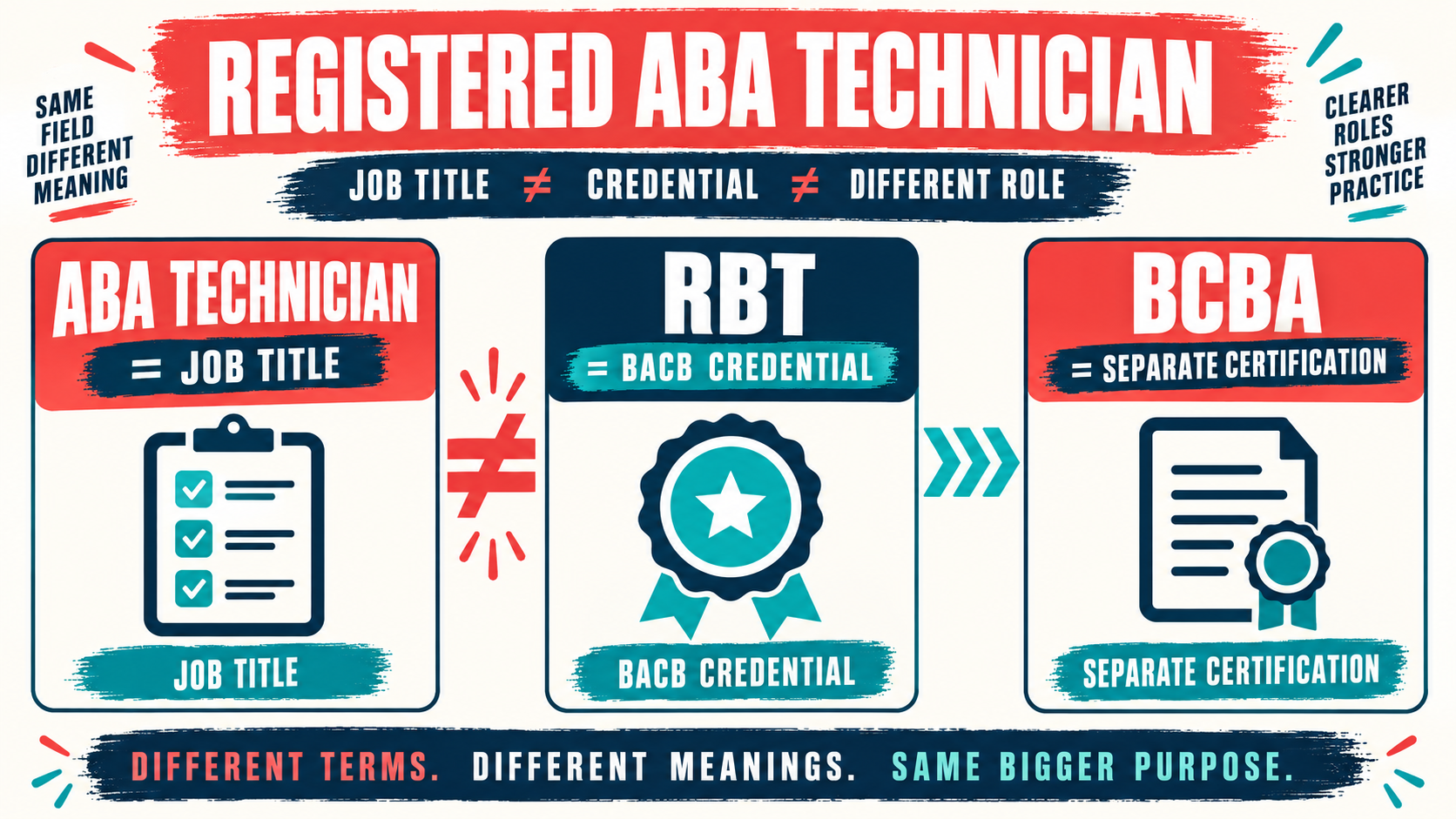
“Registered ABA technician” is not the formal name of the BACB credential. In ordinary conversation, a person may use it to describe a technician who provides applied behavior analysis services and has completed a registration or certification process. The exact meaning depends on the employer, state, payer, and organization.
When the person means the BACB credential, the precise term is Registered Behavior Technician (RBT). The RBT is a paraprofessional certification in behavior analysis. RBTs assist with delivering behavior-analytic services under the direction and close supervision of the responsible supervisor or coordinator identified by the current BACB requirements. Use the words carefully because a job title and a credential answer different questions:
- A job title describes how an employer labels a position.
- A credential indicates that a person has met the requirements of a certification system.
- A scope of work describes what the person is trained, assigned, competent, and authorized to do in a specific setting.
- A supervision relationship identifies who is responsible for direction, oversight, feedback, and escalation.
Those four ideas overlap, but they are not interchangeable. Someone can be called an ABA therapist, behavior technician, behavior interventionist, or line therapist by an employer. That title alone does not tell you whether the person holds an RBT credential, what training they have completed, or what responsibilities state law and the service organization allow.
Is Registered ABA Technician an Official BACB Credential?
No. The BACB’s official credential name is Registered Behavior Technician, abbreviated RBT. The BACB RBT resource page describes RBT certification as a paraprofessional certification in behavior analysis and directs readers to the current handbook, requirements, ethics code, and transition information.
This naming point is not just formalism. If a job posting says “registered ABA technician,” ask which organization is doing the registering and what the registration proves. It may refer to BACB RBT certification, an employer’s internal status, a state-specific requirement, or a general marketing phrase. Do not assume that every use of “registered” refers to the same registry.
For a current answer, check the official BACB page and the current RBT Handbook. Requirements, application steps, examination information, supervision rules, and transition dates can change. A study card, an old job post, or a training provider’s marketing page should not override the current official source.
What Is the Difference Between an ABA Technician, RBT, and BCBA?
The simplest comparison is credential versus job function versus supervising certification. An ABA technician may be a generic employee title. An RBT is a defined BACB credential. A BCBA is a graduate-level behavior-analytic certification with a different education, fieldwork, examination, and professional responsibility pathway.
| Term | What it usually means | What it does not automatically prove |
|---|---|---|
| ABA technician or behavior technician | An employer or organization’s title for a direct-service staff member | A BACB credential, a universal training package, or independent authority to change a plan |
| Registered Behavior Technician (RBT) | A BACB paraprofessional certification for assisting with behavior-analytic services | Independent treatment-plan design, unrestricted clinical judgment, or BCBA certification |
| BCBA | A board-certified behavior analyst who may design, analyze, supervise, and oversee services within applicable requirements | That every BCBA is licensed in every jurisdiction or qualified for every clinical specialty |
The table is a study shortcut, not a substitute for the current BACB handbooks or state rules. The exact duties assigned to a technician depend on the written plan, competence, supervision, employer procedures, client needs, and applicable law.
What Does an RBT Usually Do?
An RBT generally implements assigned behavior-analytic services rather than independently creating the clinical program. Common activities may include teaching skill-acquisition targets, implementing behavior-reduction procedures as written, collecting data, documenting sessions, preparing materials, communicating objective observations, and participating in supervision or competency activities.
The phrase “as written” is important. Implementation is not mechanical if the plan is unsafe, unclear, or mismatched to the situation; the RBT should pause when necessary, protect the client, document what happened, and contact the responsible supervisor. The RBT can contribute valuable observations without making an independent decision to change the target, function, reinforcement arrangement, measurement system, or safety procedure. In a practical workflow, the RBT may:
- Review the current plan, goals, definitions, data sheets, and safety directions.
- Prepare the environment and materials needed for the assigned session.
- Implement trained procedures within the RBT’s competence and authorization.
- Record objective data and relevant contextual information.
- Report barriers, injuries, changes in behavior, caregiver concerns, and implementation problems promptly.
- Ask for supervision or clarification before improvising a new clinical procedure.
An RBT’s work is not less important because it is supervised. Accurate implementation and observation are essential to treatment integrity and data-based decision-making. Supervision is a quality-control relationship, not a suggestion that the technician is unable to notice meaningful events.
Who Supervises a Registered Behavior Technician?
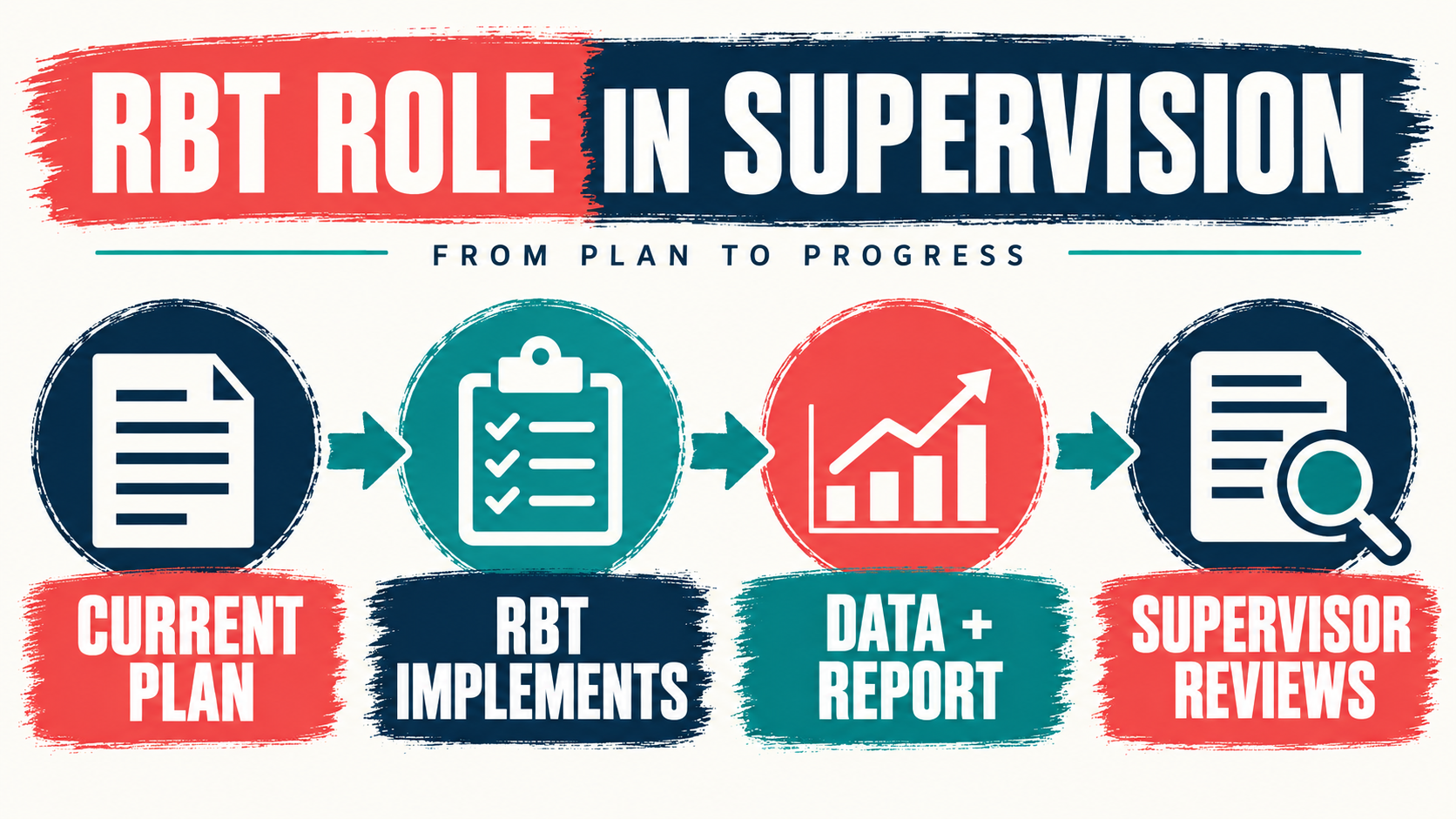
The current BACB framework identifies an RBT Supervisor and/or an RBT Requirements Coordinator as responsible for the RBT’s work, with the exact arrangement governed by current official requirements and the service setting. A BCBA may fill a supervisory role, but the correct answer to a specific question depends on the current credential, assignment, and official resource—not simply on who is physically present in the room.
Supervision can include observation, feedback, performance review, competency assessment, case discussion, and direction about implementation. It should make the chain of responsibility clear. The RBT should know who to contact when a plan is unclear, a caregiver reports a concern, a safety issue occurs, or the data do not match the expected pattern. Do not confuse three different questions:
- Who designs or changes the clinical plan? The qualified behavior analyst or other responsible professional identified by the service arrangement.
- Who implements the assigned procedure? The trained and competent RBT or technician within the written plan and supervision structure.
- Who confirms the current credential and requirement? The relevant certification board, official registry, handbook, employer, and applicable jurisdiction.
If an RBT notices that a caregiver is using a procedure incorrectly, the RBT should document and communicate the observation and provide only support already authorized by the plan, training, and supervisor. A single observation does not automatically authorize the RBT to redesign the intervention or independently deliver a new caregiver-training program.
How Does Someone Become an RBT?
The path is controlled by current BACB requirements, so avoid memorizing an old list of numbers without checking the official page. In broad terms, an applicant reviews the eligibility requirements, completes the required training or education pathway, completes the applicable competency process and background checks, applies, passes the required examination, and maintains the credential through current supervision and renewal obligations.
The BACB’s RBT page currently highlights updated requirements and transition information. That is especially important when a search result, course, or employer says “registered ABA technician” but does not state which version of the requirements applies. Confirm the date, credential name, responsible supervisor, documentation, and jurisdiction before paying for a course or accepting a role.
Training alone is not the same as certification. A person can complete an ABA training course and still need to satisfy the remaining application, competency, examination, supervision, or maintenance requirements. Conversely, a job may allow an employee to work as a technician under employer training before the employee holds the RBT credential. Those are separate facts that should be stated clearly.
What Language Should Employers and Families Use?
Clear language prevents false expectations. An employer can state the job title, whether RBT certification is required or preferred, who provides supervision, what training is paid, and which tasks are assigned. A family can ask whether the staff member is an RBT, who supervises the service, how often supervision occurs under the current rules, and how concerns are escalated.
Be cautious with marketing language such as “registered therapist,” “certified ABA specialist,” or “ABA technician” when no credentialing organization is named. Ask for the full credential name and the source that verifies it. A person’s experience may be valuable, but experience and certification are not synonyms.
For a BCBA student, this language also helps separate role boundaries. An RBT may collect data and implement a plan; that does not mean the RBT independently selects the assessment, writes the treatment goals, changes the function-based intervention, or takes responsibility for another person’s supervision. Read the scenario for authorization, competence, and direction.
How Does This Topic Appear on the BCBA Exam?
BCBA-style questions may use “behavior technician,” “RBT,” or “ABA therapist” as distractors. First identify whether the question is asking about a credential, a job title, implementation, supervision, or clinical decision-making. Then look for the action that stays within the stated role.
- If the stem asks who should modify a treatment plan, do not select an answer that gives independent authority to an RBT merely because the RBT collected data.
- If the stem asks what an RBT should do after an implementation problem, look for objective documentation, communication with the supervisor, and plan-consistent action.
- If the stem asks whether “ABA technician” equals RBT, distinguish a generic job title from the formal BACB credential.
- If the stem involves a current requirement, use the date and official resource named in the question rather than an old memorized rule.
The best answer is usually the one that protects the client, preserves the role boundary, follows the current written plan, and escalates a clinical decision to the appropriate supervisor. When you want to practice supervision, ethics, measurement, and role-boundary scenarios, try the free BCBA mock exam. It is a study aid, not a BACB protocol or certification guarantee.
Frequently Asked Questions
Is a registered ABA technician the same as an RBT?: Not necessarily. “Registered ABA technician” is an informal phrase or employer title. RBT, or Registered Behavior Technician, is the formal BACB credential. Ask which organization issued the credential and check the current official registry or documentation.
Is an ABA technician a BCBA?: No. An ABA technician is usually a direct-service job title, while a BCBA is a separate professional certification. An RBT is also distinct from a BCBA and works within a supervised paraprofessional role.
Can an RBT change a behavior plan?: An RBT should not independently redesign a behavior plan. The RBT can report objective observations and implement assigned procedures within training, competence, authorization, and supervision. The responsible supervisor makes the clinical decision about assessment, goals, and plan changes.
Does completing ABA training make someone an RBT?: No. Training may be one part of an RBT pathway, but certification depends on the current BACB requirements, application, competency, examination, supervision, and maintenance steps that apply to the applicant.
Where can I verify current RBT requirements?: Start with the current BACB RBT resource page and the current RBT Handbook. If an employer or course uses a different title, ask how that title relates to the formal credential and applicable state or payer rules.
Sources for Further Study
- Behavior Analyst Certification Board: Registered Behavior Technician — current credential overview, requirements, transition information, and official resources.
- BACB RBT Handbook — current handbook and role documentation.
- Registered Behavior Technician Handbook PDF — official handbook reference.
- BT vs RBT — comparison of the generic job title and the BACB credential.
- Making Informed Decisions About ABA — family-facing overview of tiered ABA service roles.
Take the Free BCBA Mock Exam
If you want a low-pressure way to check your recall, use the free practice resource below. Take the Free BCBA Mock Exam



