
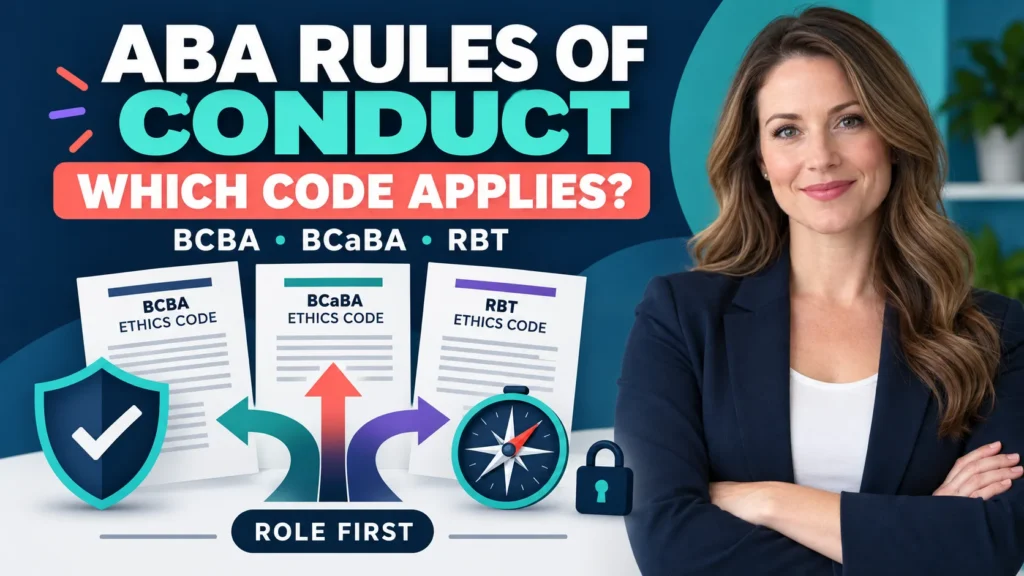
A role-first guide to the phrase “ABA rules of conduct,” including which BACB ethics code applies to BCBAs, BCaBAs, and RBTs—and what law and employer policy add. If you search for ABA rules of conduct, you may be looking for a professional ethics code, an RBT code, a state rule, or an employer policy. The phrase is useful as a starting point, but it is not the title of one universal BACB document. The safest next step is to identify the person’s role and then open the current source that governs that role.
Table of Contents
- What Do “ABA Rules of Conduct” Usually Mean?
- Why the Phrase Is Easy to Misread
- Start With Your Role
- The BCBA and BCaBA Ethics Code
- The RBT Ethics Code (2.0)
- Employer Policy, Licensure, and Law
- Compare the Main Conduct Sources
- Five Steps for an ABA Conduct Question
- Common Conduct Responsibilities to Review
- What If Duties Seem to Conflict?
- How Conduct Questions Appear on the BCBA Exam
- Practice Conduct Questions
- Frequently Asked Questions
- Quick Review Checklist
- Take the Free BCBA Mock Exam
The BACB Ethics Codes page separates the Ethics Code for Behavior Analysts from the RBT Ethics Code (2.0). This article turns that distinction into a study and decision map. It is educational information, not individualized legal advice.
What Do “ABA Rules of Conduct” Usually Mean?
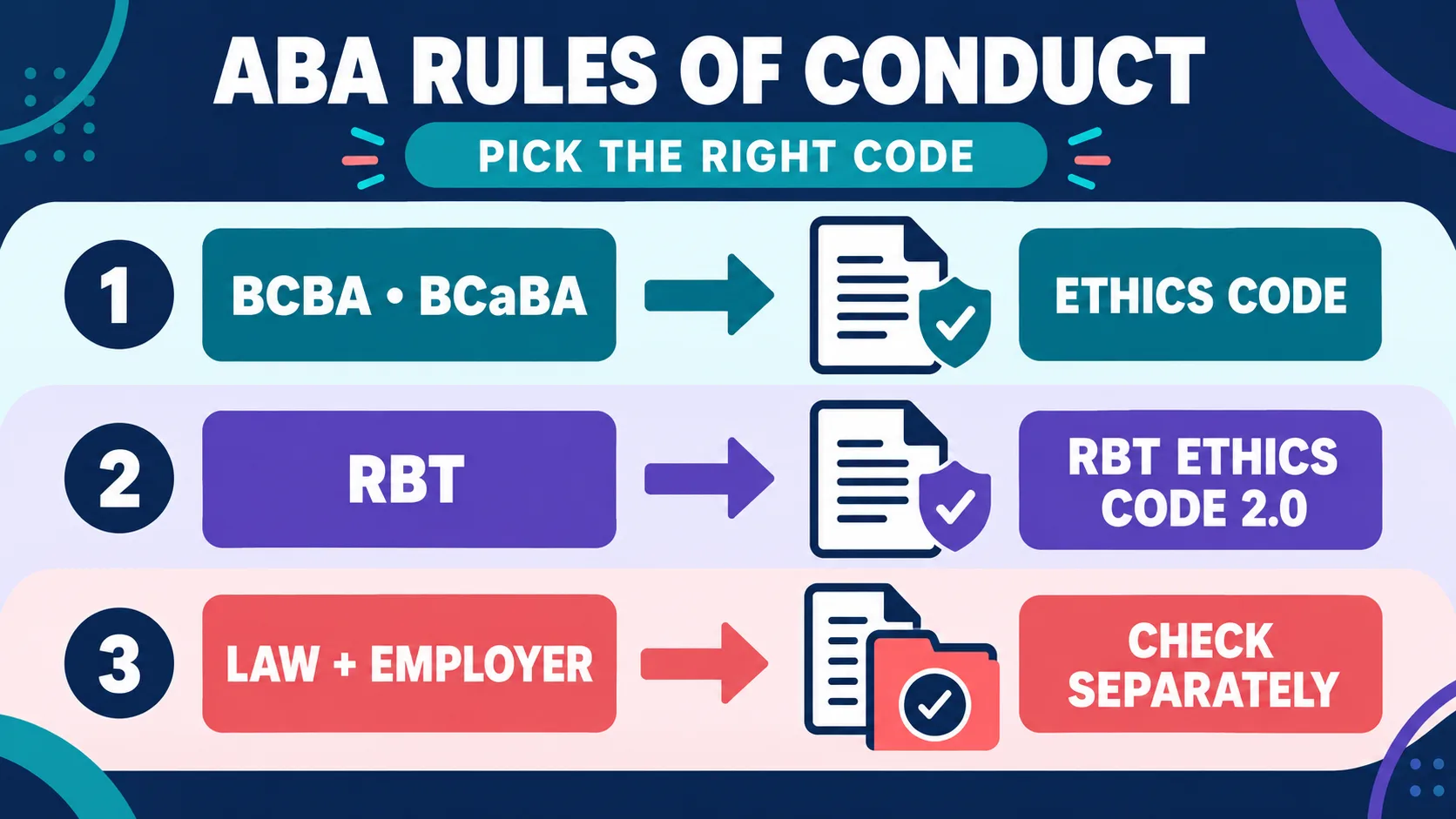
In everyday language, “ABA rules of conduct” usually means the rules a person in applied behavior analysis should follow while working with clients, families, trainees, employers, or the public. In a certification context, however, the governing document depends on the credential.
For a BCBA or BCaBA applicant or certificant, the main BACB source is the Ethics Code for Behavior Analysts. For an RBT applicant or certificant, the relevant source is the RBT Ethics Code (2.0). A state licensing board, funder, employer, school, or healthcare organization may impose additional duties. “Conduct” therefore has to be matched to the role, activity, and jurisdiction before you choose a rule.
Why the Phrase Is Easy to Misread
There are four common reasons the search phrase creates confusion:
- ABA is a field, not one credential. A BCBA, BCaBA, RBT, student, technician, and administrator may have different responsibilities.
- BACB codes are role-specific. The BCBA/BCaBA Code and the RBT Code are not interchangeable study documents.
- Certification is not the same as authorization. State licensure, registration, or payer rules may control whether and how someone can practice.
- Workplaces add procedures. An employer can require reporting, documentation, privacy, safety, or escalation steps beyond the credentialing code.
That does not mean the codes are unrelated. They share themes such as honesty, competence, confidentiality, boundaries, and responsibility. The correct source still matters because the wording, scope, supervisor relationship, and reporting pathway can differ.
Start With Your Role
Before interpreting a conduct problem, write down three facts: the person’s role, the activity involved, and the location or authority involved. This simple pause prevents a common error—answering an RBT question with a BCBA rule, or answering a state-licensure question with a BACB standard.
| Role or situation | First source to open | Key boundary |
|---|---|---|
| BCBA or BCaBA | Ethics Code for Behavior Analysts | Read the exact standard and its application guidance. |
| RBT | RBT Ethics Code (2.0) | Include the supervisor and the RBT role’s limits. |
| Student or trainee | Program, supervisor, and applicable BACB requirements | Do not assume a trainee has a certificant’s authority. |
| Licensed or funded service | Current BACB code plus state, payer, and employer rules | Certification alone may not answer authorization or billing questions. |
The BCBA and BCaBA Ethics Code
The Ethics Code for Behavior Analysts applies to BCBA and BCaBA applicants and certificants. It is organized around four core principles—benefit others; treat others with compassion, dignity, and respect; behave with integrity; and ensure competence—and six standards sections covering professional responsibility, practice, clients and stakeholders, supervision and trainees, public statements, and research.
For conduct questions, focus on the action required by the standard rather than memorizing a vague phrase such as “be professional.” The Code addresses truthful representation, competence, legal and professional compliance, boundaries, confidentiality, informed consent, documentation, supervision, public communication, and responsible use of data. Its application section also explains that standards are not exhaustive and must be interpreted in context.
The RBT Ethics Code (2.0)
The RBT Ethics Code (2.0) is the role-specific source for RBT applicants and certificants. RBTs are not independent practitioners; they provide behavior-analytic services under the direction and close supervision of an RBT Supervisor and/or RBT Requirements Coordinator. That supervision relationship is part of the conduct analysis.
RBT conduct topics include truthful information, legal and ethical behavior, multiple relationships, personal problems that affect safe work, accurate credentials, intellectual property, confidentiality, and bringing concerns to a supervisor or appropriate authority. If the question is about an RBT, do not jump directly to a BCBA standard or assume the RBT can resolve the issue independently.
Employer Policy, Licensure, and Law
A BACB ethics code is one source of professional obligations, not a replacement for law. The situation may also involve a state licensing board, mandated-reporting law, privacy rule, payer contract, school policy, or employer procedure. These sources can change the order of action, especially when there is immediate danger or a legal reporting duty.
Use the BACB code to understand the certification-related responsibility, then identify the authority that controls the next action. A workplace policy can tell you how to notify a supervisor; it cannot authorize conduct that violates applicable law or a professional code. Conversely, a certification code does not automatically answer every employment or licensure question.
Compare the Main Conduct Sources
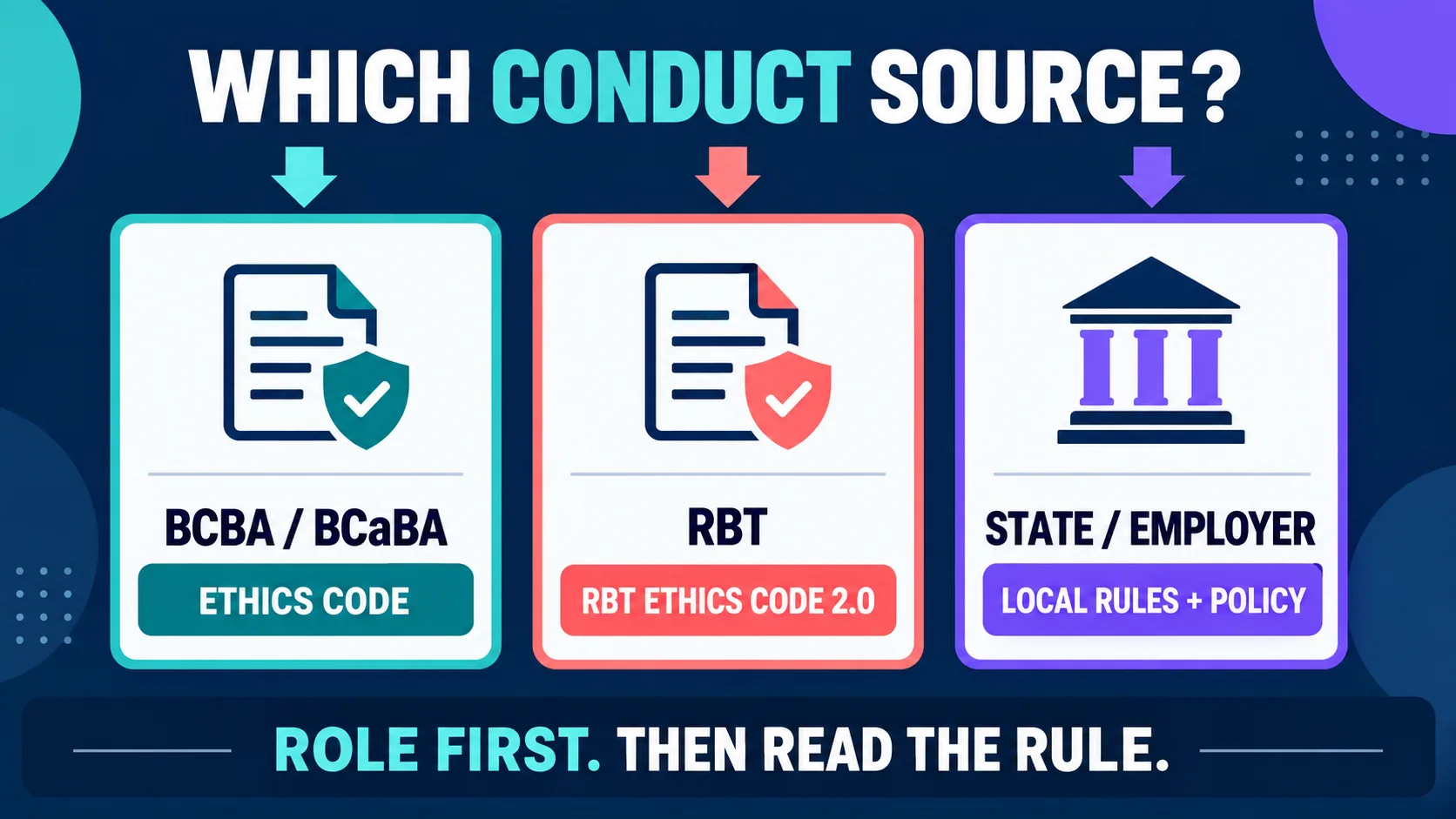
The fastest way to choose a source is to separate the question being asked. “Is this conduct consistent with my BACB credential?” is different from “Must I report this under state law?” and different again from “What does my employer’s incident procedure require?”
| Question | Likely source | Study reminder |
|---|---|---|
| Does this threaten certification status? | The role-specific BACB ethics code and enforcement resources | Use the current version, not an old number copied from a blog. |
| Is there a legal or safety duty? | Applicable law, emergency authority, or licensing board | Immediate protection can come before a BACB report. |
| How do I document and escalate it at work? | Employer, school, or payer procedure | Follow the policy without treating it as the only authority. |
Five Steps for an ABA Conduct Question
- Name the role. Is the person a BCBA, BCaBA, RBT, applicant, trainee, supervisor, or another professional?
- Describe the conduct. Write the observable action, not a conclusion such as “unethical.”
- Open the current code. Find the standard that matches the role and activity.
- Check additional authorities. Look for law, licensure, reporting, payer, and employer requirements.
- Protect, consult, document, and follow up. Reduce risk, seek appropriate consultation, record the steps, and evaluate the outcome.
This order keeps you from making two opposite mistakes: treating a policy violation as if it were automatically a BACB violation, or treating a BACB standard as if it overrides a legal safety duty.
Common Conduct Responsibilities to Review
Truthful representation: Credentials, services, outcomes, public statements, billing, and records should be accurate and not misleading. A polished website or résumé does not make an unsupported claim acceptable. Boundaries and multiple relationships: Consider power, role conflicts, gifts, personal relationships, and the risk of exploitation. When a relationship is unavoidable because of context, document the risk and use the applicable supervisory or organizational process. Confidentiality and public communication: Protect client and stakeholder information in conversation, records, social media, testimonials, teaching materials, and digital messages. Remove identifying details only when the remaining context cannot reasonably expose the person.
Competence, supervision, and delegation: Do not accept work outside competence or delegate a task without appropriate training, observation, feedback, and monitoring. For an RBT, the supervisor relationship is central; for a BCBA, supervision also carries its own professional duties.
What If Duties Seem to Conflict?
First assess immediate risk and any legal duty. Then define the people affected, gather reliable information, identify the relevant code and other authorities, consult an appropriate person, choose an action that reduces harm, and document both the decision and the outcome. This is a structured decision process, not a rule that every concern must be reported to the BACB first.
If a supervisor or employer asks you to do something that appears inconsistent with an ethics code, do not silently follow or silently ignore the conflict. Clarify the instruction, document the concern, consult the appropriate authority, and use the reporting or escalation pathway that applies to the role and jurisdiction.
How Conduct Questions Appear on the BCBA Exam
On the BCBA exam, conduct questions often test source selection and sequencing. Look for the role, the protected person, the action verb, the evidence available, and any immediate safety or legal fact. An answer can sound ethical but still be wrong if it skips consent, assumes a fact that was not established, or reports to the wrong authority.
Use a short mental script: role → conduct → code → law or policy → safest documented next step. If two standards seem relevant, choose the response that protects clients and others, stays within competence, follows applicable law, and preserves accountability.
Practice Conduct Questions
After each missed question, record the role, the conduct at issue, the source you first selected, the authority that controls the next action, and the evidence that would show follow-up. This helps you learn why an answer is correct instead of memorizing a rule number without context. Use the Free BCBA Mock Exam to practice role-first ethics decisions. Review each explanation, then return to the current BACB source before adding a shortcut to your study notes.
Frequently Asked Questions
Is there one official document called “ABA rules of conduct”?: No. The phrase is a broad search term. The applicable document depends on the role, credential, activity, and jurisdiction. Which code applies to a BCBA?: The BACB Ethics Code for Behavior Analysts applies to BCBA and BCaBA applicants and certificants. Always use the current BACB version. Which code applies to an RBT?: The RBT Ethics Code (2.0) applies to RBT applicants and certificants. RBTs also work under the direction and close supervision required by the RBT role. Do BACB rules replace state law or employer policy?: No. State law, licensure, reporting rules, payer contracts, and employer procedures may add duties or control the sequence of action. Bottom line: Treat “ABA rules of conduct” as a role-selection problem. Identify the person, open the correct current code, check law and policy, then document the safest responsible next step.
Quick Review Checklist
Use this final checklist to turn aba rules of conduct into exam-ready reasoning. The goal is not to memorize a label in isolation; it is to identify the relevant evidence and explain why the best answer fits the scenario. Key ideas to review:
- State the central definition or decision point for aba rules of conduct in your own words.
- Identify the detail that makes aba rules of conduct different from its closest related ABA term.
- Separate the observable facts in a scenario from assumptions that are not supported by the facts.
- Write one example and one nonexample so you can recognize the concept in a new setting.
Exam application checks:
- Ask what the question is actually requesting before comparing the answer choices.
- Mark the antecedent, response, consequence, or other evidence that supports the selected answer.
- Look for a distractor that describes a related process but does not answer the specific question.
Final self-check:
- Explain how you would verify the interpretation with clear observations or data.
- Change one detail in the scenario and decide whether your answer should change.
- Give a one-sentence rationale that a supervisor or study partner could evaluate.
Take the Free BCBA Mock Exam
When you are ready to apply the idea, use the free practice resource below for additional feedback. Take the Free BCBA Mock Exam



