

A source-first comparison of the 2027 BCBA fieldwork paths, supervision thresholds, and the application-date decision that determines which forms you need. If you are searching for bacb 2027 fieldwork requirements, the most important question is not simply “How many hours do I need?” It is which requirements will be in effect when you submit your BCBA certification application? The BACB’s 2027 transition guidance compares the current 2022 rules with the requirements that take effect on January 1, 2027.
Table of Contents
- BACB 2027 Fieldwork Requirements: What Changes
- 2027 Supervised vs Concentrated Fieldwork
- Who Uses the 2022 Rules and Who Uses the 2027 Rules?
- Supervision, Observations, and Transition-Safe Records
- The Application-Date and Form Decision
- A Practical 2027 Fieldwork Plan
- Common Transition Mistakes
- Frequently Asked Questions
- Take the Free BCBA Mock Exam
Short answer: the 2027 framework keeps two fieldwork types: 2,000 hours of supervised fieldwork or 1,500 hours of concentrated supervised fieldwork. The major fieldwork changes are the 20–160 monthly range, 7.5% supervision for concentrated fieldwork, and duration-based client observations of 60 or 90 minutes. If your application timing is uncertain, the BACB recommends planning to meet both sets of requirements and retaining both documentation sets.
BACB 2027 Fieldwork Requirements: What Changes
The BACB’s official 2027 BCBA Requirements summary says that the new eligibility requirements take effect on January 1, 2027. It also directs applicants to the current BCBA Handbook for the full rules. The numbers below are a planning map, not a substitute for reading the handbook version that applies to your application.
| Planning point | 2022 rules | 2027 rules |
|---|---|---|
| Supervised fieldwork | 2,000 hours; 5% supervision | 2,000 hours; 5% supervision |
| Concentrated fieldwork | 1,500 hours; 10% supervision | 1,500 hours; 7.5% supervision |
| Monthly fieldwork range | 20–130 hours | 20–160 hours in the transition comparison |
| Client observation | One observation with a client per month | 60 minutes supervised or 90 minutes concentrated, cumulative |
| Forms | Use the 2022 monthly and final verification forms when that rule set applies | Applicants after January 1, 2027 need the 2027 monthly and final forms |
Two parts do not change between the comparison columns: at least 50% of supervised hours must be individual supervision, and at least 60% of total supervised fieldwork hours must be unrestricted activities. Your supervisor also has to meet the applicable BACB qualification criteria.
2027 Supervised vs Concentrated Fieldwork
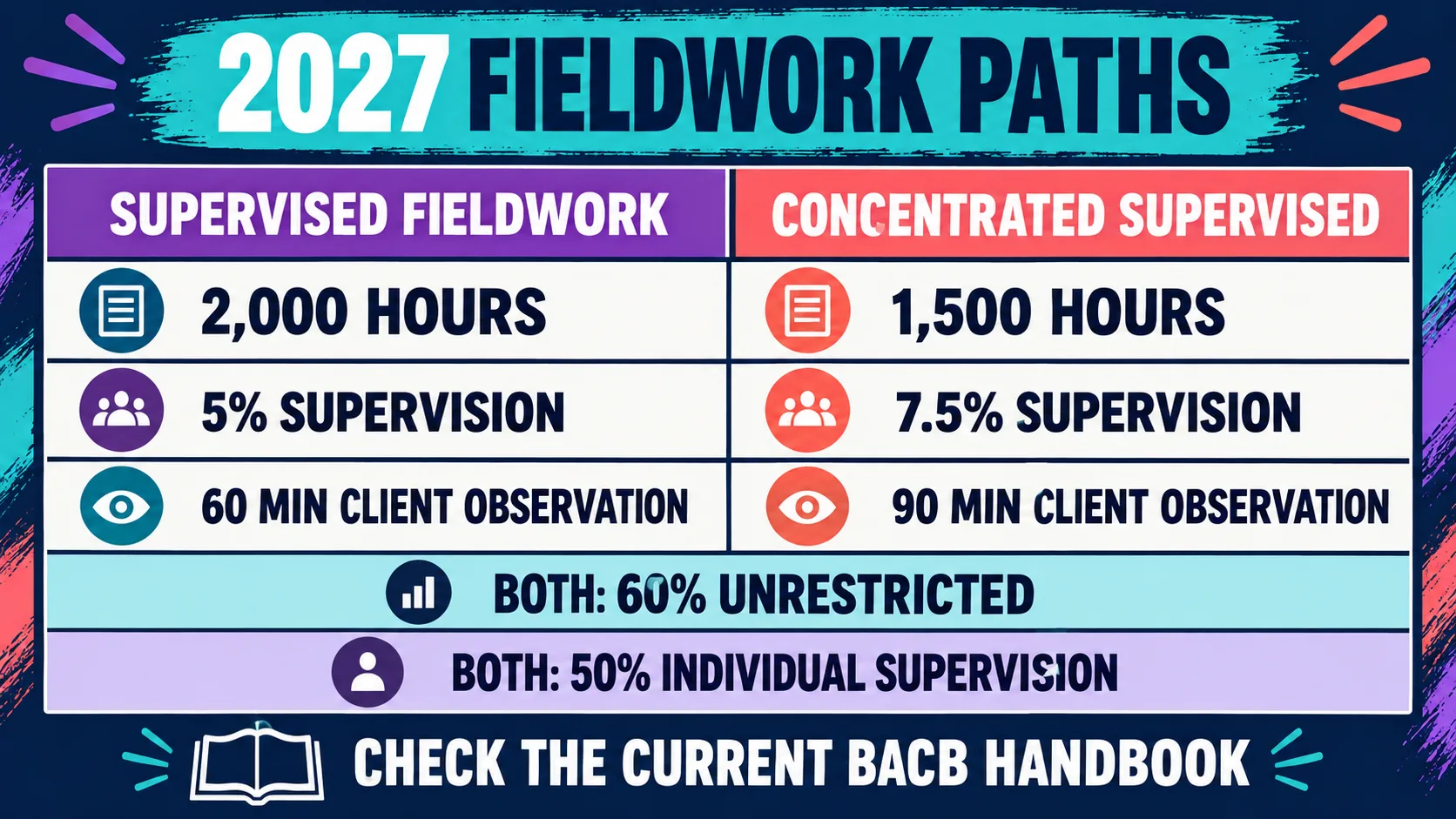
Under the 2027 overview, supervised fieldwork is the longer 2,000-hour route, while concentrated supervised fieldwork is the 1,500-hour route with a higher supervision percentage than ordinary supervised fieldwork. The shorter total does not mean “less documentation”; it changes the rate at which supervision and client observation must be documented.
| 2027 fieldwork item | Supervised fieldwork | Concentrated supervised fieldwork |
|---|---|---|
| Total hours | 2,000 | 1,500 |
| Supervision per period | 5% of hours | 7.5% of hours |
| Fieldwork range | 20–160 hours per month in the transition guidance | 20–160 hours per month in the transition guidance |
| Client observation | 60 cumulative minutes | 90 cumulative minutes |
| Individual supervision | At least 50% of supervised hours must be individual; group supervision may not exceed 50%. | |
| Unrestricted activities | At least 60% of total supervised fieldwork hours must be unrestricted activities. | |
The practical choice is not only “2,000 versus 1,500.” Consider your supervisor’s availability, the amount of unrestricted work you can legitimately perform, how consistently you can schedule client observations, and which application date you can realistically meet. Never create hours merely to hit a percentage. Each entry needs to be supported by the applicable supervision and fieldwork documentation.
Who Uses the 2022 Rules and Who Uses the 2027 Rules?
The BACB’s official transition resource ties the fieldwork requirements to the rule set in place when you submit your certification application. If you are not sure whether you will apply before or after January 1, 2027, the BACB recommends planning to meet both sets of requirements. Do not select a rule set after the fact simply because it is easier.
| Your situation | Planning implication | Documentation action |
|---|---|---|
| Application completed under the current deadline | The current 2022 rule set may apply if the application and required materials meet the BACB’s transition conditions. | Use the current forms and verify the BACB’s received-by deadline; do not rely on a draft application or an unpaid submission. |
| Application submitted on or after January 1, 2027 | Plan to meet the 2027 requirements in the handbook and transition guidance. | Use the 2027 monthly and final fieldwork verification forms that correspond to your supervisor arrangement. |
| Timing is uncertain | Build the fieldwork plan so it can satisfy both sets of requirements where practical. | Track both monthly contacts and observation minutes, and ask your supervisor to retain both form sets. |
Read the timing language carefully. A candidate should not assume that “I started fieldwork in 2026” automatically locks in every 2022 rule. The application date and the complete set of requirements matter. The BACB also advises candidates to keep qualifying documentation for at least seven years and provide it if requested.
Supervision, Observations, and Transition-Safe Records
A transition-safe record is designed around the stricter or more informative measurement whenever the official guidance allows both options. The 2027 observation rule is duration-focused, while the 2022 comparison uses one client observation per month. If you record only “observation completed,” you may not be able to show the duration later.
- Track hours by month and by fieldwork type. Keep supervised and concentrated hours distinguishable, especially if your path or application timing could change.
- Track the supervision percentage. Record total fieldwork hours, supervision hours, and the calculation for the applicable period. For concentrated work, keep enough detail to show 7.5% for 2027 and 10% if a 2022 application remains possible.
- Track observations two ways. Record the number of client observation contacts and the cumulative minutes, with date, supervisor, setting, and supporting notes.
- Track individual and group supervision separately. A single total cannot prove that at least half of supervised hours were individual.
- Track unrestricted activities separately. Preserve a short description of the behavior-analytic activity and why it qualifies; do not count a vague job-duty label without review.
- Keep signatures and versions. Save the form version, supervisor signature, organization details, corrections, and the date each record was finalized.
| Record field | Why keep it | Transition question it answers |
|---|---|---|
| Monthly total and path | Shows that the range and total-hour route are being calculated consistently. | Would these hours fit a 130-hour 2022 ceiling or the 160-hour 2027 ceiling? |
| Supervision hours and type | Shows 5%, 7.5%, or 10% calculations and the individual/group split. | Does the record support the rule set connected to the expected application? |
| Observation contacts and minutes | Preserves both the old contact measure and the new duration measure. | Can the same month be evaluated under either observation standard? |
| Form version and signatures | Links the evidence to the supervisor, organization, and applicable form set. | Which monthly or final verification form was used and retained? |
Our BCBA supervision tracking guide and fieldwork tracker resource can help with organization. Use them as workflow tools, then compare every field against the current BACB forms and handbook. A tracker is not an official approval document.
The Application-Date and Form Decision
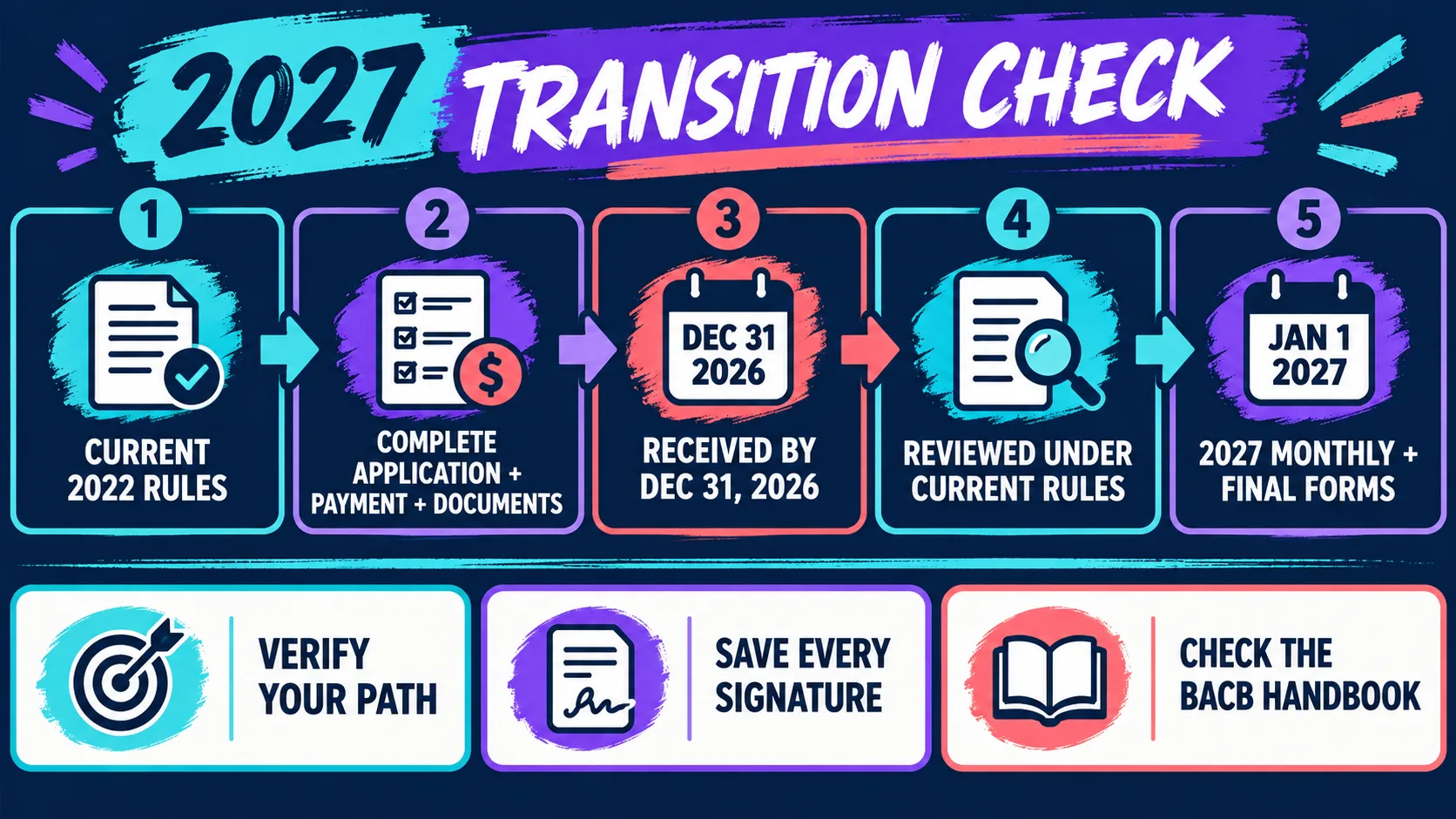
The form decision follows the application decision. The transition resource says that applicants use the forms corresponding to the requirements in place when they apply. If you are unsure, the BACB recommends completing and retaining both the 2022 and 2027 monthly forms each month, and both final forms when fieldwork is complete.
| Form decision | What to retain | Best next action |
|---|---|---|
| 2022 application path is certain | 2022 monthly and final forms, complete signatures, and evidence that the application met the current transition deadline. | Confirm the received-by conditions directly with the BACB before relying on the old forms. |
| 2027 application path is certain | 2027 monthly and final forms, supervisor/organization signatures, and the calculations required by the current handbook. | Use the 2027 form matching the individual-supervisor or organization arrangement. |
| 2022/2027 path is uncertain | Both monthly form sets, both final form sets, observation minutes and contacts, and the seven-year retention record. | Review the plan with your supervisor or advisor and recheck BACB updates before submitting. |
There is an important asymmetry in the transition comparison. Concentrated fieldwork completed under the 2022 10% supervision threshold can meet the 2027 7.5% threshold. The reverse is not automatically true: concentrated hours accrued at 7.5% do not meet the older 10% threshold. Likewise, a month with 160 hours can fit the 2027 comparison but may need to be limited to 130 or fewer hours if you later submit under the 2022 rules. Discuss the calculation with your supervisor instead of silently editing records.
A Practical 2027 Fieldwork Plan
Use the following sequence to turn the rule change into a project you can audit. It is intentionally different from a generic fieldwork tracker: the key output is a defensible application-date decision.
- Choose a target application window. Write down whether you expect to submit before January 1, 2027, or under the 2027 rules. If the date is uncertain, label the plan “dual-track.”
- Select the fieldwork type. Compare the 2,000-hour supervised route with the 1,500-hour concentrated route using real supervisor availability and legitimate unrestricted work, not only the smaller number.
- Set monthly guardrails. Monitor the 20-hour minimum and the applicable 130- or 160-hour ceiling. Have a supervisor review a month that is unusually high or low.
- Build a dual-measure observation log. Record both observation contacts and cumulative minutes until the application path is settled.
- Keep the form set synchronized. Complete the form that matches your current plan; if timing is uncertain, follow the BACB recommendation to retain both sets rather than trying to reconstruct them at the end.
- Archive the evidence. Keep signed forms, corrections, calculations, and source versions for at least the period stated in the current BACB guidance.
After your fieldwork plan is stable, use the 2027 concentrated-fieldwork explainer for a deeper look at that specific path, and the fieldwork checklist for a document-by-document review. Those pages support this article; they do not replace the current BACB requirements.
Ready to practice the national exam decisions that come after your eligibility plan? Try the Free BCBA Mock Exam. It is practice for the BCBA examination—not a substitute for BACB eligibility review, fieldwork approval, or supervisor judgment.
Common Transition Mistakes
- Assuming the start date controls the rule set. The application timing and complete transition conditions matter; starting hours in 2026 does not automatically preserve every 2022 requirement.
- Using 7.5% for a 2022 concentrated application. The lower 2027 concentrated percentage cannot simply be treated as the older 10% standard.
- Tracking only a checkbox for observations. The 2027 comparison requires cumulative minutes, so keep duration and contact details.
- Counting 160 hours without a path decision. A 160-hour month may fit 2027 but can create a problem if the final application uses the 2022 130-hour ceiling.
- Submitting the wrong final form. The final verification form needs to correspond to the requirements in effect when you apply and to your supervisor or organization arrangement.
- Deleting earlier records. Keep the original signed record and correction history. Do not rewrite a month to make it look like a different rule set applied.
Frequently Asked Questions
How many hours are required for BCBA fieldwork in 2027?: The 2027 overview lists 2,000 hours for supervised fieldwork or 1,500 hours for concentrated supervised fieldwork. The total is only one part of the standard; supervision percentage, monthly range, observation duration, individual supervision, unrestricted activities, supervisor qualifications, and documentation also matter.
What is the 2027 concentrated fieldwork supervision percentage?: The 2027 comparison lists 7.5% of hours for concentrated supervised fieldwork. The 2022 comparison lists 10%. If you may apply under the older rule set, plan and document carefully because 7.5% is not enough for a 2022 concentrated application.
Can I accrue 160 fieldwork hours in one month?: The BACB’s transition comparison lists a 20–160-hour monthly range for 2027. The 2022 comparison lists 20–130 hours. If your application timing is uncertain, a 160-hour month can reduce your 2022 flexibility; review the month with your supervisor and follow the handbook in effect for your application.
Do I need both 2022 and 2027 fieldwork forms?: Not every applicant will use both sets. If you are unsure which application path you will use, the BACB recommends completing and retaining both monthly and final form sets so your records are ready for either option. Applicants using the 2027 requirements need the corresponding 2027 forms.
How long should I keep fieldwork documentation?: The BACB transition resource says to retain fieldwork documentation, including monthly verification forms, for at least seven years and provide it upon request. Keep signed forms, calculations, observation details, corrections, and the form version together.
Where should I verify a future change?: Start with the BACB’s Recent & Upcoming Changes page, the current BCBA Handbook, and the official 2027 requirements and transition resources. Recheck them before submitting an application because implementation details can change.
Final takeaway: the safest way to plan BACB 2027 fieldwork is to treat it as an application-date and documentation decision, not just a new hour total. Compare the supervised and concentrated paths, track the stricter measures while timing is uncertain, retain the correct monthly and final forms, and verify the current handbook before you submit.
Take the Free BCBA Mock Exam
When you are ready to apply the idea, use the free practice resource below for additional feedback. Take the Free BCBA Mock Exam



