
Starting an ABA business is more than filing an LLC. A viable practice needs a defined service scope, state-specific authorization, ethical clinical systems, privacy controls, payer and cash-flow discipline, and a team that can deliver consistent care.
Table of Contents
- Starting an ABA Business: The Six Launch Gates
- Build the Compliance and Cash-Flow Backbone
- A Practical 90-Day Launch Sequence
- Common ABA Business Startup Mistakes
- Use BCBA Exam Practice to Sharpen Launch Decisions
- Frequently Asked Questions
- Sources and Verification Notes
- Quick Review Checklist
- Take the Free BCBA Mock Exam
If you are researching starting an ABA business, use this guide as a launch map rather than a shortcut. The U.S. Small Business Administration separates business formation, registration, tax identification, licenses, banking, insurance, and startup-cost planning into distinct decisions. In behavior analysis, those business decisions sit beside BACB certification and ethics requirements, state rules, payer credentialing, and client rights. An LLC alone does not make a practice ready to accept clients.
This is educational information, not legal, tax, payer, privacy, or clinical advice. Requirements vary by state, service model, funding source, and client population. Verify the current rule with the relevant state board, payer, attorney, accountant, privacy adviser, and qualified clinical supervisor before opening.
Starting an ABA Business: The Six Launch Gates
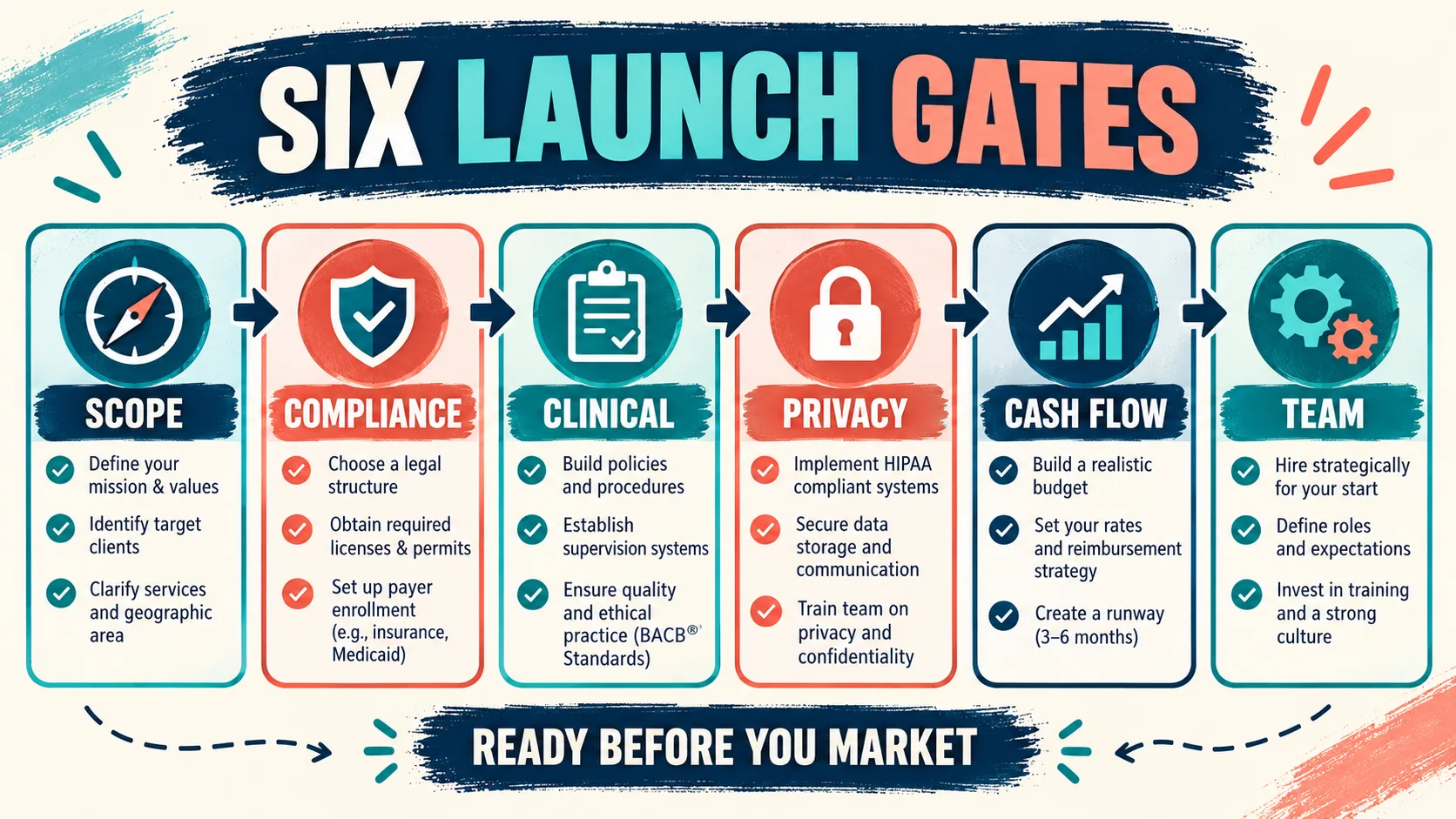
Think of a launch gate as a condition that must be documented before the next decision is safe. The gates do not replace professional review. They prevent a founder from spending heavily on advertising, leases, or hiring before the practice can legally and clinically deliver the service it is promising.
| Gate | Question to answer | Evidence before opening |
|---|---|---|
| Scope | What service, population, setting, and geography will you serve? | Written scope, state-rule check, and referral boundaries. |
| Entity | Who owns the business and who carries financial risk? | Entity, tax, banking, contracts, and insurance records. |
| Clinical | How will assessment, consent, treatment, data, and risk be governed? | Policies, forms, review roles, escalation paths, and sample records. |
| Privacy | Who may access, transmit, retain, and correct client information? | Role-based access, vendor review, incident process, and training. |
| Payer | How will services be authorized, documented, billed, and collected? | Credentialing plan, authorization workflow, rate assumptions, and reserve. |
| Team | Who can perform each task and who supervises quality? | Role descriptions, competency checks, supervision, and backup coverage. |
Gate 1: Define the Service and State Scope: Start with a one-page service definition. State whether the business will provide in-home services, clinic-based services, school consultation, caregiver training, telehealth, organizational behavior management, assessment, or another model. Then specify the population, age range, geography, hours, referral sources, and services that are outside the practice’s competence.
Next, separate three authorities that are often blended together. BACB certification is a national credentialing system; a state may separately regulate the practice of behavior analysis or the use of a title; and an employer or payer may impose credentialing and documentation rules. The BACB’s employer resources note that state licensure requirements vary and that employers should verify credentials. A founder should therefore make a state-by-state checklist instead of assuming that a BCBA credential answers every authorization question.
Write a referral rule for cases that exceed the service scope. Include medical concerns, crisis or safety risk, specialized communication needs, restrictive procedures, and situations requiring another licensed professional. A narrow, honest service promise is easier to staff, credential, document, and deliver well than a broad menu that the business cannot support.
Gate 2: Build the Legal, Insurance, and Banking Base: The SBA launch sequence is useful because it prevents business formation from becoming a vague task. Confirm the entity structure with an appropriate adviser, register where required, obtain the correct tax identification, identify local licenses or permits, open a business bank account, and document who may approve payments and contracts. Keep business and personal funds separate from the first transaction.
Insurance is not one checkbox. Ask an adviser about professional and general liability, workers’ compensation, cyber coverage, and any payer or landlord requirements. Match the policy to the services and people who will deliver them; a low premium that excludes the main risk is not a strong launch plan.
Build a startup budget with one-time setup costs, recurring monthly costs, and a reserve for delayed reimbursement. Include payroll, supervision, credentialing, software, billing, insurance, taxes, and training. Use conservative collection assumptions: “payer rate multiplied by scheduled hours” is not the same as collected revenue.
Gate 3: Create Clinical Governance Before Marketing: A practice should be able to show how it will accept a referral, obtain informed consent, assess needs, select goals, write a plan, collect data, review progress, respond to risk, and close or transition services. The BACB Ethics Code for Behavior Analysts emphasizes competence, informed consent, confidentiality, documentation, and responsibility to clients and stakeholders. Translate those principles into named owners and repeatable forms.
At minimum, define who approves an assessment, who reviews a treatment plan, how caregiver priorities are recorded, how assent and assent withdrawal are respected when applicable, when a supervisor is required, and how a client can raise a concern. Create an incident and escalation path before the first crisis. If the founder is also the clinical decision-maker, document how conflicts of interest, workload, and coverage will be managed.
Build the Compliance and Cash-Flow Backbone
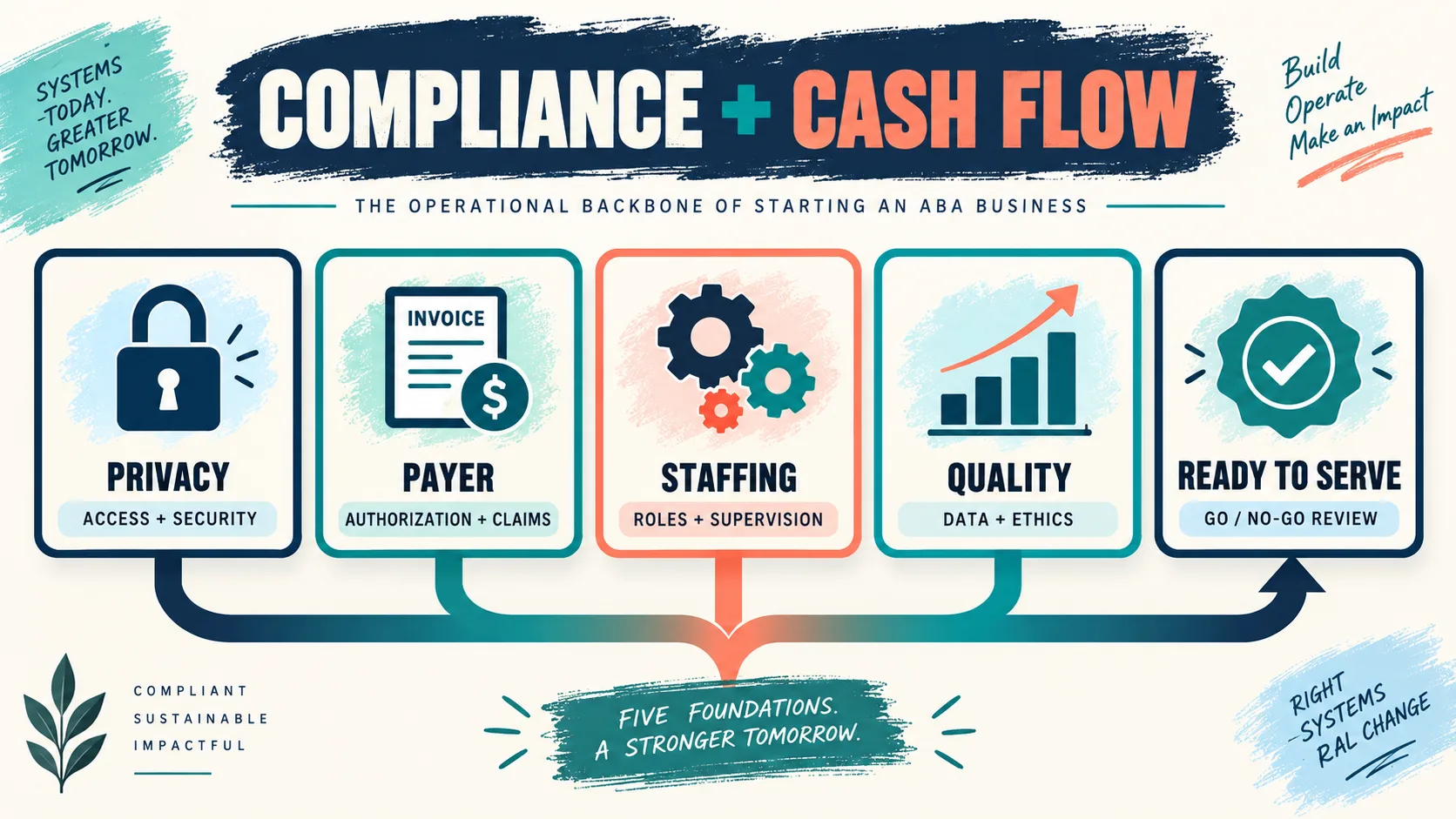
The most useful startup system is a small operating backbone that connects the clinical record to the business record without turning care into a billing exercise. A new practice does not need endless policy documents. It needs clear controls that staff can follow and a review cadence that catches drift early.
Gate 4: Protect Health Information and Access: First determine whether the business is a HIPAA covered entity, a business associate, both in different relationships, or subject to additional state or contractual privacy rules. The U.S. Department of Health and Human Services explains that covered entities include health plans, health care clearinghouses, and certain health care providers that conduct standard electronic transactions. Do not assume that a software vendor’s marketing page makes the practice compliant.
Map the information flow: inquiry, intake, consent, assessment, session note, supervision, claim, payment, communication, storage, retention, and destruction. Give each role the least access needed for its job. HHS describes the minimum necessary principle as a way to limit protected health information to what is needed for the intended purpose. Use unique accounts, multi-factor authentication where available, device controls, encrypted transmission, a vendor and business-associate review, and a documented incident response.
Train the team on practical behavior: where a note may be written, how a caregiver is verified, what may be sent by text, how a lost device is reported, and how records are corrected. Privacy is a daily workflow, not a footer on the website.
Gate 5: Make Payer and Cash-Flow Assumptions Explicit: Build a payer matrix before you promise availability. For each payer or funding route, record whether the service is covered, who may provide it, which codes or units are used, what authorization is needed, which documents are required, how claims are submitted, how denials are appealed, and how long payment usually takes. Verify every item with current payer materials; do not copy a competitor’s assumptions.
Credentialing is a project with dependencies. The clinician may need an active credential, an individual identifier, a group relationship, a contract, a roster entry, and authorization before a service is billable. Model the gap between providing care and collecting cash. A simple weekly dashboard can track scheduled hours, delivered hours, completed notes, claims submitted, clean-claim rate, outstanding authorizations, denials, days in accounts receivable, payroll due, and cash reserve.
Separate access from conversion. A potential client who completes an inquiry form is not the same as a client who has a verified benefit, an appropriate referral, a completed intake, and an available clinician. Track those stages so marketing does not hide an operational bottleneck.
Gate 6: Hire, Train, and Supervise the Team: Write role descriptions around tasks and decision rights, not impressive titles. Identify who can collect data, implement a plan, communicate with a caregiver, change a teaching arrangement, document a risk event, submit a claim, and approve a clinical change. The BACB supervision and training resources are a useful reminder that supervision is a structured professional responsibility, not a casual check-in.
Use competency-based onboarding: explain the policy, demonstrate the skill, observe performance, give feedback, and document the result. Include privacy, professional boundaries, data collection, prompting, reinforcement, incident response, cultural responsiveness, and when to stop and ask for help. Build backup coverage for absences and a realistic caseload ceiling. Growth that outpaces supervision is a quality risk, even when the waiting list looks attractive.
A Practical 90-Day Launch Sequence
A 90-day plan is not a promise that every authorization will be complete on a fixed date. It is a way to sequence decisions and identify the gate that is actually delaying the launch.
| Period | Primary work | Go/no-go evidence |
|---|---|---|
| Days 1–30 | Define scope, map state rules, choose advisers, budget setup and runway, and identify payer routes. | Written service boundary, risk list, budget, and open questions assigned to an owner. |
| Days 31–60 | Form and insure the business, build privacy and clinical policies, select systems, and begin credentialing. | Policies tested, access roles assigned, contracts reviewed, and credentialing dependencies visible. |
| Days 61–90 | Train the initial team, run a mock intake and claim, test incident escalation, and accept only in-scope referrals. | Mock chart and claim pass review; coverage, supervision, privacy, and cash controls are ready. |
At each review, record the evidence, the remaining uncertainty, and whether it affects safety, authorization, cash, or quality. Delay a launch when a high-risk question is only being guessed.
Common ABA Business Startup Mistakes
- Starting with branding instead of scope: a polished website cannot cure an undefined service boundary or missing authorization.
- Assuming certification equals licensure: national certification, state permission, employer credentialing, and payer enrollment are separate checks.
- Hiring before supervision capacity exists: a full schedule is not a quality system.
- Counting billed hours as revenue: authorization, documentation, clean claims, denials, and payment timing change the cash result.
- Writing policies nobody practices: run a mock intake, note, claim, privacy incident, and handoff before opening.
Use BCBA Exam Practice to Sharpen Launch Decisions
Founders who are also preparing for the BCBA exam can use launch planning as a structured way to review measurement, ethics, supervision, documentation, assessment, and behavior-change procedures. Keep the boundaries clear: exam practice does not grant a license, replace supervision, approve a payer contract, or make a business legally ready.
For focused practice, use the Free BCBA Mock Exam. Review each missed item by decision type: definition, measurement, function, ethics, supervision, privacy, or documentation. That habit helps a founder notice when a business question needs a qualified professional rather than a confident guess.
Frequently Asked Questions
Do I need an LLC to start an ABA business?: An LLC may be appropriate for some owners, but the right entity depends on state law, tax circumstances, ownership, risk, and professional-practice rules. Entity formation is one decision inside a larger launch plan; it does not establish clinical authorization, payer enrollment, or competence.
Can a BCBA immediately open a clinic after certification?: Not automatically. Confirm state licensure or practice rules, competence and scope, supervision and staffing, facility requirements, payer conditions, privacy obligations, insurance, and any referral or clinical constraints. A credential is important evidence, not a complete operating system.
What is the safest first marketing promise?: Describe the service you can actually deliver, the population and geography you serve, how inquiries are handled, and what happens when a referral is outside scope. Avoid promising outcomes, coverage, or availability that depends on an unverified payer, authorization, or staffing assumption.
Sources and Verification Notes
For launch planning, consult the U.S. Small Business Administration launch guidance, the BACB employer resources, the BACB Ethics Code, the BACB supervision and training resources, the HHS covered-entity overview, the HHS minimum-necessary guidance, the current BCBA Test Content Outline, and the BACB authorized continuing-education provider information. Check the current version and your local requirements before acting.
Quick Review Checklist
Use this final checklist to turn starting an ABA business into exam-ready reasoning. The goal is not to memorize a label in isolation; it is to identify the relevant evidence and explain why the best answer fits the scenario. Key ideas to review:
- State the central definition or decision point for starting an ABA business in your own words.
- Identify the detail that makes starting an ABA business different from its closest related ABA term.
- Separate the observable facts in a scenario from assumptions that are not supported by the facts.
- Write one example and one nonexample so you can recognize the concept in a new setting.
Exam application checks:
- Ask what the question is actually requesting before comparing the answer choices.
- Mark the antecedent, response, consequence, or other evidence that supports the selected answer.
- Look for a distractor that describes a related process but does not answer the specific question.
Final self-check:
- Explain how you would verify the interpretation with clear observations or data.
- Change one detail in the scenario and decide whether your answer should change.
- Give a one-sentence rationale that a supervisor or study partner could evaluate.
Take the Free BCBA Mock Exam
When you are ready to apply the idea, use the free practice resource below for additional feedback. Take the Free BCBA Mock Exam



