
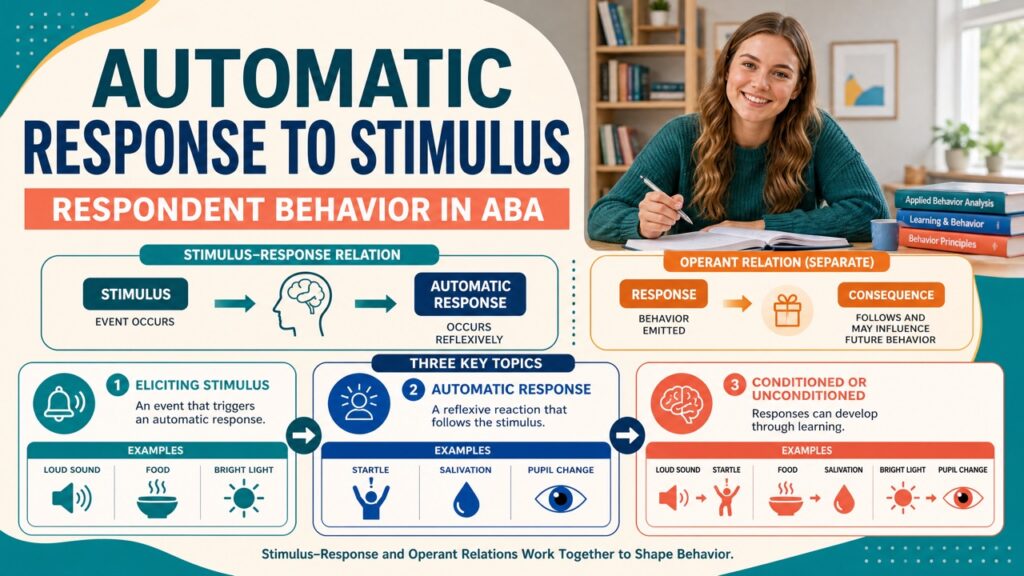
Definition: Behavior That Occurs as an Automatic Response to Some Stimulus
In applied behavior analysis (ABA), the phrase behavior that occurs as an automatic response to some stimulus refers to actions directly elicited by a preceding environmental event, without requiring conscious deliberation or the influence of consequences. This is the hallmark of respondent behavior, which is controlled by antecedent stimuli through stimulus-stimulus pairings. For example, when you smell freshly baked bread, your mouth may water automatically. This response is not learned; it is an innate reflex. Similarly, a sudden loud noise may make you jump, and a bright light may cause your pupils to constrict. These automatic responses are evoked by specific stimuli and are relatively involuntary.
Table of Contents
- Definition: Behavior That Occurs as an Automatic Response to Some Stimulus
- Examples of Behavior That Occurs as an Automatic Response to Some Stimulus
- Respondent vs. Operant Behavior
- Automatic Responses and Stimulus Control
- Common Traps and Misconceptions on the BCBA Exam
- Systematic Desensitization and Counterconditioning
- Automatic Responses in Behavior Chains
- Practice Scenarios to Test Yourself
- Conclusion and Next Steps
However, the term automatic can also apply to operant behavior maintained by automatic reinforcement. In such cases, the behavior occurs because the sensory consequence itself is reinforcing, without any social mediation. For instance, a child may rock back and forth because the motion produces a calming sensation. This behavior is also automatic in the sense that it does not depend on another person delivering reinforcement, but it is not elicited in the same way as a reflex. Instead, it is emitted because of its reinforcing effects. Understanding this distinction is crucial for the BCBA exam, as you will need to identify the controlling variables in various clinical scenarios.
This article provides a comprehensive explanation of behavior that occurs as an automatic response to some stimulus, including its definition, examples, differences from operant behavior, and its relevance to stimulus control and clinical interventions. You will also find common exam traps and practice scenarios to test your understanding. By the end, you will be well-prepared to answer questions on this topic confidently.
Examples of Behavior That Occurs as an Automatic Response to Some Stimulus
To solidify your understanding, consider the following classic examples of automatic responses. Each illustrates the antecedent-response relation that defines respondent behavior. These examples also highlight the range of automatic responses, from simple reflexes to learned emotional reactions.
- Salivation to food: Seeing or smelling a favorite meal makes your mouth water. This is an unconditioned response if innate, or a conditioned response if paired with a cue like a dinner bell.
- Startle response to a loud noise: A sudden thunderclap makes you jump. This is an unconditioned reflex that occurs without prior learning.
- Conditioned emotional response: After a car accident, the sight of a similar car may cause your heart to race. This is a conditioned response acquired through respondent conditioning.
- Eyeblink to a puff of air: A quick puff of air to your eye makes you blink. This simple reflex can also be conditioned to a neutral stimulus.
- Pupil dilation to light changes: Pupils constrict in bright light and dilate in dim light. This is an unlearned reflex that demonstrates automatic reactivity to environmental changes.
These examples show that automatic responses can be both unlearned and learned. Unlearned responses are called unconditioned responses (URs) and are elicited by unconditioned stimuli (USs). Learned responses are called conditioned responses (CRs) and are elicited by conditioned stimuli (CSs) after pairing with a US. For example, Pavlov’s dogs salivated (CR) to a bell (CS) after the bell was repeatedly paired with food (US). This basic mechanism underlies many emotional reactions and physiological responses.
Respondent vs. Operant Behavior
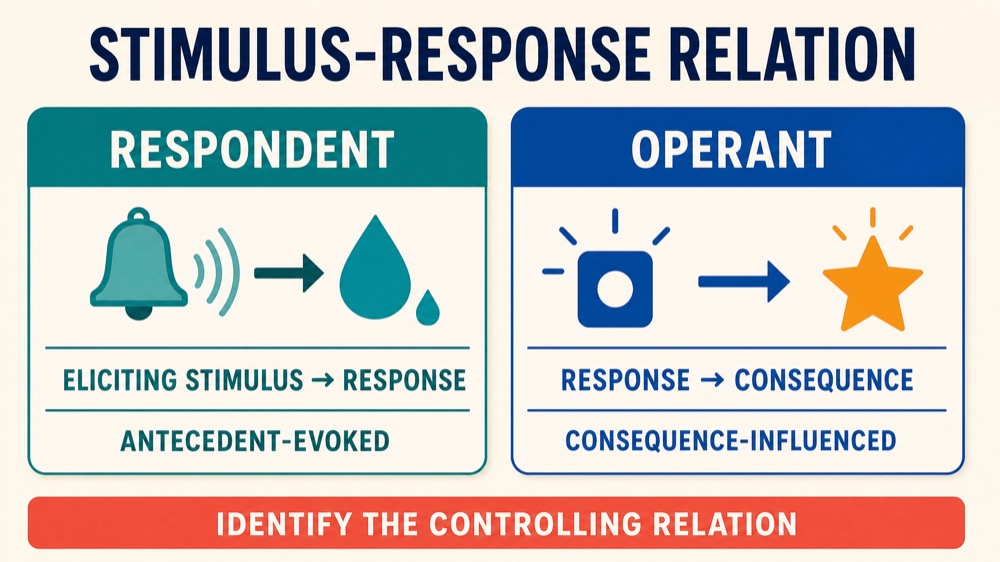
One common misconception is that behavior is either respondent or operant, with no overlap. In reality, behavior can be influenced by both types of contingencies. For example, a person with a phobia may avoid elevators (operant behavior) because doing so reduces anxiety (automatic negative reinforcement). However, the anxiety itself is a respondent response elicited by the elevator. Understanding this interaction is essential for comprehensive behavior analysis. Here is a comparison of key features:
- Control: Respondent behavior is controlled by antecedent stimuli, while operant behavior is controlled by consequences.
- Response type: Respondent responses are typically reflexive and involuntary, while operant responses are more voluntary and emitted.
- Acquisition: Respondent behavior is acquired through stimulus-stimulus pairings; operant behavior is acquired through reinforcement and punishment.
- Example: Salivating to food is respondent; pressing a lever to get food is operant.
However, respondent behavior is not totally unaffected by consequences. For example, if a conditioned response is repeatedly elicited without the unconditioned stimulus, it may undergo extinction. Additionally, respondent behavior can be modified through procedures such as systematic desensitization or counterconditioning. Therefore, saying “respondent behavior is totally unaffected by consequences” would be oversimplified. In practice, both respondent and operant processes often occur simultaneously, and a thorough functional assessment is needed to identify the controlling variables.
Automatic Responses and Stimulus Control
Stimulus control is a key concept in ABA. In stimulus control, a behavior is more likely to occur in the presence of a specific discriminative stimulus (SD) because that stimulus has been associated with reinforcement. In contrast, an S-delta signals that reinforcement is not available. For respondent behavior, the controlling stimulus is an eliciting stimulus, not an SD. The eliciting stimulus directly produces a respondent response, forming a stimulus-response relation that is not dependent on reinforcement history. However, respondent and operant processes often interact.
For example, a child may learn to say “please” (operant) when a preferred item is present (SD), but the sight of the item may also elicit salivation (respondent). In practice, it is important to distinguish between an SD and an eliciting stimulus. An SD signals the availability of reinforcement for an operant response, while an eliciting stimulus directly produces a respondent response. Misidentifying these can lead to ineffective interventions.
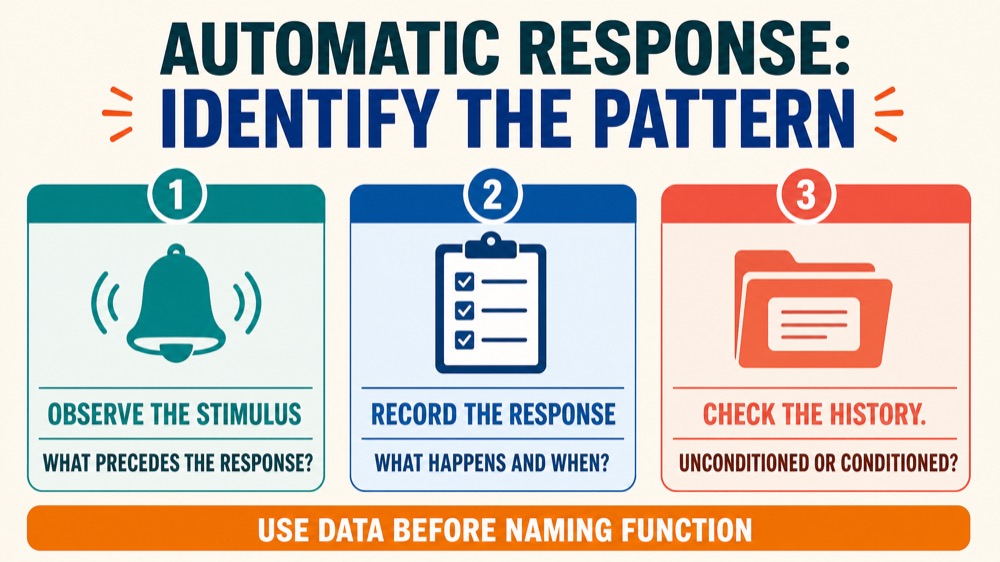
To identify whether a behavior is under automatic control, conduct a functional assessment. Present the suspected eliciting stimulus and observe whether the target response occurs. If the response happens reliably and without social consequences, it may be an automatic response. However, be cautious: operant behavior maintained by automatic reinforcement also occurs without social consequences, so you must rule that out. For more on stimulus control, see our detailed article on stimulus control.
Common Traps and Misconceptions on the BCBA Exam
BCBA candidates often stumble on subtle distinctions between respondent and operant terminology. Here are some common traps to avoid:
- Trap 1: Assuming all automatic responses are respondent behaviors. Actually, operant behavior can also be automatic if it is maintained by automatic reinforcement.
- Trap 2: Believing respondent behavior is unaffected by consequences. While not directly controlled by operant consequences, respondent behavior can be extinguished or modified through other learning processes.
- Trap 3: Confusing an SD with an eliciting stimulus. They have different functions: SD signals reinforcement availability; eliciting stimulus directly produces a reflex.
- Trap 4: Thinking respondent conditioning is the same as operant conditioning. They involve different mechanisms and are treated differently in interventions.
Another common trap is mixing up stimulus generalization with respondent generalization. In respondent conditioning, generalization occurs when stimuli similar to the CS also elicit the CR. For example, a child who fears a white rat may also fear a white rabbit. This is different from operant stimulus generalization, where a response occurs in the presence of similar SDs. Keep these distinctions clear to avoid errors on the exam.
Why Understanding Automatic Responses Matters: Understanding automatic responses is crucial for accurate assessment and intervention planning. If you misidentify a behavior as operant when it is actually respondent, you might implement consequence-based interventions that are ineffective. Conversely, if you treat a respondent behavior as if it were elicited when it is actually maintained by automatic reinforcement, you may miss opportunities for functional communication training or other operant interventions. This distinction is especially important when working with individuals with autism or other developmental disabilities, where automatic reinforcement can maintain repetitive behaviors.
Systematic Desensitization and Counterconditioning
When a respondent behavior is problematic, such as a phobia, behavior analysts may use systematic desensitization or counterconditioning. These procedures involve gradually exposing the client to the feared stimulus while teaching relaxation responses that compete with the fear response. This is a form of reflex modification, where the goal is to change the elicited response.
For example, a client with a fear of dogs might be gradually exposed to pictures of dogs while engaging in deep breathing. Over time, the conditioned response of fear may be replaced by relaxation. These interventions highlight the practical application of respondent conditioning principles and are often used in conjunction with operant strategies like reinforcement for approach behavior. Such combination approaches are common in clinical practice and are a frequent topic on the BCBA exam.
Automatic Responses in Behavior Chains
Respondent behavior can be part of behavior chains, but it is not typically the target of operant interventions. For instance, in a chain of behaviors involved in eating, salivation (respondent) may occur at the sight of food, which then leads to reaching for the food (operant). However, the primary focus of intervention is usually on the operant behavior.
It is important to recognize that some automatic responses may be part of a complex repertoire. For example, a child may cry (operant) because it has been reinforced with attention, but a sudden flinch (respondent) might be triggered by a loud noise. A thorough functional assessment will help identify the multiple control factors. In a behavior chain, respondent and operant components can alternate, and understanding these influences can help you design more effective interventions.
Practice Scenarios to Test Yourself
To solidify your understanding, try to identify the type of behavior in each scenario below. After reading each scenario, decide whether the behavior is respondent or operant, and if it is automatic, specify the controlling stimulus.
- Scenario 1: A student gets a headache whenever she sees a pop quiz on the board. The headache is an automatic response elicited by the quiz.
- Scenario 2: A child flaps his hands when alone because the sensation is pleasurable. This is operant behavior maintained by automatic reinforcement.
- Scenario 3: A dog salivates to the sound of a can opener. This is a conditioned response (respondent).
- Scenario 4: An adult checks the door multiple times before leaving because it reduces anxiety. This is operant behavior negatively reinforced by anxiety reduction.
These scenarios illustrate the complexities of identifying automatic responses. In real-world practice, you will often need to conduct a functional analysis to determine the function of behavior. Remember to consider both respondent and operant possibilities when assessing behavior.
Conclusion and Next Steps
In summary, behavior that occurs as an automatic response to some stimulus is a foundational concept in ABA that encompasses both respondent behavior and operant behavior maintained by automatic reinforcement. Understanding the differences is essential for accurate assessment and effective intervention. You have learned the definition, examples, key comparisons, stimulus control implications, and common exam traps. Use the practice scenarios to reinforce your knowledge.
To further prepare for the BCBA exam, we encourage you to take our free BCBA mock exam and explore additional practice questions on stimulus control. Consistent practice will help you master these concepts and build confidence. Good luck with your studies!
For the official BACB BCBA task list, refer to the BCBA/BCaBA Task List (6th Edition).



