
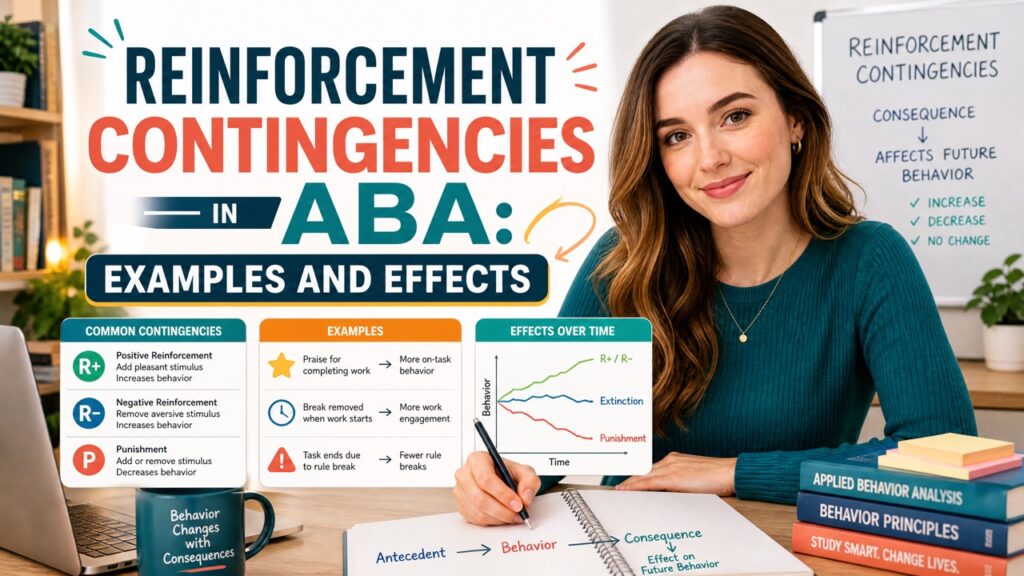
In applied behavior analysis (ABA), reinforcement contingencies are central to understanding how behavior changes. A reinforcement contingency is the contingent relation between a behavior and a consequence that increases the future probability of that behavior under similar circumstances. This article provides a clear definition, explains positive and negative reinforcement, illustrates the three-term contingency, and discusses variables that affect reinforcement. It also distinguishes between a reinforcer and reinforcement, and between a contingency arrangement and its observed effect. Practical examples and a study checklist help you apply these concepts in your BCBA preparation.
Table of Contents
- What Are Reinforcement Contingencies?
- Types of Reinforcement Contingencies
- Reinforcement Contingency Examples
- The Three-Term Contingency and Reinforcement
- Variables That Affect Reinforcement Contingencies
- Reinforcement vs. Reinforcer and Misconceptions
- Study Checklist for Reinforcement Contingencies
- Conclusion and Next Steps
- Reference
What Are Reinforcement Contingencies?
A reinforcement contingency is a specific arrangement in which a consequence is delivered only if a particular behavior occurs, and that consequence increases the future frequency of that behavior. The term “contingency” means that the consequence depends on the behavior—no behavior, no consequence. In ABA, this is often represented as a three-term contingency: Antecedent (A), Behavior (B), and Consequence (C), also known as the ABCs of behavior. The antecedent is the situation or stimulus present before the behavior, the behavior is the action, and the consequence is the event that follows. Reinforcement occurs when the consequence makes the behavior more likely to happen again in the future.
It is essential to distinguish between a reinforcer (the stimulus) and reinforcement (the process). A reinforcer is a stimulus that, when presented or removed following a behavior, increases the future frequency of that behavior. Reinforcement is the process by which the consequence increases behavior. The effect is observed behavior change; the contingency is the arrangement that produces that effect. For example, if a child studies hard (behavior) and receives praise (consequence), and the child studies more in the future, the praise is a reinforcer, and the process is positive reinforcement.
Types of Reinforcement Contingencies
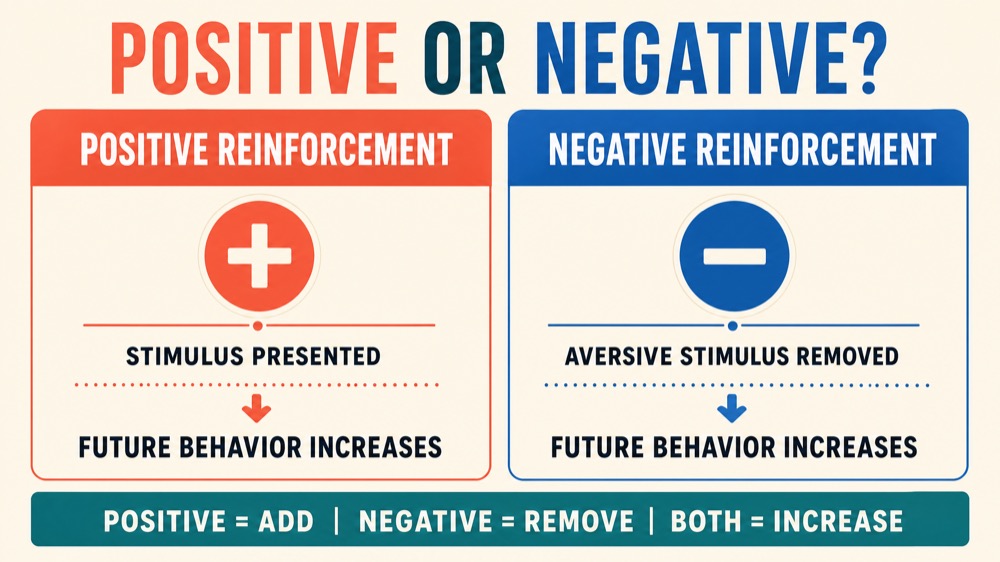
Reinforcement contingencies are divided into two primary types: positive and negative reinforcement. Both increase behavior, but they differ in the operation: whether a stimulus is presented or removed. Understanding this distinction is crucial for analyzing behavioral interventions.
Positive Reinforcement: Positive reinforcement involves the presentation of a stimulus immediately following a behavior, which increases the future frequency of that behavior. The stimulus can be tangible (e.g., a treat), social (e.g., praise), or activity-based (e.g., playing a game). The key is that the stimulus is added to the environment. For instance, if a student raises their hand (behavior) and the teacher calls on them (presentation of attention), and the student continues to raise their hand in the future, attention is a positive reinforcer.
Negative Reinforcement: Negative reinforcement involves the removal of an aversive stimulus immediately following a behavior, which increases the future frequency of that behavior. The term “negative” refers to the removal of a stimulus, not to the behavior being negative or bad. For example, if a person takes an aspirin (behavior) and a headache goes away (removal of aversive pain), and the person is more likely to take aspirin for headaches in the future, the removal of pain is a negative reinforcer. Negative reinforcement is often confused with punishment, but punishment decreases behavior, whereas reinforcement always increases behavior.
Reinforcement Contingency Examples
Here are original examples that illustrate both types, with clear contingency statements.
- Example 1 (Positive): A child completes their homework. If the child completes homework (behavior), then the parent gives 30 minutes of screen time (consequence). The child is more likely to complete homework in the future. The contingency: homework completion → screen time → increased homework completion.
- Example 2 (Positive): An employee submits a report on time. If the employee submits on time (behavior), then the supervisor gives public recognition (consequence). The employee is more likely to submit on time in the future. The contingency: timely submission → praise → increased timely submission.
- Example 3 (Negative): A student studies for an exam to avoid anxiety. If the student studies (behavior), then anxiety is reduced (removal of aversive state). The student is more likely to study for future exams. The contingency: studying → removal of anxiety → increased studying.
- Example 4 (Negative): A driver fastens a seatbelt to stop an annoying beeping sound. If the driver fastens the seatbelt (behavior), then the beeping stops (removal of aversive noise). The driver is more likely to fasten the seatbelt in the future. The contingency: buckling up → noise removal → increased buckling.
The Three-Term Contingency and Reinforcement
The three-term contingency is the fundamental unit of analysis in ABA. It comprises an antecedent, a behavior, and a consequence. The antecedent is the condition or stimulus that is present before the behavior and may evoke the behavior. The behavior is the observable action, and the consequence is the event that follows. Reinforcement is a specific type of consequence that increases the future probability of the behavior. For example, in a classroom, the teacher says “Please complete your worksheet” (antecedent), the student completes the worksheet (behavior), and the teacher gives a sticker (consequence). If this sequence increases the student’s worksheet completion, it is a reinforcement contingency.
It is important to note that the three-term contingency includes the consequence, but reinforcement is not the same as the contingency itself. The contingency describes the entire relationship, while reinforcement is the process of the consequence increasing behavior. In practice, behavior analysts manipulate these contingencies to design effective interventions.
Variables That Affect Reinforcement Contingencies
Several variables influence the effectiveness of a reinforcement contingency, including immediacy, magnitude, and schedule of reinforcement. Immediacy refers to the delay between the behavior and the consequence; reinforcement is most effective when the consequence occurs immediately after the behavior. Magnitude refers to the amount or intensity of the reinforcer; a larger magnitude often results in a stronger effect, but this can vary. The schedule of reinforcement determines the frequency and predictability of reinforcement, such as continuous (every response) or intermittent (some responses). These variables are critical in applied settings because they affect how quickly and robustly behavior changes.
Additionally, reinforcement contingencies can be natural or arranged. Natural contingencies occur as a typical part of daily life, such as a smile when someone greets you. Arranged contingencies are deliberately designed by a behavior analyst, such as using tokens in a classroom. Both can be effective, but arranged contingencies are often used to teach new skills or increase adaptive behaviors.
Reinforcement vs. Reinforcer and Misconceptions
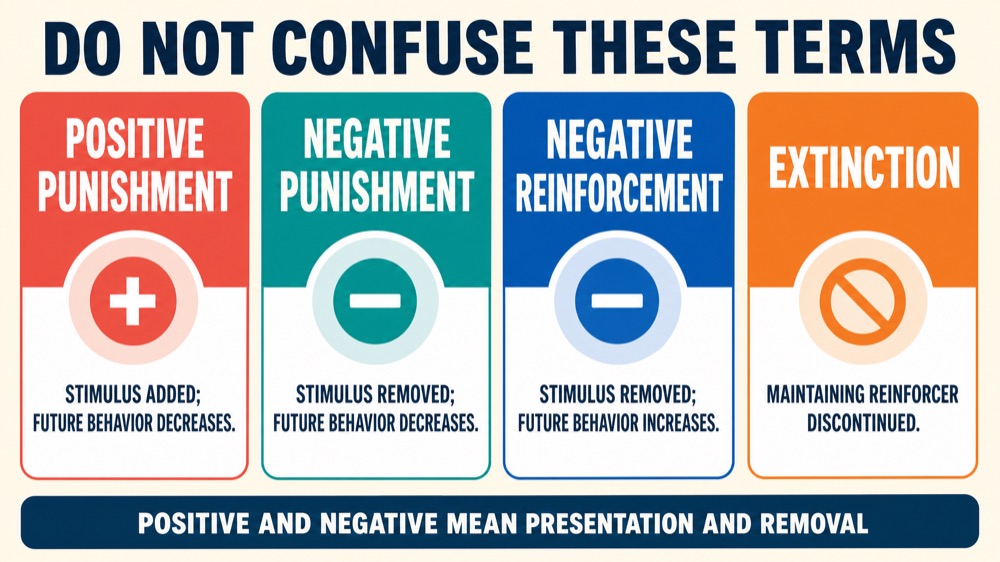
Reinforcement is the process, while a reinforcer is the stimulus that functions as a consequence. A stimulus is considered a reinforcer only if it increases the future behavior it follows. It is not based on how pleasant it is or on our assumptions. For example, for some individuals, attention may be aversive and not function as a reinforcer. Similarly, negative reinforcement is not punishment; punishment decreases behavior, while reinforcement increases it.
Common misconceptions about reinforcement contingencies include confusing positive reinforcement with pleasurable outcomes, confusing negative reinforcement with punishment, assuming behavior change must persist without measurement, and limiting contingencies to clinical sessions. These misunderstandings can lead to inaccurate analysis and ineffective interventions. It is important to rely on observed behavior change to verify the function of a consequence.
Reinforcement contingencies are not limited to therapy; they can occur naturally in classrooms, homes, workplaces, and community settings, and their effects should be verified through behavior change. For example, a student may study more because studying removes the worry about failing, or an employee may arrive on time because punctuality avoids a supervisor’s reprimand. These natural contingencies operate outside formal intervention and are equally valid subjects of analysis.
To further clarify, consider the following comparison points:
- Contingency vs. Effect: The contingency is the arrangement (if behavior, then consequence); the effect is the observed increase in behavior. A contingency exists even if the effect is not yet measured, but reinforcement is only confirmed when behavior change is observed.
- Reinforcer vs. Reinforcement: A reinforcer is the stimulus that follows behavior; reinforcement is the process of that stimulus increasing future behavior. A stimulus is not inherently reinforcing; its function is determined by its effect.
- Positive vs. Negative: Positive reinforcement involves presenting a stimulus; negative reinforcement involves removing an aversive stimulus. Both increase behavior, but the operation differs.
- Natural vs. Arranged: Natural contingencies occur without deliberate planning; arranged contingencies are designed by practitioners. Both can be effective, but arranged ones are often used to teach new skills.
Study Checklist for Reinforcement Contingencies
Use this checklist to assess your understanding of reinforcement contingencies:
- Can you define reinforcement contingency in your own words?
- Can you identify the three-term contingency in a given scenario?
- Can you differentiate positive and negative reinforcement based on the operation (presentation vs. removal)?
- Can you explain why a stimulus is a reinforcer only if it increases behavior?
- Can you list variables that affect reinforcement (immediacy, magnitude, schedule)?
- Can you provide an original example of a natural reinforcement contingency?
- Can you explain the difference between a contingency arrangement and the reinforcement effect?
Practice with original scenarios, such as those in this article, and explain the contingencies aloud to strengthen your recall. For more on related concepts, explore our guides on stimulus control and stimulus generalization.
Conclusion and Next Steps
Reinforcement contingencies are a fundamental concept in applied behavior analysis. By understanding the definition, types, examples, and effects, you can analyze behavior and design effective interventions. Remember, reinforcement is defined by its effect on behavior, not by intention or pleasantness. As you prepare for the BCBA exam, practice applying these principles to diverse situations.
Become more confident in your ABA knowledge by taking our Free BCBA Mock Exam. It offers practice questions and feedback to help you assess your readiness.



