
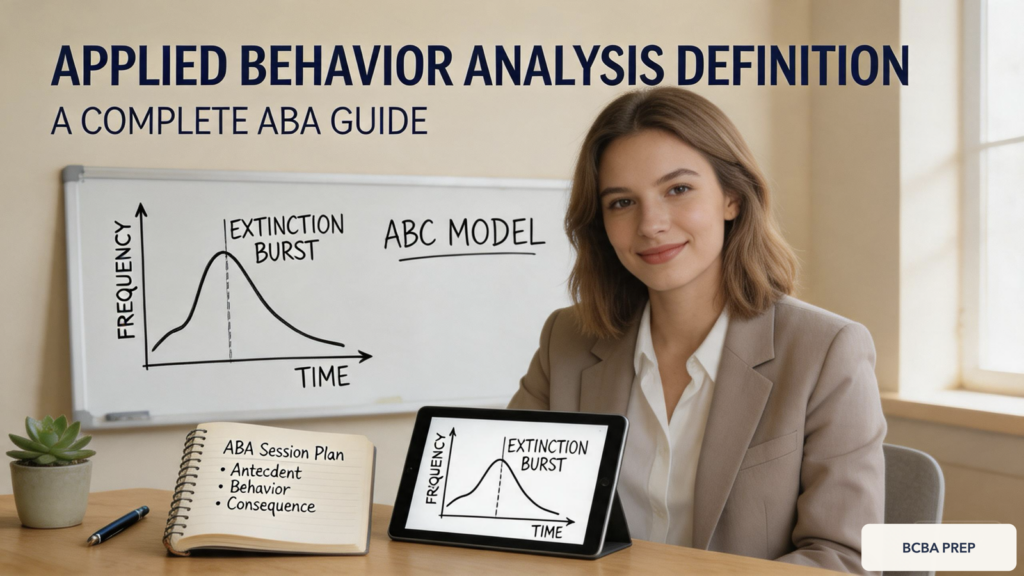
Introduction to Applied Behavior Analysis
Applied behavior analysis (ABA) is a scientific approach to understanding and improving socially significant behavior. If you are preparing for the BCBA exam, a precise grasp of the applied behavior analysis definition is essential. This guide breaks down the formal definition, core principles, and practical examples to help you apply it confidently.
Table of Contents
- Introduction to Applied Behavior Analysis
- The Official Applied Behavior Analysis Definition
- Core Principles Behind the Definition
- Worked ABA Examples with Hypothesized Function
- Exam Relevance and Common Traps
- Quick Checklist for BCBA Candidates
- Summary and Next Steps
ABA is not just a set of techniques; it is a systematic science rooted in observable behavior and environmental variables. By mastering this definition, you build a foundation for every other concept on the exam.
The Official Applied Behavior Analysis Definition
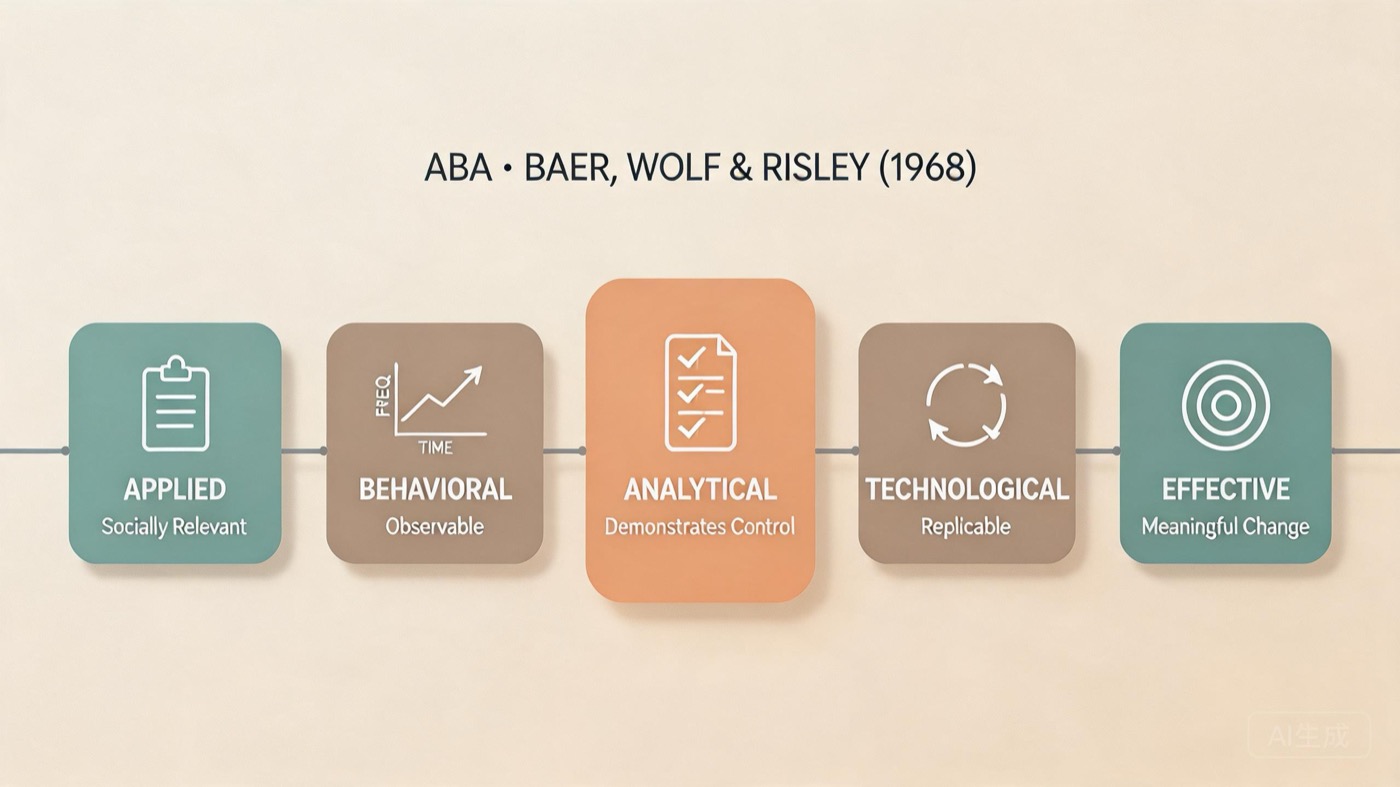
The seminal definition of ABA was provided by Baer, Wolf, and Risley in 1968. They described applied behavior analysis as the process of applying behavioral principles to improve socially important behaviors while demonstrating a reliable relationship between the intervention and the behavior change.
The Seven Dimensions of ABA
Baer, Wolf, and Risley identified seven dimensions that define high-quality ABA. These dimensions are frequently tested on the BCBA exam, both as direct recall and scenario-based questions.
- Applied: Focuses on socially significant behaviors that improve the client’s life.
- Behavioral: Targets measurable, observable behavior, not hypothetical constructs.
- Analytic: Demonstrates a functional relationship between intervention and behavior change.
- Technological: Procedures are described clearly enough to be replicated.
- Conceptually Systematic: Interventions are grounded in behavioral principles.
- Effective: Behavior change is large enough to be socially meaningful.
- Generality: Behavior change lasts over time, appears in new settings, and spreads to other behaviors.
Each dimension must be present for an intervention to be considered true ABA. The exam often asks you to identify which dimension is missing in a scenario.
Core Principles Behind the Definition
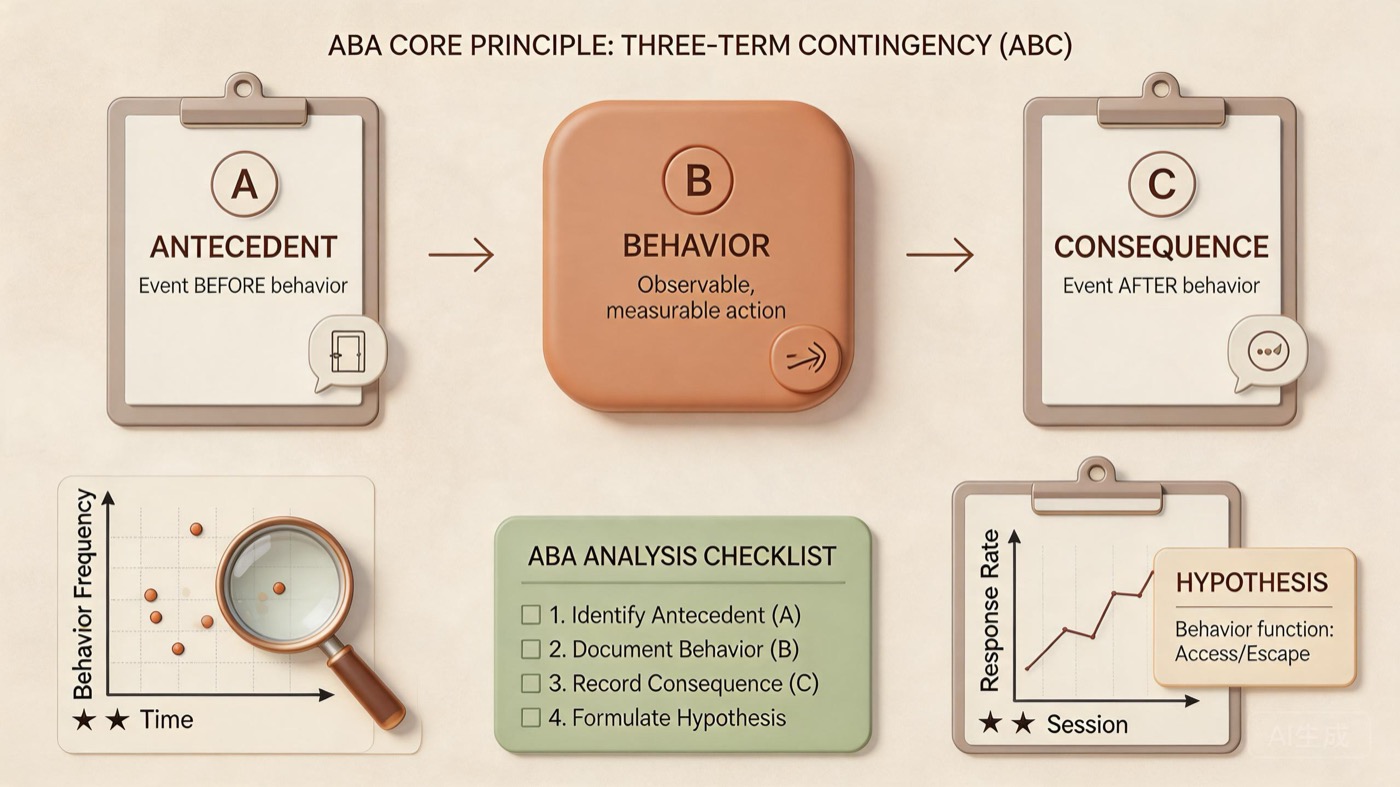
The ABA definition rests on several foundational principles. Behavior is understood as a function of environmental events. The three-term contingency (antecedent-behavior-consequence) is the core unit of analysis.
The ABC Model: Antecedent-Behavior-Consequence
The ABC model helps identify why behavior occurs. An antecedent is what happens immediately before the behavior. The behavior is the observable action. The consequence is what follows the behavior and influences its future occurrence.
For example, a teacher asks a question (antecedent), a student raises a hand (behavior), and the teacher calls on him (consequence). If hand-raising increases, the consequence is a reinforcement. This model is essential for functional behavior assessment and intervention planning.
Worked ABA Examples with Hypothesized Function
Applying the ABC model to real scenarios strengthens your understanding. Below are two examples showing how to analyze behavior and hypothesize its function.
Example 1: Increasing On-Task Behavior in a Classroom
- Antecedent: Teacher says, ‘Please work on your math worksheet.’
- Behavior: Student looks at the worksheet and writes answers (on-task).
- Consequence: Teacher gives verbal praise every 2 minutes while student works.
Hypothesized function: Access to attention (positive reinforcement). The teacher’s praise increases on-task behavior. This intervention is analytic because the teacher can show that praise (and not other variables) is responsible for the increase. It is also effective if the student completes more worksheets.
Example 2: Reducing Aggression in a Child with Autism
- Antecedent: Parent says, ‘It’s time to clean up your toys.’
- Behavior: Child hits the parent.
- Consequence: Parent removes the demand and says, ‘Okay, you don’t have to clean up.’
Hypothesized function: Escape from demands (negative reinforcement). When the child hits, the demand is removed, reinforcing aggression. An ethical intervention would involve functional communication training to teach a replacement behavior, such as saying ‘break’ to request a pause. This respects the dimension of generality if the skill transfers to other settings.
Exam Relevance and Common Traps
The BCBA exam tests your ability to apply the definition, not just memorize it. Watch for these common pitfalls.
How the BACB Tests the ABA Definition
Questions may ask you to identify which dimension is not being met, or to distinguish ABA from behavior modification (which does not require all seven dimensions). You might also be given a scenario and asked to identify the hypothesized function.
- Trap 1: Confusing ABA with behavior modification. Behavior modification uses behavioral principles but may not be applied to socially significant behaviors or be conceptually systematic. ABA includes all seven dimensions.
- Trap 2: Forgetting one or more dimensions. For example, a procedure that works only in one setting and does not generalize fails the generality dimension.
- Trap 3: Misapplying the function of behavior. Always base your hypothesis on the consequence that follows the behavior in the given scenario, not on assumptions.
Quick Checklist for BCBA Candidates
Use this checklist to verify you have mastered the applied behavior analysis definition for exam day.
- Memorize the seven dimensions and their definitions. Use the mnemonic ‘ABBAT EEG’ (Applied, Behavioral, Behavioral? no: Applied, Behavioral, Analytic, Technological, Conceptually Systematic, Effective, Generality).
- Practice ABC analyses on everyday behaviors until it becomes automatic.
- Identify functions (access to attention, escape, tangible, automatic) in sample scenarios.
- Distinguish ABA from other approaches by checking if all seven dimensions are met.
- Review real-life case studies that illustrate each dimension. Our guide on 7 dimensions of ABA provides more depth.
Summary and Next Steps
The applied behavior analysis definition is the cornerstone of the BCBA exam. By internalizing the seven dimensions and the ABC model, you can analyze any scenario with confidence. Use the checklist above to reinforce your knowledge, and then test yourself with practice questions. For more exam-focused content, visit free BCBA mock exam practice questions to apply these concepts. Also, review the BACB’s own resources at bacb.com for official guidelines.



