
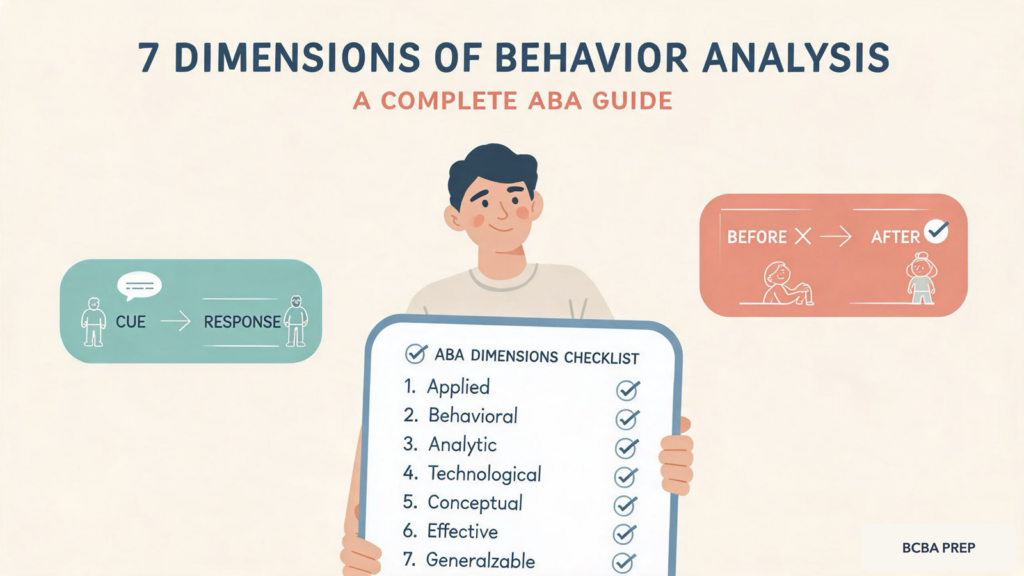
What Are the Dimensions of Behavior Analysis?
The dimensions of behavior analysis were first outlined by Baer, Wolf, and Risley in 1968 in the Journal of Applied Behavior Analysis. These seven dimensions define what makes ABA a scientific and effective approach. For BCBA candidates, understanding them is essential because they appear throughout the exam blueprint as foundational concepts, often in ethical decision-making scenarios and experimental design questions.
Table of Contents
- What Are the Dimensions of Behavior Analysis?
- The 7 Dimensions of Behavior Analysis (With Worked Examples)
- Common Exam Traps and How to Avoid Them
- Quick Checklist: Master the 7 Dimensions
The Foundational Article by Baer, Wolf, and Risley
In 1968, the seminal article “Some Current Dimensions of Applied Behavior Analysis” established criteria that distinguish ABA from other interventions. Every dimension serves as a quality standard for behavior-change programs. The authors argued that for an intervention to be considered applied behavior analysis, it must meet all seven dimensions simultaneously. This means that missing even one dimension can undermine the scientific rigor and ethical foundation of the program.
Why These Dimensions Matter for BCBA Candidates
The BACB task list requires you to evaluate interventions against these dimensions. You will see scenario-based questions asking which dimension is missing or which is best demonstrated. Reviewing them thoroughly can improve your score on ethics and application items. Moreover, understanding the dimensions helps you design more effective interventions, communicate clearly with colleagues, and advocate for evidence-based practices in your workplace. Many exam items ask you to identify a dimension that is lacking or to choose the best example of a dimension from a list.
The 7 Dimensions of Behavior Analysis (With Worked Examples)
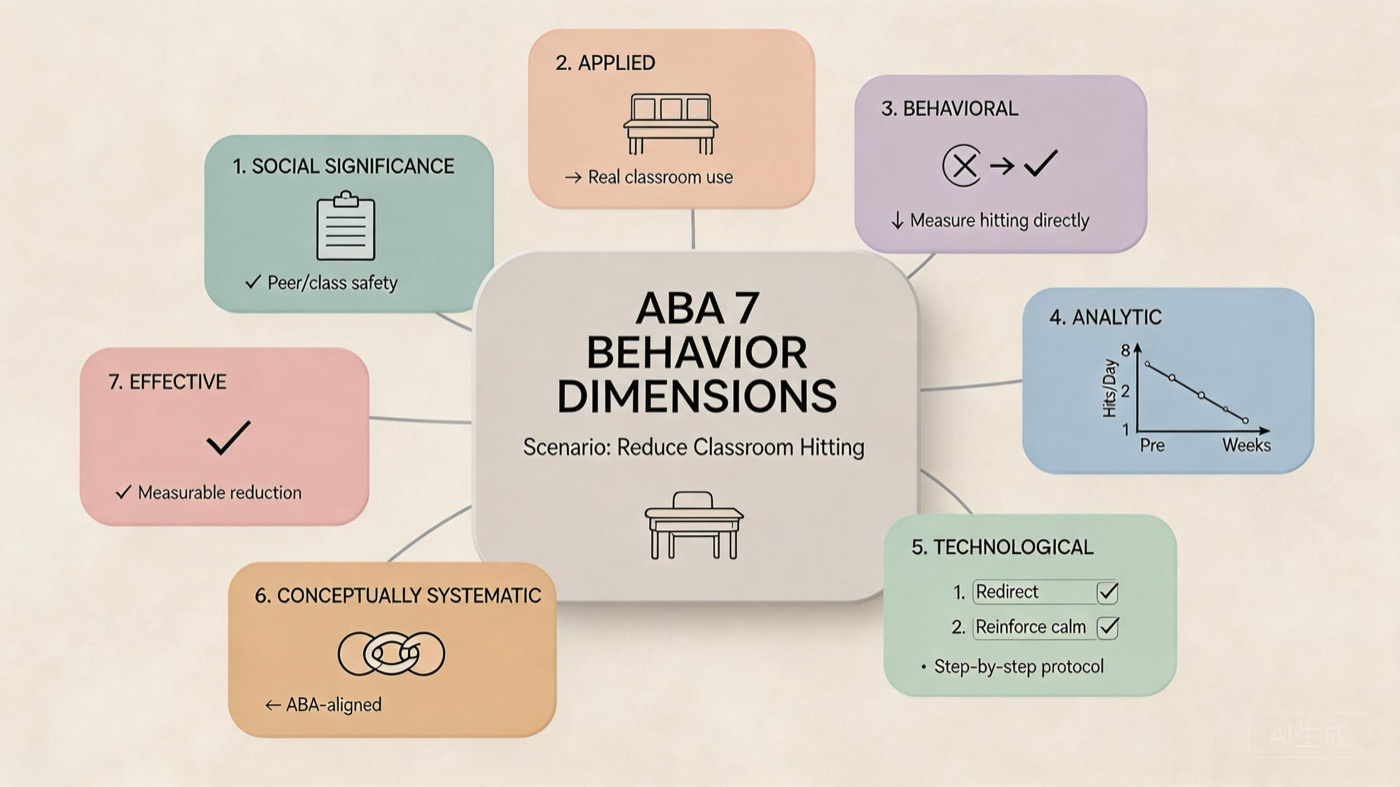
To make these concepts stick, we will use a single scenario: reducing aggression (hitting) in a classroom. Each dimension adds a specific requirement. Let’s examine each dimension in depth, using our scenario to illustrate how they work together.
1. Applied: Social Significance
The target behavior must be socially significant to the client and community. In our scenario, reducing hitting is applied because it affects peer relationships and learning. Aim for behaviors that improve quality of life, not arbitrary goals. For example, teaching a child to tie their shoes is applied only if it increases independence and participation in daily activities. Avoid selecting behaviors that are convenient for the practitioner but have little meaning for the client. On the exam, be alert to scenarios where the target behavior is trivial or not linked to the client’s long-term well-being.
2. Behavioral: The Behavior Itself
Only measurable actions qualify. Instead of labeling a student as “aggressive”, count instances of hitting. This behavioral focus ensures objectivity and reliability. To be behavioral, the target must be a physical event that can be observed and recorded. Private events like thoughts or feelings are not directly measured unless they produce observable behavior. In exam scenarios, look for vague labels like “non-compliant” or “anxious” and ask yourself: can I count that? If not, the dimension is likely missing.
3. Analytical: Experimental Control
Demonstrate a cause-effect relationship between intervention and behavior change. For example, use an A-B-A-B design showing that hitting decreases only when the intervention is active. Without experimental control, you cannot claim the intervention worked. The analytical dimension requires that the behavior change can be reliably attributed to the intervention, not to extraneous variables. Common experimental designs include reversal, multiple baseline, and alternating treatments. On the exam, you might be asked to identify which design best demonstrates experimental control.
4. Technological: Clear Procedures
Procedures must be described precisely so others can replicate them. Instead of “use reinforcement”, specify: “Provide praise after 5 seconds of no hitting.” A technological description includes all steps and materials. For instance, a technological description would detail the type of praise (e.g., “Great job keeping your hands to yourself!”), the schedule of delivery (continuous or intermittent), and the conditions under which it is delivered. If a procedure is described so vaguely that another BCBA could not implement it identically, the intervention lacks technological rigor.
5. Conceptually Systematic: Grounded in ABA Principles
Use terms from the science of behavior analysis (e.g., reinforcement, extinction) rather than novel labels. This conceptually systematic dimension ensures the intervention is based on established principles. For example, if a procedure is called “positive redirection” but its components are essentially differential reinforcement of alternative behavior (DRA), it should be described as such. This dimension helps link practice to research and facilitates communication among professionals. Exam questions may ask you to identify when a procedure uses non-ABA language or invents new terms.
6. Effective: Practical Significance
The behavior change must be meaningful. Reducing hitting from 10 times per day to 0 is effective. If the change is too small to matter, the intervention fails this dimension. Effectiveness is judged by stakeholders and the client’s environment. For instance, a 10% reduction in hitting may be statistically significant but still result in daily injuries, making it practically ineffective. On the exam, look for data that show whether the change is large enough to improve the client’s quality of life.
7. Generality: Lasting Across Settings/Time
Behavior change should persist over time and appear in different environments. Our student should stop hitting at school, at home, and weeks later. Generality includes maintenance and stimulus generalization. To promote generality, behavior analysts program for it by teaching in multiple settings, using varied stimuli, and training caregivers. Exam scenarios often depict behavior that returns to baseline after intervention ends or that occurs only in the training setting, indicating a lack of generality.
Common Exam Traps and How to Avoid Them
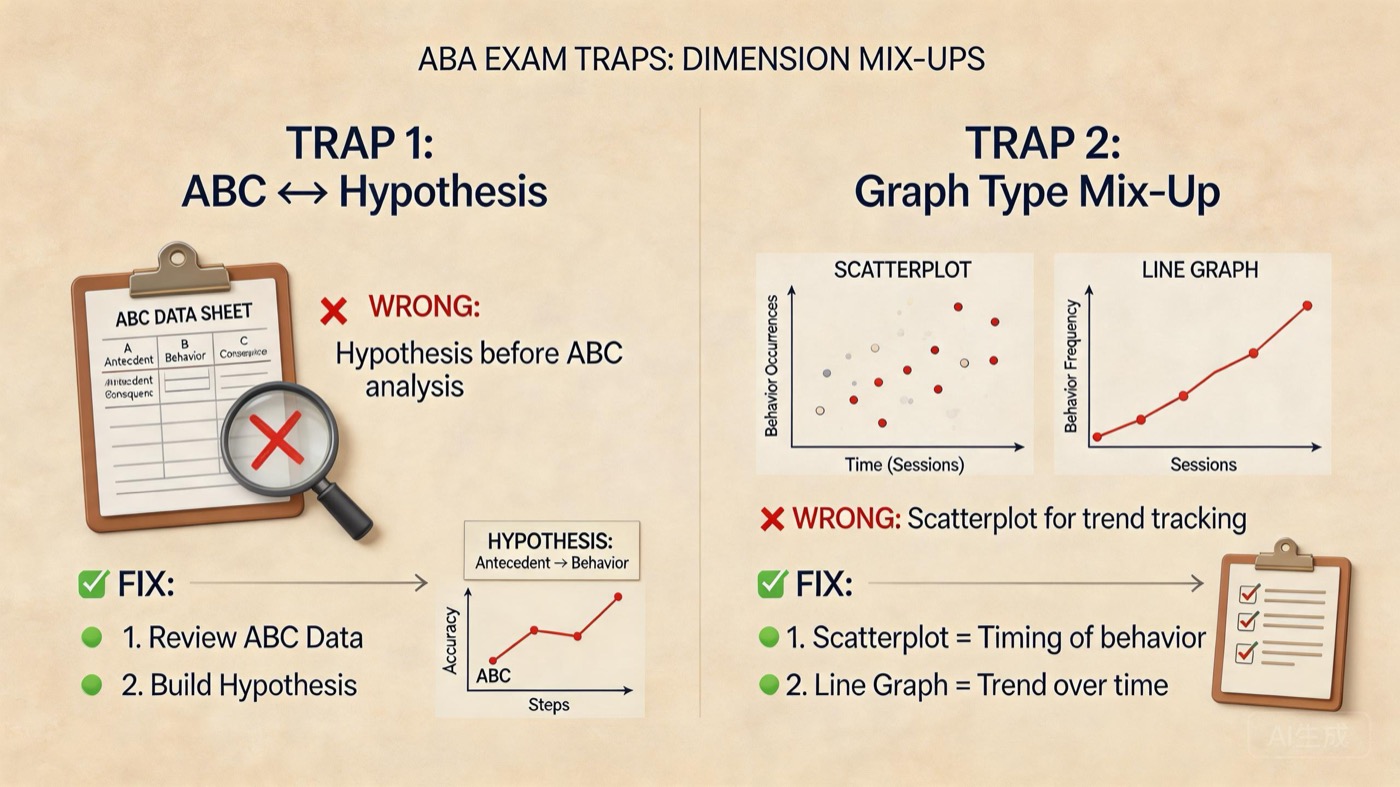
Many candidates confuse related dimensions. Here are two frequent pitfalls.
Mixing Up Effective vs. Applied
- Effective refers to the size of behavior change that is practically significant.
- Applied refers to the social importance of the target behavior itself.
- Example: Reducing a non-dangerous behavior by 90% is effective but may not be applied if the behavior is not socially important.
Additional trap: Confusing Analytical with Behavioral. Some candidates think that simply measuring behavior makes the intervention analytical. But analytical requires demonstrating experimental control through a design that shows a functional relation. Merely taking data does not satisfy this dimension.
Forgetting Generality Includes Maintenance
- Generality does not only mean across settings; it also includes over time (maintenance).
- Check for follow-up data in scenarios: if data are only collected during intervention, generality may be lacking.
- A common exam question asks: “Which dimension is missing if behavior reverts to baseline after intervention ends?” Answer: Generality.
Another common mistake is assuming that generality is automatically achieved if the intervention is effective. In reality, generality must be explicitly programmed. For example, using multiple exemplars and teaching in natural settings are strategies to enhance generality. On the exam, pay attention to whether the scenario mentions any follow-up or generalization probes.
Quick Checklist: Master the 7 Dimensions
Use this memory aid when reviewing scenarios. Ask yourself each question.
- Applied: Is the behavior socially significant for the client?
- Behavioral: Can you measure the behavior directly?
- Analytical: Is there experimental control showing the intervention caused change?
- Technological: Are procedures described so another professional could replicate them?
- Conceptually Systematic: Are you using terms from ABA principles?
- Effective: Is the change meaningful to the client and stakeholders?
- Generality: Does the change last over time and across settings?
For additional practice, explore our detailed dimension-by-dimension breakdown or review generality and maintenance strategies. For the original source, see Baer, Wolf, & Risley (1968).
Mastering the dimensions of behavior analysis will help you pass the BCBA exam and deliver quality interventions. Keep this guide handy during your study sessions. Remember, each dimension asks a critical question: Is my intervention socially significant, measurable, experimentally verified, replicable, principle-based, practically effective, and durable? If you can answer yes to all seven, you are on the path to competent and ethical practice.
Complete BCBA Exam Prep
Turn this topic into exam-day practice
Practice concepts in context with five full-length 6th Edition mock exams, two bonus practice exams, a 6th Edition study guide, and key-term flashcards—all in one $120 USD package.
Get the $120 All-in-One Prep Pack
Review everything included on the product page before ordering. No pass guarantee is implied.



