

Seven Dimensions of ABA: What Are the 7 Dimensions of ABA?
The seven dimensions of ABA form the foundational framework that defines what constitutes genuine applied behavior analysis. These criteria were first articulated in 1968 by Baer, Wolf, and Risley in their seminal article ‘Some current dimensions of Applied Behavior Analysis.’
Table of Contents
- Seven Dimensions of ABA: What Are the 7 Dimensions of ABA?
- Breaking Down Each Dimension with Examples
- Applying the Dimensions: A Worked Example
- BCBA Exam Focus: Common Traps and How to Avoid Them
- Quick-Reference Checklist for Your Study Notes
- Summary and Key Takeaways
- References
This framework serves as both a quality checklist and an ethical standard for practitioners. All seven dimensions must be present for an intervention to be considered true ABA practice.
The Original Framework for Effective Intervention
The original article established that behavior analysis must meet specific criteria to be considered ‘applied.’ These dimensions weren’t just suggestions—they represented the minimum requirements for scientific rigor and practical effectiveness.
Understanding this framework is essential for both clinical practice and BCBA exam preparation, as questions frequently test your ability to identify and apply these dimensions.
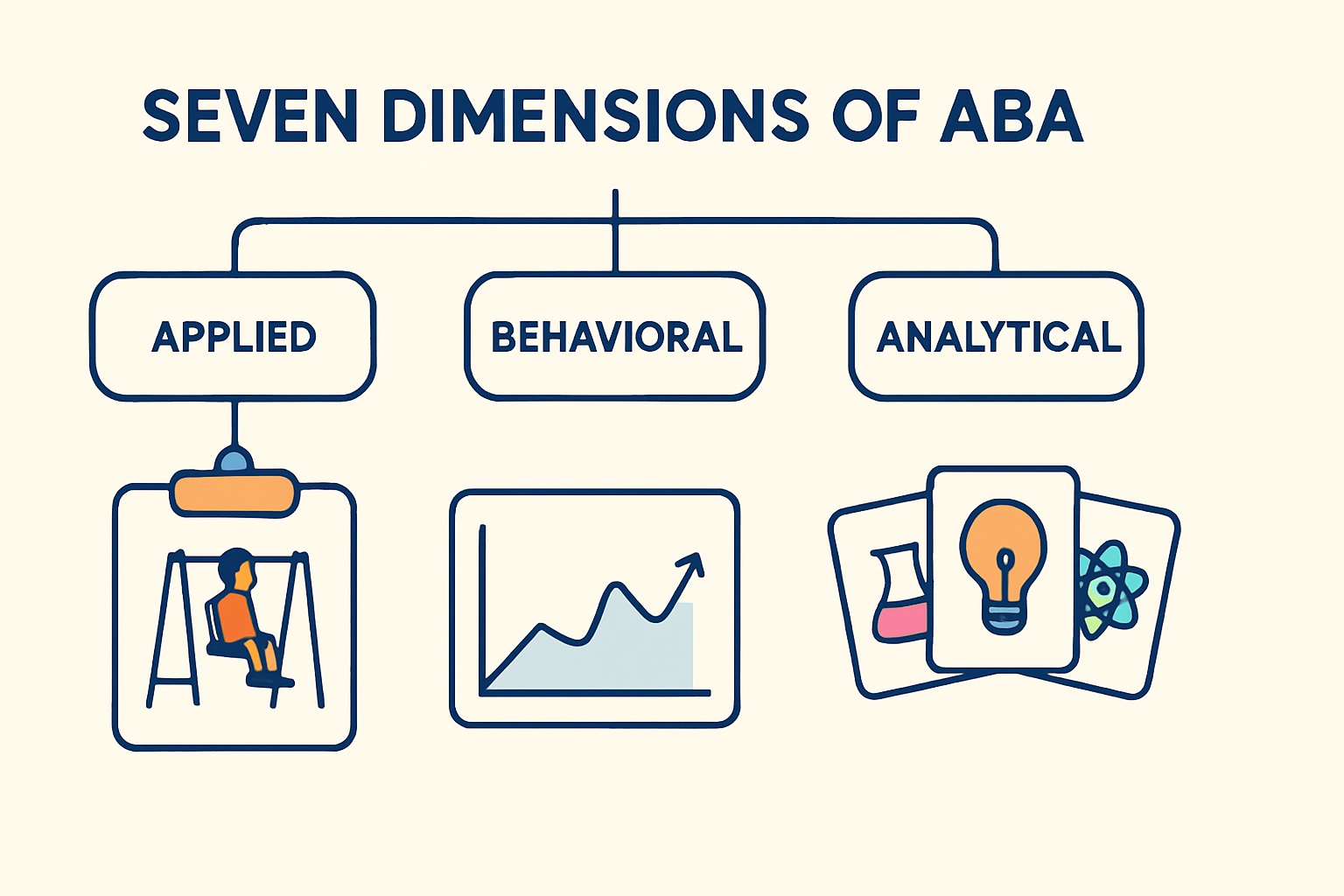
Breaking Down Each Dimension with Examples
Each dimension serves a specific purpose in ensuring interventions are scientifically sound and practically meaningful. Let’s examine each one with clear definitions and practical examples.
1. Applied: Targeting Socially Significant Behaviors
The applied dimension requires that interventions target behaviors that meaningfully improve the client’s life. This means focusing on socially significant changes rather than theoretical or trivial behaviors.
Example: Teaching a child to use a communication device to request ‘break’ instead of engaging in screaming behavior. This improves both communication and reduces family stress.
2. Behavioral: Focusing on Observable and Measurable Actions
This dimension emphasizes that ABA deals with what people actually do, not what they say they will do or how they feel. Behaviors must be observable and measurable.
Example: Counting the frequency of hand-raising during class discussions rather than rating ‘participation’ subjectively. The behavior is clearly defined and countable.
3. Analytic: Demonstrating Functional Control
The analytic dimension requires demonstrating a functional relationship between your intervention and the behavior change. This means showing that your procedures, not other variables, caused the change.
Example: Using an ABAB reversal design to show that implementing a token economy increases homework completion rates, then removing it to demonstrate the effect disappears.
4. Technological: Procedures Are Clearly Described
Technological means that procedures are described with sufficient clarity that another trained professional could replicate them. This ensures procedural integrity and consistency.
Example: A detailed teaching protocol that specifies the discriminative stimulus, prompt hierarchy, reinforcement schedule, and error correction procedures.
5. Conceptually Systematic: Grounded in Behavioral Principles
Interventions must be based on established behavioral principles like reinforcement, extinction, or stimulus control. This connects practice to the underlying science.
Example: Using differential reinforcement of alternative behavior (DRA) to reduce tantrums, which applies reinforcement principles systematically.
6. Effective: Producing Practical, Significant Change
Effectiveness means the intervention produces socially important change of sufficient magnitude. The change must be meaningful to the client and stakeholders.
Example: A self-feeding program is only effective if the client can eat independently at home, not just perform the skill during clinic sessions with maximum prompts.
7. Generality: Lasting Change Across Settings and Time
Generality means behavior change maintains over time, appears in other environments, or spreads to other related behaviors. This ensures skills are truly learned.
Example: A child using ‘please’ appropriately at school, home, and the grocery store six months after initial training, demonstrating both maintenance and generalization.
Applying the Dimensions: A Worked Example
Let’s examine how all seven dimensions work together in a single case study to understand their practical integration.
Case Study: Increasing Functional Communication
Client: 8-year-old with autism who engages in property destruction when unable to access preferred items. Current communication consists of pulling adults toward desired objects.
- Applied: Target behavior is using a picture exchange system to request items, replacing destructive behavior with functional communication.
- Behavioral: Measure frequency of independent picture exchanges and rate of property destruction episodes.
- Analytic: Use multiple baseline design across settings to demonstrate functional relationship between PECS training and reduced property destruction.
- Technological: Detailed protocol includes specific prompting procedures, reinforcement delivery, and error correction steps.
- Conceptually Systematic: Based on principles of mand training and differential reinforcement.
- Effective: Client achieves 80% independent requests across three consecutive sessions with zero property destruction.
- Generality: Client generalizes picture exchange to home setting and begins using the system to request novel items not specifically trained.
BCBA Exam Focus: Common Traps and How to Avoid Them
Exam questions about the seven dimensions often test subtle distinctions. Understanding these common pitfalls can help you avoid costly mistakes.
Distinguishing ‘Applied’ from ‘Effective’
The most frequent confusion occurs between these two dimensions. Remember: Applied refers to what you’re targeting (socially significant behaviors), while Effective refers to the outcome (practical, meaningful change).
Example trap: A program teaching shoe-tying (applied) that only works with maximum physical prompts (not effective). The target is appropriate, but the outcome isn’t meaningful independence.
Mistaking ‘Technological’ for ‘Conceptually Systematic’
These dimensions are often confused. Technological means procedures are clearly described for replication. Conceptually Systematic means interventions are based on behavioral principles.
Example trap: A beautifully written manual (technological) that uses non-behavioral strategies like ‘energy healing’ (not conceptually systematic). The procedures are clear but not grounded in behavioral science.
Overlooking ‘Generality’ as an Active Goal
Many candidates assume generalization happens automatically. In reality, generality must be actively programmed through strategies like training across multiple settings, people, and materials.
Example trap: A child who masters greetings only with their primary therapist in the therapy room. Without planning for generality, this skill won’t transfer to real-world situations.
Quick-Reference Checklist for Your Study Notes
Use this mnemonic and checklist for rapid review. Remember ‘A BAT CAGE’ for Applied, Behavioral, Analytic, Technological, Conceptually Systematic, Effective, Generality.
- Applied: Is the target behavior socially significant for the client?
- Behavioral: Can the behavior be observed and measured objectively?
- Analytic: Can you demonstrate functional control through data?
- Technological: Could another BCBA replicate your procedures exactly?
- Conceptually Systematic: Is the intervention based on established behavioral principles?
- Effective: Does the change matter practically to the client’s life?
- Generality: Does the change maintain and generalize appropriately?
For more on related concepts, see our guide on socially significant behaviors and generalization and maintenance.
Summary and Key Takeaways
The seven dimensions of ABA represent more than just a checklist—they form the ethical and scientific foundation of our practice. Each dimension serves a specific purpose in ensuring interventions are both scientifically rigorous and practically meaningful.
For exam success, focus on understanding the unique contribution of each dimension rather than memorizing definitions. Practice applying them to case scenarios and distinguishing between similar concepts. Remember that all seven must be present for an intervention to qualify as true applied behavior analysis.
As you prepare for your exam, consider how these dimensions connect to other key concepts like philosophical assumptions and evidence-based practice. This integrated understanding will serve you well both on the exam and in your future practice.



