
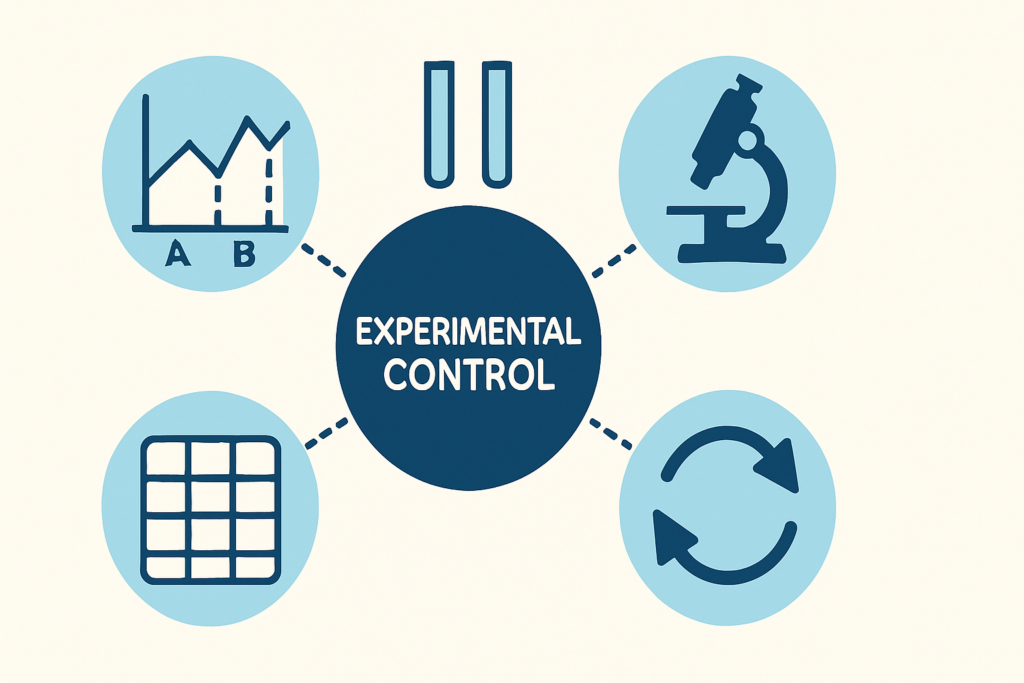
What is Experimental Control in Behavior Analysis?
Experimental control represents the foundation of scientific validation in applied behavior analysis. This concept ensures that behavior changes result from your intervention rather than external factors.
Table of Contents
- What is Experimental Control in Behavior Analysis?
- Demonstrating Experimental Control: Practical ABA Examples
- Experimental Control on the BCBA Exam: Traps and Tips
- Quick Checklist: Evaluating Experimental Control
- Summary and Key Takeaways
- References
When you achieve experimental control, you demonstrate a clear functional relationship between variables.
The Core Definition: Isolating the Variable
Experimental control occurs when a researcher shows that changes in the dependent variable (the target behavior) are a direct function of the independent variable (the intervention). This means you’ve systematically ruled out alternative explanations like maturation, history, or measurement artifacts.
It’s crucial to distinguish this from a control condition like baseline. While baseline provides comparison data, experimental control requires demonstrating that behavior changes only when your intervention is present.
Why Experimental Control Matters for BCBAs
Without experimental control, you cannot ethically claim your intervention caused behavior change. The BACB Ethics Code requires practitioners to rely on scientific knowledge, which fundamentally depends on establishing functional relationships.
Failing to demonstrate experimental control risks implementing ineffective or potentially harmful interventions. This violates both ethical standards and the scientific basis of our field.
Demonstrating Experimental Control: Practical ABA Examples
Let’s examine how experimental control works in real ABA scenarios using common single-subject designs.
Example 1: A-B-A-B Reversal Design
Consider a student with low on-task behavior during independent work. You implement a token economy system (intervention B) after collecting baseline data (A).
- Baseline (A): On-task behavior averages 40%
- Intervention (B): Token economy increases on-task to 85%
- Reversal (A): Removing tokens returns behavior to 45%
- Reintroduction (B): Tokens restore on-task to 80%
This pattern demonstrates experimental control because behavior changes systematically with the intervention’s presence and absence.
Example 2: Multiple Baseline Across Behaviors
Imagine teaching three verbal operants to a child with language delays: mands, tacts, and intraverbals.
- Baseline: Collect data on all three behaviors showing stable low rates
- Phase 1: Introduce intervention for mands only
- Phase 2: After mands improve, introduce intervention for tacts
- Phase 3: Finally, introduce intervention for intraverbals
This staggered approach shows experimental control because each behavior only improves when its specific intervention begins, ruling out maturation or general learning effects.
Experimental Control on the BCBA Exam: Traps and Tips
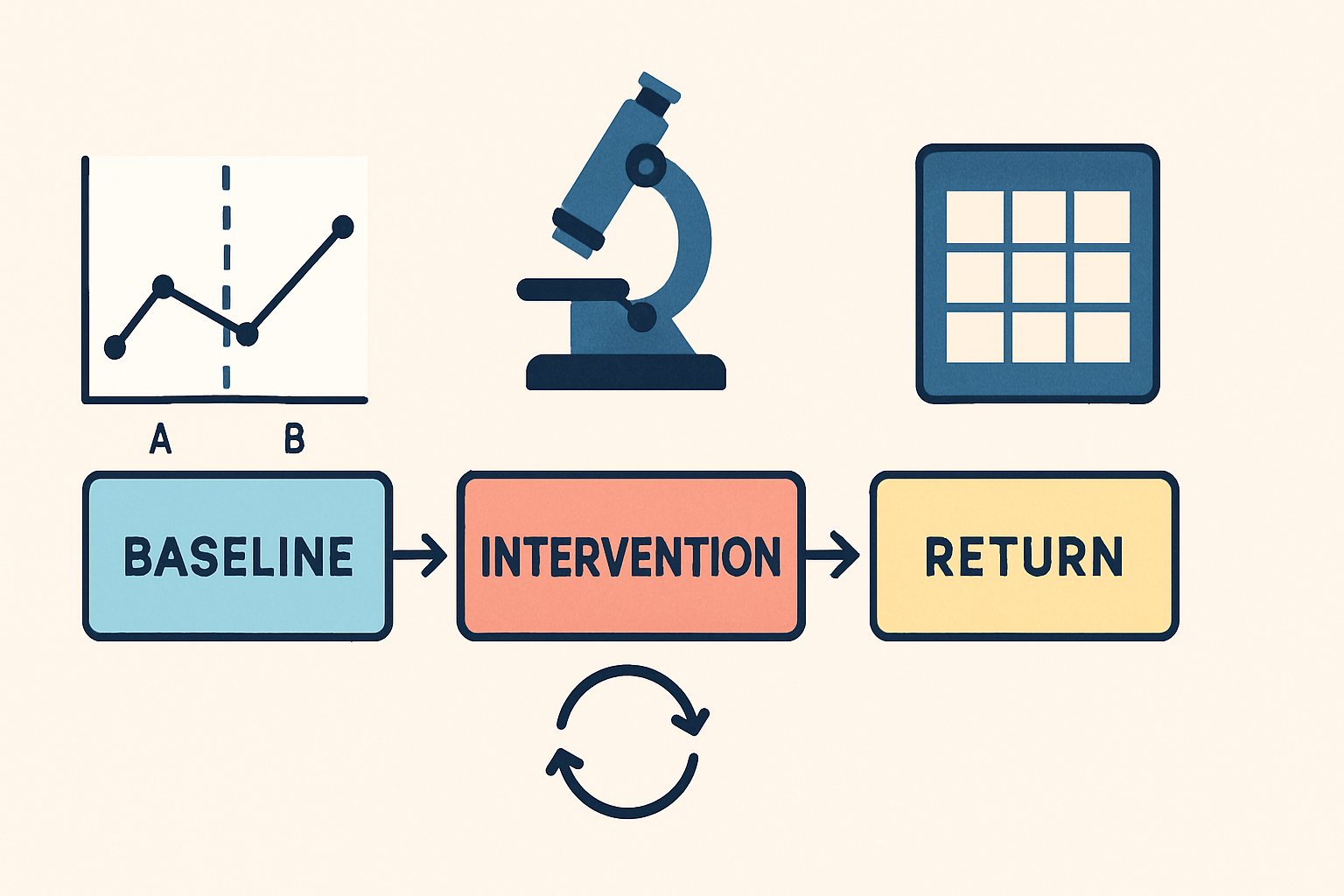
The BCBA exam frequently tests your understanding of experimental control through application questions.
Common Exam Traps and Confusions
Several misconceptions can lead to incorrect answers:
- Confusing behavioral control (compliance) with experimental control
- Mistaking a stable baseline alone as evidence of experimental control
- Selecting an A-B design when it cannot demonstrate control
- Overlooking the need to rule out extraneous variables
- Assuming correlation implies causation without experimental manipulation
Practice Application Prompts
Test your understanding with these scenarios:
A practitioner collects baseline data on aggression for 5 sessions, implements a DRO procedure for 10 sessions showing reduced aggression, and stops data collection. Has experimental control been demonstrated?
Answer: No. This A-B design cannot rule out alternative explanations like maturation or history.
Which design would best establish experimental control for self-injurious behavior that cannot be reversed for ethical reasons?
Answer: A multiple baseline design across settings or a changing criterion design.
Quick Checklist: Evaluating Experimental Control
Use this practical tool when reviewing research or your own data:
- Identify the independent variable and dependent variable
- Check for systematic manipulation of the intervention
- Look for at least three demonstrations of effect at different points in time
- Verify that behavior changes correspond with intervention changes
- Rule out plausible alternative explanations
- Ensure measurement procedures remained consistent throughout
- Confirm the design allows for replication of effects
For more on research designs, see our guide to single-subject experimental designs.
Summary and Key Takeaways
Experimental control is not just a research concept—it’s the foundation of ethical, effective ABA practice. Mastering this principle ensures your interventions are scientifically valid and client-centered.
Key points to remember:
- Experimental control demonstrates a functional relationship between intervention and behavior change
- Single-subject designs like reversal and multiple baseline provide the strongest evidence
- The BACB requires this scientific foundation for ethical practice
- Common exam errors involve confusing correlation with causation
- Always consider alternative explanations before claiming control
For comprehensive exam preparation, explore our BCBA exam prep guide and learn more about independent and dependent variables in ABA.



