
What Is Incidental Teaching in Applied Behavior Analysis?
Incidental teaching is a naturalistic teaching strategy rooted in applied behavior analysis (ABA). It capitalizes on a learner’s spontaneous interests by embedding instruction within naturally occurring activities. Unlike highly structured approaches, incidental teaching begins when the child initiates an interaction—for example, reaching for a toy or looking at a book. The therapist then uses that moment to prompt a targeted behavior and delivers natural reinforcement directly related to the child’s request.
Table of Contents
- What Is Incidental Teaching in Applied Behavior Analysis?
- Three Worked Examples of Incidental Teaching with Behavioral Functions
- Exam Relevance: Why Incidental Teaching Matters for the BCBA Exam
- Quick Checklist: Is Your Intervention Incidental Teaching?
- Summary of Incidental Teaching ABA
- References
This method is particularly effective for teaching language, social skills, and functional communication because it increases the likelihood that skills will be generalized across settings. The BACB 6th Edition Task List covers incidental teaching under naturalistic teaching strategies, making it a high-yield topic for the BCBA exam.
Key Components of Incidental Teaching
- Environmental arrangement: The therapist sets up the environment to capture the child’s interest—placing a desired item just out of reach, or providing a puzzle with a missing piece.
- Waiting for initiation: The therapist does not prompt immediately; instead, they wait for the child to initiate an interaction (e.g., a look, a reach, a vocalization). This is the defining feature of incidental teaching.
- Prompting: Once the child initiates, the therapist provides a prompt appropriate to the child’s skill level (e.g., echoic, mand, or intraverbal prompt). The goal is to evoke the target behavior.
- Natural reinforcement: The consequence is directly tied to the child’s request. If the child asks for a ball, they get the ball—not a token or a unrelated treat. This maintains the reinforcing value of the interaction.
Incidental Teaching vs. Discrete Trial Training
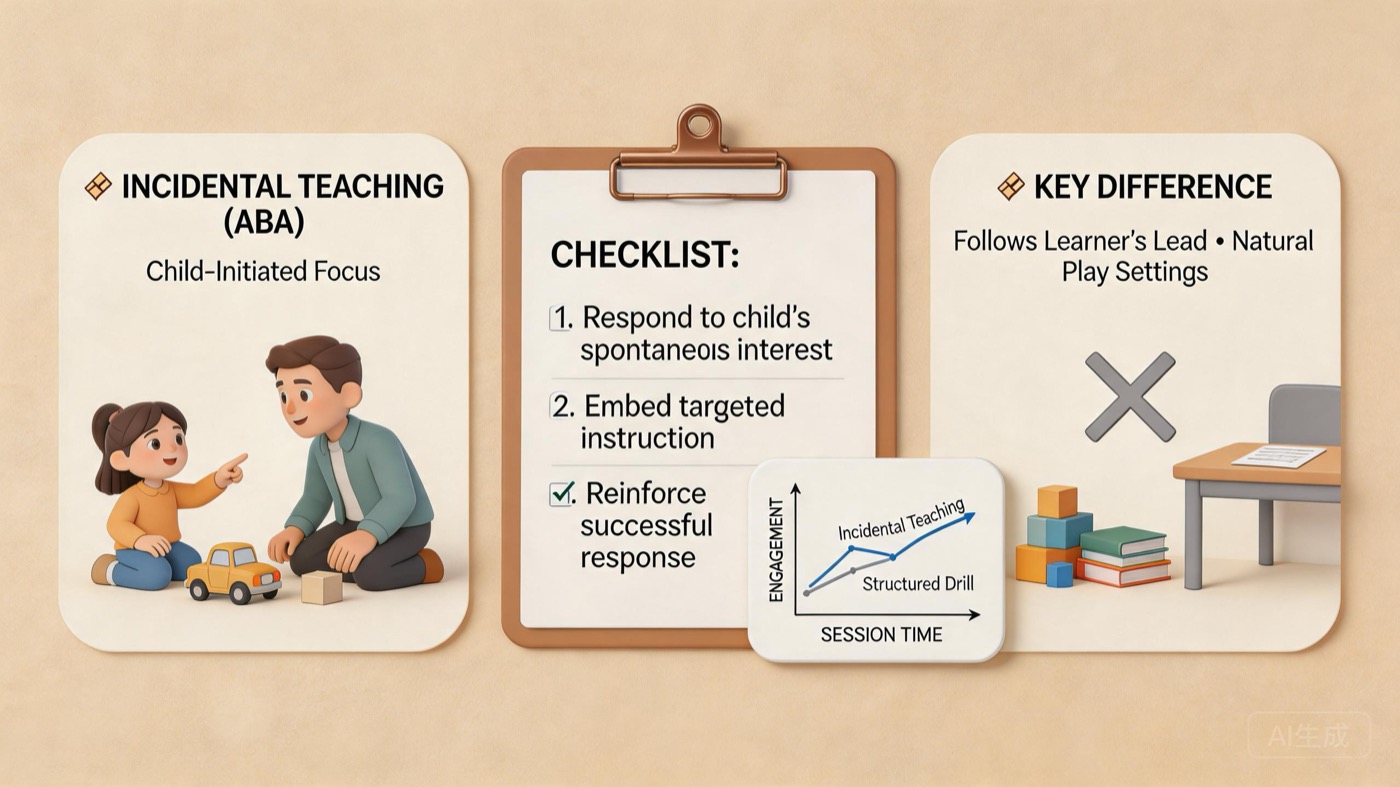
Incidental teaching is often compared with discrete trial training (DTT). The two differ on several dimensions. In DTT, the instructor controls the pace, presents repeated trials, and uses artificial reinforcers (e.g., edibles, tokens). In incidental teaching, the child initiates the learning episode, the setting is natural (e.g., play area, snack time), and reinforcement is natural and immediate.
On the BCBA exam, you may be asked to distinguish between these approaches. A key distinction is who initiates the learning opportunity. If the therapist delivers the antecedent (e.g., ‘Do this’), it is likely DTT. If the child’s own motivation starts the interaction, it is incidental teaching.
Three Worked Examples of Incidental Teaching with Behavioral Functions
Understanding how incidental teaching looks in practice is essential for both the exam and real-world application. Below are three detailed examples, each including an ABC analysis and the hypothesized function of the target behavior.
Example 1: Requesting a Preferred Item (Social Positive Reinforcement – Tangible)
Scenario: A child reaches for a toy car placed on a high shelf. The therapist stands nearby, blocking access but waiting for a vocal approximation.
- Antecedent: Toy car visible but out of reach; therapist blocks access.
- Behavior: Child says ‘car’ (approximation).
- Consequence: Therapist immediately gives the toy car.
- Hypothesized function: Access to tangibles (the toy car).
In this example, the child’s initiation (reaching) triggers the teaching opportunity. The therapist prompts only as needed—perhaps an echoic prompt ‘say car’—and then delivers natural reinforcement by handing over the car.
Example 2: Asking for Help (Social Positive Reinforcement – Attention)
Scenario: A child is working on a puzzle and gets stuck on one piece. She looks up at the therapist with a frustrated expression.
- Antecedent: Puzzle piece does not fit; child makes eye contact with therapist.
- Behavior: Child says ‘help’.
- Consequence: Therapist assists by guiding the piece into place and says ‘Good asking for help!’.
- Hypothesized function: Access to attention and assistance.
Here, the therapist waited for the child to initiate by looking, then prompted ‘help’. The natural consequence—receiving help and praise—strengthens the mand for assistance.
Example 3: Labeling a Picture (Social Positive Reinforcement – Access to Tangible)
Scenario: During free play, a child points to a book on a shelf and grunts. The therapist moves the book to a higher shelf to create a need for a clearer request.
- Antecedent: Book visible but out of reach; therapist moves it higher.
- Behavior: Child says ‘book’.
- Consequence: Therapist gives the book and says ‘Yes, that’s a book!’.
- Hypothesized function: Access to tangibles (the book).
Notice the environmental arrangement (moving the book higher) increased the likelihood of the child vocalizing. The natural reinforcement—getting the book—ensures the behavior is maintained.
Exam Relevance: Why Incidental Teaching Matters for the BCBA Exam
The BCBA exam frequently tests your ability to identify and apply naturalistic teaching strategies. Incidental teaching appears under task list items related to skill acquisition and generalization. Understanding its core features helps you eliminate wrong answers and choose the correct intervention.
Common Exam Traps
Many candidates confuse incidental teaching with natural environment teaching (NET). While both are naturalistic, NET is a broader term that can include teacher-initiated trials as long as they occur in a natural setting. Incidental teaching always requires child initiation. Another trap is forgetting the need for environmental arrangement—without it, the child may not encounter motivating opportunities. Finally, some assume incidental teaching is only for verbal behavior, but it can be used to teach any functional skill, including motor imitation and social interaction.
How to Identify Incidental Teaching in a Scenario Question
When you see a scenario on the exam, look for these cues:
- Child-initiated: The interaction begins with the child’s behavior (look, reach, vocalization).
- Natural setting: The teaching occurs during ongoing activities, not at a table with flashcards.
- Embedded learning: The target skill is taught within a meaningful context.
- Immediate natural reinforcement: The reinforcer is directly related to the child’s request.
Mock question: A therapist places a favorite snack in a clear container that the child cannot open. The child points and says ‘open’. The therapist says ‘say please’ and then opens the container. Which teaching procedure is being used? Answer: Incidental teaching. Rationale: The child initiated (pointing), the therapist prompted, and natural reinforcement (access to snack) was provided.
Quick Checklist: Is Your Intervention Incidental Teaching?
Use this checklist to evaluate whether a procedure qualifies as incidental teaching:
- Was the child’s behavior the starting point? Did the child initiate the interaction (e.g., reaching, looking, vocalizing)?
- Was the environment arranged to prompt that behavior? Did you place items just out of reach or remove a piece of a toy?
- Was reinforcement natural and immediate? Did the child receive the requested item or activity right after the response?
- Did you avoid forced trials? Did you wait for the child’s initiation rather than delivering a direct instruction?
If you can answer ‘yes’ to all four, the procedure is likely incidental teaching. If any answer is ‘no’, consider whether you are using a different strategy, such as natural environment teaching or discrete trial training.
Summary of Incidental Teaching ABA
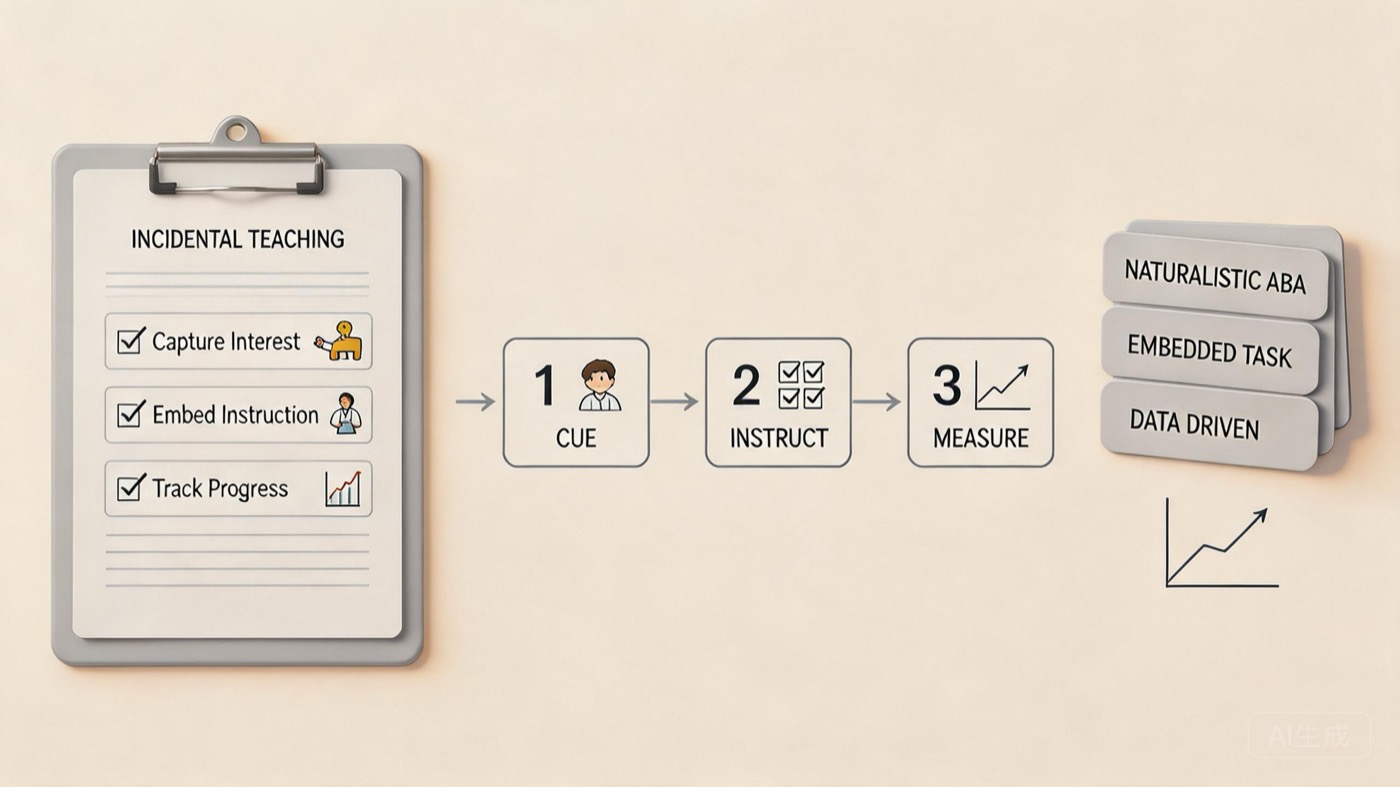
Incidental teaching is a child-led, naturalistic ABA strategy that builds on the learner’s motivation. Key points to remember for the BCBA exam: it requires child initiation, environmental arrangement, prompting, and natural reinforcement. It is distinct from DTT in terms of who initiates and the type of reinforcement used. Practically, incidental teaching promotes generalization and maintenance of skills because learning occurs in the same context where the skill will be used.
To deepen your understanding, review the natural environment training guide on our site. Incidental teaching is a subset of NET, and mastering both will help you answer exam questions with confidence. For a comprehensive review of ABA teaching strategies, explore our BCBA exam prep guide.
By integrating these concepts and practicing with scenario-based questions, you will be well-prepared for exam day. Remember: child initiation is the hallmark of incidental teaching. Keep that principle front and center, and you’ll avoid the most common pitfalls.
References
Complete BCBA Exam Prep
Turn this topic into exam-day practice
Practice concepts in context with five full-length 6th Edition mock exams, two bonus practice exams, a 6th Edition study guide, and key-term flashcards—all in one $120 USD package.
Get the $120 All-in-One Prep Pack
Review everything included on the product page before ordering. No pass guarantee is implied.



