
For the question “according to the BACB if there is an ethical complaint,” the safest exam logic is to reject a one-factor answer. A BACB ethical complaint is not reduced to one outcome. Harm to a client matters. A supervisor’s instruction may be part of the context. But professional ethics questions usually test whether the behavior analyst used a responsible decision-making process: identified the concern, considered the applicable Ethics Code standards, protected client interests, gathered facts, consulted appropriately, documented the reasoning, and took a defensible action.
Table of Contents
- In This Guide
- BACB Ethical Complaint: What the Question Is Testing
- The Current BACB Ethics Framework
- A Step-by-Step Way to Reason Through the Scenario
- What a Formal BACB Review Actually Considers
- Why Following a Supervisor Is Not a Complete Defense
- Why Harm Matters but Is Not the Only Variable
- Documentation and Response Principles
- BCBA Exam Traps and Practice Logic
- According to the BACB If There Is an Ethical Complaint FAQ
- Quick Review Checklist
- Take the Free BCBA Mock Exam
There is an important qualification. A study-question shortcut is not the same as the BACB’s current real-world enforcement procedure. In an actual matter, the BACB evaluates allegations and supporting documentation under its current Code-Enforcement Procedures. This guide separates the exam reasoning from the formal process so a learner does not memorize a misleading “the committee only looks at X” rule. It is educational information, not legal advice or a substitute for responding to a real notice from the BACB.
In This Guide
BACB Ethical Complaint: What the Question Is Testing
The wording is often written as a multiple-choice ethics question. The distractors tend to reduce professional responsibility to one outcome: whether someone was harmed, whether a supervisor gave an instruction, or whether the behavior analyst can tell an emotional story about the event. Those are incomplete frames. A behavior analyst remains responsible for applying professional standards to the situation and for taking reasonable steps to protect clients and stakeholders.
When an exam item offers “your decision-making process” as an option, read it as a prompt to consider the quality of the professional reasoning. Did the analyst recognize the ethical concern? Did they identify the people affected? Did they consult the current Code and relevant law or licensure rules? Did they assess risk, seek competent consultation, document the facts, and choose an action that serves the client’s interests? Those questions are more defensible than guessing that an investigation turns on one dramatic consequence.
Do not turn this into an absolute claim that the BACB ignores harm. Harm, risk of harm, evidence, and the specific alleged violation are all relevant. The exam distinction is that an ethical decision is judged in context, not only by whether the worst possible outcome occurred. Preventing avoidable risk is part of ethical practice even when no injury can be proven.
The Current BACB Ethics Framework
The current Ethics Code for Behavior Analysts expects certificants and applicants to know and comply with the Code and Code-Enforcement Procedures. Its ethical decision-making guidance emphasizes defining the issue, considering potential risk of harm, identifying relevant individuals, gathering documentation, identifying applicable standards, consulting resources, developing actions that reduce risk, implementing an action, monitoring the outcome, and documenting the process.
That framework explains why “decision-making process” is often the best exam-level answer when the alternatives are a single outcome or an instruction from a supervisor. The process is not a magic phrase. It must be tied to facts, applicable standards, client interests, professional competence, and follow-through.
| Possible answer frame | Why it is incomplete alone | Better reasoning |
|---|---|---|
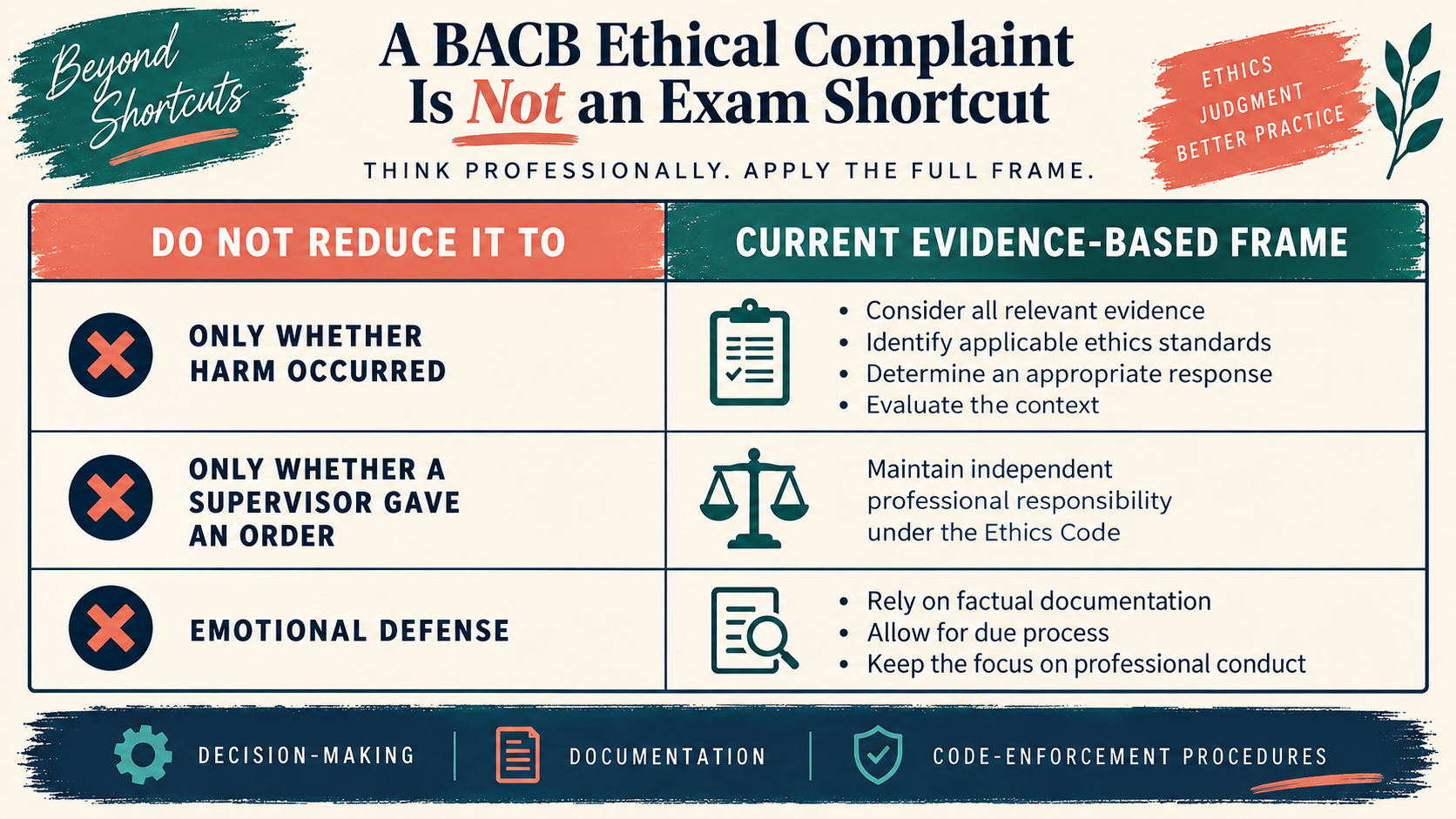
| Only whether harm occurred | An ethical concern can involve risk, misrepresentation, boundaries, documentation, competence, or failure to report even before proven injury. | Consider harm, risk, conduct, evidence, and the applicable standard together. |
| Only whether a supervisor gave an order | Delegation does not erase independent professional responsibility or the duty to address a concern. | Evaluate the instruction against the Code, competence, law, client welfare, consultation, and documentation. |
| Only the analyst’s explanation | A persuasive narrative cannot replace factual records or a fair review of the allegations. | Use contemporaneous facts, relevant records, standards, and a documented response. |
A Step-by-Step Way to Reason Through the Scenario
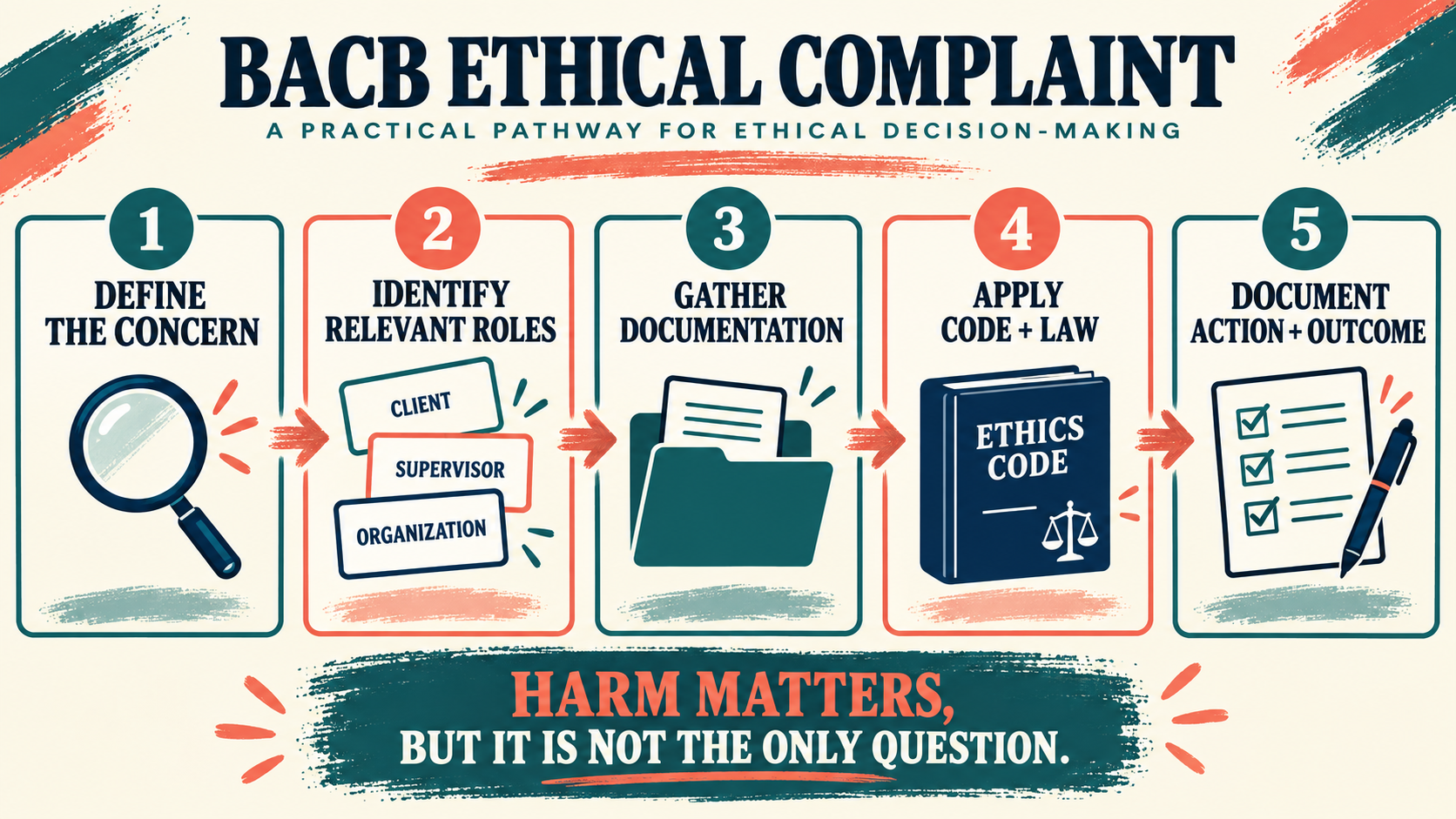
For an exam vignette, use a short internal checklist before choosing an answer:
- Define the problem. Identify the conduct, the setting, the client or stakeholder affected, and what the question actually alleges. Do not substitute a broad label such as “unprofessional.”
- Identify risk and interests. Consider immediate safety, client rights, privacy, continuity of care, informed consent or assent, and possible effects on other stakeholders.
- Find the governing standard. Separate a BACB Ethics Code standard from a state law, payer rule, employer policy, or supervisor preference. They may all matter, but they are not interchangeable.
- Gather and protect facts. Review records, dates, communications, assessment information, training records, and relevant observations. Protect confidentiality while documenting.
- Consult appropriately. Use current BACB resources, a qualified colleague, a supervisor or consultant, a licensure authority, or legal counsel when the issue requires it. Consultation does not transfer responsibility for the final professional action.
- Compare options. Prefer an action that reduces risk, protects the client’s interests, fits the Code and applicable law, and can be implemented competently.
- Document and monitor. Record what was considered, what was done, the response, and whether additional action is needed.
If an option says “because the supervisor told you to do it,” pause. A supervisor’s direction is a fact to evaluate, not an automatic ethical defense. If an option says “because no harm occurred,” pause again. No observed injury does not prove that the conduct complied with every applicable standard.
What a Formal BACB Review Actually Considers
A formal BACB ethics matter follows the current procedures published by the Board. In broad terms, the Ethics Department may review whether a notice is within jurisdiction, share an accepted notice and supporting documentation with the subject, receive the subject’s response, and conduct a review based on the submitted record. Possible outcomes are controlled by the current procedures; this article does not predict a sanction for a particular case.
The BACB’s current reporting guidance explains that an allegation should be supported with relevant documentation when available. Examples can include training or performance records, termination letters, court documents, communications, third-party investigation outcomes, photographs or videos, behavioral assessments, and intervention documents. Preserve relevant facts through appropriate, confidential channels.
For a person who receives a notice, deadlines matter. The BACB states that failure to respond by the provided deadline can lead to consequences, including automatic suspension of certification, application eligibility, or another status. A person facing a real notice should read the notice, follow the current instructions, seek qualified professional or legal advice as appropriate, and avoid relying on a study guide as a response strategy.
Why Following a Supervisor Is Not a Complete Defense
Supervision is important, but ethical responsibility remains personal. If a supervisor requests an action that appears inconsistent with the Ethics Code, client interests, scope of competence, informed consent, or law, the behavior analyst should identify the concern, seek clarification, consult appropriately, and document the steps. The safest exam answer usually favors addressing the concern rather than silently following an instruction.
This does not mean a trainee should act impulsively or publicly accuse a supervisor. The response should fit the risk and the reporting structure. A low-risk ambiguity may be resolved through clarification and consultation. A serious or immediate safety concern may require prompt protective action and escalation under applicable procedures. The analyst should not conceal records, retaliate against a reporter, or promise an outcome that only the BACB or another authority can decide.
Why Harm Matters but Is Not the Only Variable
Harm is central to client protection, and the Code directs behavior analysts to consider risk. However, ethical review is not a simple injury test. Consider a few examples:
- A misleading public statement may violate a professional standard even if no client reports immediate harm.
- A competence problem may create substantial risk before a negative outcome is documented.
- A privacy failure may expose confidential information even when the service itself was helpful.
- A failure to document or respond can obstruct continuity of care and due process.
- A restrictive or punishment-based procedure requires careful risk analysis and compliance with applicable review processes; success alone does not make the procedure ethical.
Therefore, when a question asks what a disciplinary reviewer will evaluate, think in terms of the alleged conduct, evidence, standards, context, risk, response, and professional reasoning. Do not select the option that sounds most dramatic if it ignores the rest of the record.
Documentation and Response Principles
Good documentation is factual, dated, specific, and relevant. It distinguishes what the analyst observed from what someone reported and what the analyst inferred. It includes the decision considered, the consultation obtained, the action taken, and the follow-up result when those details are relevant. It should be stored and shared according to privacy, employer, legal, and BACB requirements. For study purposes, a useful response map looks like this:
| Stage | Question to ask | Evidence or action |
|---|---|---|
| Clarify | What conduct and people are involved? | Define the allegation and protect confidentiality. |
| Evaluate | Which Code standards, laws, and risks apply? | Review the current authority and relevant records. |
| Act | Which step reduces risk and protects client interests? | Consult, report, correct, or pause the conduct as appropriate. |
| Follow up | Did the action address the concern? | Document the outcome and identify further steps. |
BCBA Exam Traps and Practice Logic
On the BCBA exam, use the current BCBA Test Content Outline and the wording of the stem. If the question is about ethical decision-making, choose the answer that reflects systematic analysis, client protection, consultation, documentation, and applicable standards. If the question is about a formal BACB case, do not invent a universal timeline or sanction; look for the answer supported by the current enforcement procedure.
Another trap is confusing an ethical code with an employer policy. An employer can impose a stricter policy, but an employer’s permission does not automatically make conduct consistent with the BACB Code or state law. A third trap is treating “I did what my supervisor said” as a reason not to think critically. Professional roles can be different, but personal accountability and client protection remain part of the analysis.
Finally, do not use an old question bank as the only authority. Ethics codes, forms, reporting channels, and enforcement procedures can be updated. Use the current BACB ethics pages for time-sensitive details and treat a practice question as a prompt to reason, not as a substitute for the source document.
According to the BACB If There Is an Ethical Complaint FAQ
Does the BACB look only at whether a client was harmed?: No. Harm and risk are important, but a review also depends on the alleged conduct, evidence, applicable standards, context, response, and current enforcement procedures. The exam-level lesson is not to reduce ethical review to one outcome.
Does following a supervisor’s instructions remove responsibility?: No. The instruction is part of the context, but the behavior analyst must still consider competence, client interests, the Ethics Code, law, consultation, and documentation. A supervisor’s direction is not a blanket defense.
What is the best answer when “decision-making process” is an option?: When the other choices reduce review to harm or obedience, “decision-making process” is usually the best exam concept because ethical practice requires contextual, documented reasoning. In real enforcement, the BACB still applies its current procedures to allegations and evidence; do not treat the phrase as a literal promise that only process is reviewed.
What should someone do after receiving a real BACB notice?: Read the notice and deadline, preserve relevant records, follow the BACB’s current submission instructions, and seek qualified ethics or legal advice when appropriate. A mock-exam explanation is not a legal response.
The strongest way to remember this topic is simple: harm matters, instructions matter as context, and professional decision-making connects the facts to the Ethics Code, client interests, evidence, action, and follow-up. For more scenario-based BCBA practice, use the free BCBA mock exam. For targeted review, use our BACB ethical complaint practice questions to apply the concept in exam-style scenarios.
Quick Review Checklist
Use this final checklist to turn BACB ethical complaint into exam-ready reasoning. The goal is not to memorize a label in isolation; it is to identify the relevant evidence and explain why the best answer fits the scenario. Key ideas to review:
- State the central definition or decision point for BACB ethical complaint in your own words.
- Identify the detail that makes BACB ethical complaint different from its closest related ABA term.
- Separate the observable facts in a scenario from assumptions that are not supported by the facts.
- Write one example and one nonexample so you can recognize the concept in a new setting.
Exam application checks:
- Ask what the question is actually requesting before comparing the answer choices.
- Mark the antecedent, response, consequence, or other evidence that supports the selected answer.
- Look for a distractor that describes a related process but does not answer the specific question.
Final self-check:
- Explain how you would verify the interpretation with clear observations or data.
- Change one detail in the scenario and decide whether your answer should change.
- Give a one-sentence rationale that a supervisor or study partner could evaluate.
Take the Free BCBA Mock Exam
If you want a low-pressure way to check your recall, use the free practice resource below. Take the Free BCBA Mock Exam



