
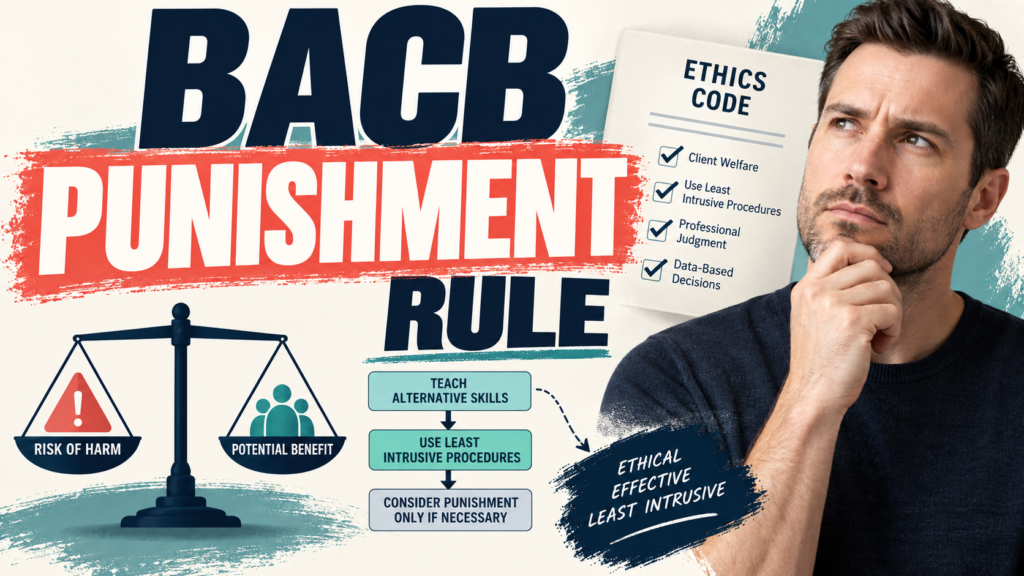
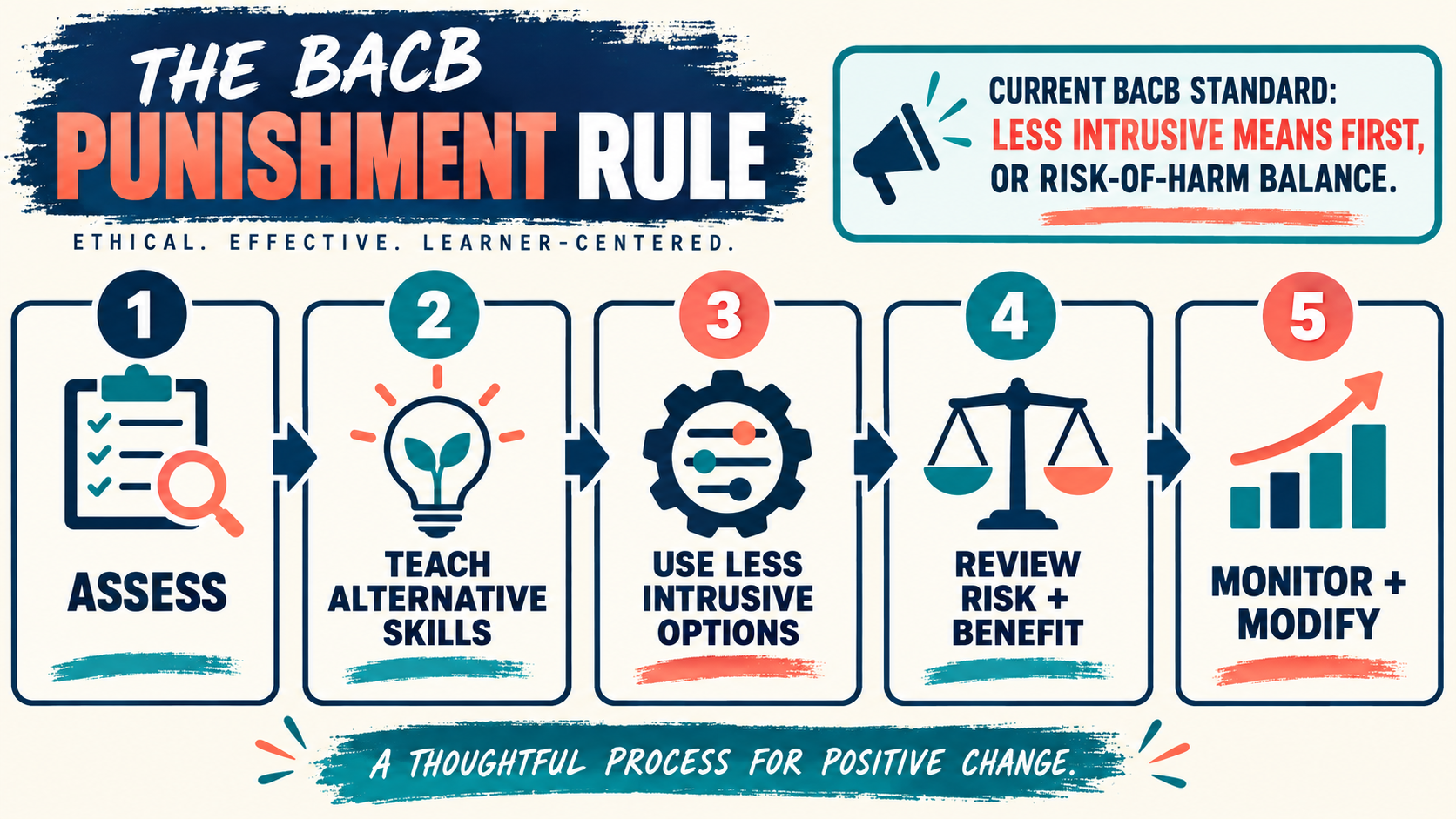
The short answer to “according to the BACB punishment” is not the old shortcut that punishment may be used only after reinforcement has failed. The current Ethics Code for Behavior Analysts gives a more careful standard: behavior analysts select interventions to minimize risk of harm, prioritize positive reinforcement, and recommend or implement restrictive or punishment-based procedures only after desired results have not been obtained with less intrusive means, or when an intervention team determines that the risk of harm from the behavior outweighs the risk associated with the procedure.
Table of Contents
- In This Guide
- What Punishment Means in ABA
- The Current BACB Standard in Plain Language
- What “Less Intrusive” Means in Exam Reasoning
- How Risk, Benefit, and Review Fit Together
- Why Continual Evaluation Is Required
- Positive, Negative, Restrictive, and Punishment-Based Are Not Synonyms
- How to Answer Punishment Questions on the BCBA Exam
- According to the BACB Punishment FAQ
- Quick Review Checklist
- Take the Free BCBA Mock Exam
That distinction is important for BCBA exam questions. “Reinforcement failed” is too vague: it does not tell you whether the intervention was function-based, implemented with integrity, acceptable to the client and stakeholders, or evaluated long enough to judge. A defensible answer considers assessment results, less intrusive alternatives, risks and benefits, review requirements, and ongoing data. This guide explains the current rule without presenting legal or clinical advice for a specific case.
In This Guide
What Punishment Means in ABA
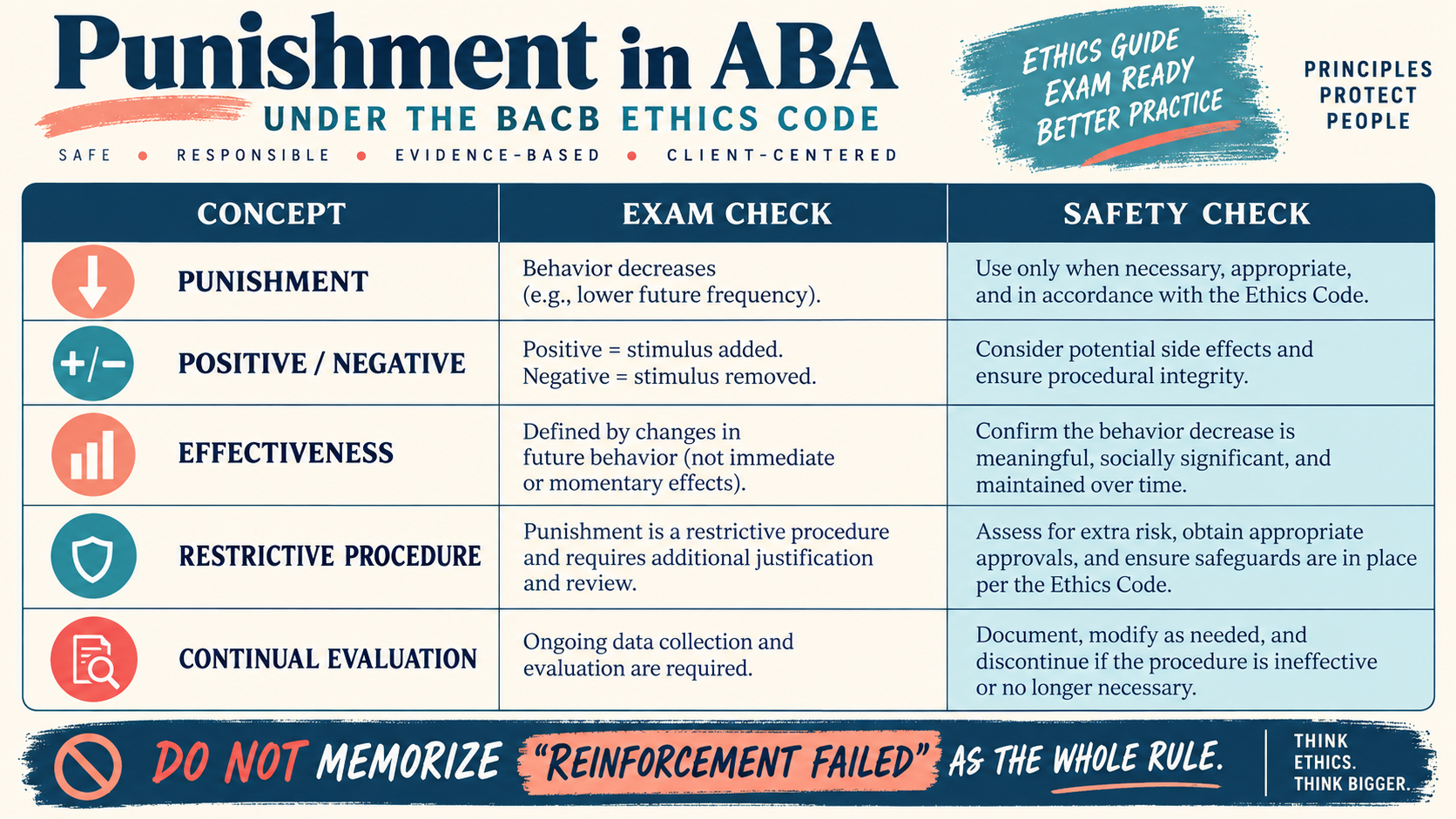
In behavior analysis, punishment is defined by its effect: after a consequence is introduced or removed, the future frequency of the behavior decreases. “Positive” means a stimulus is added; “negative” means a stimulus is removed. Those labels describe the operation, not whether the procedure is good, bad, intense, or ethically acceptable. A consequence that an adult intends to be punishing is not automatically punishment unless the relevant behavior decreases in the future.
This article is about BACB ethics and decision-making, not a repeat of the general definition. If you need a broader definition-and-example review, see the existing positive punishment in ABA guide. The new page owns the narrower question: what the current BACB standard requires before a restrictive or punishment-based procedure is recommended or implemented, and how a BCBA should reason about risk and data.
Punishment-based procedures can involve meaningful risks, including unwanted side effects, escalation, avoidance, emotional distress, damage to rapport, or a reduction in communication. The level of risk depends on the procedure, the person, the context, the behavior’s danger, and the quality of safeguards. That is why the Ethics Code frames punishment within a broader risk-minimization and intervention-design process.
The Current BACB Standard in Plain Language
Current BACB Ethics Code Standard 2.15, Minimizing Risk of Behavior-Change Interventions, can be translated into four questions:
| Question | What the analyst should examine | Exam implication |
|---|---|---|
| What is the risk? | Potential harm from the behavior and potential side effects of the intervention. | Do not treat “punishment” as automatically acceptable or automatically forbidden without context. |
| Have less intrusive means been considered? | Assessment-based teaching, reinforcement, antecedent changes, functional communication, and other appropriate options. | “Reinforcement failed” is not enough unless the alternatives were appropriate and evaluated with integrity. |
| Is there a justified risk balance? | Whether an existing intervention team determines that behavior-related risk outweighs intervention-related risk. | A high-risk case requires more than a personal preference or a supervisor’s casual request. |
| How will it be reviewed? | Required review processes, written procedures, ongoing data, and timely modification or discontinuation. | A procedure is not justified forever just because it once reduced behavior. |
The rule is therefore conditional, not a slogan. It prioritizes less intrusive and positive-reinforcement-based options while acknowledging that safety decisions can involve a more complex risk balance. The analyst must follow the current Code, applicable law and licensure rules, client and stakeholder preferences, competence limits, and any required team or human-rights review.
What “Less Intrusive” Means in Exam Reasoning
Less intrusive does not mean “try one generic reward once and then give up.” It means selecting interventions that fit the function, assessment results, client context, and likely risks. Depending on the case, the team may consider:
- Teaching a functional communication response, such as requesting a break, help, attention, or an alternative.
- Changing antecedent conditions, task difficulty, materials, transitions, schedule clarity, or access to choice.
- Teaching replacement and tolerance skills that contact reinforcement in the natural environment.
- Using differential reinforcement or other reinforcement arrangements that are functionally matched and feasible.
- Improving the quality, immediacy, magnitude, and consistency of reinforcement when data show those variables are relevant.
- Checking treatment integrity, measurement quality, generalization, and whether the procedure is being implemented as written.
- Addressing medical, sensory, communication, environmental, or contextual variables through appropriate professional collaboration.
The right answer is not always “use reinforcement” in the abstract. A BCBA exam item may test whether the analyst first conducts an assessment, identifies the maintaining variables, and designs a function-based intervention. If a reinforcement procedure was poorly matched, inconsistently delivered, or blocked by an inaccessible communication system, calling it a failure does not justify a more intrusive procedure.
How Risk, Benefit, and Review Fit Together
When a behavior creates serious risk, the analysis cannot ignore that risk. The Code permits the intervention team to consider whether the risk of harm from the behavior outweighs the risk associated with a restrictive or punishment-based procedure. This is not permission for an individual practitioner to improvise. The decision should be made by the appropriate team, supported by relevant assessment and safety information, and implemented only by people with the required competence and oversight. Risk review should include both sides of the scale:
- Behavior-related risk: What could happen if the behavior continues? Consider severity, probability, duration, setting, affected people, and the reliability of the risk estimate.
- Intervention-related risk: What could happen because of the selected procedure? Consider physical and emotional side effects, escalation, avoidance, loss of communication, dignity, relationship, and generalization.
- Alternative options: Which less intrusive options are available now, and what evidence supports or limits them?
- Safeguards: Who reviews the plan, what training is required, what stopping criteria apply, and how will adverse effects be detected?
- Client and stakeholder factors: What preferences, assent signals, cultural context, rights, and resources should shape the plan?
An exam stem that simply says “the child is difficult” does not establish a justification for punishment. A stem that describes dangerous behavior, assessment results, a team risk review, less intrusive alternatives, safeguards, and continuous evaluation is testing a different and more nuanced judgment.
Why Continual Evaluation Is Required
The current BACB standard does not stop at authorization. Behavior analysts must continually evaluate and document the effectiveness of restrictive or punishment-based procedures and modify or discontinue the intervention in a timely manner if it is ineffective. This requirement protects against an intervention becoming permanent through habit, convenience, or a single early improvement.
Data should match the decision. If the plan is intended to reduce a dangerous behavior, collect a valid direct measure of that behavior and monitor relevant side effects. Also measure the replacement skills that should make the intervention less necessary. A lower behavior count with a simultaneous loss of communication, increased avoidance, or new unsafe behavior is not a complete success story.
Review should ask whether the procedure is still necessary, effective, socially valid, and implemented with integrity. The plan should identify who reviews the data, how often review occurs, what outcome would trigger modification, and how the team will fade or discontinue the procedure when appropriate.
Positive, Negative, Restrictive, and Punishment-Based Are Not Synonyms
BCBA questions often mix labels. Positive and negative describe whether a stimulus is added or removed. Reinforcement and punishment describe whether future behavior increases or decreases. A procedure can be positive punishment, negative punishment, positive reinforcement, or negative reinforcement. “Restrictive” describes a level of intrusiveness or limitation and is not identical to the two-by-two consequence labels.
For example, removing access to a preferred activity after a response may be negative punishment if the behavior decreases. Delivering an aversive stimulus may be positive punishment if the behavior decreases, but the ethical analysis still depends on risk, competence, assessment, alternatives, review, and the current Code. Do not choose an answer because it uses a familiar label; identify the effect and then apply the ethical conditions.
How to Answer Punishment Questions on the BCBA Exam
Use this sequence when the stem asks “according to the BACB punishment” or presents the narrower statement “punishment is only used after reinforcement has failed”:
- Separate the definition from the ethics question. First decide whether the consequence is defined by a decrease in future behavior. Then analyze whether the procedure is appropriate and safe.
- Look for assessment and function. A function-based plan is stronger than a generic consequence chosen because it is convenient.
- Check the less-intrusive condition. The current standard is not a mechanical “all reinforcement failed” rule. It refers to desired results not obtained with less intrusive means or a documented risk-of-harm balance.
- Check review and data. Look for team review, required safeguards, treatment integrity, ongoing evaluation, and a plan to modify or discontinue if ineffective.
- Reject absolute distractors. “Always use punishment,” “never use punishment,” and “try one reward once” are all weaker than the contextual rule.
The official BCBA Test Content Outline is the right source for current exam scope. The Ethics Code and Code-Enforcement Procedures control the current professional standards and processes. Practice questions can be useful, but a question bank’s wording may reflect an older rule or simplify a complex standard.
According to the BACB Punishment FAQ
Does the BACB say punishment can be used only after reinforcement fails?: That sentence is an oversimplification. The current Ethics Code prioritizes positive reinforcement and less intrusive means, but it frames restrictive or punishment-based procedures around desired results, risk of harm, required review, ongoing evaluation, and timely modification or discontinuation. What does “positive” mean in positive punishment?: Positive means a stimulus is added. Punishment means the future behavior decreases. Positive does not mean good, and the label alone does not establish ethical acceptability.
What should a BCBA evaluate before recommending punishment?: The analyst should consider assessment results, function, less intrusive alternatives, potential benefits and side effects, client and stakeholder factors, competence, applicable law and review requirements, data collection, safeguards, and a plan for continual evaluation.
Can a supervisor require a punishment procedure?: A supervisor’s direction does not replace the analyst’s professional responsibility. The analyst should address concerns, consult appropriately, document, follow required safety and review procedures, and avoid implementing a procedure outside competence or applicable standards.
The exam-ready takeaway is: punishment is defined by its effect, but its ethical use requires a contextual risk-minimization process. Do not memorize “reinforcement failed” as the entire rule. For more practice applying ethics and behavior-change concepts to BCBA scenarios, use the free BCBA mock exam. For targeted review, use our according to the bacb punishment practice questions to apply the concept in exam-style scenarios.
Quick Review Checklist
Use this final checklist to turn according to the bacb punishment into exam-ready reasoning. The goal is not to memorize a label in isolation; it is to identify the relevant evidence and explain why the best answer fits the scenario. Key ideas to review:
- State the central definition or decision point for according to the bacb punishment in your own words.
- Identify the detail that makes according to the bacb punishment different from its closest related ABA term.
- Separate the observable facts in a scenario from assumptions that are not supported by the facts.
- Write one example and one nonexample so you can recognize the concept in a new setting.
Exam application checks:
- Ask what the question is actually requesting before comparing the answer choices.
- Mark the antecedent, response, consequence, or other evidence that supports the selected answer.
- Look for a distractor that describes a related process but does not answer the specific question.
Final self-check:
- Explain how you would verify the interpretation with clear observations or data.
- Change one detail in the scenario and decide whether your answer should change.
- Give a one-sentence rationale that a supervisor or study partner could evaluate.
Take the Free BCBA Mock Exam
If you want a low-pressure way to check your recall, use the free practice resource below. Take the Free BCBA Mock Exam



