

An accepting no ABA goal should describe a learner’s observable response when a preferred item, activity, or request is unavailable. A strong goal does not simply demand that a learner “obey” or stop showing emotion. It specifies what the learner can do instead: acknowledge the denial, use an appropriate communication response, move to an available option, wait when a delay is actually being taught, or continue safely with the current activity.
Table of Contents
- In This Guide
- What an Accepting No ABA Goal Should Target
- Accepting No, Delay Tolerance, and Functional Communication
- A Practical Goal-Writing and Teaching Sequence
- How to Measure Progress Without Vague Labels
- Examples of Strong and Weak Goal Language
- Common BCBA Exam Traps and Ethical Boundaries
- Accepting No ABA Goal FAQ
- Quick Review Checklist
- Take the Free BCBA Mock Exam
The most useful way to write this goal is to separate three questions: what was denied, what the learner will do after hearing “no,” and how the team will measure independence. This distinction matters because accepting no is not the same as tolerating an arbitrary demand, and it is not the same as waiting for an item that is still available later. This guide gives a measurable goal framework, teaching considerations, data options, and BCBA exam logic. A supervising BCBA must individualize any program to the learner, assent, communication system, safety plan, and setting.
In This Guide
What an Accepting No ABA Goal Should Target
“Accepting no” is a functional skill involving a denied request or unavailable item. The target response must be visible or otherwise measurable. Depending on the learner’s communication system and treatment plan, the response might include saying “okay,” using a sign or AAC button, handing back a choice card, selecting an available alternative, requesting help, or transitioning to the next activity. The learner may still feel disappointed; the goal is not to require a particular facial expression or to erase emotion.
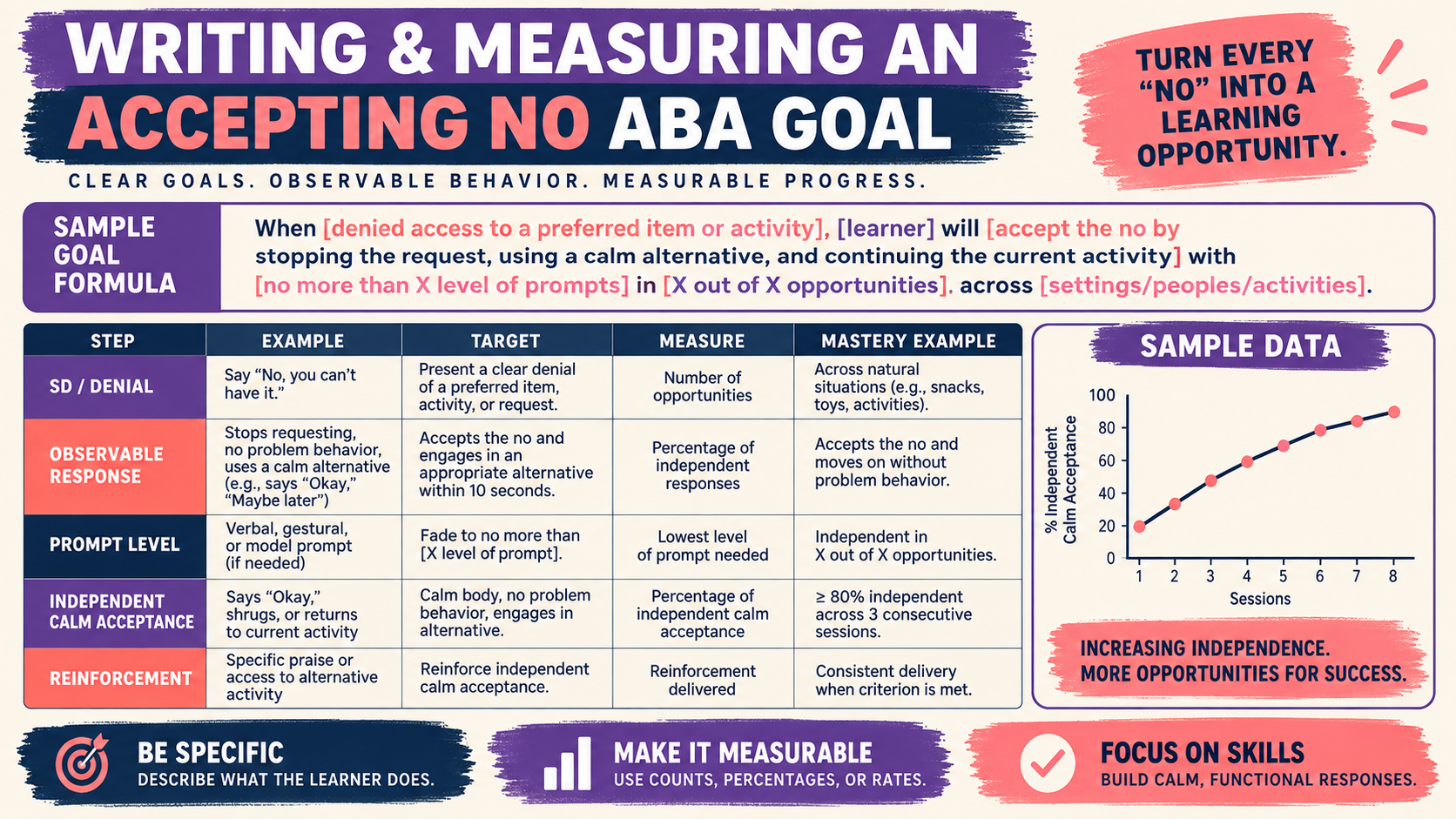
A goal becomes clinically and educationally useful when it names the situation, the response, the prompt level, the measurement rule, and the mastery criterion. For example: “When access to a selected preferred item is denied because it is unavailable, the learner will stop requesting the item, use the taught communication response, and choose an available activity within 10 seconds with no more than a gestural prompt in at least 80% of opportunities across three consecutive sessions.” That statement can be observed and scored. “Learner will handle no better” cannot.
The denied-access condition should also be genuine and predictable. If staff say “no” and then provide the original item after problem behavior, the learner may experience an inconsistent contingency. If the item is actually available after a short wait, the team should call the program delay tolerance rather than presenting it as permanent unavailability. The label matters because it tells everyone what opportunity is being arranged and what response is being reinforced.
Accepting No, Delay Tolerance, and Functional Communication
These skills are related but not interchangeable. Denied access means the requested item or activity is not available under the current condition. Delay tolerance means the learner waits for access that is expected later. Functional communication gives the learner a socially meaningful way to request, reject, ask for information, request a break, or choose an alternative. A program can include more than one of these skills, but the goal should not blur them together.
| Skill | What the situation means | Possible observable response | Measurement question |
|---|---|---|---|
| Accepting no | The requested item or activity is unavailable now. | Acknowledges the denial, uses a replacement response, and moves on. | How often does the learner respond independently after the denial? |
| Delay tolerance | Access is expected later after a defined delay. | Waits, uses the waiting routine, or engages with an available activity. | How long can the learner wait with the agreed support? |
| Functional communication | The learner needs an efficient, meaningful way to influence the situation. | Requests a break, alternative, help, information, or a different choice. | Does the response produce an appropriate communication outcome? |
This separation also protects the learner’s right to communicate a preference. The goal should not be used to make every “no” automatically correct or to suppress an appropriate protest. If an individual indicates that an activity is painful, unsafe, or inaccessible, the team must respond to that information and follow the relevant clinical and safety procedures. “Accepting no” should be a useful quality-of-life skill, not a shortcut for making a person comply with every adult decision.
A Practical Goal-Writing and Teaching Sequence
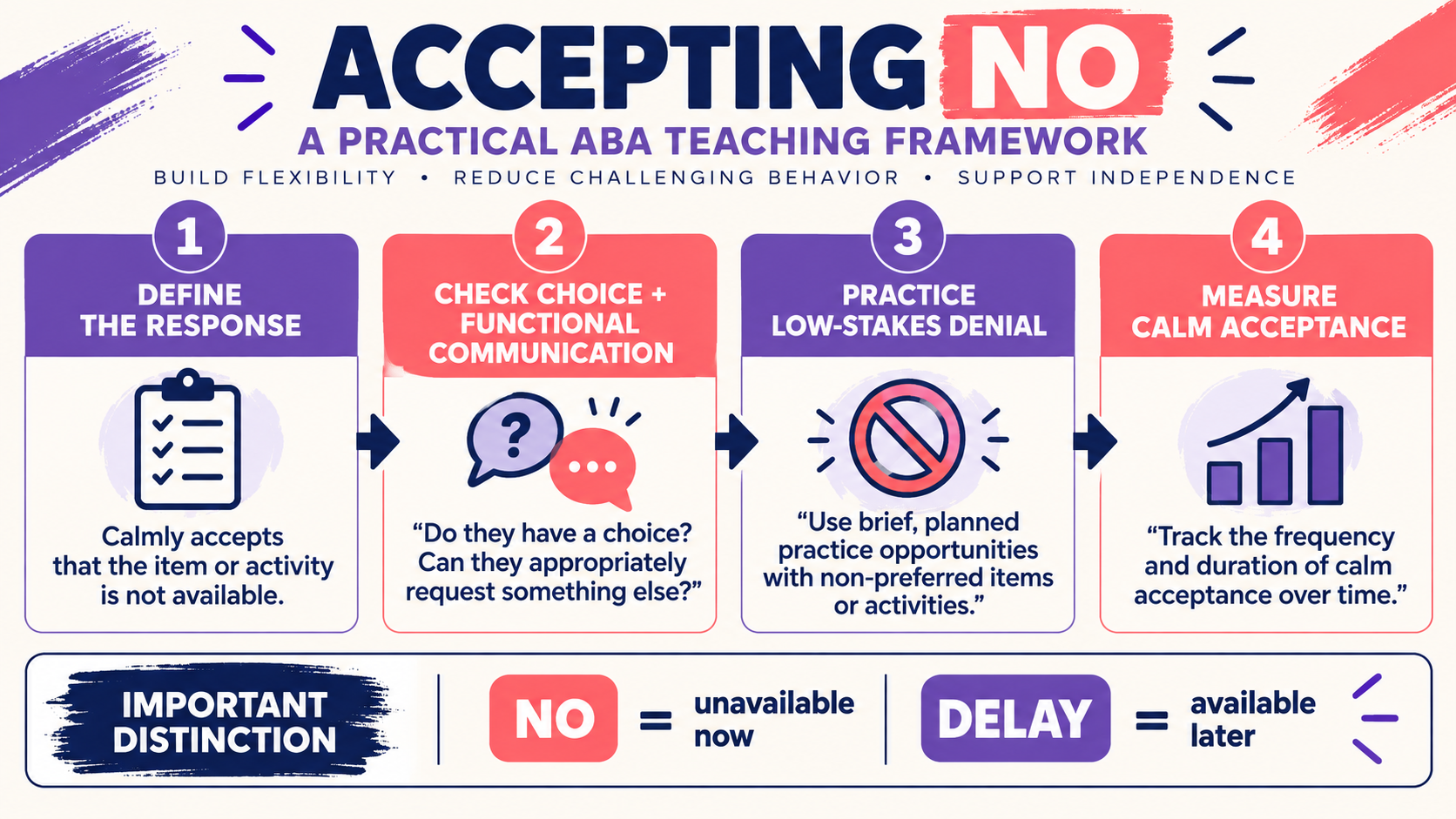
Before writing the final criterion, map the response from the opportunity to the outcome. The following sequence keeps the plan specific without assuming that one script fits every learner:
- Define the opportunity. State what can be denied, why it is unavailable, and how the denial will be communicated. Avoid creating repeated surprise denials merely to produce data.
- Check choice and communication access. Make sure the learner has an effective way to request, reject, ask for help, or select an alternative. A learner cannot demonstrate a communication goal if the response form is inaccessible.
- Choose the smallest useful response. Decide whether the initial target is saying “okay,” pressing an AAC response, handing over a card, choosing another item, or completing a transition. The response should fit the learner rather than a preferred adult script.
- Start with planned, low-stakes practice. Use situations in which the learner can contact reinforcement for the new response. Do not begin with the most valuable item, the most difficult context, or a situation involving elevated risk.
- Prompt and fade systematically. If a prompt is needed, record the level and follow the written plan for fading. A prompted acceptance is not the same as independent acceptance.
- Reinforce the replacement response. Reinforcement may involve praise, an available alternative, a break, access to a different activity, or another consequence identified in the plan. Deliver it consistently when the criterion is met.
- Generalize carefully. Vary people, settings, materials, and communication partners only when the learner is ready. Review whether the same response remains functional in each context.
A simple formula is: When [defined denied-access situation], [learner] will [observable response] within [time or transition rule], with [prompt criterion], in [opportunity criterion] across [sessions, people, or settings]. The formula is a writing aid, not a complete intervention protocol. The plan still needs an operational definition, teaching procedures, reinforcement details, data rules, and safety boundaries.
How to Measure Progress Without Vague Labels
Choose a measure that matches the goal. If the target is whether the learner accepts the denial independently, percentage of independent opportunities may be more informative than a broad rating such as “calm.” If the target includes a transition, latency to begin the replacement response or duration to complete the transition may be relevant. If problem behavior is part of the assessment, record it separately according to its operational definition rather than using “did not tantrum” as the only outcome.
| Goal component | Better data rule | Why it helps |
|---|---|---|
| Independent acceptance | Score independent, prompted, and no-response outcomes for each planned opportunity. | It shows whether progress reflects independence or increased prompting. |
| Prompt fading | Record the least intrusive prompt needed, using the plan’s prompt hierarchy. | A stable percentage can hide improvement in prompt level. |
| Transition or waiting | Record latency, duration, or completed steps when those are the actual target. | The measure maps directly to the skill being taught. |
For an example, imagine eight planned opportunities across two sessions. The learner independently uses “okay” or selects an alternative in five opportunities, needs a verbal prompt in two, and does not complete the response in one. Independent acceptance is 5/8, or 62.5%. A useful review would also note whether the independent responses occurred with low-preference items, whether the communication system was available, and whether the opportunity was truly denied rather than delayed. One percentage without context can mislead the team.
Mastery criteria should be meaningful and individualized. “80% across three sessions” is a common format, not a universal rule. The team may need a criterion across people or settings, a maximum prompt level, a safety-related condition, or a generalization test. The criterion should be chosen before reviewing the data whenever possible so that the team does not move the goalposts after seeing one convenient session.
Examples of Strong and Weak Goal Language
Compare the level of specificity in these examples:
- Weak: “The learner will tolerate being told no.” This does not define the situation, response, prompt level, or measurement.
- Stronger: “When access to a selected snack is unavailable, the learner will stop requesting the snack, select one available option, and begin the selected activity within 15 seconds with no more than a gestural prompt in 4 of 5 opportunities.”
- Weak: “The learner will remain calm.” Calm is subjective unless the plan operationally defines what observers score.
- Stronger: “Following a denial of a preferred game, the learner will use the taught break or alternative request and keep hands and materials safe while transitioning to the next activity, with the recorded prompt level.”
- Weak: “The learner will accept every adult decision.” This is overbroad and can ignore assent, communication, safety, and legitimate refusal.
- Stronger: “During the identified leisure routine, the learner will acknowledge an unavailable choice and select from the presented available options; the team will review any protest that communicates pain, fear, or an access barrier rather than scoring it as failure.”
These examples show why an accepting no ABA goal should be written around a meaningful response, not a demand for emotional performance. The plan can teach flexibility while still making room for communication and ethical review.
Common BCBA Exam Traps and Ethical Boundaries
On a BCBA exam question, first identify what is actually being denied and whether the item is unavailable or merely delayed. Then look for the dependent variable. If the stem asks for a measurable goal, select the option with an observable response and a clear criterion. If it asks about functional communication, look for an efficient response that contacts an appropriate outcome rather than a response that only suppresses behavior.
A common trap is treating a consequence as reinforcement simply because it follows an accepting response. Reinforcement is defined by its effect on future behavior, so the data must show that the response becomes more likely. Another trap is claiming that a single denial proves a behavioral function. The context can support a hypothesis, but assessment and ongoing data are needed before making a strong functional claim.
Use the BACB BCBA Test Content Outline for current exam-scope context, and remember that this educational article is not a BACB protocol or clinical directive. Any program involving significant distress, aggression, self-injury, unsafe elopement, restrictive procedures, or a suspected communication barrier requires qualified clinical oversight and an appropriate safety process.
Accepting No ABA Goal FAQ
What is an accepting no goal in ABA?: It is an individualized, measurable goal for responding to a genuine denied request or unavailable item with a defined communication, coping, choice, or transition response. The target should be observable and should not require a specific emotional expression.
Is accepting no the same as waiting?: No. Accepting no means the requested item or activity is unavailable under the current condition. Waiting or delay tolerance means access is expected after a defined delay. A plan should name which situation is being taught.
How do you measure accepting no?: Record opportunities and score the independent response, prompt level, latency, or completed transition according to the goal. Keep problem-behavior data separate when relevant, and include setting or communication context so a percentage is interpretable.
Should the goal require the learner to say “okay”?: Not necessarily. “Okay” is one possible response, but an AAC selection, sign, alternative choice, break request, or safe transition may be more functional for a particular learner. The goal should describe the response that serves the learner’s communication needs.
The best accepting no ABA goal gives the learner a clear, functional next step and gives the team a fair way to measure progress. Once the goal is specific, review the data instead of relying on impressions. When you are ready to practice similar scenario-based distinctions, use the free BCBA mock exam.
Quick Review Checklist
Use this final checklist to turn accepting no aba goal into exam-ready reasoning. The goal is not to memorize a label in isolation; it is to identify the relevant evidence and explain why the best answer fits the scenario. Key ideas to review:
- State the central definition or decision point for accepting no aba goal in your own words.
- Identify the detail that makes accepting no aba goal different from its closest related ABA term.
- Separate the observable facts in a scenario from assumptions that are not supported by the facts.
- Write one example and one nonexample so you can recognize the concept in a new setting.
Exam application checks:
- Ask what the question is actually requesting before comparing the answer choices.
- Mark the antecedent, response, consequence, or other evidence that supports the selected answer.
- Look for a distractor that describes a related process but does not answer the specific question.
Final self-check:
- Explain how you would verify the interpretation with clear observations or data.
- Change one detail in the scenario and decide whether your answer should change.
- Give a one-sentence rationale that a supervisor or study partner could evaluate.
Take the Free BCBA Mock Exam
If you want a low-pressure way to check your recall, use the free practice resource below. Take the Free BCBA Mock Exam



