

In applied behavior analysis, reinforcement assessment tests whether a consequence changes a specific behavior under defined conditions.
Table of Contents
- What Is Reinforcement Assessment?
- Why Preference Is Not Enough
- Common Methods for Conducting a Reinforcement Assessment
- How to Measure Reinforcer Strength
- Practical Considerations When Conducting a Reinforcement Assessment
- Interpreting Data and Determining a Functional Relation
- Ethical and Practical Importance in Intervention Design
- Common Traps to Avoid
- Study Checklist for Reinforcement Assessment
- Conclusion
- Reference
What Is Reinforcement Assessment?
Reinforcement assessment is a structured evaluation of stimuli to determine whether they function as reinforcers for a specific behavior under current conditions. Unlike a preference assessment, which identifies items a person may select or approach, a reinforcement assessment empirically tests whether presenting a stimulus contingent on a response increases the future probability of that response. This distinction is essential because a preferred item may not strengthen behavior.
Preference assessments, such as paired-choice or multiple-stimulus without replacement, are often a first step. They rank stimuli based on approach or selection. However, they rely on momentary preference, which can be influenced by satiation, deprivation, or instructional context. A child may choose a tablet every time but may not work for it if access is freely available or if the response effort is high. Therefore, reinforcement assessment provides a more robust method to identify effective reinforcers.
Why Preference Is Not Enough
Preference assessments measure what an individual selects or approaches. They do not measure the reinforcing effect of a stimulus on behavior. The only way to confirm that something is a reinforcer is to demonstrate that contingent delivery increases the targeted behavior over baseline. Without this empirical test, practitioners risk using stimuli that are liked but not functional.
Consider an original example: A teacher interviews a student with autism and finds that she loves stickers with unicorns. A preference assessment confirms she picks the stickers over other items. However, when the teacher uses stickers as a reward for completing math problems, the student’s completion rate does not improve. The stickers are preferred but not reinforcing. A reinforcement assessment would reveal that another stimulus, such as 5 minutes of drawing, does increase the behavior.
This example illustrates a common trap: equating preference with reinforcement. Preference can be a useful screening tool, but it does not substitute for direct measurement of behavior change. A reinforcer is defined by its effect on behavior, not by its appearance or the individual’s stated preference. Therefore, reinforcement assessment is a necessary step in intervention planning.
Common Methods for Conducting a Reinforcement Assessment
Single-Operant Arrangements: In a single-operant arrangement, one potential reinforcer is tested at a time. The participant has access to a single response that produces the stimulus. Baseline sessions measure responding without the stimulus, and test sessions measure responding when the stimulus is delivered contingent on the response. If responding increases during test sessions, the stimulus is likely a reinforcer.
For example, a therapist places a lever on a table. In baseline, pressing the lever produces nothing. In the test, pressing the lever produces a token for 30 seconds. If the participant presses the lever more frequently during the test than during baseline, the token is likely reinforcing. This method is simple and can be used with individuals who have limited verbal skills.
This method is simple, but it may miss relative value when competing options are available.
Concurrent Schedules: Concurrent schedules present two or more response options simultaneously, each associated with a different stimulus. The participant can allocate responses across options. The schedule that receives the majority of responses indicates which stimulus is more reinforcing. This method is more efficient because it directly compares stimuli.
For instance, a child is presented with two buttons on a screen. Pressing the left button produces access to a video, while pressing the right button produces a small toy. The child must choose which to press. Over multiple sessions, if the child reliably presses the left button more often, the video is more reinforcing than the toy. This allocation provides a clear measure of relative reinforcer strength.
Concurrent schedules can also be used to assess the effects of different magnitudes or delays. They require that the participant can switch between options and respond reliably. Data are typically graphed as cumulative responses per option, allowing visual inspection of preference.
Progressive Ratio Schedules: Progressive ratio (PR) schedules systematically increase the number of responses required to obtain the reinforcer. The point at which the participant stops responding, called the breakpoint, is used as an index of reinforcer strength. A higher breakpoint suggests a more potent reinforcer.
For example, a researcher asks an adult with brain injury to complete puzzles. Initially, one puzzle piece earns a coffee break. As the requirement increases, the participant must complete 5, 10, 15, then 20 pieces. If the participant stops when the requirement reaches 20, the breakpoint is 20. Comparing breakpoints across stimuli helps identify which stimulus maintains responding under increasing response costs.
PR schedules are particularly useful for evaluating reinforcer effectiveness and for comparing stimuli along a dimension of strength. They are more effortful for the participant and may not be suitable for all individuals, but they provide a quantitative measure.
How to Measure Reinforcer Strength
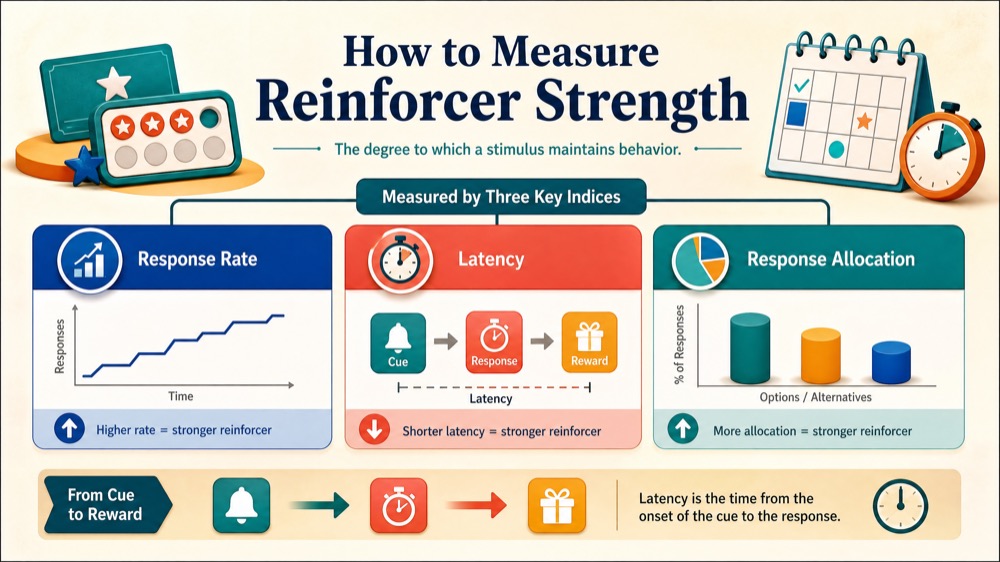
Reinforcer strength refers to the degree to which a stimulus maintains behavior. It can be measured through several indices, each providing different information. The most common measures are response rate, latency, and response allocation. Response rate is the number of responses per unit of time. In a single-operant assessment, a higher rate during the test condition compared with baseline indicates stronger reinforcement. In concurrent schedules, the proportion of responses allocated to each option reflects relative strength. For example, if a participant chooses the video option 90% of the time, that video is a stronger reinforcer than the toy.
Latency is the time from the onset of an opportunity to the first response. Shorter latencies to respond for a stimulus suggest higher motivation. However, latency alone can be confounded by other factors such as response effort. Therefore, it is often used in combination with response rate.
Response allocation across conditions is a powerful indicator. In concurrent schedules, the participant distributes behavior between options. By systematically varying the schedule requirements, one can determine the relative value of each stimulus. Progressive ratio breakpoints also measure strength by indicating how much work the individual is willing to perform.
When presenting results, graphs of response rates across conditions are essential. A typical graph displays response rate on the y-axis and sessions on the x-axis, with separate lines for baseline and test conditions. Visual inspection can reveal a clear differentiation: if response rates during test sessions are consistently higher than baseline, and there is limited overlap, a functional relation is evident. Statistical methods may also be applied, but visual analysis is standard in ABA.
Practical Considerations When Conducting a Reinforcement Assessment
- Session duration: Sessions should be long enough to allow behavior to occur but not so long that satiation or fatigue confounds results. Typically, sessions last 5–15 minutes, but duration should be adjusted based on the individual and the response.
- Satiation: Frequent access to a stimulus can reduce its reinforcing value. To minimize satiation, provide limited access during sessions and rotate stimuli across conditions or days.
- Stimulus variety: Using a variety of potential reinforcers increases the chance of finding an effective one. However, too many options can be overwhelming. Start with a preference assessment to narrow the field.
- Individual differences: Reinforcers are highly individual. What works for one person may not work for another. Always conduct assessments within the context of the person’s current preferences and needs.
Plan sessions that are long enough to observe responding but short enough to limit fatigue and satiation. Rotate stimuli when appropriate, keep response requirements clear, and consider individual differences in communication, motor skills, preference history, and access to competing activities. A brief pilot can reveal whether the arrangement produces a measurable outcome before a longer comparison is scheduled.
Interpreting Data and Determining a Functional Relation
After collecting data, the next step is to interpret the results. The primary goal is to determine whether a stimulus functions as a reinforcer. This is established by demonstrating a functional relation between the stimulus delivery and the behavior change.
In a single-subject design, such as an ABAB design, you would alternate baseline and test conditions. If behavior consistently increases when the stimulus is delivered and decreases when it is removed, you have evidence of a functional relation. Visual analysis of graphs is critical. Look for changes in level, trend, and variability. For concurrent schedules, the interpretation focuses on response allocation. If the participant consistently chooses one option over others, that stimulus is more reinforcing. However, you must also consider schedule requirements and potential side biases. Criteria for interpreting differential responding include:
- At least 50% change in response rate from baseline to test condition.
- Clear separation of data paths with minimal overlap.
- Consistency across repeated sessions.
It is important to replicate the assessment to confirm reliability. A single administration is not sufficient to identify a reinforcer, as preferences and environmental factors can change. Therefore, periodic re-assessments are recommended, especially if behavior does not improve as expected.
Ethical and Practical Importance in Intervention Design
Reinforcement assessment is not just a technical exercise; it has significant ethical and practical implications. Using stimuli that are not actually reinforcing can lead to ineffective interventions, wasted time, and frustration. Conversely, identifying powerful reinforcers can lead to faster behavior change and better outcomes.
Ethically, behavior analysts are required to use evidence-based practices and to select interventions that are likely to be effective. The BACB Ethics Code for Behavior Analysts (2020) emphasizes the use of assessment data to guide intervention. While the code does not specifically mandate reinforcement assessment, it requires that interventions be based on data. Therefore, conducting a reinforcement assessment is a best practice. Moreover, reinforcement assessment respects client dignity by ensuring that the stimuli used are meaningful and effective for that individual. It avoids assuming that a token, edible, or activity is a reinforcer without evidence.
Common Traps to Avoid
- Assuming a preferred item is automatically a reinforcer.
- Treating preference assessment and reinforcement assessment as the same thing.
- Conducting only one administration of an assessment.
- Limiting assessments to clinical settings; they can be done in schools, homes, and community.
- Relying solely on progressive ratio schedules; other methods are valid.
- Expecting the same assessment method to work for everyone.
Study Checklist for Reinforcement Assessment
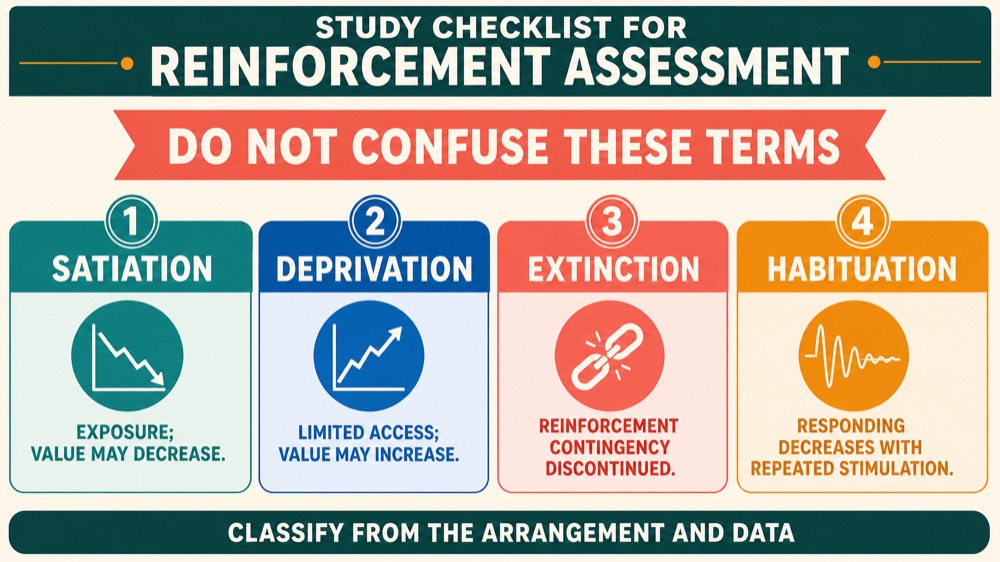
- Define reinforcement assessment and explain its purpose.
- Distinguish between preference and reinforcement.
- Describe at least three methods (single-operant, concurrent, progressive ratio).
- Explain how to measure reinforcer strength using response rate, latency, or allocation.
- List practical considerations (satiation, session duration, variety, individual differences).
- Interpret graphs showing differential responding across conditions.
- Relate reinforcement assessment to ethical practice.
Conclusion
Ready to test your understanding? Take our free BCBA mock exam and get instant feedback on your performance. It’s a great way to identify areas for further study, including topics like reinforcement and motivation. For more on related concepts, see our guide on stimulus control in ABA and stimulus generalization.



