
Quick answer: ABA therapy parent training is structured coaching that helps parents and caregivers use practical, behavior-analytic strategies during everyday routines. A BCBA or qualified behavior professional may explain a plan, model a skill, watch the caregiver practice, give feedback, and review data. The goal is not to turn a parent into a therapist. It is to help the family understand what the child is communicating, make routines more predictable, teach useful replacement skills, and support progress across the places where life actually happens.
Table of Contents
- What Is ABA Therapy Parent Training?
- What Parent Training Is—and What It Is Not
- How Does an ABA Parent-Training Session Work?
- What Goals Can Parent Training Address?
- How Does Behavior Skills Training Fit In?
- What Data Should Parent Training Use?
- How Does Caregiver Coaching Generalize Across Routines?
- How Do Parent-Training Formats Compare?
- What Should Families Ask an ABA Parent-Training Provider?
- What Consent and Ethical Boundaries Matter?
- How Do Funding and Scheduling Work?
- ABA Therapy Parent Training FAQ
- Key Takeaway
- Take the Free BCBA Mock Exam
Parent training can be part of a broader ABA service, a caregiver-coaching visit, consultation, or a focused teaching plan. The exact format varies by child, family priorities, provider model, funding pathway, and location. Before a program begins, clarify what the caregiver will learn, how much practice is expected, who supervises the plan, how the child’s assent and preferences are considered, and how the team will decide whether the approach is helping.
What Is ABA Therapy Parent Training?
ABA therapy parent training applies behavior-analytic teaching to the routines a family wants to improve. Those routines might include getting dressed, communicating a request, starting homework, preparing for bedtime, playing with a sibling, tolerating a change, completing a self-care step, or responding safely in the community. The provider should define the target in observable terms and connect it to a meaningful family outcome.
In federal special-education language, parent counseling and training can refer to services that help parents understand a child’s special needs and support implementation of an individualized education program in certain circumstances. The IDEA regulation on parent counseling and training is useful context, but it does not mean that every ABA parent-training session is an IEP service or automatically covered by a school district. A well-defined parent-training plan should make several things visible:
- the routine or skill that matters to the child and family;
- the observable response the team wants to teach or support;
- the caregiver actions that will be practiced, not just broad advice;
- the type of prompt, reinforcement, visual support, or environmental change being considered;
- the data that will show whether the routine is becoming easier or more independent; and
- the process for adapting the plan when it is burdensome, ineffective, or not respectful of the child.
What Parent Training Is—and What It Is Not
Parent training is collaborative skill-building. A caregiver may learn how to offer a clear choice, arrange materials, wait for communication, reinforce a replacement response, prompt a task step, record a simple measure, or respond consistently to a predictable pattern. The caregiver remains the child’s parent, not an unpaid employee responsible for delivering every clinical procedure.
It is also not a promise that one technique will stop every challenging behavior. Behavior can be affected by communication access, sleep, pain, sensory needs, task difficulty, relationships, environment, and many other variables. A responsible provider asks what the child may be communicating and whether the proposed teaching makes the routine safer, more understandable, and more usable.
How Does an ABA Parent-Training Session Work?
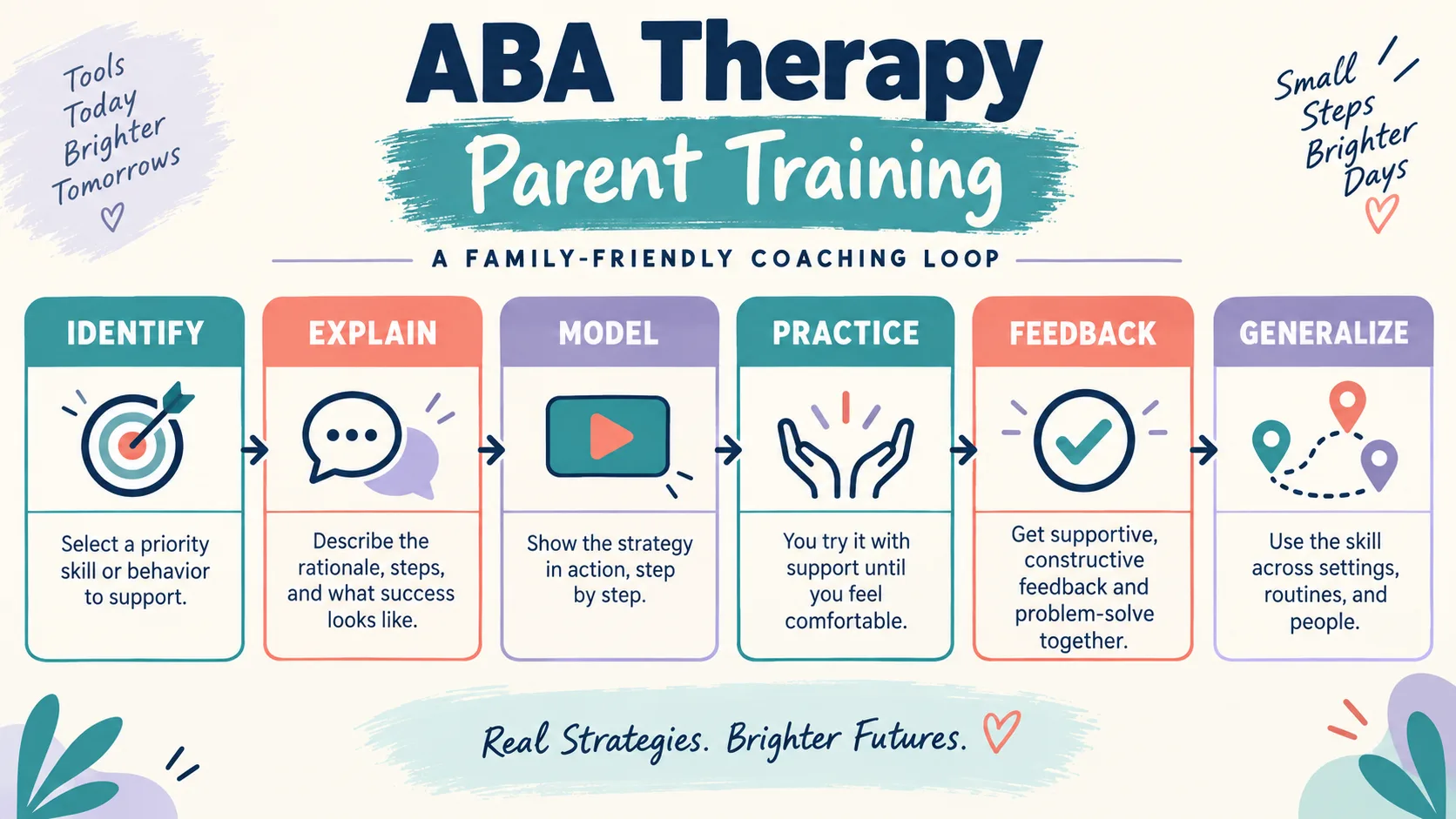
A session should begin with the family’s current priorities. The provider may ask what happened since the last visit, observe a routine, review a small amount of data, and identify one situation to analyze. The caregiver’s description is important evidence because many routines unfold when a clinician is not present.
The provider can then explain the skill or behavior in plain language. Instead of saying “increase compliance,” the team might define a target such as “the child requests help using speech, a device, or a gesture within one minute of a difficult task.” A precise definition makes the plan easier to teach, measure, and revise.
Next comes modeling and rehearsal. The clinician demonstrates a step, the caregiver practices it in a realistic routine, and the clinician gives specific feedback. The team may adjust the materials, shorten the task, change the prompt, or build in a way for the child to request a break. Practice should be manageable enough that the caregiver can use it between visits without turning the whole day into therapy.
The session should end with a small action plan: what to practice, when to practice it, what to record, what would count as a success, and when to contact the provider. If the plan depends on perfect timing or constant adult attention, say so. A good coach redesigns the plan around the family’s real capacity rather than treating feasibility as a character test.
What Goals Can Parent Training Address?
Goals should be individualized and meaningful. Families may choose goals related to communication, transitions, daily living, play, sleep routines, safety, school preparation, community participation, or reducing a barrier that makes ordinary activities difficult. The target should describe a useful skill or a safer way to participate, not simply a preference for quietness or adult convenience.
For example, a family might work on requesting a break before leaving a task, following a three-step morning routine with a visual schedule, asking for a preferred item, waiting for a short turn, or moving from one activity to another with less distress. The provider should also ask whether the child can refuse, choose an alternative, communicate discomfort, and use the skill with different people.
Family priorities can change. A caregiver who initially asks for help with mealtime may later identify sleep, sibling play, or a new school transition as more urgent. Review goals regularly so the program remains relevant rather than continuing a target only because it is easy to count.
How Does Behavior Skills Training Fit In?
Many caregiver-coaching plans use elements of behavior skills training: instruction, modeling, rehearsal, and feedback. Instruction explains what to do and why. Modeling shows the action in context. Rehearsal lets the caregiver practice. Feedback identifies what worked and what to change. This cycle is more useful than handing a family a long document and assuming that reading it creates fluency.
Training should be adapted to the caregiver’s language, schedule, learning style, and available resources. Use plain examples, ask the caregiver to explain the plan back in their own words, and make sure the procedure can be used without unsafe physical demands or unrealistic materials. If another adult will implement the plan, include that person when possible or create a clear handoff.
What Data Should Parent Training Use?
Data do not need to be complicated to be useful. A family and provider might track how often a child requests help, how long it takes to begin a routine, how many steps are completed independently, how often a replacement response occurs, or whether a routine ends safely. The measure should answer a decision question and fit naturally into family life.
Ask how much recording is expected. If a caregiver must stop a bedtime routine to write down every event, the measurement plan may need revision. A brief tally, a rating with clear anchors, or a sample of opportunities may be sufficient for a first decision. The provider should review the data, explain what they mean, and change the plan when progress is flat or the cost to the family is too high.
Progress also includes quality and generalization. A child may complete a task only with heavy prompts, only with one caregiver, or only when a preferred item is immediately available. Look at independence, communication, flexibility, safety, and the child’s experience—not one percentage in isolation.
How Does Caregiver Coaching Generalize Across Routines?
Generalization means a useful skill carries over to new people, materials, settings, and situations. Parent training can support this by practicing the same communication response during dressing, meals, play, and community routines. The provider might begin with one predictable context, then gradually vary the adult, location, materials, or level of distraction.
Generalization should not mean forcing the child to perform everywhere before the skill is stable. Plan small changes, observe the child’s response, and keep an effective way to request help or a break. If a strategy works at home but not at school, ask whether the instruction, materials, communication system, reinforcement, or environmental demands are different. The answer may be a coordination problem rather than a motivation problem.
How Do Parent-Training Formats Compare?
Parent training may happen in the home, clinic, school-planning context, community, or through telehealth when permitted and clinically appropriate. The label matters less than the actual coaching, supervision, data, and opportunity to practice. Use this comparison as a starting point, not as a promise that one format is best.
| Format | Often useful for | Verify | Watch for |
|---|---|---|---|
| Home coaching | Bedtime, meals, play, self-care, and caregiver practice in natural routines | Privacy, family schedule, supervision, and realistic implementation demands | Treating the home as a clinic or ignoring household boundaries |
| Clinic coaching | Structured modeling, concentrated teaching, and planned rehearsal | How the plan transfers to home, school, and community routines | A skill that depends on clinic materials or staff |
| School collaboration | School transitions, communication, participation, and consistent routines | Consent, educational roles, data sharing, and IEP boundaries | Assuming outside clinical services control school decisions |
| Virtual coaching | Remote consultation, observation, data review, and access to a BCBA | Technology, privacy, local rules, hands-on support, and a backup plan | A camera view that misses important context or distress signals |
What Should Families Ask an ABA Parent-Training Provider?
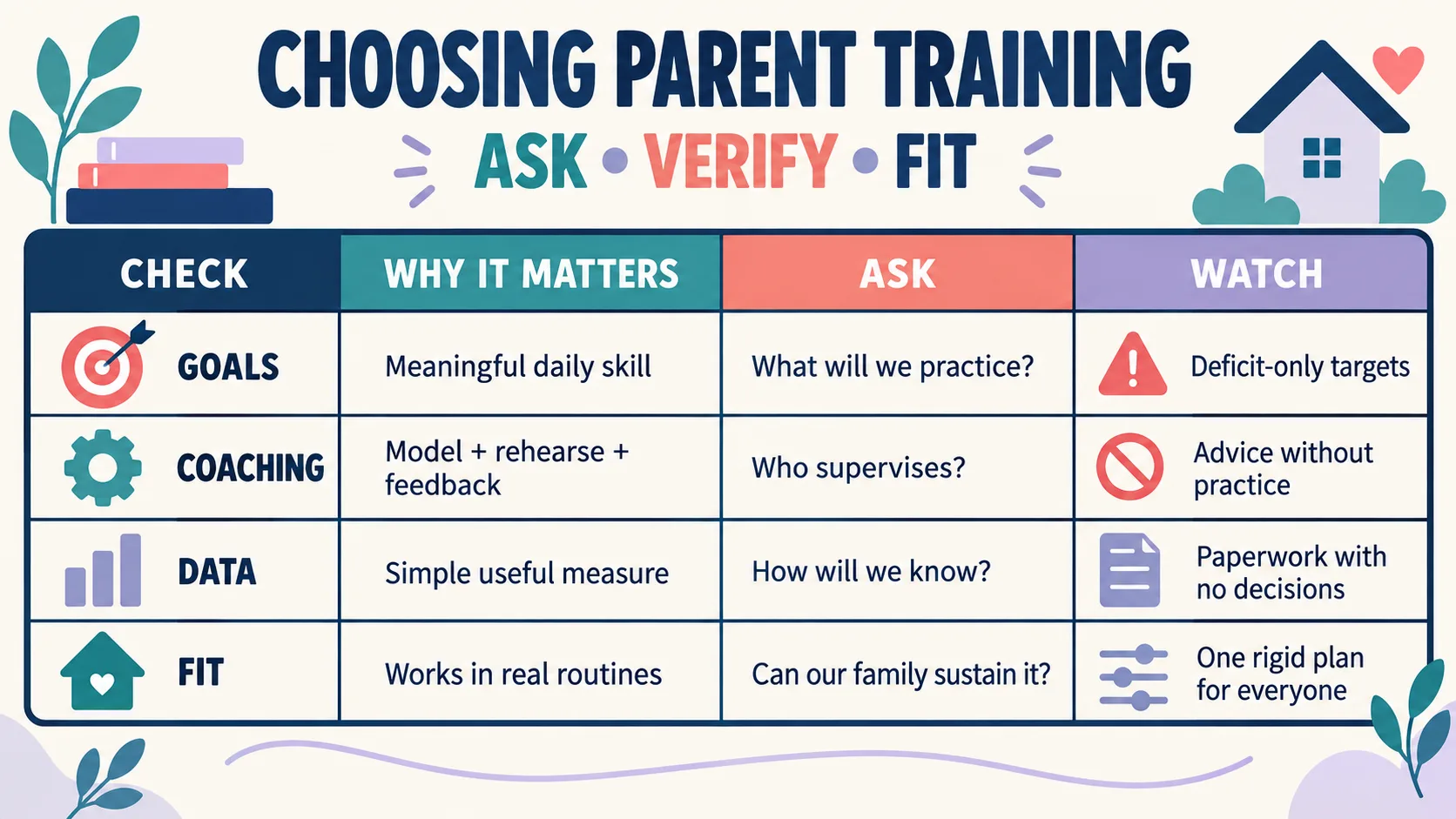
Ask for specific answers before agreeing to a plan:
- What will I practice? Ask for a short example of the caregiver action, the child’s response, and the routine where it will be used.
- Who supervises the coaching? Confirm the BCBA’s role, how often the plan is reviewed, and how questions are handled between visits.
- How will my child communicate refusal or discomfort? Ask how assent, preferences, breaks, and alternative communication are included.
- What data will we collect? Confirm what is measured, how long it takes, where it is stored, and how it changes decisions.
- How will this fit our life? Ask how the provider adapts practice to siblings, work schedules, language, transportation, and available materials.
- How will skills generalize? Ask when the team will vary people, settings, materials, and routines without adding unnecessary pressure.
- What happens if it is not helping? Confirm how the family can pause, report concerns, revise a target, or request a different approach.
A provider should welcome these questions. Be cautious if the explanation depends on guarantees, treats caregiver disagreement as noncompliance, or describes the child only by deficits. A strong plan explains both the intended benefit and the safeguards around burden, dignity, privacy, and safety.
What Consent and Ethical Boundaries Matter?
Caregiver participation is important, but it should not erase the child’s voice. Explain the plan in an accessible way, notice assent and refusal, and consider whether the child has a reliable way to request a break or alternative. The BACB Ethics Code for Behavior Analysts provides professional context for client welfare, competence, confidentiality, collaboration, and individualized services.
Privacy also matters. Ask who can see video, notes, data, and messages; whether sessions are recorded; how records are stored; and how information about siblings or other people is protected. A provider should explain the limits of confidentiality and follow the rules that apply to the service setting.
How Do Funding and Scheduling Work?
Coverage is not automatic. Depending on the arrangement, parent training may be part of a clinical ABA benefit, an educational service, a consultation model, or a private-pay plan. Verify the child’s plan, provider network, authorization, location rules, caregiver participation requirements, cancellation policy, and whether remote coaching is allowed. A provider’s general statement about insurance does not decide an individual claim.
- Confirm the service location and who is responsible for obtaining authorization.
- Ask what happens when a caregiver misses a session or needs a lower-burden plan.
- Request a plain-language explanation of fees, records, cancellations, and communication.
Scheduling should protect the family’s basic routines. A coaching plan that requires more paperwork, travel, or daily practice than the household can sustain is not a better plan because it is more intensive on paper. Discuss a minimum workable version, how to handle missed sessions, and when the team will review burden as well as progress.
ABA Therapy Parent Training FAQ
Do parents have to provide every ABA session?: No. The caregiver’s role depends on the service model and goals. Parent training may involve coaching, observation, practice, data review, or consultation rather than taking over all direct therapy. Is parent training only for challenging behavior?: No. It may address communication, daily living, play, transitions, independence, safety, school preparation, and participation. The target should be meaningful to the child and family.
How long does ABA parent training take?: There is no universal schedule. Frequency and duration should reflect the goal, caregiver availability, child needs, progress data, and service authorization. Ask how the provider decides when to continue, reduce, or revise coaching.
Can parent training happen online?: Virtual coaching may be appropriate in some situations, but technology, privacy, local rules, clinical fit, and hands-on support must be considered. Ask what the provider can observe and how the plan works if the connection fails.
Key Takeaway
ABA therapy parent training should give caregivers practical, respectful coaching that fits real routines. Look for clear goals, modeling and rehearsal, feedback, manageable data, supervision, generalization planning, consent, privacy, and a way to change the plan when it is not helping. If you are studying BCBA concepts such as measurement, behavior skills training, collaboration, and ethics, you can reinforce those skills with the site’s free BCBA mock exam. For targeted review, use our aba therapy parent training practice questions to apply the concept in exam-style scenarios.
Take the Free BCBA Mock Exam
If you want a low-pressure way to check your recall, use the free practice resource below. Take the Free BCBA Mock Exam



