

Quick answer: An autistic ABA therapist should be part of a qualified, supervised team that understands the autistic person’s communication, preferences, sensory needs, family priorities, and daily environment. The title “ABA therapist” may refer to a direct-care technician, an RBT, or another implementer, while a BCBA typically assesses behavior, designs the behavior-analytic plan, and supervises implementation. Before choosing a provider, verify the credentials, watch how the team responds to communication and refusal, ask who sets goals, and request a clear way to review data and change the plan.
Table of Contents
- What Does “Autistic ABA Therapist” Mean?
- What Should the Therapist’s Goals Focus On?
- How Can You Evaluate an Autistic ABA Therapist?
- How Important Are Supervision and Staff Stability?
- How Should Progress Be Measured?
- What Should Family Collaboration Look Like?
- How Do ABA Therapist Settings Compare?
- What Questions Should You Ask Before Choosing a Provider?
- What Are Red Flags When Choosing an ABA Therapist?
- How Do Cost, Insurance, and Availability Affect the Choice?
- How Can a Family Make a Final Decision?
- Autistic ABA Therapist FAQ
- Key Takeaway
- Take the Free BCBA Mock Exam
Finding an autistic ABA therapist is not just a search for the first available opening. Families are comparing a person, a supervision model, a clinical philosophy, a schedule, a setting, a funding pathway, and the child’s experience during sessions. A strong choice is individualized and observable: the provider can explain what will be taught, why it matters, how the child can communicate a break or refusal, and how the team will know whether the service is helping.
What Does “Autistic ABA Therapist” Mean?
The phrase is commonly used by families searching for ABA support for an autistic child, but it does not identify one universal credential. A BCBA is a board-certified behavior analyst who may conduct assessment, develop and monitor a behavior-analytic plan, and supervise other staff. An RBT is a registered behavior technician who provides behavior-analytic services under ongoing supervision. Some providers also use titles such as behavior technician, therapist, implementer, or interventionist with different training and legal requirements. Ask each provider to describe the role in plain language:
- Who completes the assessment and writes the treatment plan?
- Who works directly with the child, and what training do they receive?
- Which BCBA supervises the case, how often do they observe, and who answers questions?
- Who can change goals, prompts, reinforcement procedures, or safety steps?
- How does the team coordinate with speech, occupational, educational, medical, or mental-health professionals?
You can use the BACB certification verification page to check a BACB credential when applicable. Certification verification does not by itself prove that a provider is a good match, has availability in your area, accepts your plan, or uses an approach that fits your family.
What Should the Therapist’s Goals Focus On?
Good goals describe skills that improve communication, autonomy, safety, access, learning, relationships, or participation. A child might work on requesting help, using AAC or another communication system, completing a self-care sequence, navigating a transition, joining a preferred activity with another person, tolerating a necessary health routine, or replacing a dangerous response with a safer way to communicate.
Goals should not be chosen only because a behavior looks different from what adults expect. Ask what the behavior may communicate, what the child gains from the skill, and whether the plan respects harmless self-regulation and personal boundaries. Eye contact, still hands, quietness, and appearing “normal” are not automatically meaningful outcomes. The family and clinical team should be able to explain how a target supports the individual’s quality of life.
Invite the child’s perspective in a way that fits their communication. Notice approach, engagement, avoidance, distress, and recovery. A plan that looks successful on paper but repeatedly creates fear, pain, exhaustion, or loss of communication needs an immediate review.
How Can You Evaluate an Autistic ABA Therapist?
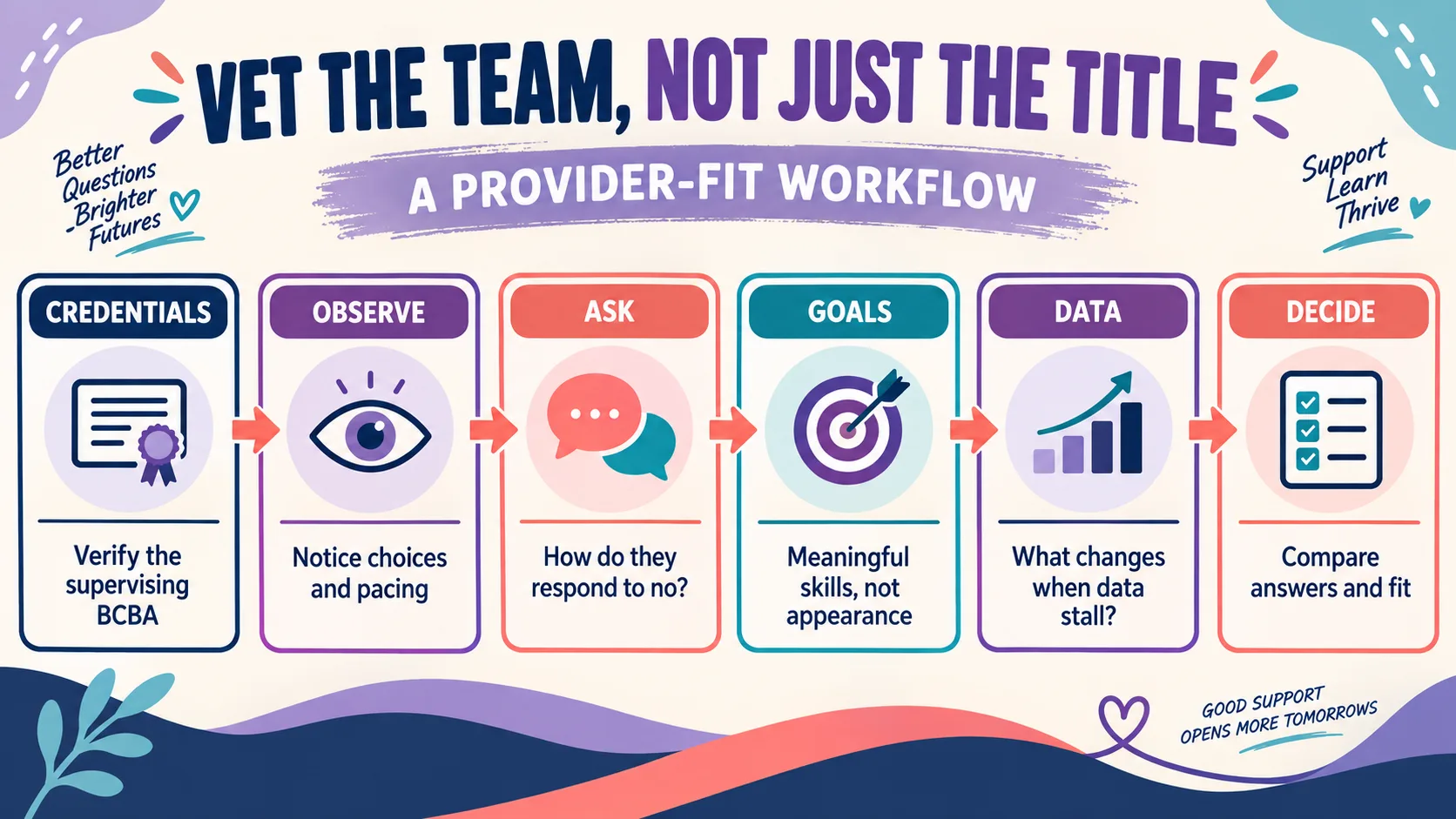
A short evaluation workflow can help a family compare providers consistently. Start with credentials and the actual supervising BCBA. Then ask how the provider establishes rapport, identifies priorities, teaches communication, and responds when a child says no through words, a device, gestures, movement, or behavior.
If possible, observe a session or request a detailed description of one. Look for clear communication, reasonable pacing, opportunities for choice, reinforcement that is meaningful to the child, and adults who notice signs of overload. A single observation cannot prove clinical quality, but it can reveal whether the provider welcomes questions and whether the language used about the child is respectful.
Ask for an example of how the provider would teach a skill. The explanation should include what happens before the response, what the child is expected to do, what support is offered, what happens after the response, and how prompts will be faded. It should also explain how the child can request help, a break, a different activity, or a pause. If the only answer is “we increase compliance,” ask for a more specific and individualized description.
How Important Are Supervision and Staff Stability?
Direct-care staff may spend more time with a child than the supervising BCBA, so the supervision and communication system matters. Ask how frequently the BCBA observes, reviews data, coaches staff, updates caregivers, and responds to safety or consent concerns. Ask what happens when a therapist leaves, calls out, or is replaced.
A provider should be able to explain how staff learn the child’s communication system, preferences, support needs, and safety plan. Staff should not rely on a generic script when a child’s response changes. The team needs a process for distinguishing a skill deficit from an inaccessible environment, unclear instruction, pain, fatigue, sensory overload, or a mismatch between the task and the child’s current capacity.
How Should Progress Be Measured?
Data should help the team make decisions, not simply fill a chart. Depending on the goal, useful measures might include independent steps completed, opportunities to communicate, latency to begin, duration of participation, frequency of a replacement response, successful transitions, or recovery time after a difficult event. The measure should match the question and be understandable to the family.
Ask to see how data become a plan change. If progress is flat, will the provider adjust the teaching arrangement, goal, prompt, reinforcement, environment, or measurement? If the child performs a skill only with one therapist, can the team plan gradual generalization to caregivers, teachers, peers, and community routines? A rising number is not automatically good progress if the target is distress, masking, or adult convenience.
What Should Family Collaboration Look Like?
Families should be partners in selecting priorities, understanding the plan, and deciding whether the routine is workable. Parent training can show caregivers how to arrange materials, model a communication response, prompt a task step, reinforce a replacement skill, and record a small amount of data. It should not make the family responsible for delivering every clinical procedure or blame them when the plan is unrealistic.
Ask how the provider adapts to language, culture, work schedules, siblings, transportation, and household boundaries. Ask whether caregivers can pause or decline a procedure and how concerns are escalated. The family’s observations outside sessions are essential because the provider sees only a small sample of the child’s life.
How Do ABA Therapist Settings Compare?
The best setting depends on the goal, child, family, provider, and practical constraints. Home sessions can reveal household routines; clinic sessions may offer materials and a larger team; school collaboration can address classroom participation; and telehealth may improve access to BCBA coaching. Compare the actual plan rather than assuming that one setting is automatically more intensive or effective.
| Setting | Often useful for | Verify | Watch for |
|---|---|---|---|
| Home | Family routines, self-care, play, and caregiver coaching | Privacy, household boundaries, schedule, and generalization | Treating family life like a clinic or ignoring refusal |
| Clinic | Structured teaching, materials, and concentrated team access | Child experience, staff turnover, data sharing, and transfer home | Skills that depend on clinic-only materials or prompts |
| School collaboration | Classroom participation, transitions, and educational access | Consent, roles, IEP boundaries, privacy, and staff coordination | Outside staff assuming control of school decisions |
| Virtual | Remote coaching, consultation, and data review | Technology, privacy, local rules, and hands-on backup | A camera view that misses context or distress signals |
What Questions Should You Ask Before Choosing a Provider?
Use the first call or visit to ask concrete questions:
- Who is the supervising BCBA? Ask for the person’s credential, case responsibilities, observation schedule, and communication process.
- Who will work directly with my child? Ask about training, expected staff changes, backup coverage, and how the team learns the child’s communication.
- How are goals chosen? Ask how the child and family participate and how the team avoids goals based only on adult convenience or appearance.
- What happens when my child refuses? Ask how the provider interprets refusal, offers alternatives, adjusts the task, and protects the child from coercive escalation.
- How will progress be shown? Ask for examples of data, review meetings, goal changes, and generalization beyond one therapist.
- Can I observe or participate? Ask about family access, parent training, privacy, and the process for raising a concern without retaliation.
- What does a typical week cost? Ask about authorization, copays, waitlists, cancellations, travel, and services that are not covered.
What Are Red Flags When Choosing an ABA Therapist?
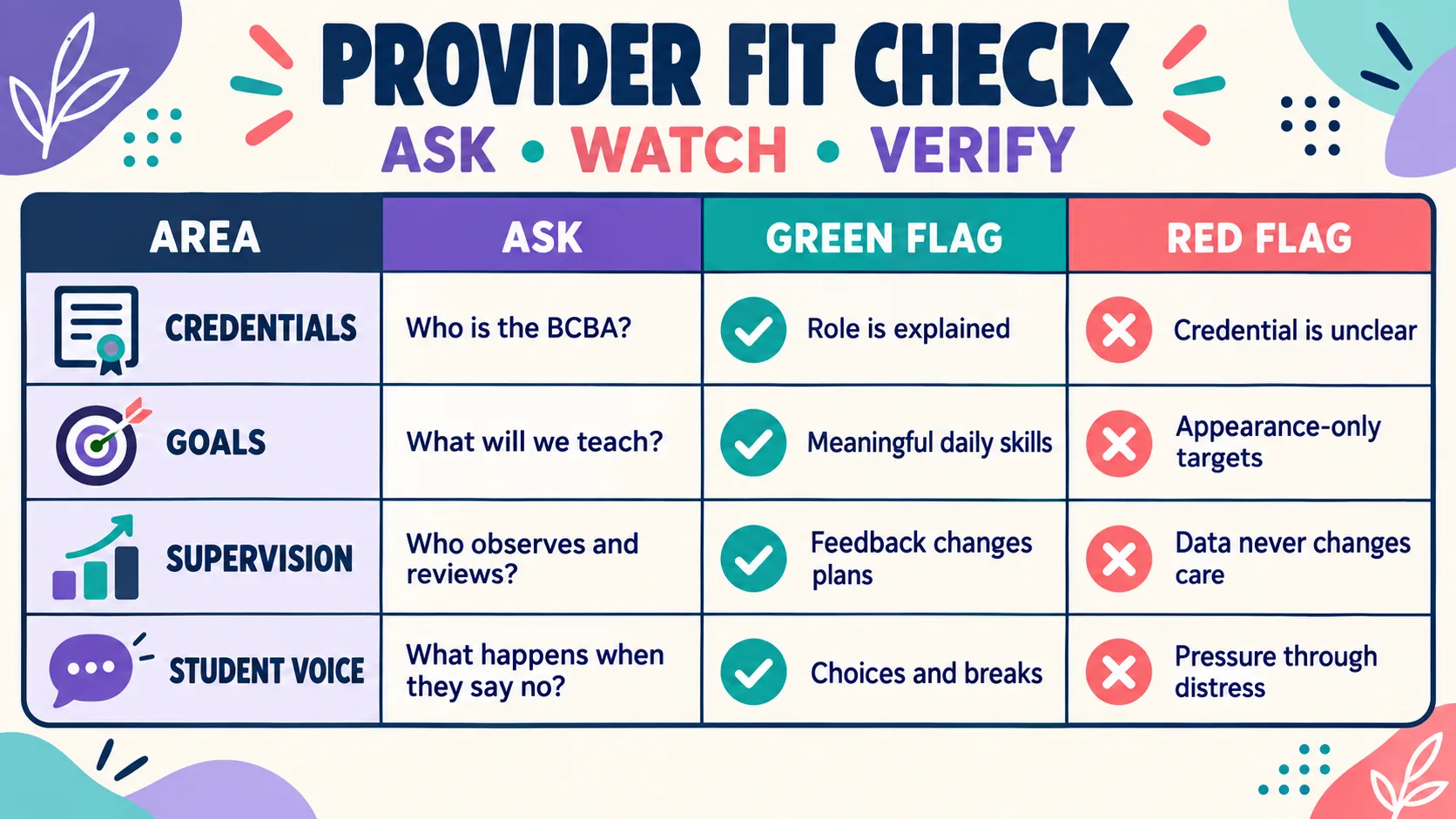
Be cautious if a provider guarantees a specific outcome, prescribes the same number of hours to every child without explaining the rationale, refuses reasonable questions, or cannot identify the supervising BCBA. Other concerns include goals focused mainly on looking less autistic, pressure to suppress harmless communication or self-regulation, no way to request a break, unexplained physical procedures, data that never change the plan, or staff who describe distress as a behavior to ignore.
A red flag does not always prove that a service is unsafe, but it is a reason to pause and ask for clarification. The BACB Ethics Code for Behavior Analysts gives professional context for client welfare, competence, confidentiality, collaboration, and individualized decision-making. If the answer remains vague or defensive, compare another provider before committing.
How Do Cost, Insurance, and Availability Affect the Choice?
Availability can shape the decision, but a short waitlist should not be the only reason to choose a provider. Ask whether the clinician is in network, what authorization is required, which settings are covered, whether parent training is included, and what happens when a therapist is absent. Coverage and licensing rules vary by plan and location; do not treat a provider’s general statement as a guarantee for one family.
- Write down the supervising clinician and the best route for urgent questions.
- Confirm the expected schedule, travel, waitlist, cancellation, and replacement-staff rules.
- Ask which records, reports, and data summaries the family receives and when.
Ask how many direct staff may rotate through the case and whether the schedule preserves school, sleep, medical appointments, play, and family time. A program can be intensive on paper but still be a poor fit if the child is exhausted, the family cannot sustain it, or the targets do not improve meaningful participation.
How Can a Family Make a Final Decision?
After interviews or observations, write down the same categories for each provider: credentials, supervision, goals, child voice, direct staff, data, family training, setting, schedule, access, cost, and response to concerns. Then compare specific answers rather than marketing language. Ask the child’s existing professionals or trusted advocates what information is still missing, while keeping the family’s priorities central.
A good match is not a promise of perfect sessions. It is a team that can explain its decisions, notice when a plan is not working, collaborate across settings, and change course without treating the child or family as the problem. Revisit the fit as the child’s communication, needs, interests, and environment change.
Autistic ABA Therapist FAQ
Is an ABA therapist the same as a BCBA?: Not necessarily. “ABA therapist” is a broad service label. A BCBA typically designs or supervises behavior-analytic services, while direct care may be provided by an RBT or another trained staff member under supervision. Ask the provider to define each role.
How can I tell whether an ABA therapist is a good fit?: Look for individualized goals, respectful communication, meaningful choices, competent supervision, understandable data, family collaboration, and a clear response to refusal or distress. Credentials matter, but they are only one part of fit.
Should ABA goals include eye contact or stopping stimming?: Ask why any goal is proposed and how it benefits the autistic person. Harmless self-regulation and communication should not be removed simply because they look different. Meaningful participation, autonomy, safety, and access are more useful questions than appearance alone.
Can I change therapists or stop services?: Families should ask about the provider’s cancellation, transition, complaint, and discharge policies before starting. If the child is distressed or the plan is not helping, request a review and consider other supports with qualified professionals.
Key Takeaway
Choosing an autistic ABA therapist means evaluating the whole service: credentials, supervision, goals, communication, assent, staff stability, data, family fit, setting, cost, and the provider’s willingness to change course. Choose the team that can explain its work clearly and treats the child’s dignity and voice as part of clinical quality. If you are studying BCBA concepts such as ethics, supervision, measurement, and behavior skills training, reinforce those skills with the site’s free BCBA mock exam. For targeted review, use our autistic aba therapist practice questions to apply the concept in exam-style scenarios.
Take the Free BCBA Mock Exam
If you want a low-pressure way to check your recall, use the free practice resource below. Take the Free BCBA Mock Exam



