
Quick answer: School based ABA therapy is behavior-analytic assessment, teaching, consultation, or support delivered in a school setting. A BCBA may design and supervise an individualized plan, an RBT or other trained staff member may provide direct support, and teachers or school staff may help the learner use skills during real classroom routines. The work can address communication, participation, transitions, social interaction, independence, and behavior that interferes with learning.
Table of Contents
- What Is School Based ABA Therapy?
- What Happens During a School-Based ABA Session?
- What Goals Can School-Based ABA Address?
- Who Does What at School?
- How Does School-Based ABA Relate to an IEP?
- How Does School-Based ABA Compare With Other Formats?
- What Questions Should Families and Schools Ask?
- What Privacy and Consent Boundaries Matter?
- How Do Funding and Scheduling Work?
- What Ethical Boundaries Matter in School-Based ABA?
- School-Based ABA Therapy FAQ
- Key Takeaway
- Quick Review Checklist
- Take the Free BCBA Mock Exam
School-based ABA is not automatically the same thing as special education, an Individualized Education Program (IEP), or an outside provider’s insurance-funded service. The exact arrangement depends on the learner’s needs, the school or district, family consent, provider credentials, funding pathway, and applicable rules. Before agreeing to a program, clarify who authorizes it, who writes the goals, who collects data, who can access the school, and how the team will protect the student’s dignity and educational rights.
What Is School Based ABA Therapy?
School based ABA therapy applies behavior-analytic assessment and intervention in the places where a student learns and participates. That may include a classroom, hallway, cafeteria, playground, bus transition, daycare, or after-school program. The goal is not simply to move a clinic program into a school. The team should identify behaviors and skills that matter in that environment, observe the relevant conditions, and design teaching that fits the student’s educational context.
Programs vary. A provider may offer direct one-to-one support, classroom consultation, staff coaching, caregiver training, BCBA observation, functional assessment, behavior-plan support, or a combination. Some services are arranged by a school or district. Others are delivered by an outside clinical provider with permission to work on campus. A label such as “school-based ABA” does not tell you which arrangement is in place. Ask whether the service includes:
- an assessment tied to classroom routines and observable participation;
- measurable goals that are understandable to the student’s team;
- direct teaching, consultation, staff coaching, parent training, or a defined combination;
- BCBA supervision and a clear process for changing the plan;
- data collection that explains what is measured, by whom, and for what decision;
- coordination with special educators, general educators, speech or occupational therapists, and families when appropriate; and
- a plan for generalizing skills beyond one classroom, adult, or prompt.
What Happens During a School-Based ABA Session?
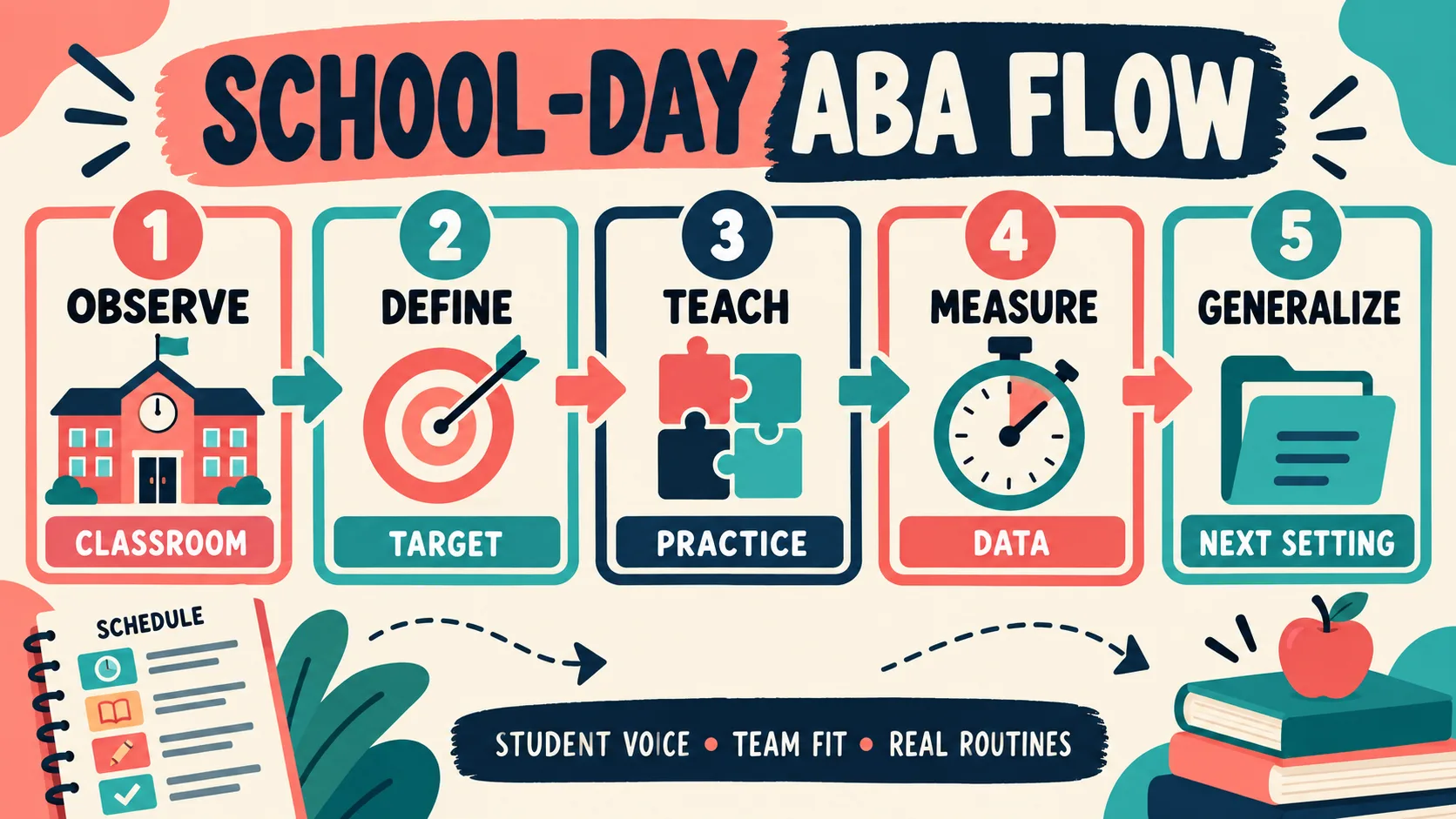
A school-based session usually begins with a specific routine or goal rather than a broad attempt to change everything at once. The BCBA or implementer may review recent data, observe the classroom context, and identify what the student is expected to do. The target could be requesting help, joining group instruction, starting independent work, following a transition, communicating a break, completing a task sequence, or interacting with a peer.
The team then arranges practice in the natural school routine. It may adjust an antecedent, teach a replacement response, use prompts, reinforce a useful behavior, or modify the task so the student can contact success. The procedure should be described in observable terms. “Improve compliance” is less useful than a clear statement about what the student will do, under which condition, and how progress will be measured.
Data may include opportunities completed, latency to start, duration of engagement, frequency of a response, percentage of steps completed, communication attempts, or staff-implementation measures. The measure should match the question. At the end of the session, the team should review what changed, what still needs support, and whether the next practice opportunity should occur in another routine or with another adult.
What Goals Can School-Based ABA Address?
School-based goals should connect to meaningful participation and learning access. Depending on the assessment and the student’s educational plan, goals may include communication, requesting assistance, following a classroom routine, transitioning between activities, independent work, play or peer interaction, self-management, safety, or using a replacement response when a task becomes difficult.
The team should avoid treating a quiet or compliant classroom appearance as the only sign of progress. A student may need support to communicate discomfort, request an accommodation, choose between activities, or participate in a way that respects their communication and sensory needs. Progress should be interpreted with the student’s preferences, context, and quality of life in mind.
Generalization also matters. A response that occurs only with one RBT may not yet be useful when the teacher gives an instruction, a peer changes the game, or the student enters the cafeteria. Ask how the team will practice across people, materials, activities, and settings without creating unnecessary demands.
Who Does What at School?
School-based ABA works best when responsibilities are explicit. A BCBA may conduct or interpret assessment, design the behavior-analytic plan, supervise implementation, review data, and coordinate with the relevant team. An RBT or other trained implementer may carry out teaching procedures and record data within the scope of their training and supervision. Teachers and school staff understand the instructional schedule, classroom expectations, accommodations, and school procedures. Families provide valuable context and participate in decisions about their child.
These roles can overlap, but they are not interchangeable. An outside ABA provider does not automatically control the classroom, rewrite an IEP, or direct school staff without agreement. A teacher is not automatically responsible for implementing a clinical protocol without training and a workable plan. At intake, ask how the team communicates, who can approve changes, and how disagreements are handled.
How Does School-Based ABA Relate to an IEP?
An IEP is an educational document developed for an eligible student under the Individuals with Disabilities Education Act. The U.S. Department of Education explains that an IEP is the primary vehicle for providing a free appropriate public education and is based on the individual needs of the child. IDEA regulations also require the IEP Team to consider positive behavioral interventions and other strategies when behavior impedes the child’s learning or the learning of others.
That does not mean every school-based ABA service is automatically an IEP service, or that an outside provider can add a goal to an IEP by itself. The school team, family, and applicable professionals must follow the process that applies to the student. A clinical ABA treatment plan and an IEP may inform one another, but they can have different purposes, decision-makers, funding sources, and documentation requirements.
Use the site’s IEP in ABA guide for a deeper explanation of how school goals, therapy goals, data, and collaboration can fit together. When a provider says that services will “go through the IEP,” ask what that phrase means in the specific district and whether the service is school-provided, clinically provided, or coordinated across both.
How Does School-Based ABA Compare With Other Formats?
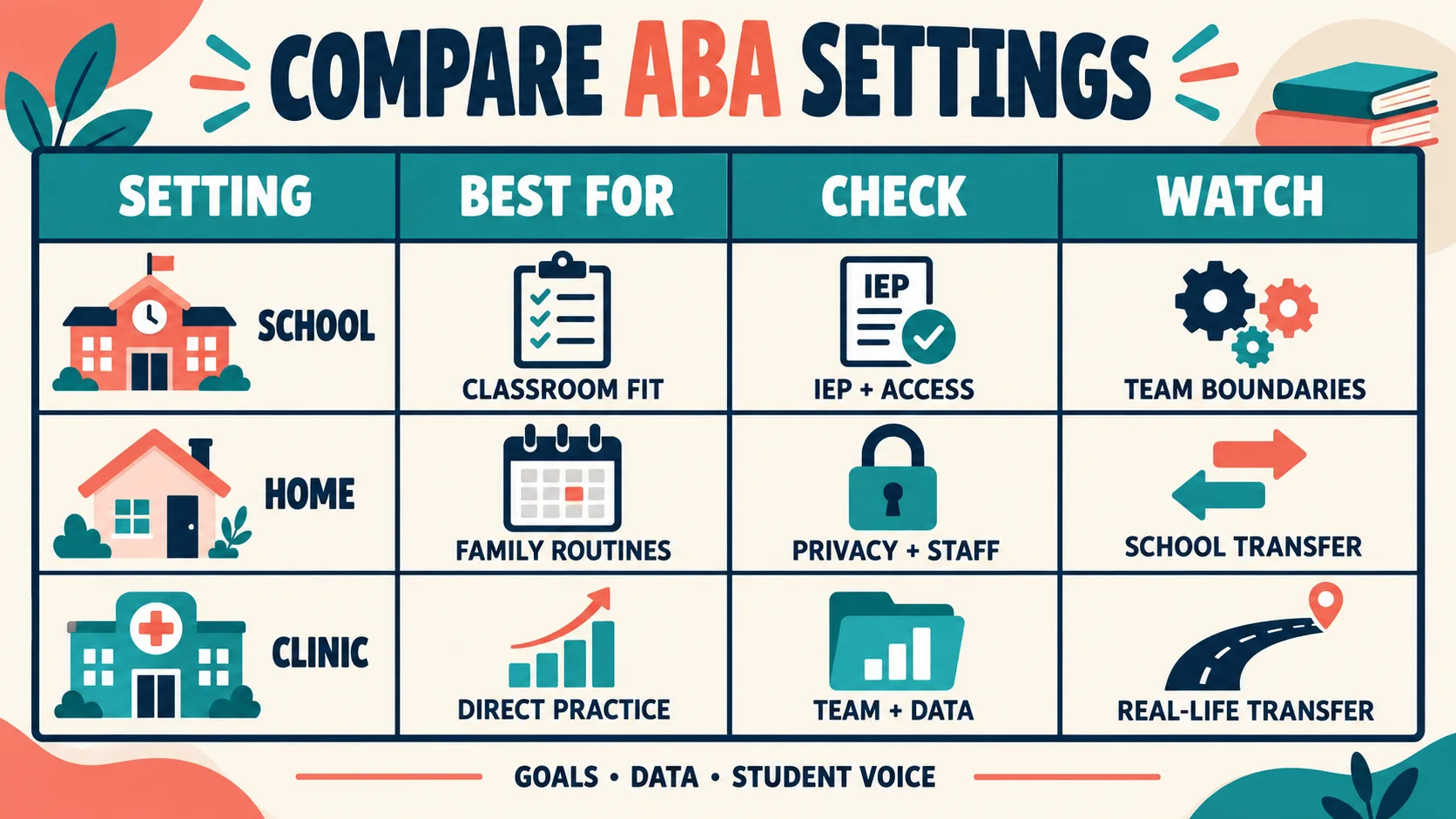
No setting is best for every learner or every goal. A school setting offers access to real classroom routines and peers, but it also includes rules, schedules, privacy limits, and shared responsibility. Home-based care may reveal household routines. Clinic-based care may offer a controlled environment and larger staff team. Virtual care may make BCBA coaching more accessible. Compare the actual plan, not just the label.
| Format | Often useful for | Verify | Watch for |
|---|---|---|---|
| School | Classroom participation, transitions, peer routines, and school-day generalization | Access, consent, staff roles, data sharing, and educational alignment | Confusing clinical authority with school authority |
| Home | Family routines, caregiver coaching, and skills used at home | Privacy, schedule, household boundaries, and generalization to school | Assuming a home result transfers automatically to class |
| Clinic | Structured direct teaching, materials, and concentrated team access | School transfer plan, caregiver training, and relevant classroom observation | Skills that remain dependent on the clinic setting |
| Virtual | Remote consultation, coaching, data review, and access to a BCBA | Technology, privacy, available implementer, and school observation options | A camera view that misses the relevant classroom context |
What Questions Should Families and Schools Ask?
Ask the provider and school team for concrete answers before services begin:
- Who authorizes the service? Is it arranged by the district, an IEP team, a payer, an outside provider, or more than one pathway?
- What is the clinical goal? Which observable skills or behaviors will be addressed, and why do they matter in the student’s school life?
- Who is present? Which BCBA, RBT, teacher, aide, or caregiver participates, and what happens when someone is absent?
- How is data collected? Where are records stored, who can view them, and how do data lead to a plan change?
- How will the student’s voice be included? Ask how communication, preferences, assent, refusal, and accommodations affect the plan.
- How will skills generalize? Ask how the team will practice with different adults, peers, routines, and school spaces.
- What happens when the plan conflicts with the schedule? Clarify who makes the decision and how missed opportunities are handled.
Also ask how the program coordinates with the IEP without claiming to replace the school’s responsibilities. The IDEA regulations describe related services and parent counseling or training in specific educational contexts, but the label alone does not resolve whether a particular ABA service is funded or authorized. The family should receive a plain-language explanation of the pathway being proposed.
What Privacy and Consent Boundaries Matter?
A school is a shared environment, so the team must consider student confidentiality, classroom disruption, visitor rules, documentation, and communication with other families. Ask whether sessions are recorded, whether notes identify other students, where data are stored, and who can access them. An outside provider should follow the school’s access procedures and the applicable professional and legal requirements.
Consent is not a one-time excuse to ignore the student’s experience. Explain what will happen, use an age-appropriate communication method, and notice signs of refusal or distress. A plan should teach meaningful skills and reduce barriers to participation, not make the student perform for an adult’s convenience. When the team proposes a restrictive or high-burden procedure, ask what less intrusive alternatives were considered and how safety will be monitored.
How Do Funding and Scheduling Work?
Funding varies. A school district may provide services through its educational program; an outside clinical provider may bill insurance or Medicaid where allowed; or the family may encounter a combination of sources. Provider pages often list the states, districts, and plans they serve, but those claims are not universal. Verify the student’s plan, network, authorization, service location, provider credentials, school permission, and any limits on hours or settings.
Scheduling should fit the school day and preserve access to instruction, meals, recess, related services, and peer activities. Ask whether sessions remove the student from class, how missed time is handled, and how the plan avoids making ABA the only activity available. A useful service should support educational participation rather than quietly displace it.
What Ethical Boundaries Matter in School-Based ABA?
The BACB Ethics Code for Behavior Analysts provides professional context for competence, client welfare, confidentiality, collaboration, and individualized decision-making. A BCBA should be clear about what they can observe, what they are responsible for, and what belongs to the school team or another provider.
Be cautious about promises that school-based ABA will automatically improve grades, eliminate behavior, or fit every student. The team should define the target, measure it, review outcomes, and revise the plan when it is not helping. The student’s dignity, communication, preferences, and access to education should remain part of the decision—not an afterthought.
School-Based ABA Therapy FAQ
Is school-based ABA the same as special education?: No. ABA describes a behavior-analytic approach and service model. Special education is an educational system with its own eligibility, planning, and procedural requirements. The services may coordinate, but one label does not automatically replace the other.
Can school-based ABA be included in an IEP?: It depends on the student’s needs, the IEP team’s decisions, the district, and applicable rules. A family or provider cannot assume that an outside clinical service becomes an IEP service simply because it takes place at school. Ask the team to explain the exact authorization and accountability pathway.
Does a BCBA replace the teacher in a classroom?: No. The BCBA may provide behavior-analytic assessment, consultation, supervision, or direct services within the agreed model. The teacher and school team retain their educational roles and responsibilities. Successful coordination requires written expectations and respect for each professional’s scope.
What if a school will not allow an outside ABA provider on campus?: Ask the school and provider what access, consent, safety, scheduling, and district policies apply. The team may consider school consultation, an IEP process, home or clinic services, or virtual coaching depending on the student’s needs. Do not assume that one provider’s policy applies to every school.
Key Takeaway
School based ABA therapy can connect behavior-analytic support to real classroom routines, but it must be distinguished from special education, IEP decisions, and funding assumptions. Compare the actual roles, goals, data, access rules, privacy safeguards, student voice, and generalization plan. If you are studying BCBA questions about behavior change, collaboration, ethics, and measurement, reinforce those skills with the site’s free BCBA mock exam. For targeted review, use our school based aba therapy practice questions to apply the concept in exam-style scenarios.
Quick Review Checklist
Use this final checklist to turn school based aba therapy into exam-ready reasoning. The goal is not to memorize a label in isolation; it is to identify the relevant evidence and explain why the best answer fits the scenario. Key ideas to review:
- State the central definition or decision point for school based aba therapy in your own words.
- Identify the detail that makes school based aba therapy different from its closest related ABA term.
- Separate the observable facts in a scenario from assumptions that are not supported by the facts.
- Write one example and one nonexample so you can recognize the concept in a new setting.
Exam application checks:
- Ask what the question is actually requesting before comparing the answer choices.
- Mark the antecedent, response, consequence, or other evidence that supports the selected answer.
- Look for a distractor that describes a related process but does not answer the specific question.
Final self-check:
- Explain how you would verify the interpretation with clear observations or data.
- Change one detail in the scenario and decide whether your answer should change.
- Give a one-sentence rationale that a supervisor or study partner could evaluate.
Take the Free BCBA Mock Exam
If you want a low-pressure way to check your recall, use the free practice resource below. Take the Free BCBA Mock Exam



