

A practice-level ABA business plan for choosing the right model, designing the client journey, protecting clinical quality, and measuring whether the practice is ready to grow. If you are searching for an ABA practice business plan, you may not need another generic startup checklist. You need a working plan for how your practice will deliver care week after week: who it serves, what the first contact looks like, how referrals become appropriate intakes, how supervision and documentation are protected, and when growth would exceed your capacity.
Table of Contents
- What an ABA Practice Business Plan Is Really Planning
- Choose the Practice Model Before the Budget
- Write the Operating Blueprint
- Map the Client Journey to Revenue and Care
- Add Clinical and Ethical Guardrails
- Build a Lean Practice Financial Model
- Use a One-Page Practice Plan Template
- Measure the Practice Before You Scale It
- Turn Plan Knowledge Into Exam Practice
- Frequently Asked Questions
- Quick Review Checklist
- Take the Free BCBA Mock Exam
An ABA company business plan can explain the legal entity, funding request, market, and long-range strategy. An ABA practice business plan goes one level closer to the work. It turns that strategy into a repeatable operating model for a solo BCBA, a home- and community-based practice, or a small clinic. Use this framework as planning guidance, not legal, tax, licensing, payer, or financial advice.
Important boundary: State rules, payer contracts, credentialing requirements, employment laws, privacy duties, and scope-of-practice limits vary. Verify them with the relevant authority and qualified professionals before accepting clients, hiring staff, billing, or opening a location.
What an ABA Practice Business Plan Is Really Planning
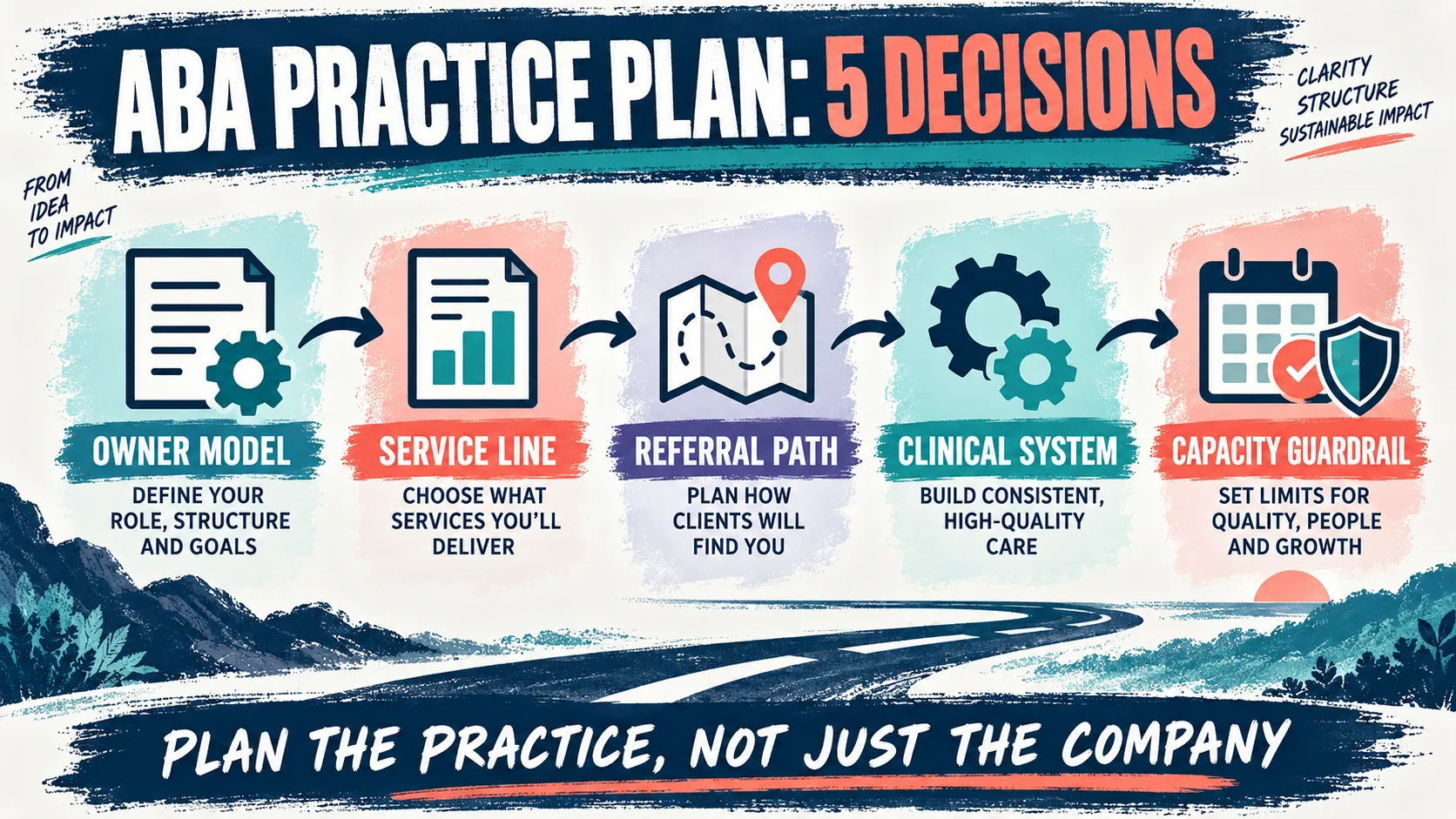
A practice plan answers five operational questions:
- Who is the practice for? Define the population, service area, settings, languages, access needs, and the cases you can competently support.
- What will the practice deliver? Name the service line, clinical boundaries, assessment process, caregiver involvement, supervision model, and discharge or transition logic.
- How will a family move through the system? Describe inquiry, fit screening, intake, assessment, authorization or payment steps, service start, review, and transition.
- Which systems make quality repeatable? Specify documentation, scheduling, data review, supervision, privacy, incident response, and communication ownership.
- What proves that growth is safe? Choose capacity, quality, client-experience, and cash-collection measures before adding caseload, staff, or space.
The U.S. Small Business Administration’s business-plan guidance describes traditional and lean formats and emphasizes that the plan should serve the owner’s purpose. For an ABA practice, a lean operating plan can be updated monthly and expose unsafe assumptions.
Choose the Practice Model Before the Budget
Do not begin with a rent number or a hoped-for caseload. Start by choosing the model you can staff, supervise, document, and serve well. The same phrase “ABA practice” may describe very different obligations and cost structures.
| Model | Best planning question | Main guardrail |
|---|---|---|
| Solo or consultation practice | Which services can one qualified professional deliver without promising more access than the calendar allows? | Protect clinical time, documentation time, leave coverage, and referral boundaries. |
| Home and community practice | How will travel, setting variation, caregiver participation, safety, and scheduling affect service quality? | Model travel time, cancellations, supervision access, privacy, and backup coverage. |
| Small clinic or micro-site | What minimum staffing, room use, scheduling, and administrative system must work before opening? | Do not let square footage outrun qualified staff, supervision, demand, or cash reserves. |
Write the Operating Blueprint
Your plan becomes useful when every promise has an owner, a record, and a review point. Use the table below to turn a broad idea into a practice system. These are planning prompts, not universal legal or clinical requirements.
| Plan block | Write down | Evidence of readiness |
|---|---|---|
| Service promise | Who you help, what you provide, what you do not provide, and what a family can expect next. | Plain-language website and intake explanation reviewed for accuracy. |
| Clinical workflow | Inquiry, screening, consent, assessment, treatment planning, supervision, data review, and transition. | A documented test case can move through each step without an unowned handoff. |
| People and roles | Clinical decision-maker, supervisors, technicians, intake contact, scheduler, biller, and backup roles. | A role map shows who can make, document, review, and escalate each decision. |
| Information system | Scheduling, records, data, secure communication, access levels, corrections, and backup ownership. | A sample record can be located, reviewed, corrected, and retained safely. |
| Referral system | Referral sources, response time, fit criteria, follow-up, and what happens when the practice is not appropriate. | A referral log distinguishes inquiries, qualified fits, waitlist cases, and declined referrals. |
| Quality review | Client outcomes, caregiver experience, supervision reliability, incidents, complaints, and improvement actions. | A monthly review produces a decision, an owner, and a due date—not just a score. |
The BACB Ethics Code for Behavior Analysts should anchor this plan: name who protects client welfare, checks competence, manages conflicts, secures information, and reviews quality. Assign orientation, supervision, escalation, and documentation owners.
Map the Client Journey to Revenue and Care
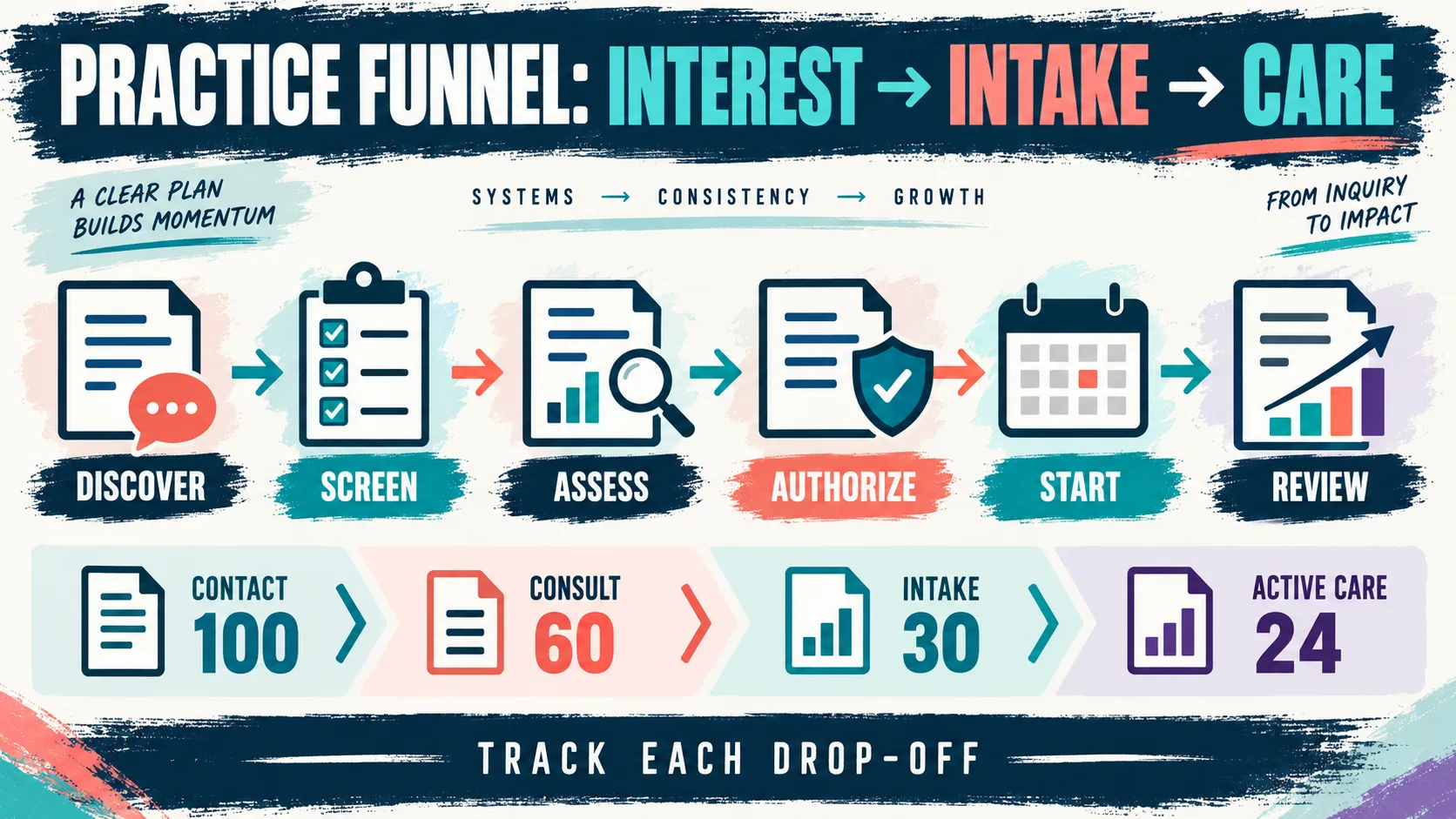
Marketing is not complete when a person submits a form. The practice plan should show how an inquiry becomes an appropriate next step and where the process stops when the service is not a fit. That protects families and prevents the financial model from counting every lead as future revenue.
| Stage | Practice action | Track |
|---|---|---|
| Discover | Explain the service, population, setting, availability, and next contact in plain language. | Source, page viewed, inquiry date. |
| Screen | Check basic fit, location, schedule, service need, payer or payment pathway, and urgent safety issues. | Response time, qualified fit, reason for waitlist or referral out. |
| Assess and plan | Complete the appropriate clinical process and explain what information is needed before services begin. | Completed intake, open items, decision owner. |
| Authorize or agree | Confirm the applicable payer, self-pay, employer, or other agreement and the limits that affect delivery. | Approval or agreement date, unresolved dependency, expected collection timing. |
| Start and review | Schedule care, orient the team, monitor progress, involve caregivers as appropriate, and review whether the model remains a fit. | Start date, attendance, supervision reliability, outcomes, and next review. |
Use conservative assumptions: a website visit is not a client, an inquiry is not an intake, an approved service is not collected cash, and a full calendar is not sustainable capacity. Keep claims accurate and follow applicable privacy guidance before placing information into forms or marketing tools.
Add Clinical and Ethical Guardrails
Growth decisions in an ABA practice are clinical decisions as well as business decisions. Put a stop rule beside each growth lever:
- New case: accept only when the practice has an appropriate scope, qualified decision-maker, workable schedule, and a plan for supervision and documentation.
- New staff member: define role, orientation, supervision, competency checks, access to records, and backup before assigning cases.
- New setting: review consent, privacy, safety, travel, materials, communication, and the responsibilities of the setting.
- New marketing channel: review claims, referral expectations, tracking, consent language, and whether the channel can be kept separate from protected information.
- New location or payer: verify state, contract, credentialing, billing, and documentation requirements before treating projected revenue as available.
Write the escalation path in the plan: who pauses a service, who reviews a concern, how the family is informed, where the record is kept, and when outside advice is required. This is more useful than a generic statement that the practice “follows ethics.”
Build a Lean Practice Financial Model
A practice-level financial model should connect care capacity to collected revenue without pretending that every scheduled hour becomes cash. Start with a monthly scenario, then add conservative, expected, and stretch versions. The most important question is not “What could we bill?” but “What can we deliver, document, collect, and sustain?”
| Model line | Examples to test | Decision it informs |
|---|---|---|
| Capacity | Available clinical hours, supervision hours, travel, cancellations, documentation, and leave. | How many cases can be served without reducing quality? |
| Collected revenue | Payment pathway, rate assumptions, authorization limits, timing, denials, and family balances. | When does care become cash that the practice can actually use? |
| Delivery cost | Wages or contractor costs, payroll burden, supervision, travel, materials, software, and billing support. | Which service or staffing assumption changes the margin most? |
| Fixed overhead | Insurance, rent, licenses, accounting, technology, phone, marketing, and administrative time. | What monthly cost must be covered before expansion? |
| Reserve and triggers | Cash buffer, delayed collections, hiring trigger, pause trigger, and a contingency for unexpected gaps. | When should the owner slow growth, change the model, or obtain advice? |
Define assumptions and reconcile scheduled hours, documentation, deposits, payroll, and overhead to actuals each month. An updated simple spreadsheet beats a static forecast.
Use a One-Page Practice Plan Template
Keep a first version short enough to review with a supervisor, business advisor, or potential partner. Fill in the brackets, then attach the detailed procedures separately:
- Practice promise: We help [population] in [service area/setting] with [service] and will not provide [out-of-scope service].
- Model: We will operate as [solo/home/community/clinic/hybrid] because [evidence and constraint].
- Client journey: An inquiry moves through [screening], [clinical process], [agreement], [start], and [review].
- Clinical owner: [role] makes or reviews [clinical and quality decisions].
- System owner: [role] owns [schedule, records, billing, privacy, or follow-up].
- Capacity limit: We will pause or change intake when [specific quality, staffing, or cash trigger] occurs.
- Financial assumption: We expect [conservative scenario], and we will verify it with [actual record] by [date].
- Next test: Before expansion, we will complete [small operational test] and review [metric] with [owner].
Measure the Practice Before You Scale It
Choose a small dashboard that combines access, quality, operations, and financial reality. Review it at a fixed cadence; do not use one metric to justify every decision.
| Area | Example measure | Review question |
|---|---|---|
| Access | Response time, waitlist age, referral fit, and start delay. | Are families receiving an accurate next step? |
| Clinical reliability | Supervision completed, documentation reviewed, data available, and safety concerns escalated. | Is the practice doing what it promised? |
| Experience | Caregiver questions, complaints, missed contacts, and follow-up completion. | Where is communication creating friction? |
| Financial health | Collected cash, days outstanding, payroll coverage, fixed cost, and reserve. | Can the practice sustain the current model without unsafe expansion? |
Turn Plan Knowledge Into Exam Practice
For a BCBA candidate, an ABA practice business plan is also a useful way to rehearse ethics and best-next-step reasoning. Practice questions may ask you to distinguish a business preference from a professional obligation, a referral opportunity from an appropriate case, or a growth request from a capacity and competence problem.
Use the Free BCBA Mock Exam as a separate practice check. After each question, identify the client-welfare, competence, documentation, or supervision principle that controls the answer. The score is study data; it is not a business license, payer approval, or clinical consultation.
Frequently Asked Questions
How is an ABA practice business plan different from an ABA company business plan?: The company plan may focus on ownership, funding, market, entity structure, and growth. The practice plan explains how care is delivered: the model, client journey, staffing and supervision, records, capacity limits, quality review, and collected-cash assumptions. They can be linked, but they answer different planning questions.
What should an ABA practice business plan include?: Include a specific service promise, target population and setting, operating workflow, role map, referral process, clinical and ethical guardrails, privacy and documentation system, financial scenarios, capacity triggers, and a monthly dashboard. Add jurisdiction-specific requirements after verifying them with the relevant authority.
How often should the practice plan be updated?: Review the operating and financial assumptions monthly while the practice is changing, and revisit the full plan whenever the service model, location, payer mix, staffing, or clinical scope changes. Update the plan from actual records rather than optimism.
Can an ABA practice business plan guarantee profitability?: No. A plan can expose assumptions, test capacity, and define decision triggers, but it cannot guarantee demand, payment, staffing, authorization, outcomes, or profitability. Use conservative scenarios and obtain professional advice for legal, tax, billing, financing, and licensing decisions.
Bottom line: A strong ABA practice business plan is a living operating system. Define the model, map the client journey, assign clinical and administrative ownership, protect ethical practice, connect delivery to collected cash, and set measurable stop rules before growth. That is what turns a business idea into a practice that can serve families responsibly.
Quick Review Checklist
Use this final checklist to turn aba practice business plan into exam-ready reasoning. The goal is not to memorize a label in isolation; it is to identify the relevant evidence and explain why the best answer fits the scenario. Key ideas to review:
- State the central definition or decision point for aba practice business plan in your own words.
- Identify the detail that makes aba practice business plan different from its closest related ABA term.
- Separate the observable facts in a scenario from assumptions that are not supported by the facts.
- Write one example and one nonexample so you can recognize the concept in a new setting.
Exam application checks:
- Ask what the question is actually requesting before comparing the answer choices.
- Mark the antecedent, response, consequence, or other evidence that supports the selected answer.
- Look for a distractor that describes a related process but does not answer the specific question.
Final self-check:
- Explain how you would verify the interpretation with clear observations or data.
- Change one detail in the scenario and decide whether your answer should change.
- Give a one-sentence rationale that a supervisor or study partner could evaluate.
Take the Free BCBA Mock Exam
When you are ready to apply the idea, use the free practice resource below for additional feedback. Take the Free BCBA Mock Exam



