

An ABA supervision contract is the written agreement that defines a supervised fieldwork relationship between a qualified supervisor and a BCBA or BCaBA trainee. Under the current BCBA Handbook, a trainee may not begin accumulating fieldwork until a qualified supervisor has been secured, qualifying coursework has begun when applicable, and the trainee has developed and signed a contract with each relevant supervisor. The contract protects the parties by making responsibilities, training objectives, documentation, evaluation, verification-form decisions, and consequences explicit before fieldwork begins. It is a certification document, not a substitute for an employment agreement, legal advice, payer rules, or any licensure requirement that may apply in the jurisdiction.
Table of Contents
- What Is an ABA Supervision Contract?
- Key Components of a BACB-Compliant Supervision Contract
- Common Mistakes to Avoid
- Change Management: Amendments and Termination
- Distinguishing the Supervision Contract from Other Documents
- Practical Examples of Supervision Contracts
- Study Strategies for BCBA Candidates
- Test Your Knowledge with a Free BCBA Mock Exam
What Is an ABA Supervision Contract?
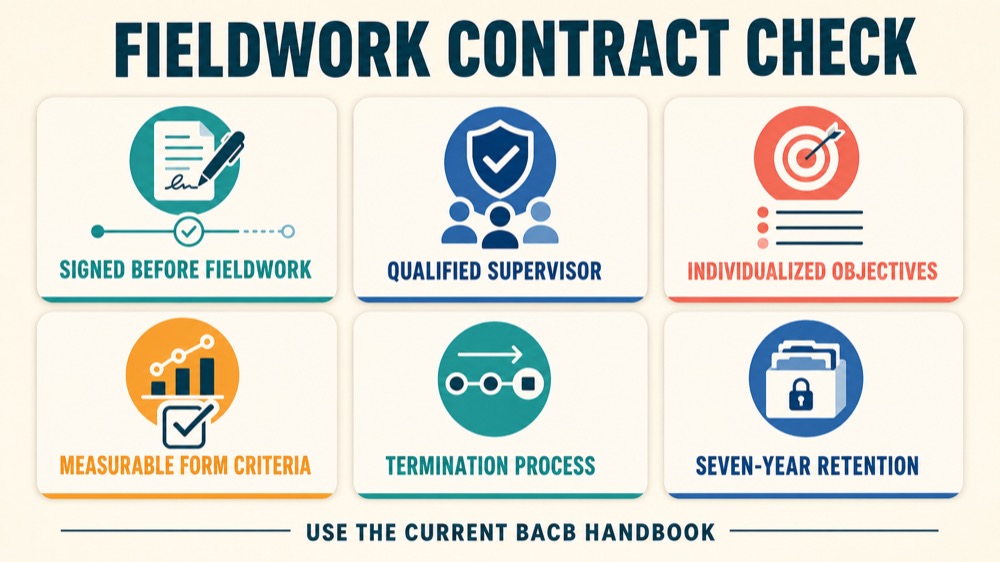
The written supervision contract must be developed and signed by the relevant parties before fieldwork begins. It should describe supervisor and trainee responsibilities, confirm the supervisor’s required supervision training and everyone’s adherence to fieldwork requirements, and identify individualized activities and training objectives. It must also address verification-form decision rules, consequences for failing to meet responsibilities, proper termination, written permission from an on-site employer or manager when applicable, and adherence to the Ethics Code. Each party must retain the contract and supervision documentation for at least seven years from the date of the final supervision meeting and provide them to the BACB if requested.
It is important to distinguish an ABA supervision contract from other types of agreements. An employment agreement or an RBT supervision arrangement is not interchangeable with a trainee fieldwork contract. The supervision contract is specifically required for BCBA and BCaBA fieldwork and must comply with current BACB standards. Always refer to the official BACB handbook and resources when drafting or reviewing a contract.
Key Components of a BACB-Compliant Supervision Contract
The current handbook identifies the following substantive components. A contract may also contain useful scheduling, payment, cancellation, privacy, or communication provisions, but those additions should not be mislabeled as the complete BACB-required list.
- Roles and responsibilities: State the responsibilities of the supervisor or supervisors and trainee, including the supervisor’s completion of the required 8-hour supervision training and adherence by all parties to current fieldwork requirements.
- Individualized preparation: Describe appropriate behavior-analytic activities and individualized activities and training objectives for this trainee, setting, and experience.
- Verification-form decisions: Define the objective and measurable circumstances under which the supervisor will not sign a Monthly Fieldwork Verification Form or Final Fieldwork Verification Form. This decision rule is distinct from the termination clause.
- Consequences and termination: Describe what happens when a party does not meet an agreed responsibility, including a process for proper termination of the relationship.
- Site authorization: Require the trainee to obtain written on-site permission from an employer or manager when applicable.
- Ethical commitment: Include an attestation that all parties will follow the Ethics Code.
- Record retention: State that each party will retain the contract and supervision documentation for seven years from the final supervision meeting and provide the records to the BACB if requested.
For multiple supervisors at one organization, one contract may be used only if it names every supervisor, explains each person’s roles, responsibilities, expectations, effective dates, and documentation duties, and identifies who will sign the relevant verification forms. All parties must sign. If circumstances later change, the contract may be amended, but every amendment requires signed and dated amendments from all relevant parties. An amendment documents the arrangement from its effective date forward; it should not be used to rewrite a prior unsigned relationship.
The BACB provides a BCBA Handbook and a Fieldwork Checklist for Supervisors that outline these requirements. Do not rely on a generic template as a substitute for the current BACB handbook. The contract must be individualized to the specific supervision arrangement.
Common Mistakes to Avoid
Many candidates and supervisors inadvertently make errors that can jeopardize fieldwork hours or lead to ethical violations. Avoid these common pitfalls by carefully reviewing your contract before signing and periodically checking it against current BACB standards.
- Starting too soon: Hours accrued before the qualified supervisor and trainee have executed the applicable written contract do not satisfy the starting-fieldwork condition.
- Copying an old template: A sample is a starting point, not proof that the current handbook, the setting, and the trainee’s objectives have been addressed.
- Using vague refusal criteria: Terms such as “unprofessional” or “not ready” are not measurable enough by themselves to explain when a verification form will not be signed.
- Combining unlike documents: An employment contract, RBT ongoing-supervision arrangement, BCaBA ongoing-supervision contract, trainee fieldwork contract, log, M-FVF, and F-FVF serve different purposes.
- Leaving supervisors out: Contact with a BCBA who is not covered by the applicable contract does not automatically count as supervised fieldwork.
- Making an unsigned change: A new supervisor, role, or material contract revision should be documented in an amendment signed and dated by every relevant party.
- Keeping records only at work: Both parties need secure, accessible copies that can still be produced after employment or supervision ends.
To avoid these mistakes, cross-reference your contract with the BACB Supervision and Training page and seek guidance from experienced supervisors if needed. The BACB also offers guidance on handling supervision challenges which can be useful when problems arise.
Change Management: Amendments and Termination
Over the course of fieldwork, supervision arrangements may need to change. The BACB requires that any modification to the contract be documented as a signed and dated amendment. Amendments do not operate retroactively; they apply only from the date of signing forward. Common reasons for amendments include adding a new supervisor, changing supervision format, or adjusting the schedule.
Two clauses are often confused. First, the contract must state the objective and measurable circumstances under which a supervisor will not sign an M-FVF or F-FVF. Second, it must state the consequences of either party failing to meet responsibilities, including proper termination. A supervisor should apply the contract that was in effect for the period being verified, document feedback and relevant evidence, and avoid inventing a refusal criterion after the fact. Ending supervision should follow the agreed process and, consistent with ethical duties, minimize disruption and support an orderly transition when feasible.
When termination occurs, it is important to document the reason and ensure that all parties retain copies of the contract and any amendments. The BACB’s resource on when supervising fieldwork doesn’t go as planned provides additional guidance on managing difficult situations.
Distinguishing the Supervision Contract from Other Documents
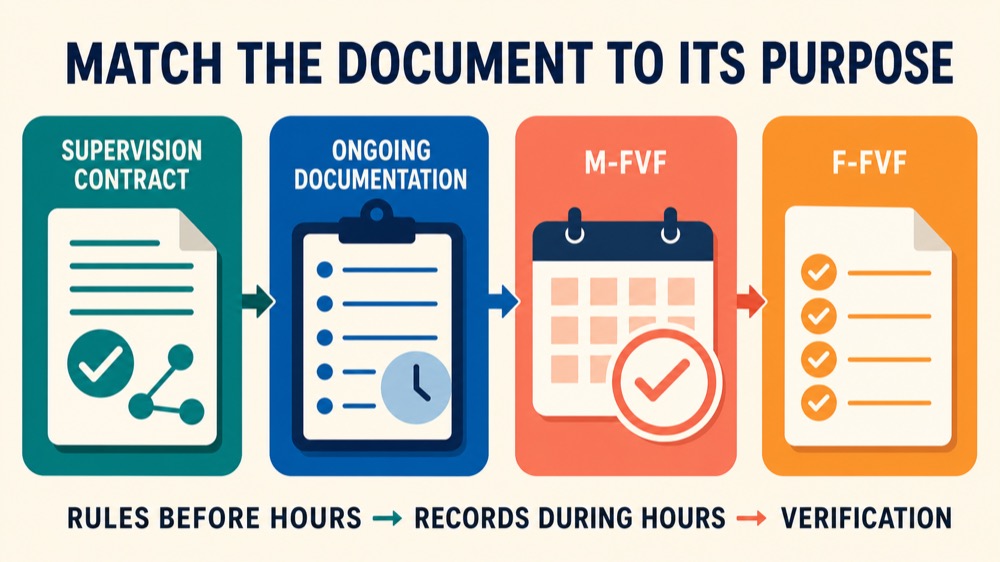
The Monthly Fieldwork Verification Form is completed for each supervisory period and retained as part of the fieldwork record; it is not ordinarily submitted with the initial BCBA certification application. The Final Fieldwork Verification Form documents the organized fieldwork experience and is submitted as part of the application. The ongoing documentation system records independent hours, supervised hours, observations, dates, durations, activity categories, supervision format, and summaries needed to demonstrate adherence if audited. The contract instead establishes the rules for the relationship before the hours are accrued.
The supervision contract is not the same as an employment contract, an informed consent document, or a behavior intervention plan. Each serves a distinct purpose. For example, an employment contract outlines job duties and compensation, while the supervision contract is specific to fieldwork training. Confusing these can lead to missing required elements or ethical violations.
The contract must state that the trainee and supervisor will each retain a copy of the contract and supervision documentation for at least seven years from the date of the final supervision meeting and will provide the documentation to the BACB if requested. Secure retention should account for confidentiality, continued access after a job change, and any longer period imposed by another applicable rule.
Practical Examples of Supervision Contracts
To illustrate how contracts function in real settings, consider the following examples. In each case, the contract tailors supervision to meet BACB requirements while addressing individual needs.
- One supervisor: The parties identify the trainee’s client-related activities, training goals, feedback and observation plan, documentation system, and form-signing criteria. The calendar is then designed to meet the applicable contact, observation, percentage, and individual-supervision requirements rather than assuming one weekly meeting is always sufficient.
- Multiple supervisors at one organization: The contract lists every supervisor and effective date, assigns activities and oversight, identifies the responsible form signer, explains how records will be coordinated, and is signed by all parties.
- Changed circumstances: Before a new supervisor begins counting supervision or a material arrangement changes, the parties document the new roles and effective date in a signed amendment. Earlier periods remain governed by the contract that was in force then.
These examples show how contracts can be customized. Always ensure the contract reflects the actual arrangements and is updated if changes occur during the supervision period. Any amendments must be signed and dated by all relevant parties.
Study Strategies for BCBA Candidates
Mastering the supervision contract is essential for BCBA candidates. Use the following strategies to ensure you understand the requirements and can apply them in practice.
- Read the current BACB Supervision Standards and Ethics Code thoroughly. Focus on the supervision contract section in detail.
- Review sample supervision contracts from official BACB resources to understand format and language. Pay attention to how each component is worded.
- Identify all required components in a contract template and explain the purpose of each. Be able to list them without reference.
- Differentiate the supervision contract from fieldwork verification forms, supervision logs, and learning contracts. Understand the unique role of each document.
- Practice applying stimulus control concepts (Sd vs. S-delta) to supervision scenarios using our stimulus control guide and stimulus generalization guide.
- Understand the consequences of non-compliance (e.g., hours may be disallowed, ethical violations). Review real case examples from BACB disciplinary actions.
- Create a sample contract for a hypothetical supervisee to solidify your knowledge. Include all required components and customize it based on a scenario.
For additional study resources, explore our culturally responsive supervision guide and function-based performance diagnostics guide to deepen your understanding of supervision practices.
Test Your Knowledge with a Free BCBA Mock Exam
After reviewing the current handbook, use the Free BCBA Mock Exam for general practice and feedback. Treat every practice item as an original study exercise rather than a recalled BACB examination item, and return to the official source whenever a rule depends on the certification year or your fieldwork pathway.
Next step for BCBA exam prep
Turn this topic into exam-day practice
Use this topic as a focused review, then test it in exam-style conditions with a free mock before deciding whether five full-length mocks are the right next step.
Start the Free BCBA Mock Exam
Continue with Five Full-Length Mocks — $99
Review the included materials and access details before ordering. No pass guarantee is implied.



