
What Is Organizational Behavior Management (OBM)?
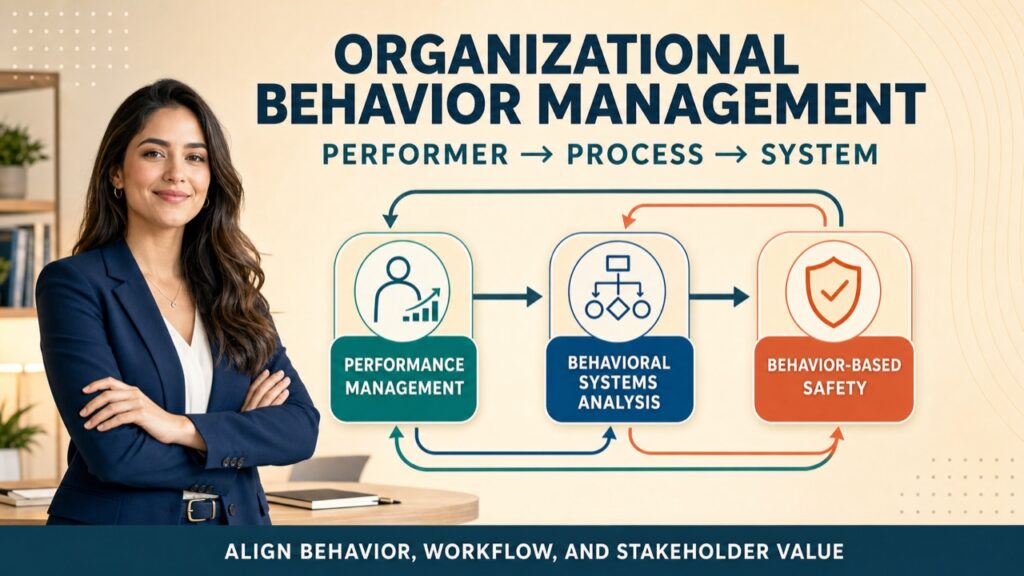
Organizational behavior management (OBM) is a subspecialty of applied behavior analysis (ABA) that assesses and changes work environments, behavior, processes, and systems to improve meaningful employee, customer, safety, service, and organizational outcomes. Unlike the broader descriptive field of organizational behavior—which often focuses on attitudes, personality, and group dynamics—OBM relies on behavioral principles such as reinforcement, punishment, extinction, stimulus control, and motivating operations. OBM is not generic management consulting, an annual HR review process, client-focused ABA programming, or a narrow attempt to change individual employees without examining the system. Instead, it targets observable behavior and measurable results through data-driven, systems-oriented analysis. For authoritative background, see the BACB’s description of OBM at bacb.com/about-behavior-analysis/organizational-behavior-management/ and recent systematic reviews such as pmc.ncbi.nlm.nih.gov/articles/PMC10976614/.
Table of Contents
- What Is Organizational Behavior Management (OBM)?
- Three Useful Scopes of OBM
- How OBM Differs from Similar Fields
- Evidence-Based OBM Workflow
- Ethical and Practical Considerations
- Study Checklist for BCBA Candidates
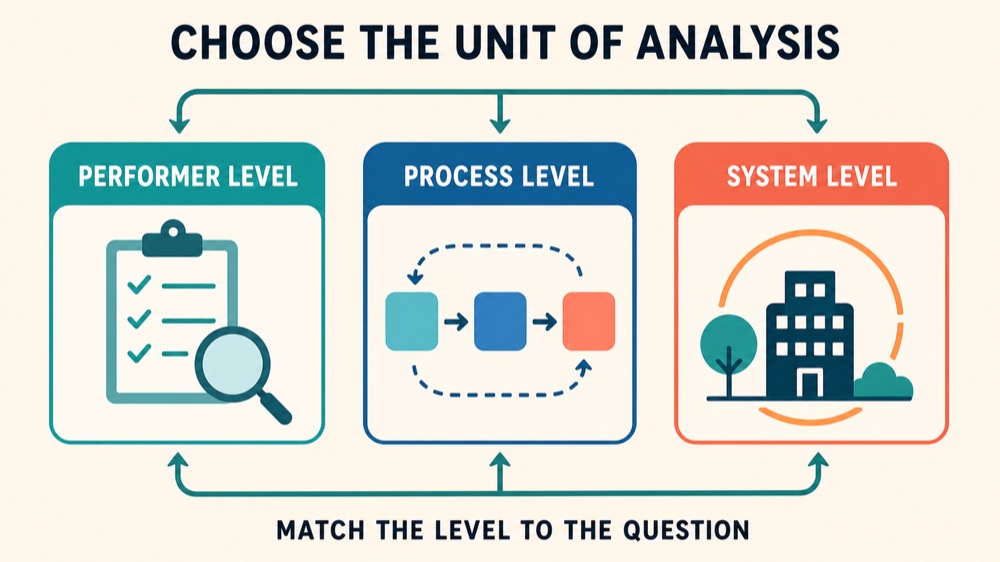
OBM can examine interacting conditions at the performer level, process level, and system level rather than assigning a workplace result to an employee trait. Performance may be affected by skills, instructions, materials, workflow, response effort, consequences, competing demands, interdepartmental handoffs, or the way organizational outputs connect to stakeholder value. The relevant unit of analysis depends on the question.
Measurement should match that unit and the critical dimension of performance. Direct observation may be appropriate for a safety step, a permanent product may represent documentation accuracy, and an organizational indicator may track wait time or defects. An outcome trend cannot by itself identify which behavior or system relation changed. A defensible evaluation connects representative measures across levels and records procedural integrity for the selected change.
Three Useful Scopes of OBM
OBM interventions typically fall into three overlapping scopes. They are not mutually exclusive; many projects address multiple levels simultaneously. Understanding these scopes helps practitioners select appropriate strategies for different organizational challenges.
Performance Management (Performer Level): Performance management concentrates on the performer level: specific employee or small-group actions and their work products. The practitioner pinpoints behavior, establishes a representative baseline, assesses environmental variables, selects a procedure, and measures both implementation and performance. Task clarification, training, feedback, goal setting, workflow changes, and reinforcement arrangements are possible components rather than a required package.
Consider a hypothetical clinical documentation project. The team defines complete documentation using observable fields and the organization’s legitimate deadline, samples completed notes, and asks whether staff have the skill, information, time, system access, and consequences needed. A matched change might revise the template, place criteria at the point of performance, repair an access problem, or add descriptive feedback. Any improvement supports the evaluated package under those conditions; further analysis is needed before assigning the effect to one component.
Behavioral Systems Analysis (Process and System Levels): Behavioral systems analysis maps how the organization exchanges value with its environment and how inputs move through processes to produce outputs. At the process level, the analyst studies steps, handoffs, delays, rework, information, and resources. At the system level, the analyst asks whether departmental outputs and contingencies align with the result valued by customers, workers, funders, or other stakeholders. Individual performance remains part of the map, but it is interpreted inside these relations.
For example, a hypothetical service organization with long intake delays could trace referral, authorization, scheduling, assessment, and start-of-service steps. Measurement might reveal duplicate entry and an approval queue rather than a staff skill deficit. The resulting test could change the workflow or information path and then measure cycle time, accuracy, worker effort, and unintended effects. A systems map guides inquiry; it does not establish causation without an evaluation design.
Behavior-Based Safety: Behavior-based safety applies behavioral measurement and environmental analysis to critical safety practices and conditions. A project may define a safe action, observe it with a feasible and respectful method, remove hazards or response-effort barriers, provide appropriate feedback, and monitor incidents alongside leading indicators. The analysis should include equipment, staffing, production contingencies, training, reporting systems, and worker knowledge rather than locating responsibility only in frontline behavior.
Worker participation is especially important because a narrow productivity measure can compete with safety. A valid safety project invites information about hazards and near misses, protects reporting from retaliation, tests whether the support is implemented, and watches for gaming or underreporting. Feedback or recognition is selected from assessment and evaluated by its effect; neither is a defining requirement of every safety intervention.
How OBM Differs from Similar Fields
Understanding what OBM is not helps clarify its unique contribution. The following distinctions prevent common misconceptions:
- Compared with organizational behavior: The fields can study overlapping workplace topics, but OBM is anchored in applied behavior analysis, repeated measurement, environmental relations, and experimental or quasi-experimental evaluation where feasible. It should not be defined by claiming that another field uses only one kind of measure.
- Compared with management consulting: OBM describes an analytic and intervention approach, not a job title or guarantee of competence. Recommendations should be traceable to measurement, assessment, evidence, contextual fit, and evaluation.
- Compared with periodic personnel review: A review may summarize employment performance. An OBM project establishes an operational target and measurement cycle for a specific improvement question; the appropriate observation or feedback schedule is selected from context rather than a universal cadence.
- Compared with client-focused ABA programming: Both apply behavioral science, but OBM addresses work behavior, processes, safety, and organizational systems. Practice still requires competence and the authority relevant to the setting.
- Compared with person-focused blame: OBM replaces trait explanations with questions about behavior-environment relations and the system that managers and performers jointly encounter.
Evidence-Based OBM Workflow
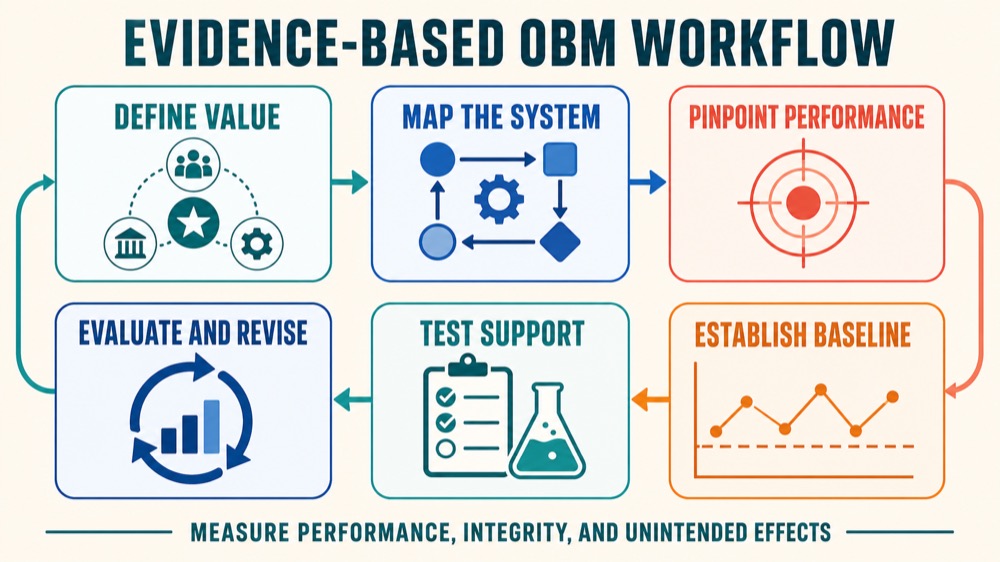
The workflow below integrates performer, process, and system questions. Current BCBA supervision competencies appear in Domain I of the BCBA Test Content Outline (6th ed.), including culturally responsive performance-management procedures, function-based performance diagnostics, and data-based evaluation of supervision. OBM also applies outside certification supervision, so the workflow should be adapted to the organization’s purpose and the practitioner’s competence.
- Identify a socially valid organizational result. Choose an outcome that matters to stakeholders—e.g., reduced error rate, improved customer satisfaction, fewer safety incidents.
- Map the relevant system and process. Use BSA tools like a behavior systems analysis diagram or flowchart to identify inputs, process steps, outputs, and feedback loops.
- Pinpoint observable behavior or product. Define the target behavior in measurable terms. Instead of “improve attitude,” pinpoint “number of thank-you statements per call” or “percentage of orders filled without errors.”
- Establish representative baseline measurement. Select direct, product, process, or outcome measures that match the question and sample ordinary conditions. The amount and timing of measurement depend on variability, risk, feasibility, and the evaluation design; there is no universal minimum count.
- Assess the environment. Evaluate training or skill deficits, antecedents and information, resources and workflow, consequences, response effort, and competing demands.
- Select a contextually fitted procedure. Choose an intervention supported by evidence and tailored to the organization’s culture, resources, and constraints.
- Measure procedural integrity and outcomes. Track whether the intervention is implemented as designed and whether the target behavior and organizational result improve.
- Revise and plan sustainability from data. Continue, modify, withdraw, or expand the change based on replicated performance, integrity, stakeholder feedback, cost, unintended effects, and the conditions needed to maintain the valued result.
Ethical and Practical Considerations
Workplace contingencies affect income, advancement, reputation, workload, and safety, so technical efficiency is not the only value. An OBM plan should define who benefits, who bears effort or risk, what information will be collected, and what unintended outcomes could follow. The implementation-science discussion at PMC7518547 also illustrates why organizational systems and implementation conditions matter when supporting evidence-based practice.
- Collaboration and cultural responsiveness: Seek worker and stakeholder input on goals, definitions, measures, communication, feedback, and feasible support. Avoid treating one cultural preference as the norm.
- Privacy and transparency: State the measurement purpose, access, retention, and decision rules. Follow applicable law, contracts, consent requirements, professional duties, and organizational policy rather than promising one privacy rule for every workplace.
- Safety and competing contingencies: Measure whether speed, volume, or incentive arrangements displace safety, accuracy, reporting, teamwork, or service quality.
- Acceptability and unintended effects: Monitor burden, stress, inequitable impact, workarounds, gaming, underreporting, and competition as well as the intended result.
- Choice and coercion risk: Prefer supportive environmental changes and meaningful participation when possible. Evaluate how employment power changes the voluntariness and consequences of participation.
- Competence and role authority: A behavior-analytic credential demonstrates a defined professional qualification; hiring, discipline, compensation, labor relations, and regulated decisions may require different expertise or delegated authority. Confirm the actual role before acting.
- Social validity: Productivity, safety, service, employee experience, and stakeholder value may move differently. Judge success across the outcomes that matter, not from one convenient metric.
Study Checklist for BCBA Candidates
- Define OBM and distinguish it from organizational behavior, management consulting, and HR reviews. Know that OBM is a subspecialty of ABA.
- Identify the three overlapping scopes: performance management (performer level), behavioral systems analysis (process and system levels), and behavior-based safety.
- Describe the BSA diagram: customer value → outputs → process steps → performer behavior → resources → contingencies.
- Explain the evidence-based OBM workflow: identify a socially valid result, map the system, pinpoint behavior, baseline, assess environment, select intervention, measure integrity and outcomes, and revise or maintain.
- Apply ethical considerations: staff collaboration, confidentiality, safety, coercion, competence, and legal scope.
- Practice OBM scenarios with mock questions. Use the free BCBA mock exam at bcbamockexam.com/free-bcba-mock-exam/ to test your knowledge of personnel supervision and management with original practice questions and detailed feedback.
Next step for BCBA exam prep
Turn this topic into exam-day practice
Use this topic as a focused review, then test it in exam-style conditions with a free mock before deciding whether five full-length mocks are the right next step.
Start the Free BCBA Mock ExamContinue with Five Full-Length Mocks — $99
Review the included materials and access details before ordering. No pass guarantee is implied.



