
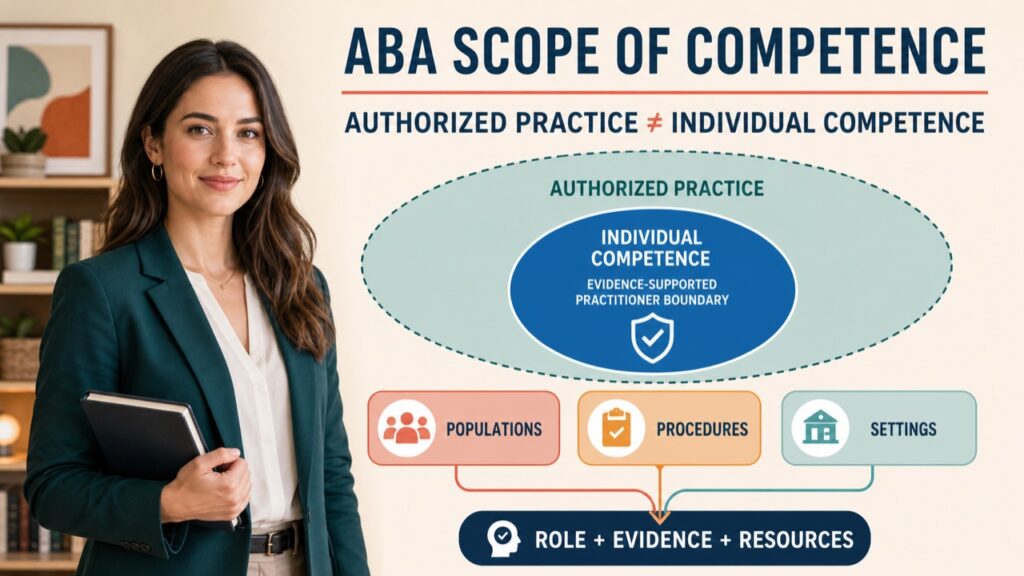
Scope of competence in ABA is the set of professional activities an individual behavior analyst can currently perform with the knowledge, skill, safeguards, and contextual understanding needed for responsible service. It is narrower and more personal than the profession’s scope of practice. The current BACB Ethics Code requires behavior analysts to define and document their professional role in writing under standard 1.04 and limits practice to their identified scope of competence under standard 1.05. Certification establishes a professional credential; it does not establish expertise with every population, procedure, setting, risk level, or service model.
Table of Contents
- Defining Scope of Competence in ABA
- Why Scope of Competence Matters in ABA
- How to Determine Your Scope of Competence
- Common Pitfalls When Defining Your Scope of Competence
- Examples of Scope of Competence in Practice
- Expanding Your Scope of Competence Ethically
- References and Further Reading
- Test Your Knowledge
Defining Scope of Competence in ABA
A practitioner’s identified scope of competence is task- and context-specific. Relevant dimensions include the target problem, assessment and intervention procedures, client populations, service settings, cultural and linguistic variables, collaboration demands, medical or safety risk, and the resources needed for effective implementation. Standard 1.05 governs this individual competence question. Standard 1.04 separately requires a defined professional role, while standard 1.02 requires compliance with applicable legal and professional requirements. These standards interact, but they should not be assigned the wrong numbers or treated as synonyms.
- Scope of practice describes activities a profession, credential, license, or other regulator authorizes. The actual boundary may differ by jurisdiction, credential status, role, sanction, payer, or employer requirement.
- Scope of competence describes what this practitioner can perform proficiently under the present conditions. Two BCBAs can therefore have different competence profiles inside an overlapping authorized practice area.
- Role describes what the practitioner has agreed and is authorized to do in a particular relationship. A competent skill may still sit outside the documented role or another applicable rule.
- Resources and fit include time, staffing, consultation, equipment, interdisciplinary support, evidence applicable to the client, and cultural responsiveness. Competence cannot be separated from the conditions needed to use it safely.
For example, a behavior analyst may be authorized to provide behavior-analytic services yet lack the preparation and interdisciplinary resources needed for a complex feeding presentation. The next decision is not automatically “accept” or “decline.” The analyst must clarify the requested role, consider relevant medical and professional boundaries, evaluate current competence and resources, and then arrange documented competence-building, consultation, co-treatment, referral, or transition as the circumstances require. Authorization and individual competence must both be present; neither one substitutes for the other.
Why Scope of Competence Matters in ABA
Practicing beyond current competence can produce inaccurate assessment, ineffective or unsafe intervention, delayed referral, poor collaboration, and avoidable disruption for the client. Ethics Code standard 1.05 requires practice within the identified scope; standard 1.06 requires active professional development to maintain and further competence; and standard 3.03 limits client acceptance to the analyst’s competence and available resources. A practitioner directed to accept an unsuitable case should discuss and resolve the concern with relevant parties and document the actions and outcome. This is a client-protection decision, not a claim that one unfamiliar diagnosis automatically disqualifies every practitioner.
How to Determine Your Scope of Competence
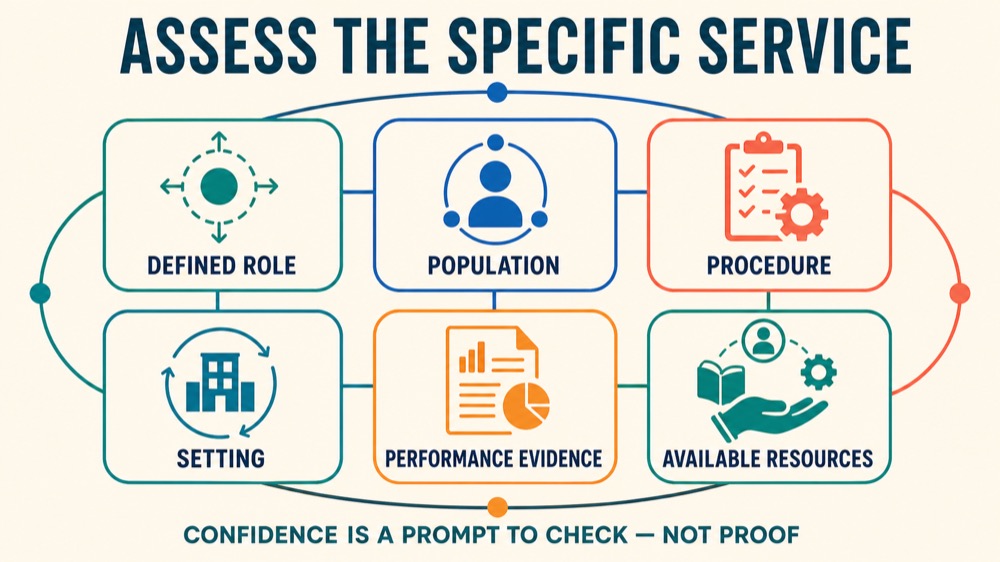
Determining competence requires more than confidence or a résumé. Review performance evidence across the specific service request, including what must be assessed, implemented, monitored, communicated, and adapted. The following domains synthesize the Code and the scholarly discussion in Brodhead, Quigley, and Wilczynski; they are decision prompts, not an official BACB scoring tool or a validated competence test.
- Procedures and decisions: Can you accurately select, implement, interpret, and revise the assessments or interventions involved, including safety and stop criteria?
- Populations and presenting variables: Does your preparation address the person’s age, communication, disability, health, risk, culture, language, and relevant learning history?
- Settings and systems: Have you demonstrated the skill under conditions similar enough to the current home, school, clinic, workplace, residential, or remote context?
- Evidence and experience: Do coursework, literature knowledge, supervised performance samples, outcome data, feedback, and prior cases together support the required repertoire?
- Available resources: Are competent consultation, interdisciplinary input, staffing, time, equipment, oversight, and transition options available when needed?
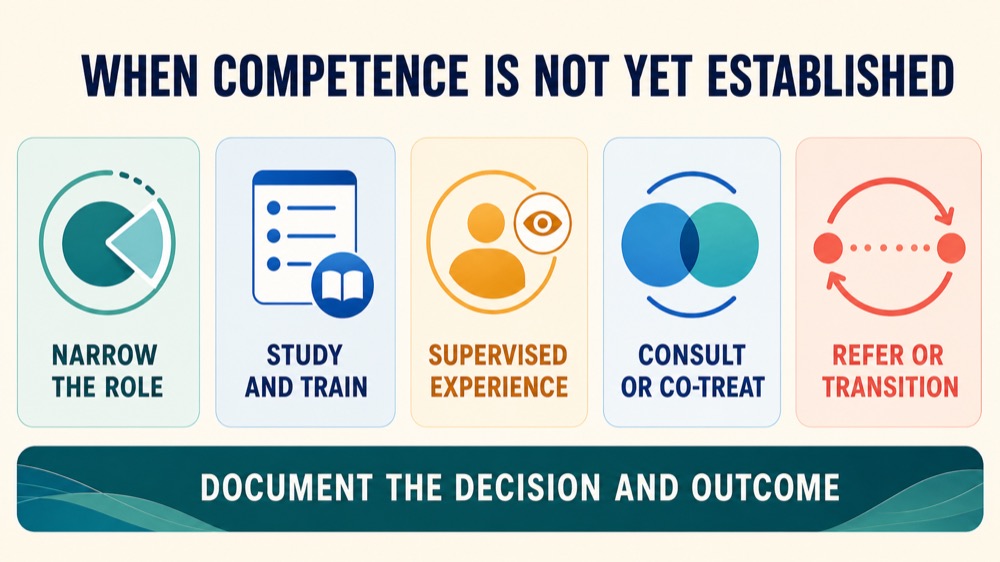
For a new practice area, standard 1.05 permits professional activity only after the analyst accesses and documents appropriate study, training, supervised experience, consultation, and/or co-treatment from professionals competent in that area. If those conditions are not in place, the analyst must refer or transition services to an appropriate professional. The mix depends on risk and the exact repertoire; the Code does not publish one universal number of hours, cases, CEUs, or observations that proves competence.
Structured Self-Assessment Prompts
- What exact actions and decisions will this role require, and which could create significant harm if performed poorly?
- What direct evidence shows I can perform those actions accurately, safely, and consistently under comparable conditions?
- How well do the research participants, procedures, safeguards, and settings match this client and context?
- What do recent supervision, consultation, outcome data, integrity data, or work samples reveal about my current performance?
- Which cultural, linguistic, accessibility, assent, and stakeholder variables require additional knowledge or collaboration?
- What competent support and available resources will be present when an unfamiliar condition arises?
- What is the documented plan to learn, obtain oversight, pause, refer, or transition if the evidence does not support independent work?
A “no,” “unknown,” or weak evidence point calls for analysis rather than an automatic pass/fail score. Depending on the risk and supports, the defensible response may be to narrow the role, obtain consultation, arrange supervised experience or co-treatment, build a written training plan, delay acceptance, or refer or transition the service. Record the question, evidence considered, competent people consulted, decision, safeguards, and later performance data so the conclusion can be revisited.
Common Pitfalls When Defining Your Scope of Competence
Many behavior analysts inadvertently exceed their scope of competence. Common pitfalls include:
- Credential overgeneralization: Passing an examination or holding a license does not demonstrate every specialized assessment, population, procedure, or setting repertoire.
- Confidence as evidence: Familiar terminology and good intentions do not replace observed skill, accurate products, feedback, integrity, outcome monitoring, and knowledge of limits.
- Employer pressure: Staffing need does not expand competence. Discuss the gap, propose safeguards or a narrower role, seek competent support, and document the resolution.
- One-source preparation: A workshop, CEU, article, or vendor certificate may contribute to learning but does not by itself establish competence for a novel or high-risk service.
- Ignoring role-specific requirements: Competence does not override formal qualifications for supervision, licensure, funding, research, medical collaboration, or another regulated activity.
- Failure to maintain competence: Skills and evidence change. Maintaining competence can include current literature, coursework, coaching, consultation, supervision, mentorship, credentials, and direct review of professional performance.
Avoid these pitfalls by engaging in continuous self-reflection and seeking feedback from peers and supervisors. Understanding stimulus control is essential for many interventions; test your skills with our stimulus control article.
Examples of Scope of Competence in Practice
Example 1: A BCBA is asked to lead assessment and intervention for pica but has no pica-specific supervised experience, no medical coordination plan, and preparation limited to a brief literature review. The analyst does not infer competence from general functional-assessment training. Before taking that role, the analyst identifies the safety and interdisciplinary requirements, consults competent professionals, clarifies who holds each decision, and either establishes documented training and supervised participation or refers or transitions the service.
Example 2: A clinician is asked to lead an organizational behavior management project. The underlying behavioral principles are familiar, but the analyst lacks experience with workplace systems, employment power, privacy, process measures, and stakeholder contracting. A targeted course may be useful, yet it is not treated as proof of independent competence. The analyst develops a respecialization plan, obtains mentorship and supervised work samples, and evaluates performance before expanding the documented role.
Example 3: An early-intervention BCBA is offered a residential consultation involving severe aggression. Age, setting, staffing, risk controls, consent and assent, crisis coordination, and treatment-history variables differ from prior cases. The analyst and a competent consultant define a limited role, arrange observation and supervised performance, identify pause and transition criteria, and document training, consultation, decisions, and outcomes. Those safeguards support competence-building; the scenario alone cannot certify that competence has been achieved.
Expanding Your Scope of Competence Ethically
Competence can expand, but respecialization should be planned around observable repertoires and client protection. The BACB’s respecialization guidance recommends research, planning, training, supervised or mentored experience, continual self-assessment, and a maintenance strategy. The document is informational and expressly does not establish one competence standard for every practice area.
- Define the new area and the critical knowledge, performance, collaboration, and safety skills rather than using a broad specialty label.
- Study the relevant literature and rules, including sources outside behavior analysis when the service requires interdisciplinary knowledge.
- Build and rehearse skills through training, modeling, feedback, competency-based practice, supervised experience, consultation, and co-treatment as appropriate.
- Collect work samples, integrity measures, decision records, supervisor feedback, and outcomes that can support or challenge the competence judgment.
- Document the professional role, training plan, competent oversight, limits, safeguards, progress, and decision to expand or retain restrictions.
- Plan for maintaining competence through current literature, performance review, professional development, cultural responsiveness, and continuing access to needed resources.
Ethical expansion is an ongoing decision process, not a certificate event. Avoid claiming independent competence beyond the evidence available, and continue monitoring performance after the role changes. If conditions, procedures, populations, settings, laws, or resources change, re-evaluate the boundary. The universality of behavioral principles does not create universal practitioner competence to apply them in every context.
References and Further Reading
Start with the current Ethics Code for Behavior Analysts, especially standards 1.04, 1.05, 1.06, 3.03, and 3.06, and verify the current version on the BACB Ethics Codes page. The peer-reviewed article A Call for Discussion About Scope of Competence in Behavior Analysis offers a multidimensional self-evaluation framework, but its authors describe that framework as preliminary rather than an official BACB standard or empirically validated test.
Test Your Knowledge
Use the Free BCBA Mock Exam for general practice and feedback after you review the primary sources. Treat practice scenarios as original study exercises, not recalled BACB examination items or substitutes for ethics consultation. For related behavioral foundations, review the stimulus control and stimulus generalization guides.



