

A TCO-first buying and study workflow for turning a baseline mock score into targeted BCBA exam review. If you are looking for an ABA exam review study guide, do not begin by asking which book has the most pages. Begin by asking whether the guide helps you identify a weak TCO domain, practice the skill in a scenario, and verify that the weakness is shrinking. A long glossary can support review, but it cannot replace a diagnostic, retrieval practice, and a second measurement.
Table of Contents
- What a useful ABA exam review study guide should do
- Start with the current TCO, not the cover date
- Use the four-step review map
- Budget study time by domain weight
- Take a baseline mock before choosing chapters
- Turn one missed question into a study action
- Choose a review timeline that matches your gap
- Compare study guides by the decision they help you make
- Watch for study-guide red flags
- Use practice to make the guide convert into progress
- ABA exam review study guide FAQ
- The bottom line
- Sources to recheck
- Quick Review Checklist
- Take the Free BCBA Mock Exam
The current BCBA Test Content Outline (6th ed.) organizes 104 tasks across nine content domains. The BCBA Handbook says the examination includes 175 scored questions and 10 unscored questions, with four hours to complete the exam. Use that blueprint to audit any review resource, but remember that the BACB does not endorse specific study guides and no purchase guarantees a passing result.
What a useful ABA exam review study guide should do
A useful guide should connect four things: the current TCO, a clear explanation, an exam-style application, and a feedback loop. If a resource only gives definitions, it may help you recognize terms but leave you unprepared for a vignette that asks what to do next. If it only gives questions without rationales, you may memorize an answer without fixing the underlying discrimination.
| Resource feature | Evidence to look for | Warning sign |
|---|---|---|
| Current blueprint | Names the BCBA TCO 6th ed. and maps content to domains or tasks. | Uses an old task list without a date or update note. |
| Scenario practice | Questions require a decision, application, or discrimination among similar options. | Only flashcards or isolated definitions. |
| Rationales | Explains the correct answer and why distractors fail. | Shows a letter or answer with no reasoning. |
| Feedback | Lets you see patterns by domain, task, or error type. | Reports only one overall percentage. |
Start with the current TCO, not the cover date
A review product can be labeled “2025,” “2026,” or “6th edition” and still require a closer check. Open the resource and find the edition, domain labels, task mapping, update date, and explanation of how practice questions were built. The official BACB page is the source of truth for the examination content; a private guide is a study aid, not a replacement for the TCO or Handbook.
The TCO is a blueprint, not a promise that your exact form will contain a fixed sequence of questions. It tells you where the tested knowledge and skills are organized. Use it to prevent a common mistake: spending nearly all your time on familiar vocabulary while avoiding the domains in which you cannot apply a concept to a case.
Use the four-step review map
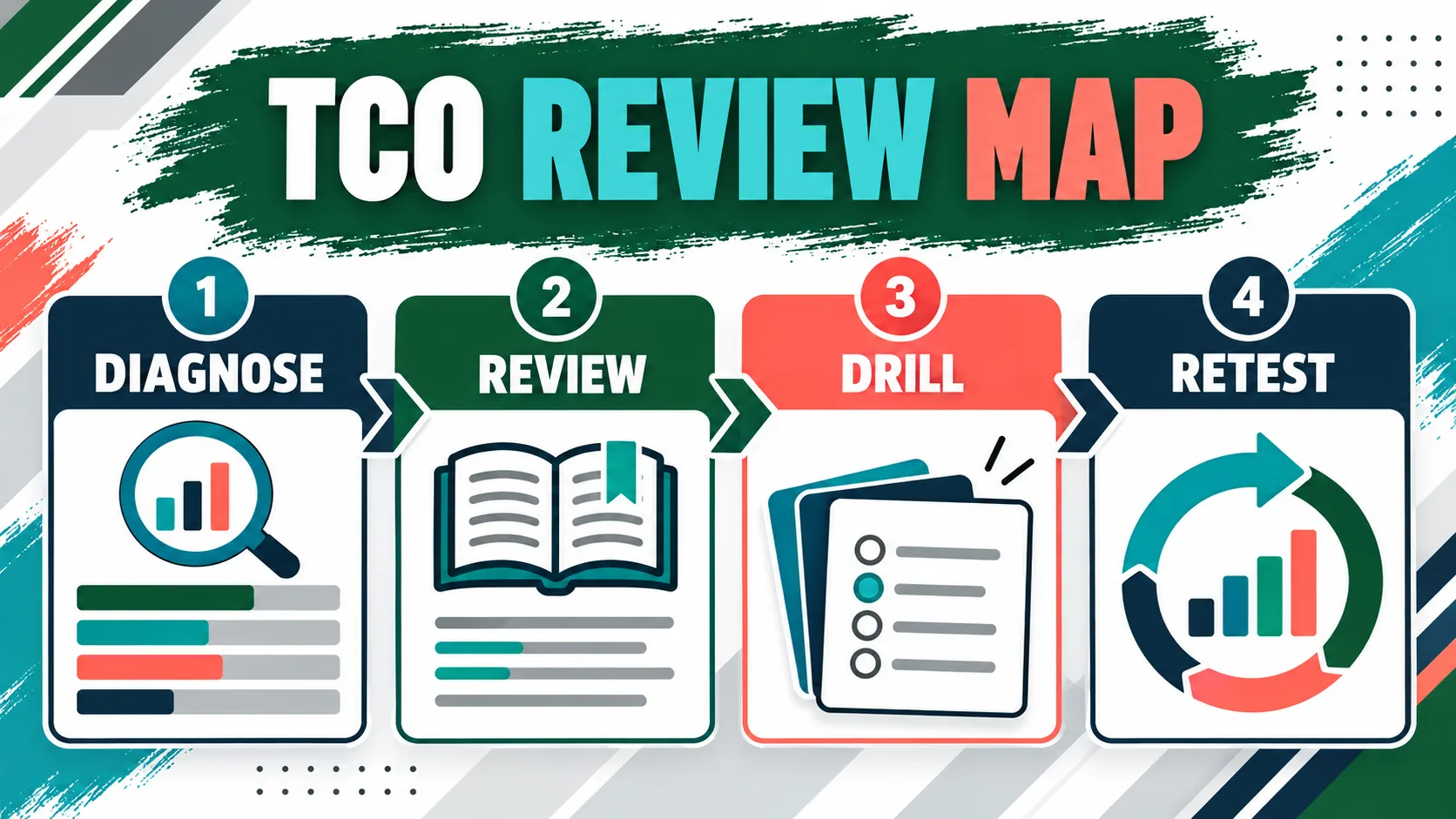
Move through the loop in order. Diagnose before you read everything. Review only the concepts connected to the error. Drill the same task in new scenarios. Then retest after enough time has passed that you are not simply remembering the answer. This sequence turns a study guide into a decision system.
Budget study time by domain weight
The current TCO lists the approximate share of scored questions for each domain. Use those percentages as a starting point for time allocation, then adjust for your diagnostic results. A small domain can still be a major personal weakness, and a large domain that you already handle well may need maintenance rather than endless rereading.
| TCO domain | Official share | Study-guide use |
|---|---|---|
| A. Behaviorism and Philosophical Foundations | 5% | Clarify assumptions and distinguish scientific explanations from attractive distractors. |
| B. Concepts and Principles | 14% | Practice discriminations among contingencies, schedules, stimulus control, and verbal behavior. |
| C. Measurement, Data Display, and Interpretation | 12% | Work with definitions, calculations, graphs, reliability, and interpretation—not just terms. |
| D. Experimental Design | 7% | Identify variables, control logic, design selection, and threats to validity. |
| E. Ethical and Professional Issues | 13% | Drill the best-next-action logic using the current Ethics Code and context. |
| F. Behavior Assessment | 13% | Compare assessment questions, measurement choices, and functional hypotheses. |
| G. Behavior-Change Procedures | 14% | Apply procedures to conditions, goals, and side effects rather than reciting names. |
| H. Selecting and Implementing Interventions | 11% | Practice matching intervention decisions to assessment, client values, and data. |
| I. Personnel Supervision and Management | 11% | Use scenarios involving feedback, training, documentation, and performance management. |
For example, if you have 40 hours available, a purely proportional starting point gives more time to B and G than to A or D. Your diagnostic score then moves hours toward the tasks you miss. The percentages are a planning guide, not a separate pass threshold: the BACB states that the overall examination result is not based on performance in each individual content area.
Take a baseline mock before choosing chapters
A baseline mock exam is useful when you treat it as measurement rather than a verdict. Use timed conditions as closely as practical, record the domain and task behind each miss, and note whether the problem was knowledge, discrimination, calculation, reading, pacing, or careless responding. A single overall percentage cannot tell you which chapter to open next.
The BACB examination information page explains that failing candidates receive a report showing the percentage of questions answered correctly and the total number of questions within primary content areas. Your private practice result will not be the official report, but you can adopt the same domain-level habit: turn each error into a next action.
Turn one missed question into a study action
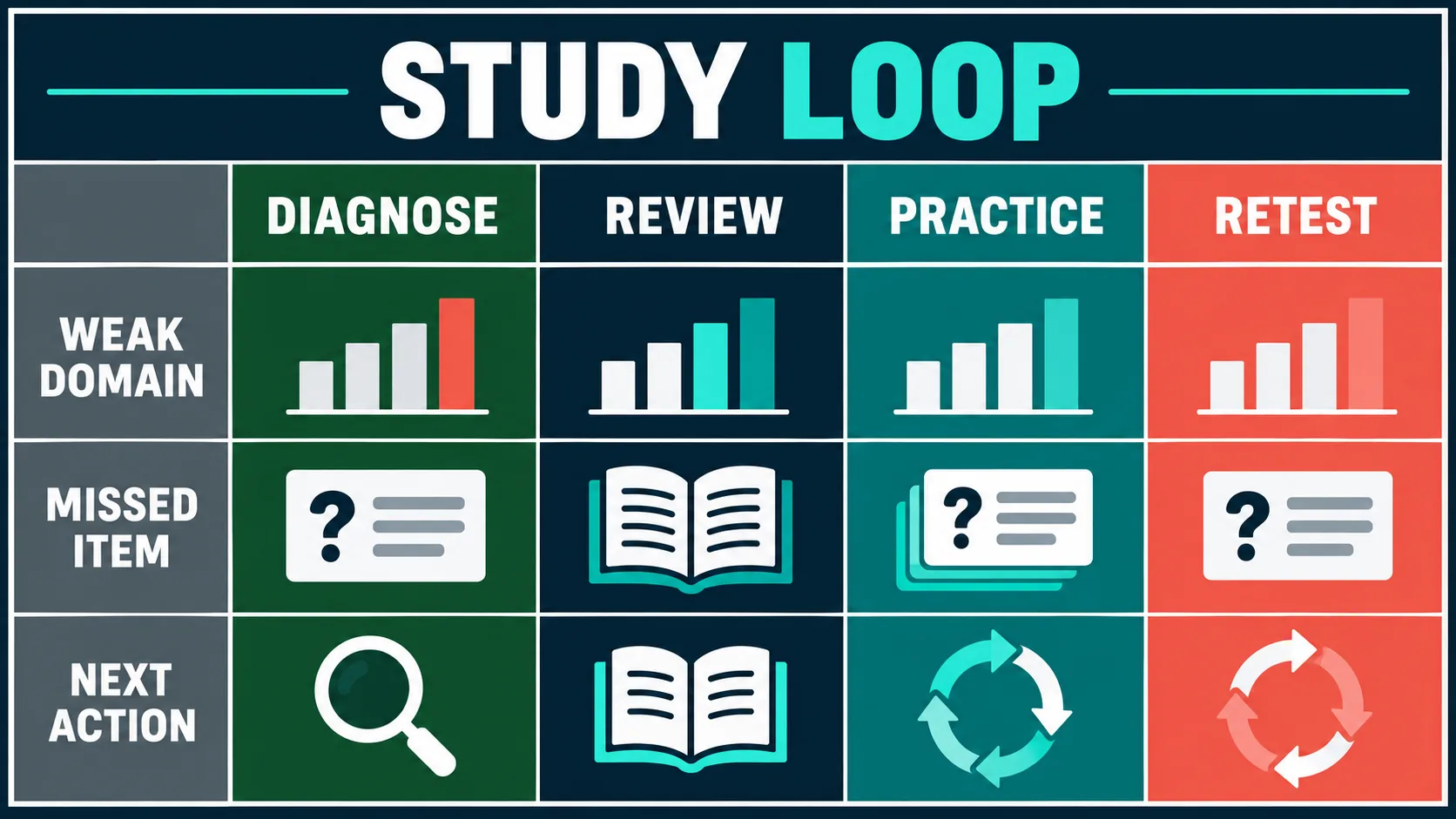
Do not solve a missed item by rereading the entire textbook. First identify the exact task. Then write the rule in your own words, create a contrast with the closest distractor, and answer a new item without looking at the rationale. If you cannot explain why the wrong options are wrong, the review is not finished.
| Error type | Repair action | Retest signal |
|---|---|---|
| Definition confusion | Write a two-column contrast and one original example for each term. | You can classify a new example without keyword matching. |
| Best-next-action error | Underline the client, data, ethics, and scope constraints in the vignette. | You can state why the tempting action is premature or outside scope. |
| Calculation or graph error | Rework the problem step by step, then complete a changed-number version. | The process works when the surface numbers and order change. |
| Pacing error | Use short timed sets and review skipped items separately from knowledge misses. | Accuracy stays stable as time pressure gradually increases. |
Choose a review timeline that matches your gap
If the diagnostic shows broad gaps, start with a full TCO map and a weekly rotation. If the gaps cluster in two or three domains, use a targeted plan and keep the other domains on maintenance. If you are close to test day, prioritize retrieval, timed mixed sets, and error correction over collecting another resource.
- First session: take a baseline and label every miss by domain and error type.
- Middle sessions: alternate explanation, contrast practice, and scenario questions for the weakest tasks.
- Weekly checkpoint: take a mixed timed set so you do not confuse isolated fluency with transfer.
- Final checkpoint: complete a full mock, review the error log, and decide whether the remaining gap is content, strategy, or pacing.
Keep one primary guide and one practice system long enough to learn from the feedback. Switching among five books can feel productive while making it impossible to tell which method helped.
Compare study guides by the decision they help you make
A guide is more useful when it tells you what to do after a miss. Before buying, check whether the resource supports your stage: first-pass orientation, domain repair, scenario practice, timed simulation, or retake diagnosis.
| Your current need | Best resource role | What to verify before purchase |
|---|---|---|
| I do not know the TCO structure. | Blueprint or concept guide | Current edition, domain map, plain-language explanations. |
| I know terms but miss scenarios. | Targeted question bank with rationales | Independent items, distractor explanations, domain labels. |
| I need timing practice. | Timed mock exam | Full-length format, review mode, and a useful performance breakdown. |
| I am retaking the exam. | Diagnostic and remediation loop | A way to map old weak areas to current TCO tasks instead of repeating the same reading. |
Watch for study-guide red flags
Be cautious when a resource promises a guaranteed pass, treats a private score as an official passing cutoff, presents an old exam structure as current, or uses recalled exam questions. The BACB’s official materials should control claims about the examination. A private product can offer instruction and practice, but it cannot authorize testing, replace eligibility requirements, or guarantee your result.
Also check the update policy. If the TCO, Handbook, Ethics Code, or application rules change, you need to know whether the resource will be revised and how the date will be shown. A visible version note is more useful than a generic “latest” badge.
Use practice to make the guide convert into progress
After you finish a targeted review block, do not wait weeks to find out whether it worked. Take a short set aligned to the same domain, record the error types, and schedule a mixed retest. This is where a study guide and a mock exam work together: the guide explains the gap, practice exposes the gap, and the next mock checks transfer under pressure.
Start with the Free BCBA Mock Exam to establish a baseline, then use the result to choose your next review block. Review every missed item—not only the percentage—so the click leads to a measurable study decision rather than another unfocused resource.
ABA exam review study guide FAQ
What should I look for in an ABA exam review study guide?: Look for alignment with the current BCBA TCO, explanations that connect concepts to scenarios, independent practice questions, distractor rationales, and a way to review results by domain or task. A long list of terms alone is not a complete review system.
Should I read a study guide before taking a mock exam?: Usually take a short baseline first, if you can do so without exhausting your best practice resource. The baseline shows which chapters deserve time. After targeted review, use a new or mixed set to see whether you can apply the idea rather than recognize the same answer.
How much should I study each BCBA domain?: Use the TCO’s domain percentages as a starting budget, then adjust for your diagnostic gaps. The percentages describe the blueprint; they are not individual pass cutoffs. Spend enough time on high-weight domains while repairing any low-weight domain that creates repeated errors.
Are mock exams enough to pass the BCBA exam?: No. Mocks measure readiness and expose gaps, but they do not replace learning, official eligibility requirements, or the current BACB materials. Use the rationale and error log to decide what to review next.
Can a study guide guarantee a passing score?: No. Treat any guarantee as a warning sign. The BACB does not endorse specific study guides, and your result depends on your overall performance on the examination form you receive.
The bottom line
The best ABA exam review study guide is not the one with the most pages; it is the one that helps you move from a current TCO task, to a clear explanation, to independent scenario practice, and then to a retest that shows whether the gap changed. Start with a baseline, budget by the blueprint, log the reason for every miss, and use a mock exam as a measurement tool throughout the plan.
Sources to recheck
Authoritative references: the BCBA Test Content Outline (6th ed.), the updated BCBA Handbook, and the BACB Examination Information page. Existing BCBA Mock Exam resources—including the exam study materials hub, 6th-edition study guide, and free mock exam—provide adjacent paths; this page owns the TCO-gap-to-review decision workflow. For targeted review, use our aba exam review study guide practice questions to apply the concept in exam-style scenarios.
Quick Review Checklist
Use this final checklist to turn aba exam review study guide into exam-ready reasoning. The goal is not to memorize a label in isolation; it is to identify the relevant evidence and explain why the best answer fits the scenario. Key ideas to review:
- State the central definition or decision point for aba exam review study guide in your own words.
- Identify the detail that makes aba exam review study guide different from its closest related ABA term.
- Separate the observable facts in a scenario from assumptions that are not supported by the facts.
- Write one example and one nonexample so you can recognize the concept in a new setting.
Exam application checks:
- Ask what the question is actually requesting before comparing the answer choices.
- Mark the antecedent, response, consequence, or other evidence that supports the selected answer.
- Look for a distractor that describes a related process but does not answer the specific question.
Final self-check:
- Explain how you would verify the interpretation with clear observations or data.
- Change one detail in the scenario and decide whether your answer should change.
- Give a one-sentence rationale that a supervisor or study partner could evaluate.
Take the Free BCBA Mock Exam
A useful next step is to apply this idea in a fresh set of BCBA-style practice questions and review the feedback. Take the Free BCBA Mock Exam



