

A decision-first guide to choosing reversal, multiple-baseline, alternating-treatments, or changing-criterion designs from the research question. If you search for single case design aba, the most useful skill is not memorizing four labels. It is matching the design to the question, the way the intervention can be delivered, and the kind of experimental control you can ethically demonstrate. On a BCBA exam item, the best answer is usually the design whose phase changes produce the clearest repeated demonstration of the intervention effect.
Table of Contents
- Start with the research question
- What a single-case design must demonstrate
- Use the design-selection map before memorizing names
- Compare the four major design choices
- Choose reversal when withdrawal is defensible
- Choose multiple baseline when withdrawal is not practical
- Choose alternating treatments for a rapid comparison
- Choose changing criterion for stepwise goals
- Read the graph for control, not just improvement
- Check threats and ethics before choosing the label
- Build a design-selection worksheet
- Common exam traps
- Use targeted practice after the design logic is clear
- Single case design ABA FAQ
- The bottom line
- Sources to recheck
- Quick Review Checklist
- Take the Free BCBA Mock Exam
Use this page as a decision guide. First identify what must be compared. Then ask whether treatment can be withdrawn, whether introduction can be staggered across tiers, whether two conditions can alternate quickly, or whether the target should change in planned steps. The current BACB Test Content Outline places experimental design in Domain D, so design-selection questions are about applied reasoning—not just vocabulary.
Start with the research question
Before naming a design, rewrite the vignette as one sentence. Is the question asking whether one intervention changes behavior? Whether a treatment can be withdrawn safely? Whether the same effect appears across people, settings, or responses? Whether two treatments differ? Or whether behavior follows progressively higher criteria?
| Question in the vignette | First design family to consider | Why |
|---|---|---|
| Does behavior change when treatment is introduced and removed? | Reversal or withdrawal | The repeated return to baseline can demonstrate covariation. |
| Can the effect be replicated without removing a helpful treatment? | Multiple baseline | Treatment is staggered across comparable tiers. |
| Which of two or more conditions works better? | Alternating treatments | Conditions are compared in rapid alternation under controlled arrangements. |
| Does behavior track gradually changing performance goals? | Changing criterion | The dependent variable should move with successive criterion levels. |
What a single-case design must demonstrate
Single-case experimental designs use repeated measurement and treat the case—an individual, setting, behavior, or other unit—as its own source of comparison. The aim is to make predictions from baseline, verify what happens when the independent variable changes, and replicate the relation. The What Works Clearinghouse single-case technical documentation describes designs in terms of the causal questions they can answer and the threats to internal validity they must address. For exam purposes, look for three linked signals:
- Prediction: baseline data establish what behavior is likely to do if the intervention is not introduced.
- Verification: the intervention is introduced, withdrawn, staggered, alternated, or adjusted in a way that tests the prediction.
- Replication: the effect is demonstrated again within or across tiers, phases, behaviors, settings, or participants.
Use the design-selection map before memorizing names
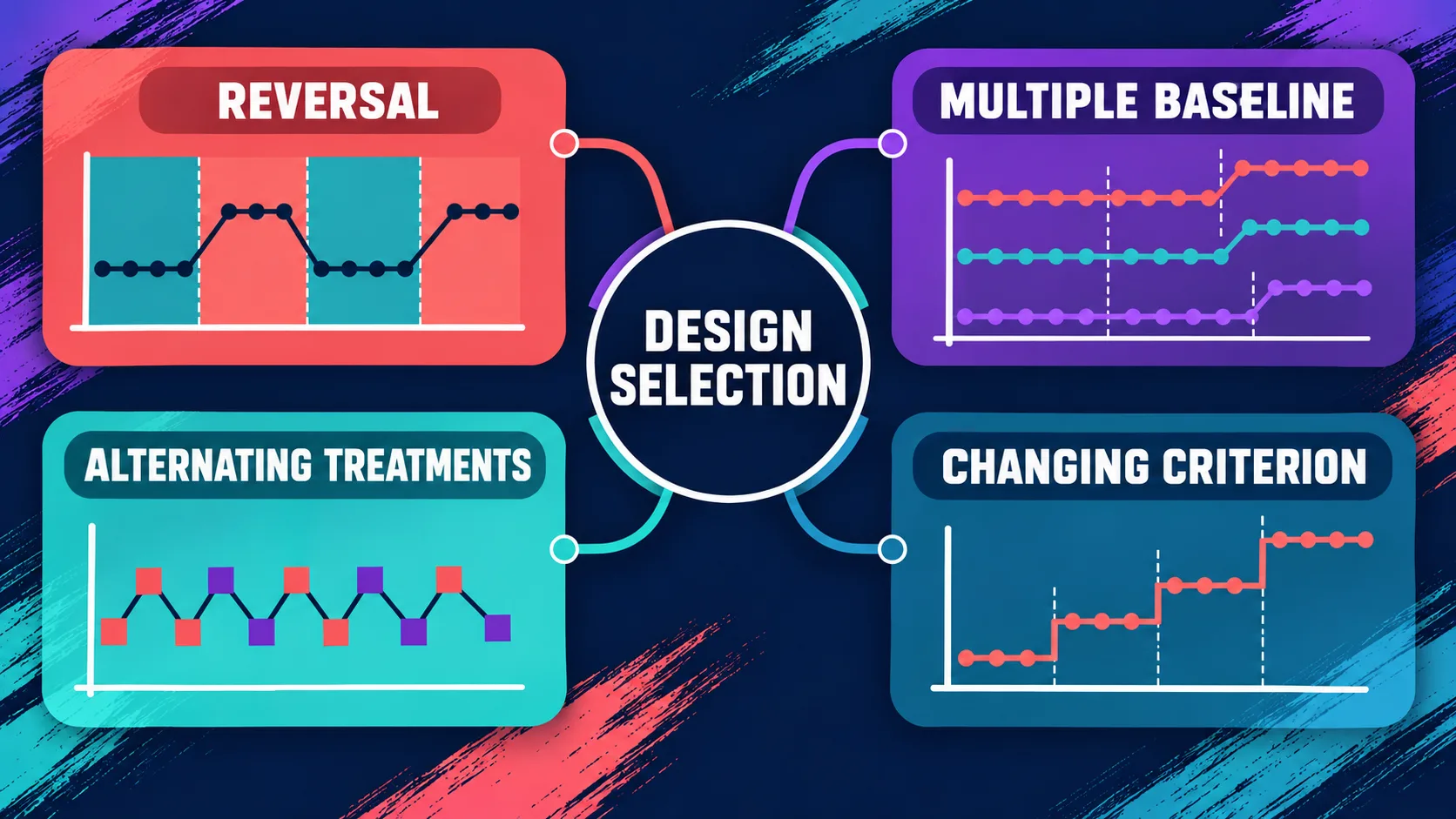
Use the map from left to right. Start with the manipulation you can defend, then select the design that makes its logic visible. “Can I remove treatment?” is often the fastest discriminator, but it is not the only one. A permanent learning effect, a dangerous behavior, or a treatment that should not be withheld can make a withdrawal design a poor choice even when it is easy to draw.
Compare the four major design choices
| Design | Core phase logic | Best-fit question | Main caution |
|---|---|---|---|
| Reversal | A-B-A or A-B-A-B | Does behavior covary with introducing and withdrawing B? | Withdrawal may be unsafe, unethical, impractical, or unable to reverse learning. |
| Multiple baseline | Staggered A-B changes across people, behaviors, or settings | Does the effect appear only when treatment reaches each tier? | Tiers must be comparable, and baseline conditions cannot be prolonged without justification. |
| Alternating treatments | Two or more conditions alternate rapidly | Which treatment produces the better outcome under comparable opportunities? | Carryover, order effects, discrimination problems, and unequal treatment fidelity can blur the comparison. |
| Changing criterion | The intervention remains, while performance criteria change step by step | Does behavior track each planned criterion shift? | The outcome must be able to change gradually and the steps must be meaningful. |
Choose reversal when withdrawal is defensible
A reversal design is a strong answer when the intervention’s effect should change when the intervention changes, and removing it will not create unacceptable risk. In an A-B-A-B sequence, baseline, treatment, return to baseline, and treatment are arranged so that the expected relation is tested more than once. The second B phase is not decorative; it is a replication of the treatment effect.
Ask whether the behavior is reversible and whether removing treatment is acceptable. If an intervention teaches a skill that will persist, withdrawing it may not recreate baseline. If the target is dangerous, removing an effective treatment can be unethical. A vignette that emphasizes either issue is often pointing away from reversal and toward a multiple-baseline or changing-criterion design.
Choose multiple baseline when withdrawal is not practical
Multiple-baseline designs introduce the same intervention at different times across participants, behaviors, or settings. The staggered start is the key. If each tier changes only after treatment is introduced for that tier, and the pattern repeats across tiers, the design can support a functional relation without withdrawing treatment from a tier that has already improved.
Ethics still matter. Keeping a person or behavior in baseline is not automatically harmless just because treatment has not yet started. A strong practitioner monitors risk, uses the shortest defensible baseline, and does not delay necessary support merely to make a graph more attractive.
Choose alternating treatments for a rapid comparison
An alternating-treatments design compares two or more interventions, often by presenting them in rapidly alternating sessions or opportunities. It fits a question such as “Which of these two teaching procedures produces more independent responses under comparable conditions?” The comparison is strongest when the conditions are distinguishable, measurement is consistent, and the sequence is balanced or otherwise controlled. Check for carryover, order effects, unequal practice, and treatment-fidelity differences. If the vignette emphasizes these threats, consider whether counterbalancing, discrimination training, washout time, or a different design family is needed.
Choose changing criterion for stepwise goals
A changing-criterion design is useful when the intervention stays in place and the target should improve gradually. The practitioner establishes a baseline, introduces a criterion, and then shifts the criterion in planned steps. The strongest visual pattern is that the behavior tracks each new level after the criterion changes.
This fits a goal such as gradually increasing task completion or reducing a response in safe, measurable steps. It is less suitable for an immediate all-or-none change or an outcome that cannot be measured on a meaningful continuum. The intervention stays in place; the criterion changes.
Read the graph for control, not just improvement
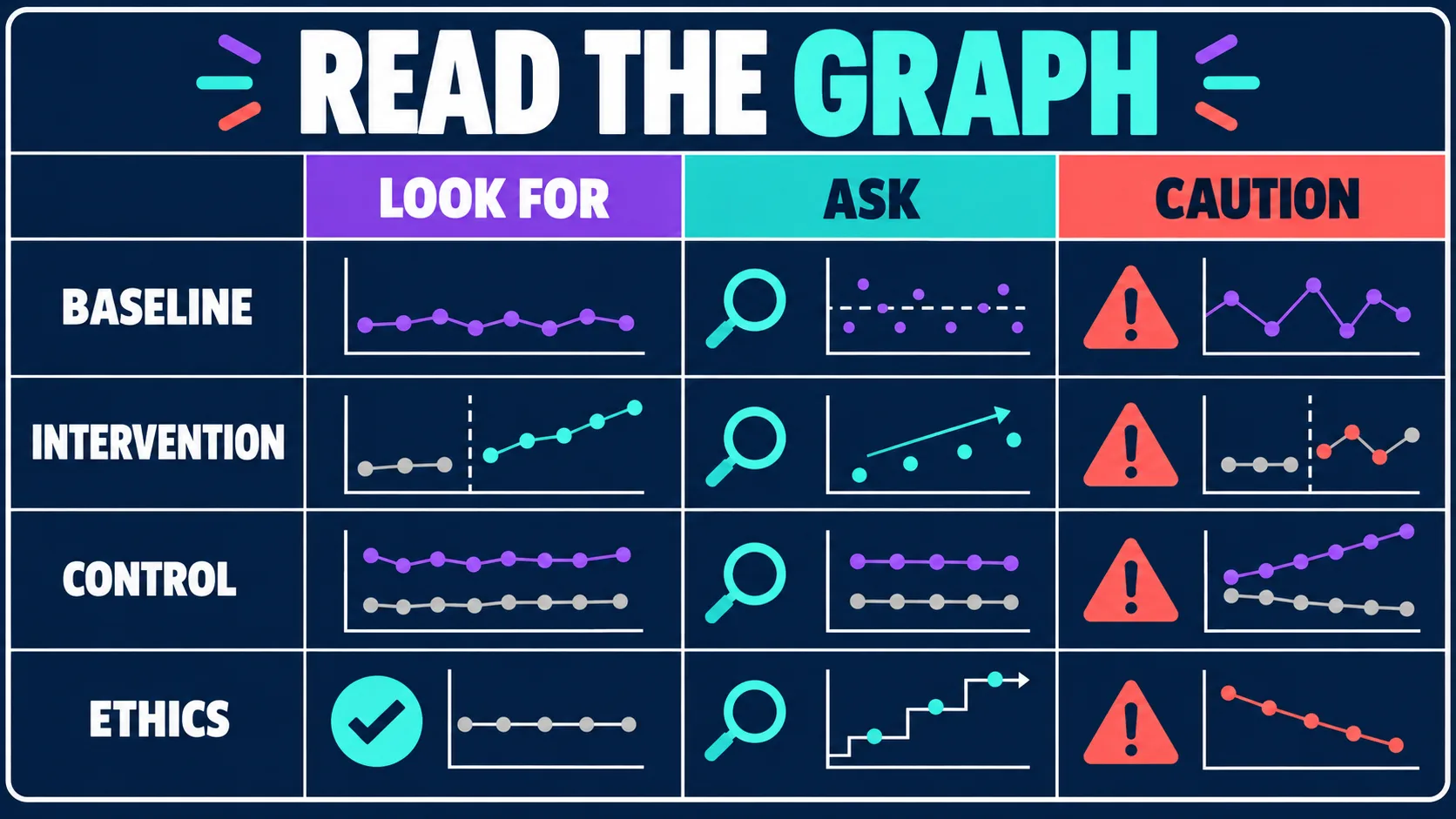
On an exam graph, first locate phase-change lines and then compare level, trend, variability, immediacy, overlap, and consistency across replications. A higher or lower mean after treatment may be encouraging, but visual improvement alone does not establish that the independent variable caused it.
| Graph clue | Question to ask | What it supports—or fails to support |
|---|---|---|
| Immediate level change | Did the shift occur right after the phase change? | Supports a possible treatment effect, but needs replication. |
| Trend change | Did the slope change when the intervention or criterion changed? | Can support a functional relation when alternative trends are unlikely. |
| High overlap | Do adjacent phases share many data points? | Weakens a simple claim of clear separation. |
| Repeated pattern | Does the same relation recur across phases or tiers? | Strengthens prediction, verification, and replication. |
Check threats and ethics before choosing the label
History, maturation, testing, instrumentation, therapist changes, and inconsistent implementation can produce apparent change. Ask how the design separates the intervention from those alternatives, and whether the arrangement is acceptable for the client. Withdraw only when safe; stagger only without unreasonable delay; alternate only with controlled conditions; change criteria only when gradual change is appropriate.
Build a design-selection worksheet
For a practice vignette, write one line for each of these fields. This turns a long paragraph into a decision path:
| Field | Write down |
|---|---|
| Independent variable | What condition, treatment, or criterion changes? |
| Dependent variable | What behavior is measured, in what dimension, and how often? |
| Comparison logic | Withdrawal, staggered introduction, rapid comparison, or stepwise criterion? |
| Replication | Where will the effect be demonstrated again? |
| Boundary | What safety, carryover, irreversibility, or feasibility issue constrains the design? |
Common exam traps
- Choosing AB because it is the shortest option: short is not the same as controlled.
- Choosing reversal whenever “withdrawal” appears: first check whether withdrawal is ethical and whether behavior can reverse.
- Calling simultaneous starts a multiple baseline: staggered implementation is the defining clue.
- Calling any two-condition comparison alternating treatments: rapid alternation and comparable conditions must support the comparison.
- Calling a gradual goal a changing-criterion design without criterion changes: the criterion must shift in planned steps and behavior should track it.
- Ignoring measurement: a design cannot rescue an unstable, poorly defined, or inconsistently measured dependent variable.
Use targeted practice after the design logic is clear
Once you can explain why a design fits—and why the other choices do not—use scenario questions to find the remaining error. Practice should force you to identify the research question, phase logic, experimental-control signal, and ethical boundary before you look at the answer.
Try the Free BCBA Mock Exam and review every missed design-selection item by writing the one sentence that should have guided your choice. The practice result is a study signal; it is not an official BACB eligibility or certification decision.
Single case design ABA FAQ
What is the fastest way to choose a single-case design?: Identify the comparison first. Withdrawal points toward reversal, staggered introduction across tiers points toward multiple baseline, rapid comparison of conditions points toward alternating treatments, and planned stepwise goals point toward changing criterion. Then check safety and feasibility.
Is AB a strong single-case experimental design?: AB can show that behavior changed after an intervention, but it provides weaker control over history and maturation than designs with withdrawal, staggered introduction, alternation, or replicated criterion changes. The best answer depends on the question and the strength of control required.
When should a reversal design not be used?: Do not choose it when withdrawing an effective intervention would be unsafe or unethical, when the behavior or skill is unlikely to reverse, or when the vignette offers a better nonwithdrawal design.
What is the main clue for multiple baseline?: Look for the same intervention introduced at different times across participants, behaviors, or settings. The staggered starts create repeated demonstrations without withdrawing treatment from a tier that has already received it.
How is changing criterion different from reversal?: Changing criterion keeps the intervention in place and changes the performance standard in steps. Reversal changes the presence or absence of the intervention itself. The graph should show behavior tracking the criterion in the first design and covarying with treatment withdrawal in the second.
The bottom line
For single case design ABA questions, let the research question choose the design. Select reversal when withdrawal is defensible, multiple baseline when staggered replication avoids withdrawal, alternating treatments when the task is a controlled comparison, and changing criterion when gradual performance steps are the independent-variable change. Then inspect the graph, measurement, experimental-control logic, and ethics before committing to an answer.
Sources to recheck
Authoritative references: the BACB Test Content Outlines, the BCBA Test Content Outline (6th ed.), the What Works Clearinghouse single-case technical documentation, the peer-reviewed family of single-case experimental designs overview, and the SCRIBE reporting guideline. Existing BCBA Mock Exam pages on single-subject design and single-subject experimental designs provide related context; this page owns the design-selection task.
For targeted review, use our single case design aba practice questions to apply the concept in exam-style scenarios.
Quick Review Checklist
Use this final checklist to turn single case design aba into exam-ready reasoning. The goal is not to memorize a label in isolation; it is to identify the relevant evidence and explain why the best answer fits the scenario. Key ideas to review:
- State the central definition or decision point for single case design aba in your own words.
- Identify the detail that makes single case design aba different from its closest related ABA term.
- Separate the observable facts in a scenario from assumptions that are not supported by the facts.
- Write one example and one nonexample so you can recognize the concept in a new setting.
Exam application checks:
- Ask what the question is actually requesting before comparing the answer choices.
- Mark the antecedent, response, consequence, or other evidence that supports the selected answer.
- Look for a distractor that describes a related process but does not answer the specific question.
Final self-check:
- Explain how you would verify the interpretation with clear observations or data.
- Change one detail in the scenario and decide whether your answer should change.
- Give a one-sentence rationale that a supervisor or study partner could evaluate.
Take the Free BCBA Mock Exam
A useful next step is to apply this idea in a fresh set of BCBA-style practice questions and review the feedback. Take the Free BCBA Mock Exam



