
A North Carolina-specific sequence from BACB eligibility to state licensure, fingerprinting, and payer verification. If you are searching for how to become a BCBA in North Carolina, the safest way to plan is to separate three checkpoints: BACB certification, a North Carolina behavior analyst license, and any employer or payer enrollment that comes afterward. They are related, but they are not the same approval. A strong plan follows the order of the authorities, keeps a dated document trail, and rechecks the official pages before each submission.
Table of Contents
- The short answer: build the sequence in the right order
- Start with the current BACB pathway
- Use the BACB-to-North Carolina pathway map
- Do not confuse BCBA certification with a North Carolina license
- Plan around the 2027 transition without guessing
- Prepare the North Carolina application packet
- Treat fingerprints and background checks as a timeline
- Use a three-authority packet check
- Keep NC Medicaid and payer enrollment separate
- Build a date-stamped checklist
- Avoid the common North Carolina pathway mistakes
- Turn the next exam step into measurable progress
- How to become a BCBA in North Carolina FAQ
- The bottom line
- Official sources to recheck
- Quick Review Checklist
- Take the Free BCBA Mock Exam
This guide is a planning tool, not legal advice. The North Carolina Behavior Analyst Licensure Board (NCBALB), the Behavior Analyst Certification Board (BACB), and NC Medicaid can change instructions, forms, fees, and timelines. Use the links in this article as your verification points.
The short answer: build the sequence in the right order
Most candidates begin with the national BACB pathway: qualifying education, required coursework, supervised fieldwork, and a complete BCBA application. After BACB approval and examination, the North Carolina licensure step becomes its own packet-and-background-check task. Only after those credentials are clear should you confirm employer privileges, insurance enrollment, or Medicaid requirements.
| Stage | Primary authority | Proof to keep |
|---|---|---|
| Eligibility and fieldwork | BACB | Degree, coursework, fieldwork forms, supervisor records, and current handbook checks. |
| Certification application and exam | BACB | Submitted application, payment confirmation, approval notice, and exam result. |
| State license | NCBALB | State application, public-notice materials, photo, references, fingerprints, and background-check result. |
| Practice and payment enrollment | Employer, insurer, or NC Medicaid | Separate enrollment, taxonomy, network, supervision, and service-documentation confirmations. |
Start with the current BACB pathway
The BACB’s BCBA certification page and BCBA Handbook control the national eligibility and examination instructions. Start there rather than relying on a school brochure or an old checklist. Confirm which eligibility pathway applies to you, what documentation is required, and whether your supervised fieldwork records are complete before you pay for an application.
For a candidate planning around 2027, open the BACB’s 2027 BCBA requirements page and transition guidance. The BACB says a complete application, including payment and required documents, must be received by December 31, 2026 to be reviewed under the current 2022 requirements. Applications received on or after January 1, 2027 are handled under the new 2027 rules. Treat that as a date checkpoint, not as a promise that an incomplete file will be grandfathered.
Use the BACB-to-North Carolina pathway map
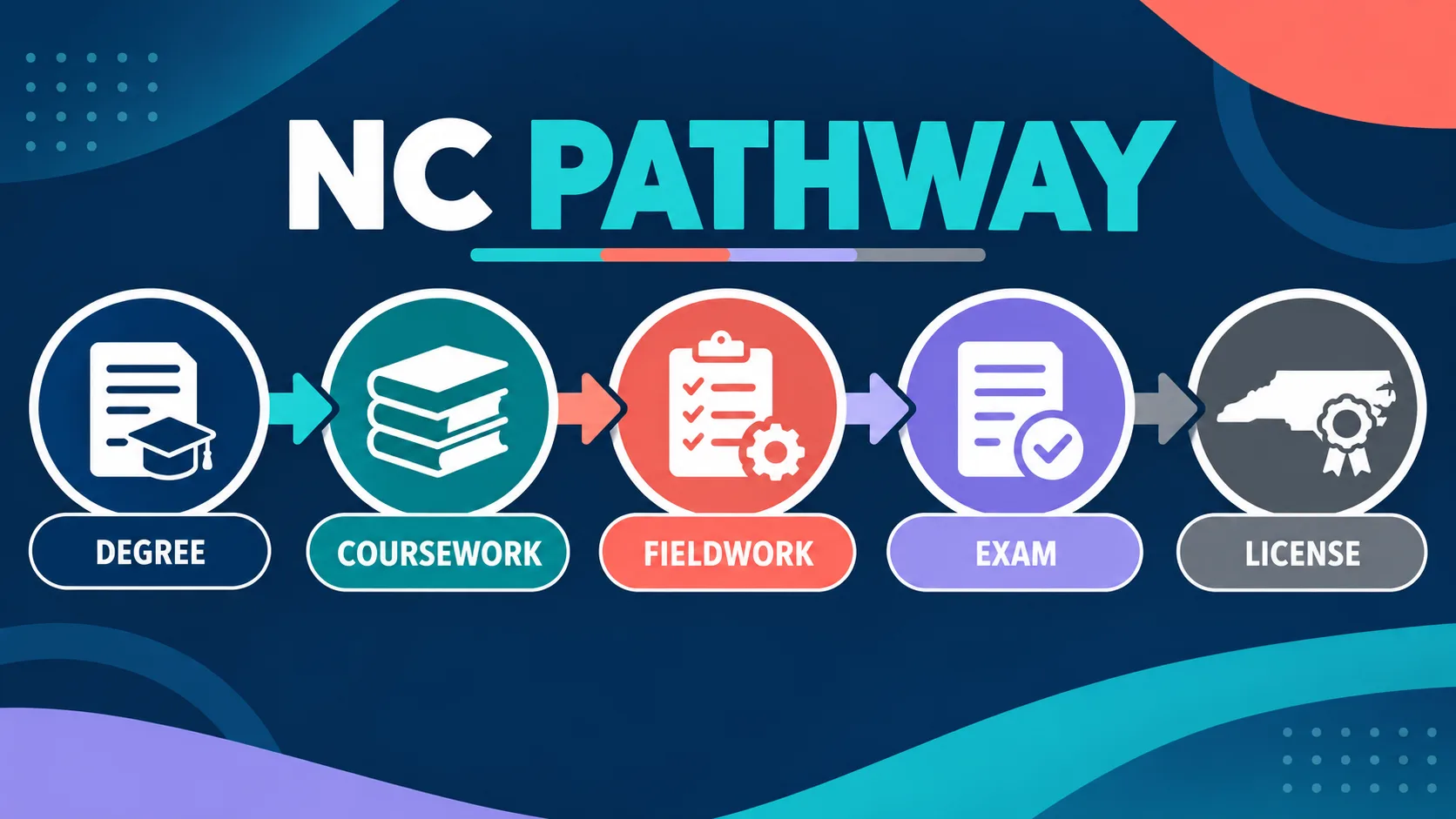
The visual sequence is deliberately simple: degree, coursework, fieldwork, exam, then license. In practice, each circle represents a document audit. If your degree or coursework evidence is unclear, fix that before treating the exam as the next step. If you have passed the exam but have not submitted the NCBALB packet, the state-license step is still open.
Do not confuse BCBA certification with a North Carolina license
North Carolina’s board describes licensure as a separate state process. A BCBA credential can establish national certification, but it does not automatically mean that a person has completed every North Carolina licensing requirement. Likewise, a state license does not replace BACB certification documents when an employer or payer asks for them.
| Question | BACB certification | North Carolina licensure |
|---|---|---|
| What does it establish? | National BCBA credential eligibility and certification. | Permission to practice under the state board’s requirements and scope. |
| Who checks the packet? | BACB application and examination systems. | NCBALB application reviewers and background-check process. |
| What can delay it? | Missing coursework, fieldwork, transcripts, payment, or application evidence. | Incomplete state packet, public notice, fingerprints, references, or background information. |
| What should you verify? | Current handbook, TCO, eligibility route, and application status. | Current board checklist, forms, fees, license status, and renewal rules. |
Plan around the 2027 transition without guessing
Make a two-column date audit. In the first column, record the date you expect to submit a complete BACB application. In the second, record the version of the BACB requirements, handbook, and forms you used. If the complete file will not be received by December 31, 2026, plan under the 2027 requirements instead of assuming that an earlier course or fieldwork plan will automatically qualify.
After January 1, 2027, compare your file with the BACB’s published 2027 pathways and transition instructions. Save the official page as a reference, but re-open it when you are ready to apply. The transition date affects the national certification application; it does not erase the separate North Carolina license packet or any state background-check step.
Prepare the North Carolina application packet
Use the NCBALB requirements for licensure page and application instructions as the controlling checklist. The board’s materials describe a complete application process that can include the application, public notice, fees, a current BCBA certificate, photograph, references, authority to release information, and fingerprint/background-check materials. Because forms and fees can change, copy the current values from the board instead of using a screenshot or an old blog post.
Create one folder with a date in its name, such as NCBALB_application_2026-10-12. Add a PDF or scan of every submitted item, the exact form version, payment receipt, delivery confirmation, and any message from the board. A clean audit trail helps you identify whether a delay belongs to the BACB file, the state file, or the background check.
Treat fingerprints and background checks as a timeline
Fingerprints are not a last-minute checkbox. The NCBALB fingerprint instructions explain that applicants should use either the mail or electronic route, not both. The electronic option is limited to fingerprints taken through North Carolina law-enforcement agencies. The board also states that it can take an average of five to six weeks from the time fingerprint cards are sent for the report to clear, so build that window into your plan and confirm the current instructions before sending anything.
Use the board’s current fingerprint page for the ORI, reason-for-fingerprint wording, delivery route, and any package instructions. If you live outside North Carolina or a local agency cannot provide the accepted electronic service, do not improvise. Ask the board which current route applies to your situation and keep the response with your application record.
Use a three-authority packet check
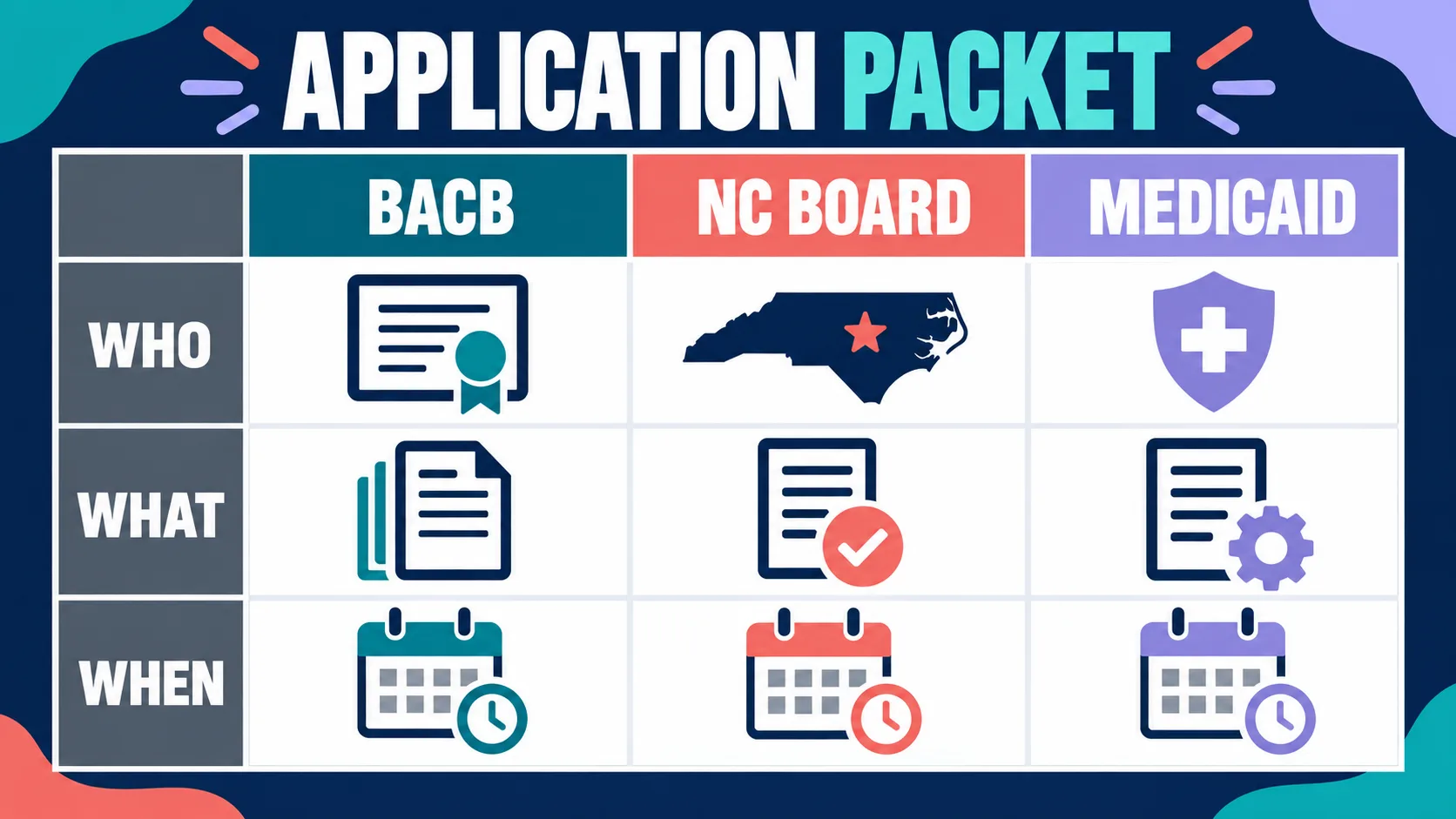
The matrix is a reminder that “who,” “what,” and “when” are different questions. BACB checks national certification evidence. The NC board checks the state license packet and background process. Medicaid or another payer may ask for a separate enrollment or service-provider record. A document that satisfies one column should not be assumed to satisfy the other two.
Keep NC Medicaid and payer enrollment separate
Once your BACB and state-license files are clear, check the current payer rules for the work you plan to do. The NC Medicaid 2026 reminder describes additional provider and service-delivery requirements for research-based behavioral health treatment. That payer guidance is not a substitute for the NCBALB license, and a license is not by itself proof that you are enrolled, credentialed, or eligible for every Medicaid service.
| Before you say “I am ready” | Verify separately |
|---|---|
| National credential | BACB status, certificate, current handbook rules, and renewal date. |
| State permission | NC license status, scope, board correspondence, and renewal obligations. |
| Payment pathway | Employer credentialing, insurer network rules, NCTracks or other payer enrollment, taxonomy, and service-specific supervision requirements. |
Build a date-stamped checklist
- Mark the authority: write BACB, NCBALB, employer, or payer beside every requirement.
- Mark the evidence: identify the transcript, form, certificate, fingerprint receipt, reference, or portal confirmation that proves completion.
- Mark the date: record the form version, submission date, response date, and next follow-up date.
- Run a gap check: compare the saved packet with the current official page immediately before submission.
- Keep the boundary visible: never represent a pending application as a license or an approved certification.
Avoid the common North Carolina pathway mistakes
Starting with the state form too early: first confirm the BACB credential and the board’s current entry requirements. Using old fees or forms: the board’s live checklist wins over a saved screenshot. Sending fingerprints twice: follow the current mail-versus-electronic instruction. Assuming a passing exam equals permission to practice: certification and state licensure remain separate. Counting payer enrollment as licensure: payer approval is another administrative layer. Ignoring the 2027 date boundary: record when the complete BACB application will be received, not when you started coursework.
Turn the next exam step into measurable progress
Credentialing paperwork and exam preparation are different workstreams, but they can use the same discipline: one checklist, one date, one next action. If the BACB exam is the open step in your North Carolina plan, start with the Free BCBA Mock Exam. Use the result to identify a TCO domain to review; do not treat a practice score as an official BACB result.
How to become a BCBA in North Carolina FAQ
Can I be a BCBA without a North Carolina license?: You may hold national BCBA certification while a state-license application is pending, but whether you may provide a particular service in North Carolina depends on current state law, board rules, employer policy, and payer requirements. Confirm the current NCBALB position before practicing.
Should I apply to the BACB or North Carolina first?: Build the BACB eligibility and certification file first because the North Carolina packet may ask for current BCBA certification evidence. Then follow the NCBALB checklist and background-check instructions. The exact order can depend on your situation, so use the board’s current application requirements.
How does January 1, 2027 affect the process?: The BACB’s published transition guidance distinguishes complete applications received by December 31, 2026 from applications received on or after January 1, 2027. Check the current 2027 requirements and make sure your file is complete under the rule set that will apply to its receipt date.
Can an out-of-state applicant use electronic fingerprints?: Do not assume so. The NCBALB fingerprint instructions say the electronic route is tied to North Carolina law-enforcement agencies. If that route is unavailable, follow the board’s current mail instructions or contact the board before sending a packet.
Does a North Carolina license automatically enroll me with Medicaid?: No. Licensure, national certification, employer credentialing, and Medicaid or insurer enrollment are separate checks. Review the current NC Medicaid and payer instructions for the specific services and provider type you plan to deliver.
The bottom line
To become a BCBA in North Carolina, map the BACB education, fieldwork, application, and exam steps first; then complete the NCBALB license packet, fingerprint/background process, and state verification; then handle employer and payer enrollment as a separate layer. Save a dated copy of every form and recheck the official BACB, NCBALB, and payer pages before submitting. That sequence reduces avoidable delays and keeps your credential claims accurate.
Official sources to recheck
- BACB BCBA certification information
- BACB Handbook
- BACB 2027 BCBA requirements
- BACB 2027 transition guidance
- North Carolina requirements for licensure
- NCBALB general FAQs
- NCBALB fingerprint instructions
- NC Medicaid 2026 provider reminder
For targeted review, use our how to become a bcba in north carolina practice questions to apply the concept in exam-style scenarios.
Quick Review Checklist
Use this final checklist to turn how to become a bcba in north carolina into exam-ready reasoning. The goal is not to memorize a label in isolation; it is to identify the relevant evidence and explain why the best answer fits the scenario. Key ideas to review:
- State the central definition or decision point for how to become a bcba in north carolina in your own words.
- Identify the detail that makes how to become a bcba in north carolina different from its closest related ABA term.
- Separate the observable facts in a scenario from assumptions that are not supported by the facts.
- Write one example and one nonexample so you can recognize the concept in a new setting.
Exam application checks:
- Ask what the question is actually requesting before comparing the answer choices.
- Mark the antecedent, response, consequence, or other evidence that supports the selected answer.
- Look for a distractor that describes a related process but does not answer the specific question.
Final self-check:
- Explain how you would verify the interpretation with clear observations or data.
- Change one detail in the scenario and decide whether your answer should change.
- Give a one-sentence rationale that a supervisor or study partner could evaluate.
Take the Free BCBA Mock Exam
A useful next step is to apply this idea in a fresh set of BCBA-style practice questions and review the feedback. Take the Free BCBA Mock Exam



