

An ABA discharge plan is the written, data-based roadmap for reducing or ending applied behavior analysis services while protecting progress, dignity, safety, and continuity of support. It is not a last-minute note that appears only when authorization is about to expire. A strong plan starts with meaningful goals, defines the evidence needed for a transition, and explains what the client, caregivers, providers, and payer should do next.
Table of Contents
- What Is an ABA Discharge Plan?
- Why Discharge Planning Starts at Intake
- How to Set Discharge Criteria From Data
- The Four Parts Every Plan Should Include
- Fading Services and Checking Generalization
- Caregiver Handoff and Continuity of Care
- Documentation, Authorization, and Payer Rules
- How the Topic Appears on BCBA-Style Questions
- Common ABA Discharge Plan Mistakes
- A Practical Review Template
- FAQ
- Quick Review Checklist
Discharge does not always mean that every need has disappeared. It may mean that the current intensity is no longer necessary, that goals have been met, that another service or setting is more appropriate, that the family requests a change, or that services cannot continue under the current authorization. The decision should be explained with objective information rather than a date, a vague impression, or a single session.
This guide explains what belongs in an ABA discharge plan, how a BCBA can connect discharge criteria to data and generalization, and how to recognize common exam traps. It is educational information, not a clinical, insurance, or legal determination. The current treatment plan, payer rules, professional responsibilities, and the client’s individual circumstances control. Table of Contents
What Is an ABA Discharge Plan?
An ABA discharge plan describes the conditions under which services will be reduced, transferred, paused, or ended, plus the supports needed after that change. It should be individualized to the person and the service setting. A plan for a young child moving from intensive clinic-based treatment may look different from a plan for an adolescent moving toward school, vocational, or community supports. An adult plan may focus on independent living, employment routines, communication, self-advocacy, health routines, or safety.
The central question is not “Has the client reached a certain age?” or “Has the client received services for a certain number of months?” The central question is whether the current service model and intensity remain justified by the goals, data, risk, environment, and available alternatives. A discharge decision can involve mastery, stable maintenance, generalization, a change in priorities, a move, a funding change, or another documented reason.
The TRICARE discharge-planning guidance describes discharge as a transition after goals are reached or when ABA services are no longer appropriate, and explains that the provider develops a plan as part of the treatment plan. That is a payer-specific example, not a universal rule for every ABA program, but it illustrates why transition planning belongs in treatment rather than at the very end.
Why Discharge Planning Starts at Intake
Writing a discharge plan early does not predict failure or set an arbitrary end date. It gives the team a direction for treatment: meaningful outcomes, measures of progress, people who need training, and settings in which skills must occur. The plan can be revised as data and priorities change.
How to Set Discharge Criteria From Data
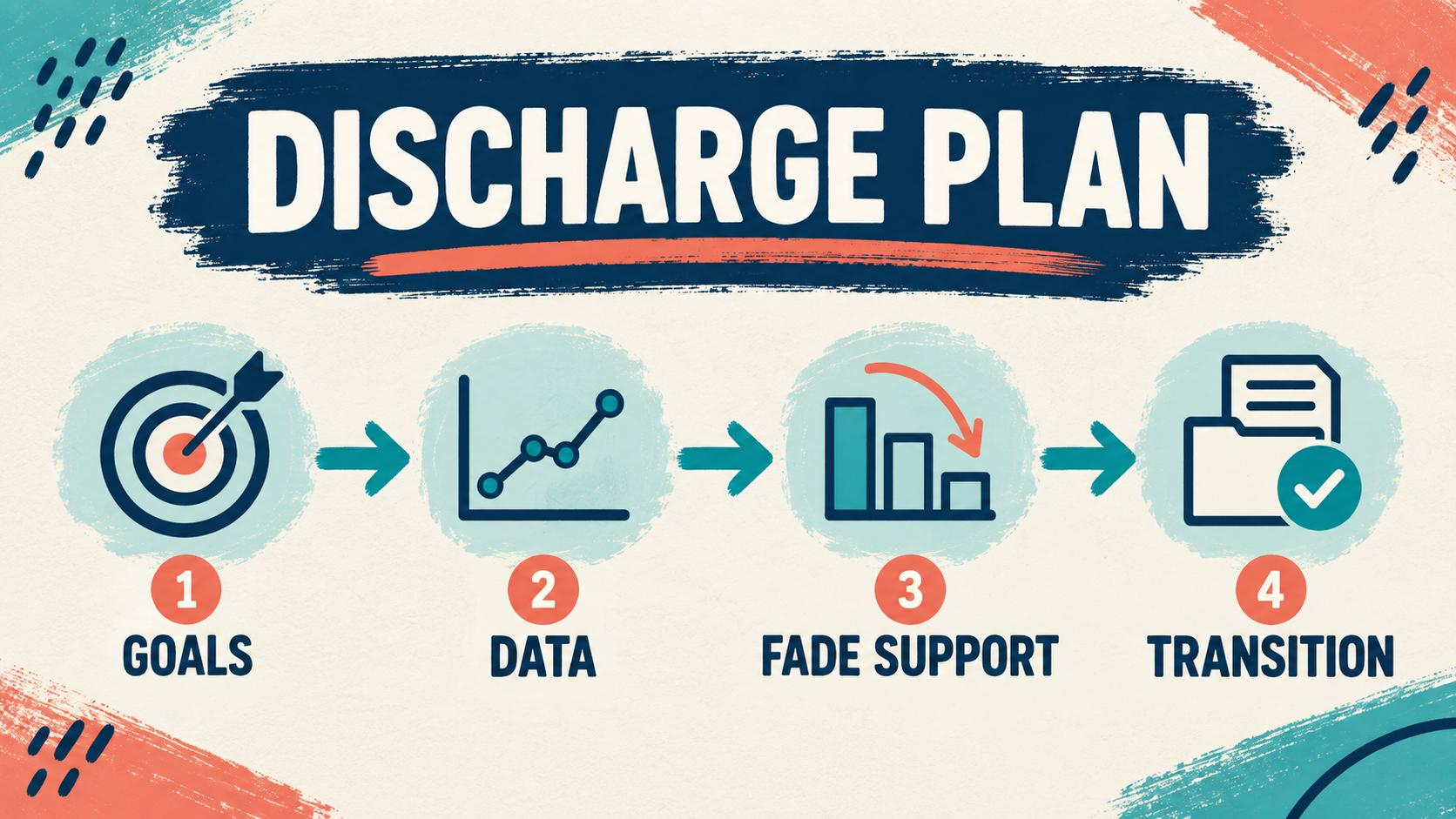
Discharge criteria should be observable, measurable, and connected to the reason services were started. “The client is doing better” is not a criterion. A stronger criterion identifies the response, setting, measure, time frame, prompting rule, and acceptable variability. The actual threshold must be individualized and clinically justified.
Use the same measurement logic that supports any data-based treatment decision: define the target, select a measure, establish the context, inspect the trend, and decide what change would matter. A criterion may include acquisition, maintenance, generalization, reduction of risk, caregiver implementation, or the availability of a safer and more appropriate support. One impressive data point should not outweigh a variable trend or a missing setting.
| Decision area | Evidence to review | Question before discharge |
|---|---|---|
| Goal progress | Level, trend, variability, and mastery data for each priority target. | Has meaningful change been demonstrated, not merely observed once? |
| Maintenance | Performance after prompts, dense teaching, or immediate reinforcement are reduced. | Does the skill persist when the original arrangement changes? |
| Generalization | Performance with different people, materials, routines, and settings. | Can the person use the skill where it matters in daily life? |
| Continuity | Training, written supports, referrals, contacts, and follow-up arrangements. | Who supports the next step if risk or regression appears? |
Criteria should not be used to keep services indefinitely or end them abruptly. If progress is limited, review the assessment, intervention, measurement system, setting, preferences, and barriers. If the client is progressing, test whether current intensity can be reduced safely. The decision should follow the evidence and the client’s needs, not a preselected conclusion.
The Four Parts Every Plan Should Include
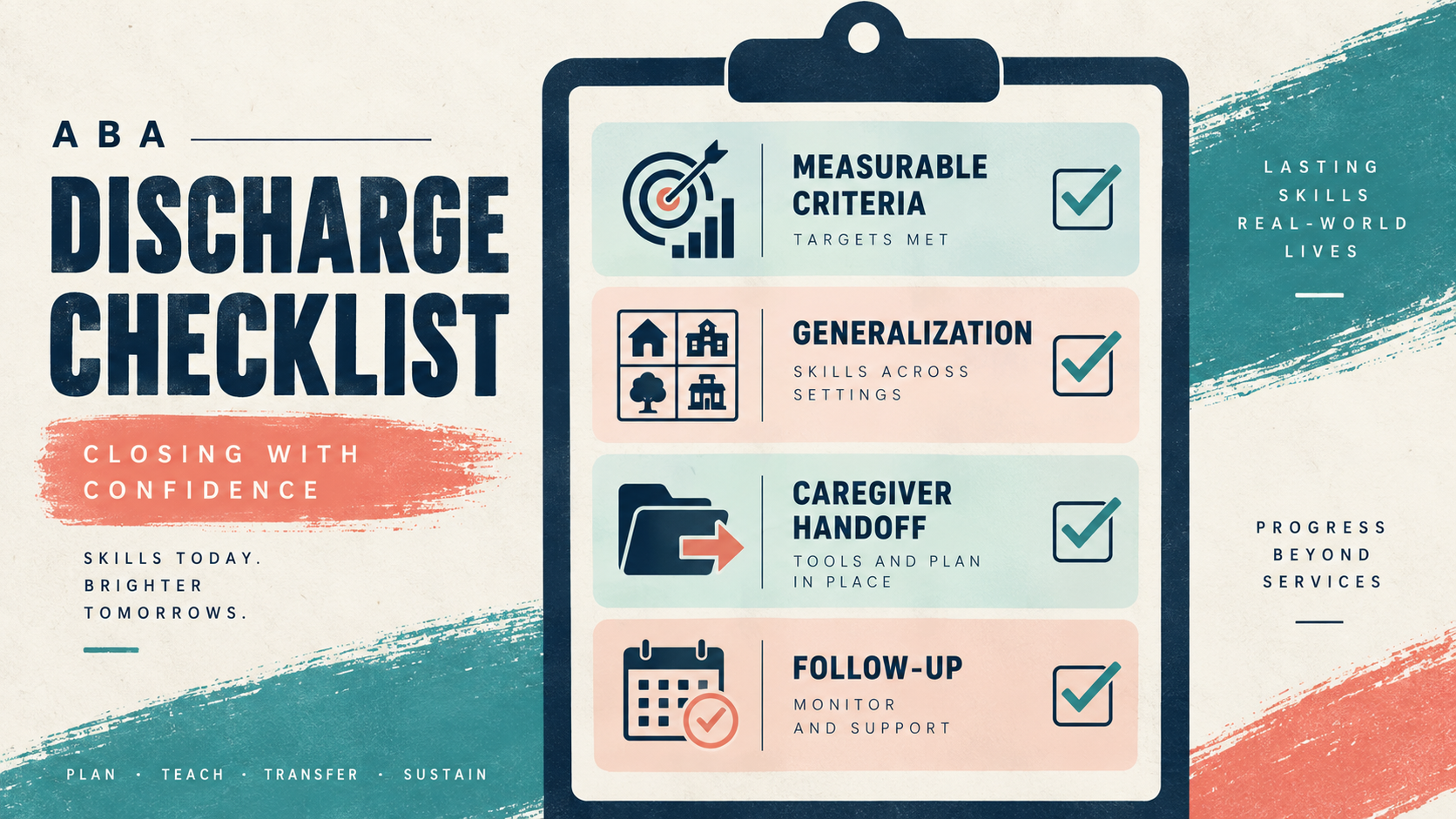
A practical ABA discharge plan can be organized into four connected parts. The exact form varies by provider and payer, but the reasoning should remain clear.
- Reason and decision. State why a transition is being considered: goals met, stable progress with lower support, a move, a family decision, a change in clinical appropriateness, a funding issue, or another documented circumstance. Say whether the plan is a step-down, transfer, pause, or full discharge.
- Measurable criteria and current status. List priority goals, relevant data, remaining risks or barriers, and the evidence supporting the proposed change. Include the review date and who participated. Do not present a percentage without naming the measure and context.
- Transition and handoff actions. Describe how prompts, hours, sessions, or direct support will change; what caregiver or staff training will occur; what records can be shared with consent; and which provider, school, workplace, or community resource receives the handoff.
- Follow-up and re-entry plan. Explain what will be monitored, for how long, by whom, and how the person can request help if a concern appears. A follow-up plan is not a promise that services will automatically restart; it is a route for reviewing new information.
Make responsibilities concrete. “Family will continue strategies” is less useful than “caregiver will use the visual schedule, record the agreed measure twice each week, and contact the named provider if the safety criterion is met.” The plan should be understandable to someone who was not present for every session.
Fading Services and Checking Generalization
When discharge is based on progress, a planned reduction often provides better evidence than an abrupt stop. The team may reduce session frequency, change the setting, thin reinforcement, transfer implementation to caregivers or staff, or shift from direct treatment to consultation. Each step should have a reason, a measure, and a review point. If performance deteriorates, the team should know which support was removed and what adjustment is appropriate.
Generalization deserves special attention. A skill that appears in a therapy room with one therapist may not yet be functional in a home, school, workplace, or community routine. Program relevant variations deliberately: different people, materials, instructions, times, locations, and naturally occurring consequences. Include the client’s communication method and preferences. If the target is safety-related, the plan should describe how safety will be protected during practice and after transition. Maintenance and generalization are not the same. Maintenance asks whether behavior persists over time; generalization asks whether it occurs under changed conditions. Checking only the original teaching arrangement can overestimate readiness.
Caregiver Handoff and Continuity of Care
A handoff should transfer usable knowledge, not just a file: explain the target, purpose, successful steps, warning signals, and least intrusive response. Provide practice, confirm understanding, and share only information permitted by consent and privacy requirements. If the person is relocating, identify the receiving service, contact, timing, and records that need to move. The TRICARE Autism Care Demonstration FAQ is one payer-specific example connecting treatment-plan review with continuation, transition, or discharge.
- Give the receiving person a concise summary of goals, progress, current supports, and open questions.
- Specify what the caregiver or staff member should do in the routine, not only what the BCBA previously did.
- Identify a contact route for questions and the conditions that warrant prompt review.
- Record consent, referrals, training, attendance, and the date the handoff was completed.
Documentation, Authorization, and Payer Rules
An ABA discharge plan can be clinically sound and still need a payer’s process, such as a treatment-plan update, discharge notification, final summary, referral, or authorization record. Payer arrangements differ. Check notice, documentation, retention, referral, safety, and continuity requirements. If coverage changes, document that administrative reason rather than implying clinical mastery. The CMS autism-services overview is background, not a substitute for current plan language; the BACB Test Content Outline frames exam reasoning, not payer rules.
How the Topic Appears on BCBA-Style Questions
On a BCBA-style question, “discharge plan” may be tested through data-based decision-making, treatment integrity, generalization, caregiver training, ethics, or coordination of care. Read the reason services are changing and the evidence available. A correct answer usually preserves meaningful outcomes, uses objective data, and plans for continuity. It does not end services simply because a calendar date arrived or because one person says the client looks ready.
- Look for missing evidence. If improvement appears in only one setting, consider generalization before discharge.
- Separate clinical and administrative reasons. A funding change may require a different pathway, but it does not prove mastery.
- Prefer data over impression. “Seems independent” is weaker than a defined measure across relevant routines.
- Protect continuity and dignity. Look for training, handoff, monitoring, and meaningful outcomes rather than convenience alone.
A distractor may sound efficient: stop immediately or continue indefinitely “just in case.” The better answer describes a proportionate step that can be evaluated with data.
Common ABA Discharge Plan Mistakes
- Writing the plan at the last minute. A late note cannot replace gradual teaching, training, and coordination.
- Using age or duration as the only criterion. A birthday or treatment length does not demonstrate mastery, maintenance, or generalization.
- Listing goals without measures. The team needs a defined target, context, time frame, and decision rule.
- Confusing maintenance with generalization. Repeating a skill with the same therapist is not evidence that it works in daily life.
- Transferring a document but not the procedure. The receiving person needs training, examples, and a question route.
- Calling a coverage ending a clinical discharge. Document the administrative reason accurately and identify continuity options.
A Practical Review Template
Use the following as a study and planning framework, adapted to the applicable service and policy.
| Plan section | Write this down | Review prompt |
|---|---|---|
| Reason | Step-down, transfer, pause, full discharge, or administrative change. | Does the reason match the evidence? |
| Criteria | Targets, measures, data range, remaining risks, and decision threshold. | Are the criteria observable and individualized? |
| Handoff | Training, records, referrals, contacts, and the transfer date. | Can the next support person act on the plan? |
| Follow-up | Monitoring period, contact route, and response if progress changes. | What information will trigger a review? |
FAQ
What should an ABA discharge plan include?: It should explain the reason for the change, measurable criteria and current data, transition or handoff actions, and the follow-up or re-entry route. It should also identify who participated and which payer or provider requirements apply.
When should an ABA discharge plan be written?: Planning should begin at intake and be updated as goals, data, settings, risks, and priorities change. The final version should be completed early enough for training, referrals, records, and a safe transition.
Does discharge mean the client no longer needs any support?: No. Discharge may mean that the current ABA intensity or service model is no longer appropriate, that another setting will provide support, or that the family or payer is changing the arrangement. The plan should describe the next support rather than assume that no support is needed.
How is an ABA discharge plan different from a treatment plan?: A treatment plan describes current goals, assessment, intervention, measurement, and review. A discharge plan focuses on the conditions and actions for reducing, transferring, pausing, or ending that service, including continuity after the change.
What is the biggest BCBA exam trap on this topic?: The common trap is choosing an answer based on age, time in treatment, or a single improvement observation instead of individualized data, maintenance, generalization, and continuity. Read what the scenario actually establishes before selecting the next action.
An effective ABA discharge plan turns the end of one service arrangement into a measurable, coordinated next step. Start early, define criteria with data, test maintenance and generalization, train the receiving support person, and document the reason accurately. If you want to practice distinguishing a data-based transition decision from a tempting but incomplete answer, take the free BCBA mock exam for additional scenario practice.
Quick Review Checklist
Use this final checklist to turn aba discharge plan into exam-ready reasoning. The goal is not to memorize a label in isolation; it is to identify the relevant evidence and explain why the best answer fits the scenario. Key ideas to review:
- State the central definition or decision point for aba discharge plan in your own words.
- Identify the detail that makes aba discharge plan different from its closest related ABA term.
- Separate the observable facts in a scenario from assumptions that are not supported by the facts.
- Write one example and one nonexample so you can recognize the concept in a new setting.
Exam application checks:
- Ask what the question is actually requesting before comparing the answer choices.
- Mark the antecedent, response, consequence, or other evidence that supports the selected answer.
- Look for a distractor that describes a related process but does not answer the specific question.
Final self-check:
- Explain how you would verify the interpretation with clear observations or data.
- Change one detail in the scenario and decide whether your answer should change.
- Give a one-sentence rationale that a supervisor or study partner could evaluate.



