
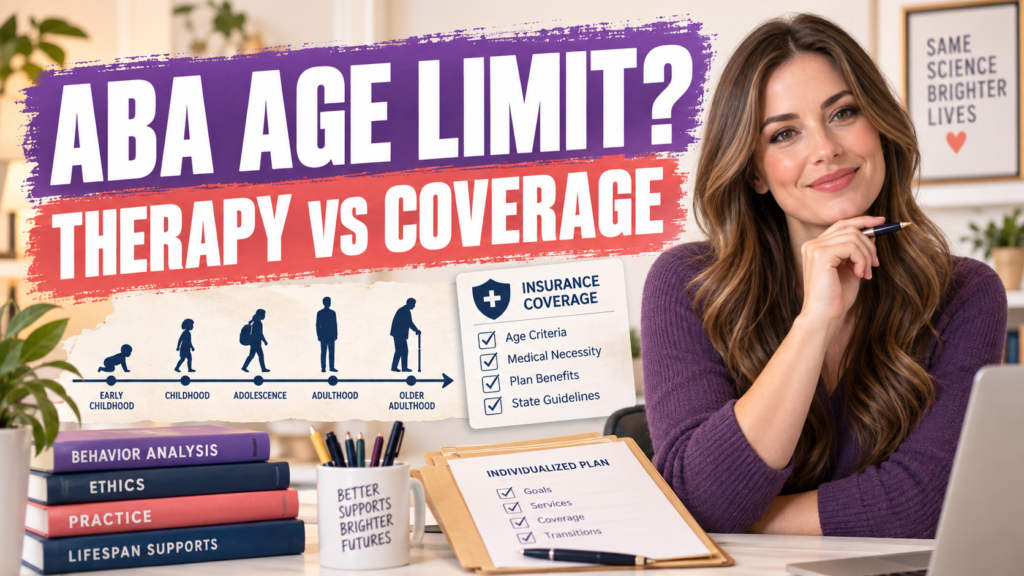
If you are searching for an ABA age limit, the short answer is that there is no single maximum age for ABA as a clinical approach. Applied behavior analysis can be adapted to children, adolescents, and adults when the goals are meaningful, the assessment supports the plan, and the provider has the right competence. The more difficult question is usually not whether ABA “works after” a particular birthday. It is whether a specific insurance plan, Medicaid program, state rule, employer benefit, or service authorization will pay for the requested care.
Table of Contents
- Is There an ABA Age Limit?
- Clinical Access and Coverage Are Different Questions
- What Changes Across the Lifespan?
- What About Medicaid, Private Insurance, and TRICARE?
- How to Check Your Actual Coverage
- How a BCBA Should Think About Age and Goals
- Common ABA Age-Limit Mistakes
- Quick Review Checklist
- FAQ
That distinction matters because a coverage cutoff is an administrative rule, not proof that learning or behavior change stops at that age. A plan may emphasize early intervention, limit a benefit to children, require a new authorization after a transition, or cover adult services under different criteria. Before assuming that a person is too young or too old, separate clinical fit from funding eligibility and verify both. Table of Contents
Is There an ABA Age Limit?
There is not one universal clinical ABA age limit in the United States. ABA is a way of analyzing behavior and arranging teaching or environmental conditions; it is not a child-only procedure. The appropriate question is whether the proposed goals are socially meaningful, observable, measurable, and suited to the person’s current context. For a young child, goals might involve communication, play, daily routines, or safety. For an adult, goals might involve independent living, employment routines, self-advocacy, communication, health habits, or participation in community activities.
“No universal age limit” does not mean that every person qualifies for every service, that every provider treats every age group, or that every payer must authorize ABA. It also does not mean that an early-intervention model should simply be copied into an adult program. The assessment, treatment setting, goals, communication needs, preferences, risks, and available supports all influence what a competent provider can reasonably offer.
The Autism Society of America’s plain-language ABA resource describes ABA across the lifespan and emphasizes individualized goals, collaboration, and quality of life. That is a better starting point than a single age number. Early support can be important, but “early” is not the same as “only.”
Clinical Access and Coverage Are Different Questions
Many confusing answers about the ABA age limit happen because two different questions are treated as one. Clinical access asks whether a behavior-analytic service may be appropriate for a person and a defined goal. Coverage asks whether a particular payer will reimburse that service under its current rules. A person may be clinically appropriate for a service but face a coverage barrier, or may have coverage available but need a different service model than the one originally requested.
| Question | What it asks | What to verify |
|---|---|---|
| Clinical fit | Could behavior analysis help with the person’s defined goals and current environment? | Assessment, goals, risks, provider competence, assent or consent, and data. |
| Coverage eligibility | Will this plan or program pay for the requested service? | Member age, diagnosis rules, network status, benefit language, authorization, and exclusions. |
| Service pathway | Where will services be delivered and what transition rules apply? | Home, clinic, school, community, employment, adult waiver, or another authorized setting. |
This table is a reasoning tool, not a coverage determination. A provider’s statement that “we only serve children” may describe that provider’s program, staffing, or contract rather than a universal ABA age limit. Conversely, a payer’s policy may impose a real reimbursement boundary even when another payer or private-pay arrangement would not. Ask which rule is being cited and whether it applies to the clinical service, the benefit, or only that organization.
What Changes Across the Lifespan?
The goals, teaching arrangements, and measures should change with the person’s life stage. Age is relevant context, but it should not replace an individualized assessment. A strong plan explains what the person wants or needs to do, what environmental barriers are present, how progress will be measured, and how the skill will matter outside the therapy session.
Young children: For young children, services may focus on communication, play, imitation, daily routines, learning readiness, and participation with caregivers or peers. Naturalistic teaching in ordinary routines can make practice more meaningful. Families should still ask how goals were selected, how the child’s preferences are respected, and how intensity is justified instead of assuming that more hours automatically means better care.
School-age children and adolescents: For school-age learners, goals may include academic routines, social participation, self-management, adaptive skills, safety, or reducing behavior that blocks access to instruction. Collaboration with education and other providers may be important. During adolescence, the plan should also consider privacy, autonomy, puberty-related changes, self-advocacy, transition planning, and skills needed for the next setting.
Adults: Adult ABA services can address practical outcomes such as communication, independent living, vocational routines, community participation, health-related routines, and reducing dangerous behavior. An adult program should not be a child program with different materials. Goals should be respectful, consent- and assent-aware where applicable, culturally responsive, and connected to the adult’s own priorities and quality of life.
Across every age group, the provider should be able to explain why a target matters, what observable change is expected, and what data will support continuation or revision. A person’s age may influence the setting and the type of support available, but the plan still needs a behavior-analytic rationale and a meaningful outcome.
What About Medicaid, Private Insurance, and TRICARE?
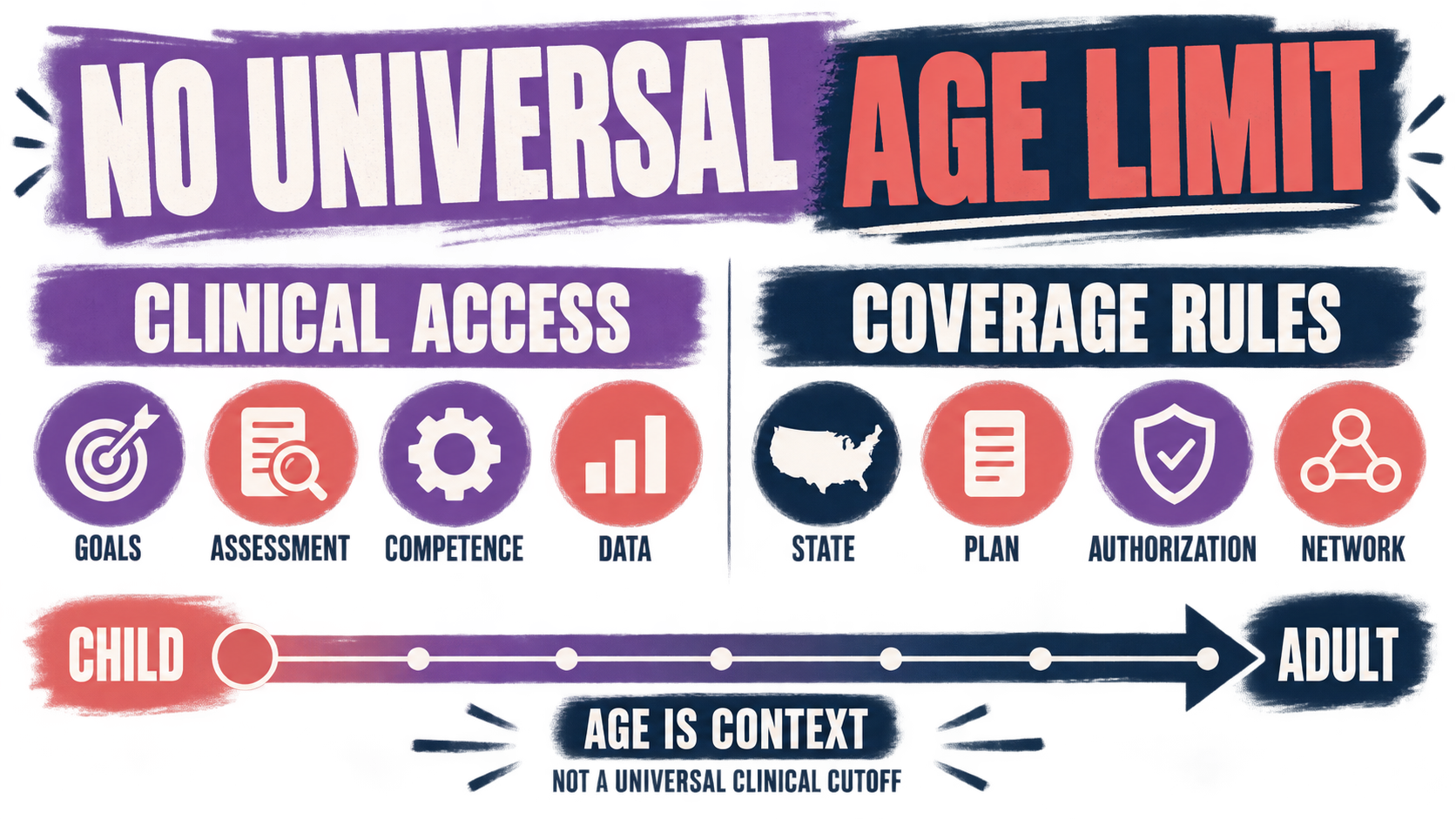
Coverage is where the answer becomes plan-specific. The Centers for Medicare & Medicaid Services says its autism guidance is intended to improve understanding of Medicaid support for beneficiaries across the lifespan, but states administer their own programs and determine the type, amount, duration, and scope of services within federal rules. That means a federal page can explain the framework without providing a universal age cutoff for every state plan.
Medicaid’s EPSDT benefit applies to enrolled children under age 21 and requires medically necessary services within the federal benefit framework. That is an important child-coverage protection, but it should not be turned into the claim that “ABA always ends at 21.” Adult Medicaid coverage, managed-care rules, waivers, state policy, medical-necessity standards, and service definitions can differ. Read the current state and plan documents rather than relying on a general age statement.
Private insurance is also variable. A state autism mandate may apply to some fully insured plans but not to every employer-sponsored or self-funded arrangement. The plan may use a different name for the benefit, require an autism diagnosis from a specified provider, restrict network access, or require periodic authorization. A provider’s intake policy and an insurer’s benefit policy are separate sources of information.
TRICARE provides a useful example of why a payer must be named. Its Autism Care Demonstration questions and answers state that there are no age or time limits under that demonstration, while services must be clinically necessary and appropriate and are authorized through the program’s process. That does not create a rule for commercial insurance or every Medicaid state; it shows why “What does this specific plan say?” is the right follow-up question.
For a broader federal overview, review Medicaid’s autism-services guidance and the EPSDT explanation. These sources help separate federal program concepts from a state’s current operational policy. They do not replace a member-services confirmation or a written authorization.
- Age rule: Does the benefit use a child, adolescent, adult, or no-age category?
- Eligibility rule: Is a particular diagnosis, referral, or program enrollment required?
- Service rule: Which settings, goals, provider credentials, and hours are covered?
- Authorization rule: How often must the plan review medical necessity or renew approval?
- Transition rule: What changes when the member turns a certain age or changes programs?
How to Check Your Actual Coverage
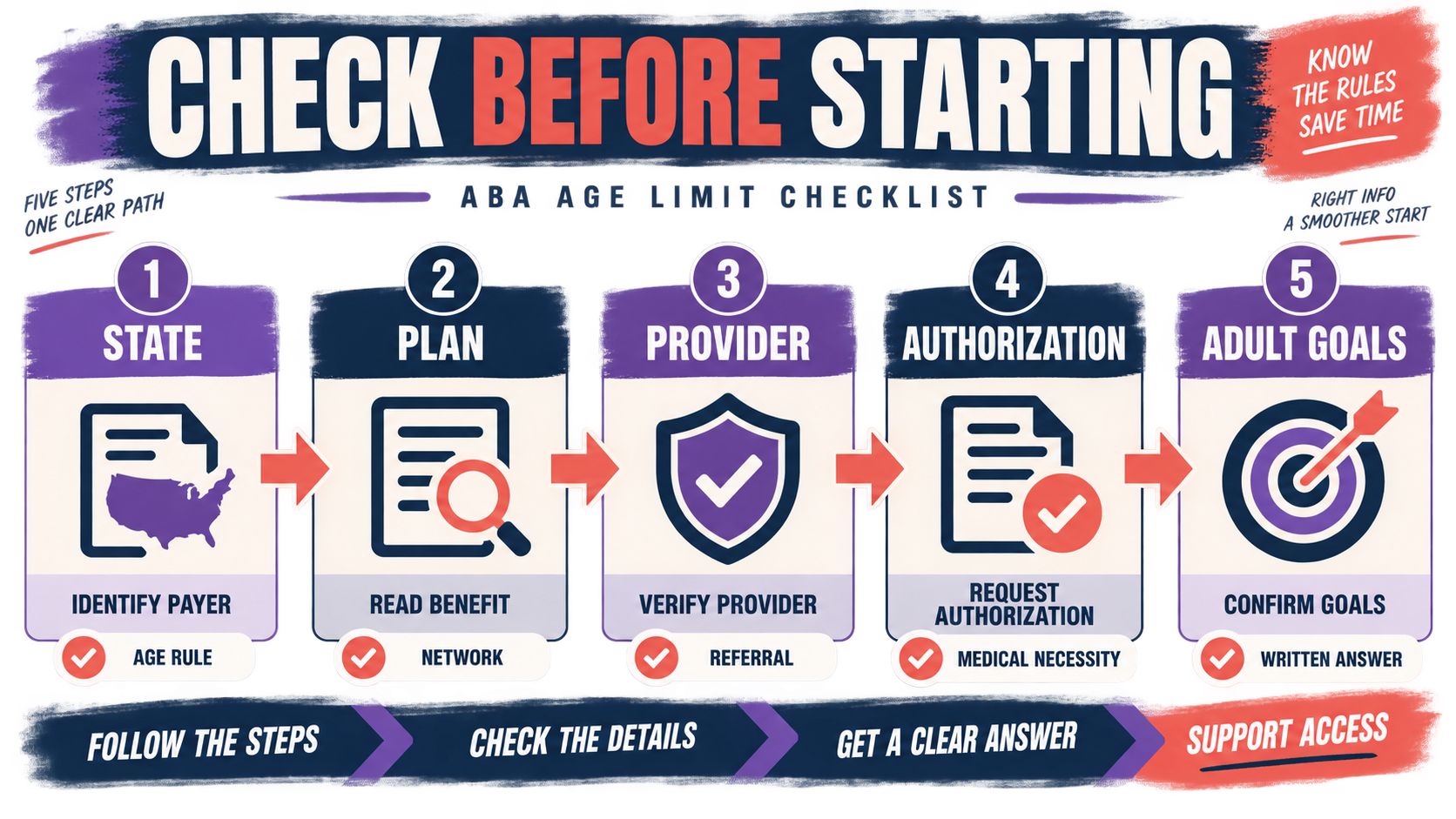
If someone says there is an ABA age limit, do not stop with the number. Ask for the exact source and work through the following sequence. Keep a copy of the response because benefits and authorization rules can change.
- Name the payer and plan. Record the state, Medicaid managed-care plan, commercial carrier, employer plan, TRICARE program, or private-pay arrangement involved.
- Ask whether the rule is clinical or administrative. Is the person being told that the service is not clinically appropriate, that the provider does not serve that age, or that the benefit will not reimburse it?
- Request the current benefit language. Look for age limits, diagnosis requirements, covered settings, exclusions, visit or hour limits, network rules, and authorization periods.
- Confirm the transition point. Ask what changes at a birthday, school exit, change from child to adult coverage, or move between states.
- Verify provider availability. A plan may cover a service in theory but have no in-network provider for the person’s age, location, or goal set.
- Ask how an appeal works. If coverage is denied, request the written reason, deadline, clinical documentation requirements, and appeal instructions.
These steps are practical navigation guidance, not legal or insurance advice. A state agency, plan administrator, member-services representative, or qualified professional can explain the current rule for a specific case. Avoid making a treatment decision solely from a search result or a provider’s general marketing page.
How a BCBA Should Think About Age and Goals
For BCBA exam preparation, the key distinction is between an age label and an individualized clinical decision. The current BACB BCBA Test Content Outline frames assessment, intervention selection, data-based decision-making, and professional responsibilities as behavior-analytic tasks. A question about age should therefore prompt you to look for the client’s goals, context, assessment evidence, and scope-of-competence details—not an invented universal cutoff.
- Do the proposed targets describe meaningful behavior rather than compliance for its own sake?
- Does the intervention fit the person’s communication, culture, preferences, setting, and support needs?
- Is the provider competent to serve this age group and address the relevant goals?
- Are consent, assent, dignity, safety, and least-restrictive practice addressed?
- Will the data show useful change across people, settings, and activities?
- Is the plan being changed because of data, or only because a birthday occurred?
The exam trap is to confuse an administrative transition with a clinical conclusion. A coverage rule may force a new referral or a different funding source; it does not by itself establish that the person can no longer learn, communicate, participate, or benefit from a behavior-analytic service.
Common ABA Age-Limit Mistakes
- “ABA is only for young children.” Early intervention is often discussed, but age range and treatment goals are broader than early childhood.
- “No clinical age limit means every plan must pay.” Clinical adaptability and reimbursement are different questions.
- “Under 21 is the national ABA cutoff.” Under 21 is important in the Medicaid EPSDT context, not a universal end point for every payer or service.
- “A provider’s age policy is federal law.” It may reflect staffing, training, contract scope, or business policy.
- “Adult goals should look like child goals.” Goals should be age-appropriate, meaningful, and connected to the person’s priorities.
- “Age alone proves medical necessity.” Medical necessity and authorization depend on the plan’s current rules and the documented case.
- “The first search snippet is enough.” Coverage rules change; confirm the current official policy, written benefit language, and authorization process.
Quick Review Checklist
- There is no single universal ABA age limit.
- Clinical appropriateness and insurance eligibility are separate questions.
- Early intervention is not the same as an upper-age cutoff.
- Adult services require meaningful adult-centered goals and competent providers.
- Medicaid EPSDT protects medically necessary services for enrolled children under 21 within its framework.
- State Medicaid, private insurance, employer plans, and TRICARE can use different rules.
- Always verify the current payer, network, authorization, and appeal requirements.
FAQ
What is the maximum age for ABA therapy?: There is no universal maximum clinical age for ABA therapy. A specific provider, payer, state program, or authorization may set an administrative limit, so the exact policy must be identified before drawing a conclusion.
Is ABA covered for adults?: Sometimes, but coverage varies by payer, state, plan type, diagnosis rules, medical-necessity criteria, network, and authorization. Adult coverage should be confirmed with the plan and the provider rather than inferred from a general statement about ABA.
Does Medicaid stop ABA at age 21?: Medicaid’s EPSDT benefit applies to enrolled children under 21, but that does not create one universal rule that all ABA services end at 21. Adult Medicaid pathways and state policies can be different, so check the current state and plan documents.
What should I ask an ABA provider about age limits?: Ask whether the limit is the provider’s policy or the payer’s rule, which age groups and goals the team serves, what happens during a transition, which documentation is required, and whether adult or community-based options are available.
For a final study reminder, think: age is context, not the whole decision. Separate clinical fit, payer rules, provider scope, authorization, and meaningful goals. If you want to practice distinguishing a clinical answer from an administrative distractor, Take the Free BCBA Mock Exam for additional practice and feedback.



