
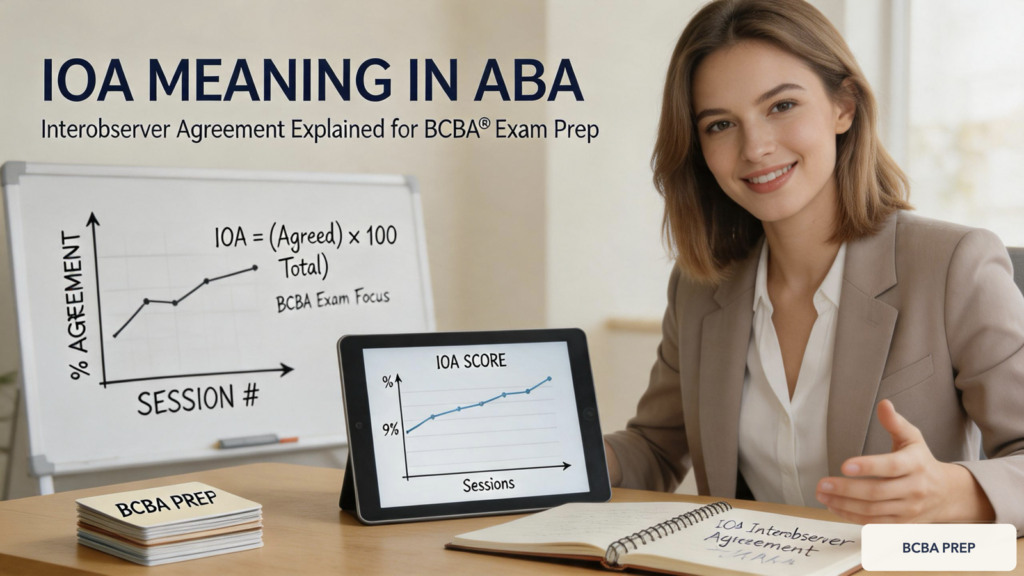
What Is IOA (Interobserver Agreement) and Why It Matters for the BCBA Exa
If you are preparing for the BCBA exam, understanding IOA meaning in ABA is essential. Interobserver agreement (IOA) refers to the degree to which two independent observers report the same observed behavior. It is a cornerstone of data reliability in applied behavior analysis.
Table of Contents
- What Is IOA (Interobserver Agreement) and Why It Matters for the BCBA Exa
- How to Calculate IOA: 3 Core Methods with ABA Examples
- Worked ABA Examples: Understanding IOA in Context
- Exam Relevance: Common Traps and How to Avoid Them
- Quick Checklist: IOA for Exam Day
- Final Summary
- References
IOA Definition in Behavior Analysis
IOA measures the extent of agreement between independent observers when recording the same target behavior. In practice, a second observer simultaneously but independently collects data during a session. The agreement percentage tells us how consistently the behavior is being measured. High IOA strengthens confidence that the data reflect true behavior, not observer bias or drift. The BACB emphasizes IOA as part of standard practice to ensure the validity of behavioral data.
For more on measurement and data collection, check our guide on data collection methods in ABA.
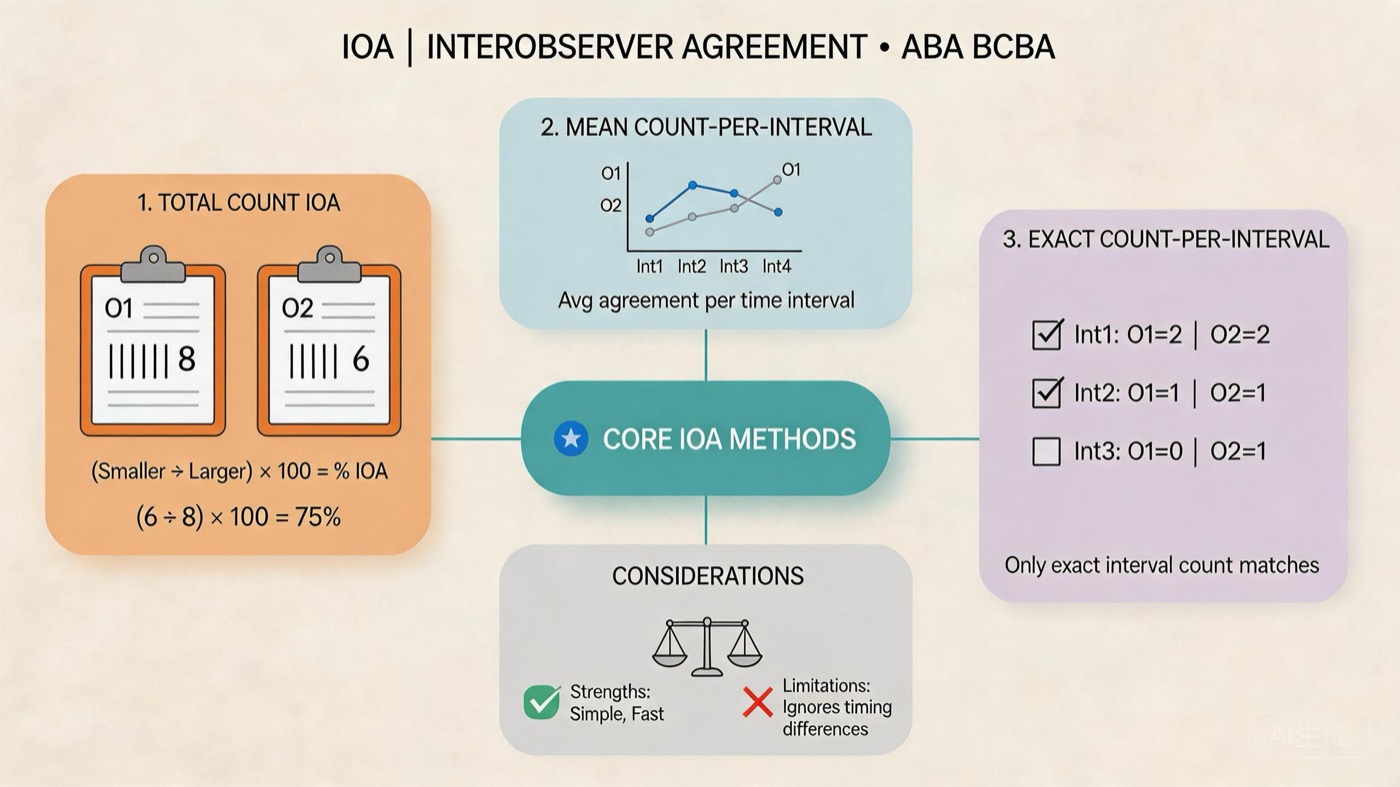
How to Calculate IOA: 3 Core Methods with ABA Examples
There are several ways to calculate IOA, and the BCBA exam expects you to know the most common ones. Each method has strengths and limitations.
Total Count IOA: Simple but Limited
Total count IOA compares the total number of recorded behaviors between two observers. The formula is: (smaller count / larger count) x 100. For example, Observer A records 10 aggression episodes and Observer B records 12 in a 30-minute session. IOA = 10/12 x 100 = 83.3%. This method is easy and quick but can be misleading if observers miss different instances or if agreement is low on a session-by-session basis.
Interval-by-Interval IOA: Common Exam Choice
Interval-by-interval IOA is frequently tested on the BCBA exam. The formula is: (number of intervals with agreement / total intervals) x 100. For example, using 15-second partial interval recording for self-stimulatory hand flapping, two observers mark whether behavior occurred in each of 40 intervals. They agree on 32 intervals. IOA = 32/40 x 100 = 80%. This method provides a more precise measure of observer consistency across time.
Time Sampling IOA (Scored-Interval, Unscored-Interval)
The exam may also ask about scored-interval IOA (agreement on intervals where behavior was recorded) and unscored-interval IOA (agreement on intervals where behavior was not recorded). These are useful when behavior is very frequent or very infrequent. For instance, if behavior occurs rarely, unscored-interval IOA can inflate overall agreement, so exam questions often require you to calculate both separately.
Worked ABA Examples: Understanding IOA in Context
Applying IOA to real clinical scenarios helps solidify the concept. Below are two examples with ABC data and function identification.
Example 1: Aggression with Hypothesized Function of Escape
Antecedent: Therapist instructs child to complete a math worksheet. Behavior: Child hits the therapist. Consequence: Therapist removes the worksheet. Two observers record aggression: Observer A counts 10 instances, Observer B counts 12. Total count IOA = 10/12 = 83.3%. Is this acceptable? The standard threshold is typically 80-90%, so 83% is borderline but may be acceptable depending on the target. However, further analysis is often needed—perhaps the observers used slightly different definitions or missed some occurrences.
Example 2: Hand Flapping with Hypothesized Automatic Function
Antecedent: Quiet demand during break. Behavior: Hand flapping. Consequence: Behavior continues (no social consequence). Interval-by-interval IOA is calculated across 25 intervals. Observers agree on 20 intervals, yielding IOA = 80%. Because the behavior is maintained by automatic reinforcement, observers may need extra training to identify subtle instances. Low IOA could indicate the need for clearer operational definitions.
Exam Relevance: Common Traps and How to Avoid Them
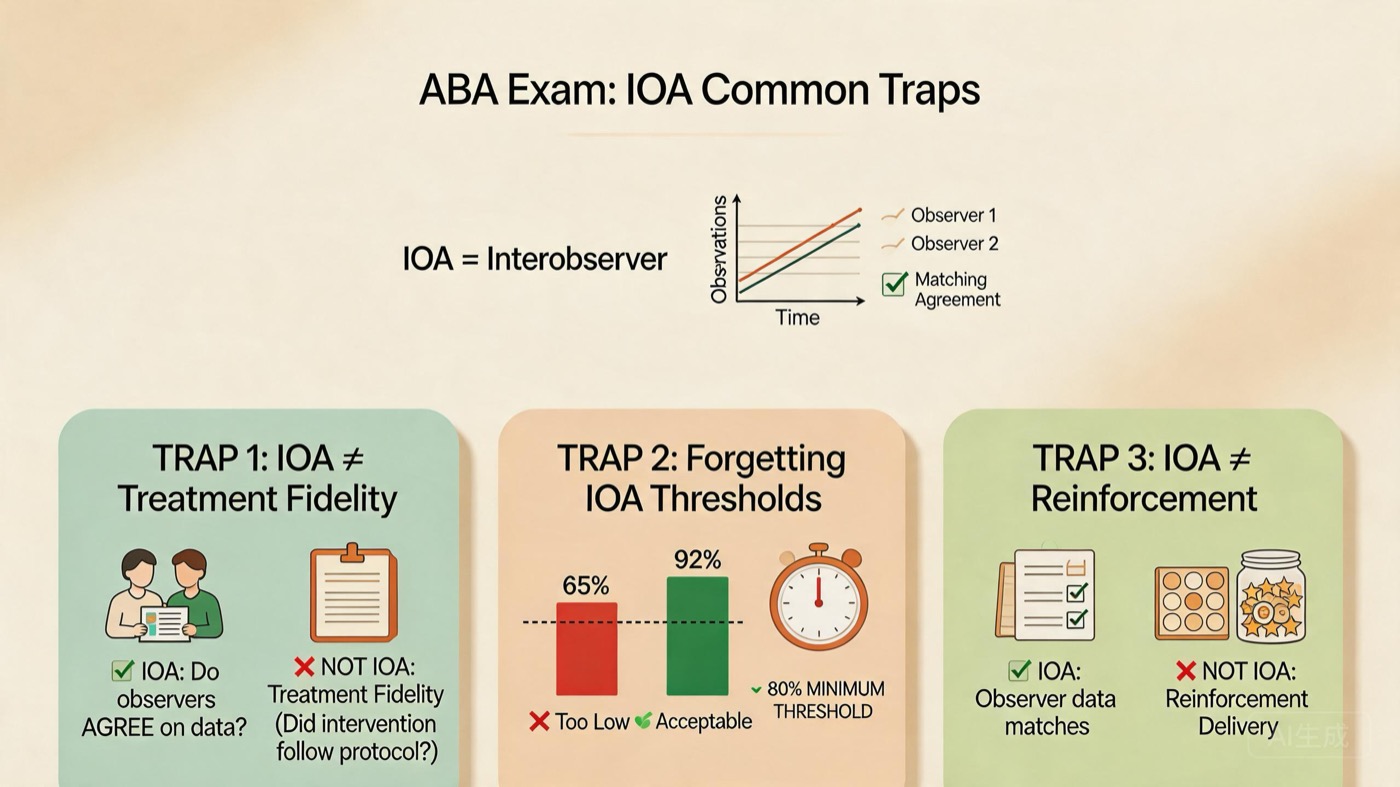
The BCBA exam often includes questions that test your ability to distinguish IOA from related concepts and to apply thresholds correctly. Here are three common traps.
Trap 1: Confusing IOA with Treatment Fidelity
IOA measures observer agreement, not whether the intervention was implemented correctly. Treatment fidelity (also called procedural integrity) assesses how accurately the independent variable was applied. Exam scenarios may mix these two; always ask: ‘Are they comparing observer records or comparing procedure to plan?’
Trap 2: Accepting Below-Threshold IOA Without Justification
Standard acceptable IOA is usually 80% or higher, but some behaviors may require 90% or above (e.g., low-frequency dangerous behaviors). If an exam scenario gives an IOA of 75%, look for a rationale (e.g., the behavior was subtle or the observers were new). Never automatically accept low IOA.
Trap 3: Forgetting That IOA Alone Does Not Ensure Data Validity
High IOA does not guarantee that the behavior was measured accurately. Both observers could systematically miss the same instances (e.g., both recording only loud vocalizations but missing quiet ones). Validity also depends on the measurement system and operational definition. Always consider whether the data truly capture the behavior of interest.
Quick Checklist: IOA for Exam Day
- Review three calculation methods: total count, interval-by-interval, and time sampling (scored/unscored).
- Know the standard threshold (80-90%) and when higher or lower might be acceptable.
- Differentiate IOA from treatment fidelity and interrater reliability.
- Practice with sample data: compute IOA from hypothetical observer data.
- Consider function: automatic vs. socially mediated—does it affect IOA expectations?
- Always check operational definitions: clear definitions improve IOA.
For a broader review of measurement and experimental design, see our guide to visual analysis in ABA.
Final Summary
Understanding IOA meaning in ABA is critical for both the BCBA exam and effective practice. IOA ensures that behavioral data are reliable: two independent observers see the same thing. The main calculation methods—total count, interval-by-interval, and time sampling—each have appropriate contexts. Be alert for exam traps that confuse IOA with treatment fidelity, accept low IOA without justification, or assume high IOA means valid data. Use the quick checklist above as a final review before exam day.
For more exam prep resources, visit the BACB website or our BCBA mock exam page.


