
What Are Threats to Internal Validity?
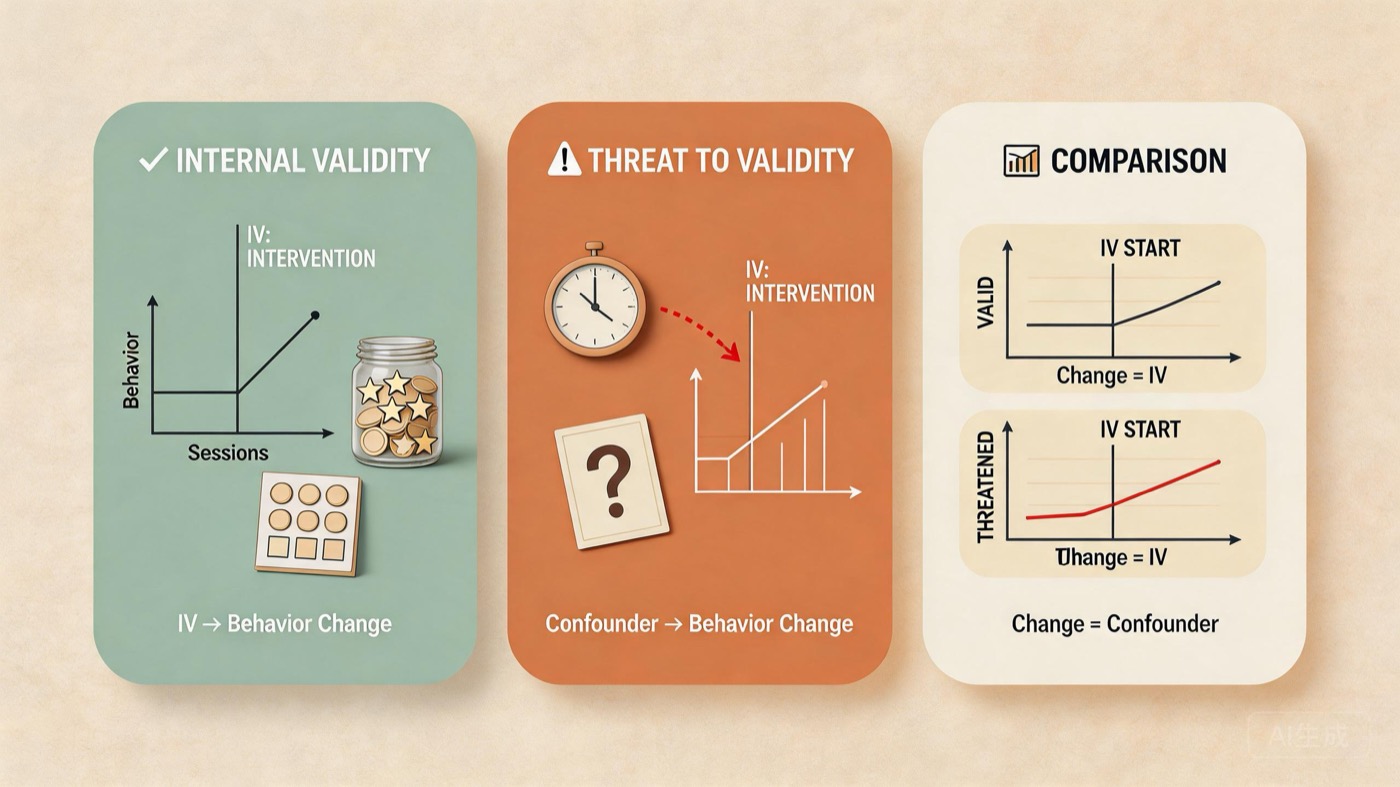
Internal validity is the degree to which an experiment demonstrates a functional relation between the independent and dependent variables. When something other than the independent variable causes a change in behavior, that something is called a threat to internal validity. For BCBA exam candidates, understanding these threats is essential because they directly affect the credibility of your data and conclusions. In applied behavior analysis, internal validity underpins every claim that an intervention produced meaningful behavior change. Without strong internal validity, you cannot confidently assert that your treatment—rather than an extraneous variable—caused the observed outcomes. The BCBA exam routinely tests your ability to recognize these threats in vignettes, so mastering them is both a study priority and a professional necessity.
Table of Contents
- What Are Threats to Internal Validity?
- Common Threats to Internal Validity Every BCBA Candidate Should Know
- ABC Analysis and Hypothesized Function: Putting Threats in Context
- Exam Relevance and Common Traps
- Quick Checklist for Identifying Threats to Internal Validity
- Summary
- References
Why Internal Validity Matters in ABA
In single-subject research, internal validity is the foundation for claiming that an intervention caused behavior change. The BCBA exam frequently tests your ability to identify threats in vignettes. Recognizing them helps you design better studies and critique research. For example, when a functional analysis shows differentiation, you must be sure that no confounding variable—like a change in staffing or a medication adjustment—could explain the results. The Task List explicitly includes internal validity under experimental design, and questions often ask candidates to select the most plausible threat from a short story. Because ABA practitioners rely on data-based decision making, any lapse in internal validity undermines the ethical obligation to implement effective interventions.
Common Threats to Internal Validity Every BCBA Candidate Should Know
Understanding these threats to internal validity will help you spot confounds in exam scenarios and real-world practice. Below are eight common threats with ABA examples.
- History: External events affect the dependent variable. For example, a power outage disrupts a token economy, reducing on-task behavior unrelated to the intervention. Another example: a celebrity visit to a school increases overall excitement, boosting social initiations temporarily.
- Maturation: Natural changes over time, like a child’s language development improving during a speech intervention, can be mistaken for treatment effects. Similarly, a teenager’s self-control may improve due to neurological development rather than a behavior contract.
- Testing: Repeated exposure to assessments leads to practice effects. A fluency drill may show improvement just from taking the test multiple times, not because of the teaching strategy.
- Instrumentation: Changes in measurement tools or observer drift. If data collectors become more lenient over time, results may appear inflated. Changing from a stopwatch to a smartphone timer can also introduce subtle differences.
- Regression to the Mean: Extreme baseline scores tend to move toward the average on subsequent measures. Selecting participants with very low rates of behavior can produce misleading improvements. For instance, a child with extremely high rates of tantrums on day one may have fewer on day two regardless of intervention.
- Selection Bias: Non-equivalent groups when comparing conditions. For instance, comparing a morning classroom to an afternoon classroom without random assignment. The morning group might be more alert, skewing results.
- Attrition: Participants drop out, altering the sample. If a student moves away during a social skills study, the remaining data may not represent the original group. High attrition in the control condition can artificially inflate treatment effects.
- Interaction Effects: When two threats combine, like selection-maturation. One group of children matures faster than another, making an intervention appear effective when it is merely a developmental difference.
ABC Analysis and Hypothesized Function: Putting Threats in Context
Applying ABC analysis (Antecedent-Behavior-Consequence) and hypothesizing the function of behavior can help you identify how threats operate in real interventions. Consider these two examples.
Example 1: History Threat in a Self-Injury Reduction Study
ABC: Antecedent = classroom noise, Behavior = self-injury, Consequence = teacher attention. The hypothesized function is attention. However, if a fire drill (history event) occurs during the intervention, the change in self-injury may be due to the drill, not the treatment. The drill acts as an extraneous variable that alters the antecedent (noise) and may temporarily suppress behavior.
Example 2: Maturation Threat in a Toilet Training Program
ABC: Antecedent = scheduled bathroom time, Behavior = successful toileting, Consequence = praise. The hypothesized function is automatic/sensory. But bladder control naturally improves with age (maturation), so gains might not be solely from training. A control condition—such as a wait-list group—can help tease apart maturation from treatment effects.
Exam Relevance and Common Traps
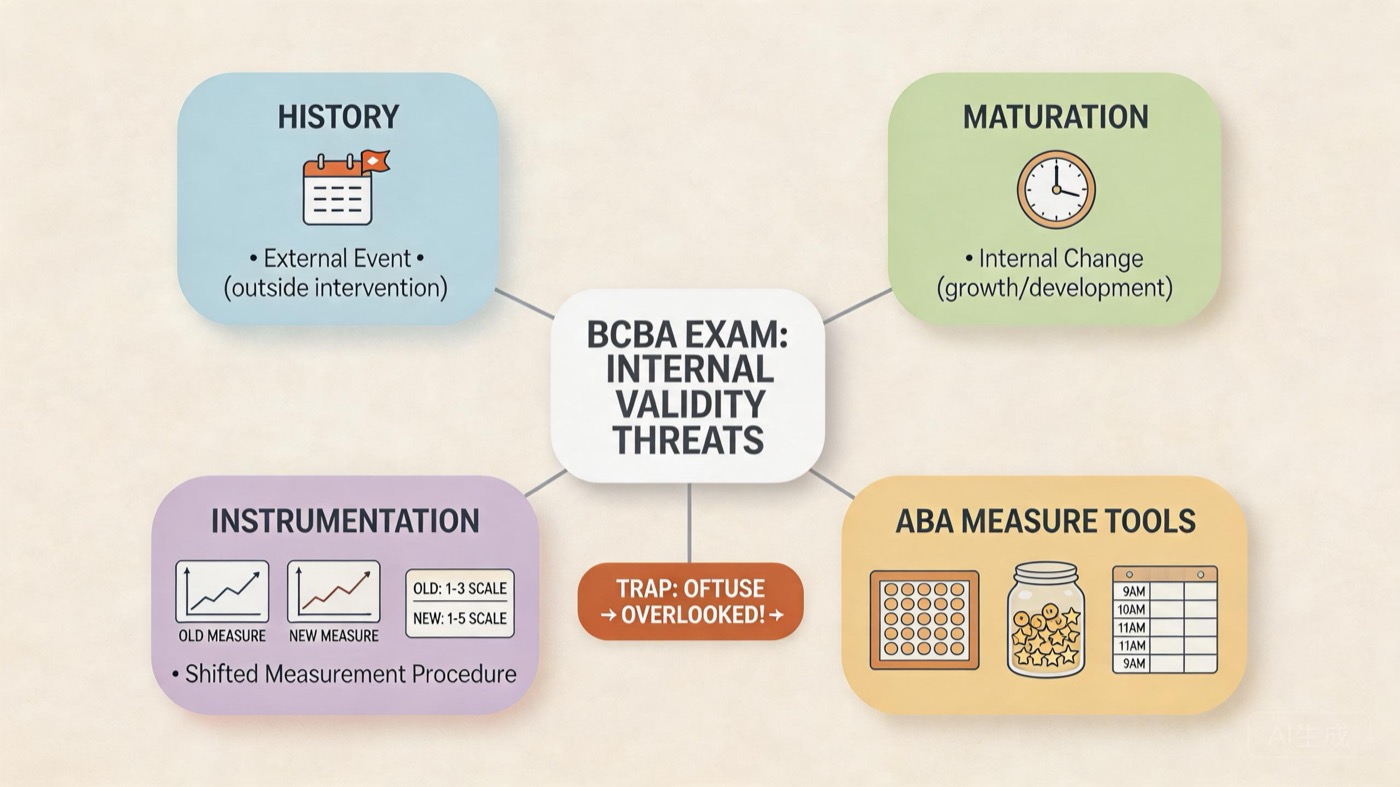
BCBA exam questions often present a vignette and ask which threat is present. Common traps include confusing history with maturation (external event vs. internal change) or overlooking instrumentation when measurement procedures shift. Another trick: regression to the mean is often tested when extreme scores are selected. To avoid errors, always ask: “Could this change have happened without the intervention?” Additionally, watch for scenarios where multiple threats co-occur; the question may ask for the “most likely” threat. Frequent practice with mock vignettes can train your eye to spot subtle clues like “over several months” (maturation) or “after a holiday break” (history).
Quick Checklist for Identifying Threats to Internal Validity
Use this checklist when reviewing study designs or exam vignettes:
- ☐ Did any external event occur during the study? (History)
- ☐ Did participants change naturally over time? (Maturation)
- ☐ Was there repeated testing that could cause practice effects? (Testing)
- ☐ Did measurement methods or observers change? (Instrumentation)
- ☐ Were participants selected based on extreme scores? (Regression)
- ☐ Were groups equivalent at the start? (Selection)
- ☐ Did any participants drop out? (Attrition)
- ☐ Do multiple threats combine? (Interaction)
For more practice, review our single-subject experimental designs guide and explore experimental design fundamentals to strengthen your understanding.
Summary
Mastering threats to internal validity is a must for BCBA exam success and ethical practice. By learning to identify history, maturation, testing, instrumentation, regression, selection, attrition, and interaction effects, you can design rigorous studies and critically evaluate research. Keep the checklist handy and always look for alternative explanations for behavior change. When you consistently apply this knowledge, you not only improve your exam performance but also enhance the quality of your future ABA services.



