
Introduction: What Does ‘Conditioned Stimulus’ Mean in ABA?
Understanding the conditioned stimulus is essential for the BCBA exam because it appears in questions about respondent (Pavlovian) conditioning. A conditioned stimulus (CS) is a previously neutral stimulus that, after repeated pairing with an unconditioned stimulus (US), begins to elicit a learned response. For example, a doorbell sound becomes a CS if it consistently precedes food delivery, causing salivation.
Table of Contents
- Introduction: What Does ‘Conditioned Stimulus’ Mean in ABA?
- Respondent Conditioning Basics: How a Neutral Stimulus Becomes a CS
- ABA-Relevant Examples of Conditioned Stimuli (With ABC + Function)
- Common Exam Traps When Identifying Conditioned Stimuli
- Quick Checklist: Conditioned Stimulus vs. Unconditioned Stimulus vs. Discriminative Stimulus
- Summary: Master Conditioned Stimulus for Exam Day
- References
In this guide, you will learn how to define conditioned stimulus, see how it works in ABA therapy, and avoid common exam traps. We also provide a quick checklist to distinguish CS from related concepts like the unconditioned stimulus and discriminative stimulus.
Respondent Conditioning Basics: How a Neutral Stimulus Becomes a CS
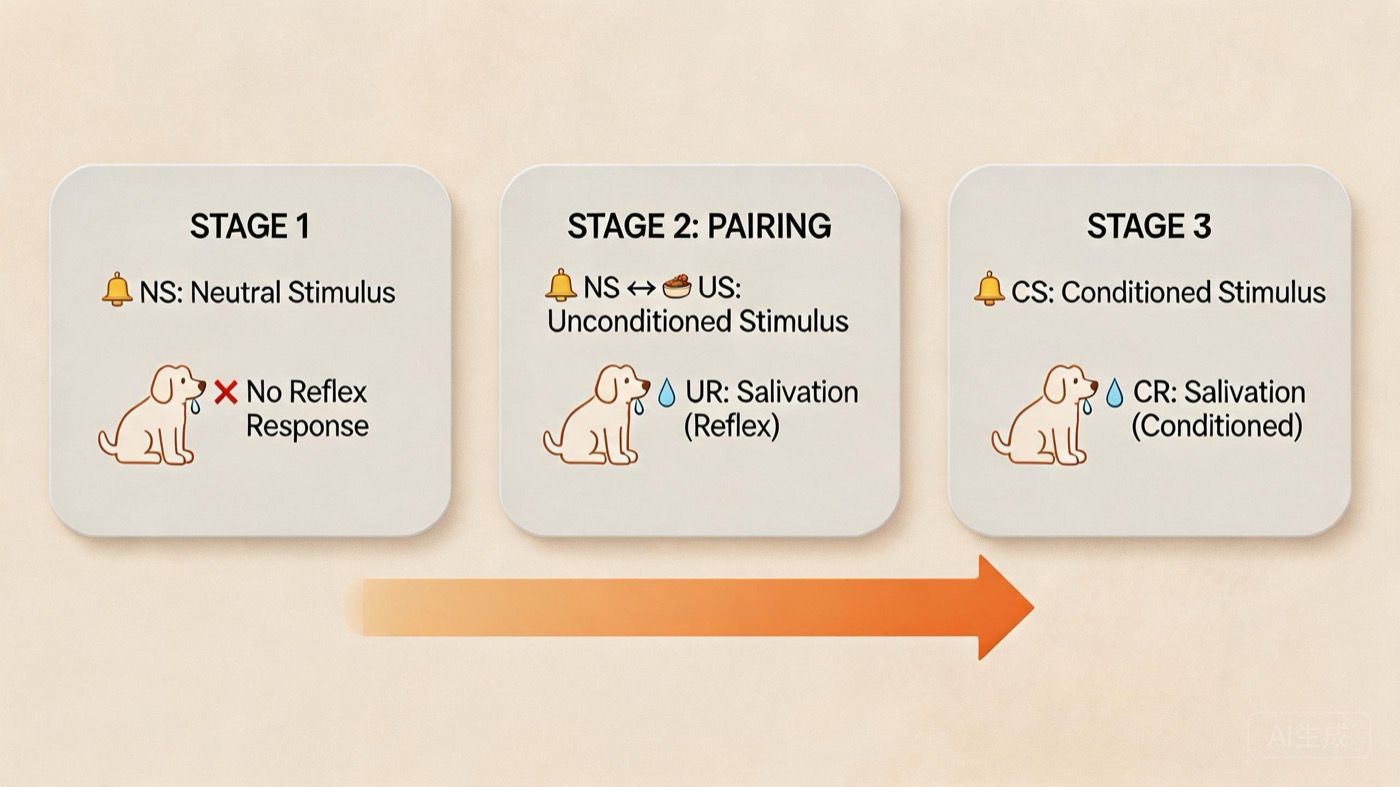
Respondent conditioning, also called Pavlovian or classical conditioning, is the process by which a neutral stimulus acquires the ability to elicit a reflexive response. The key steps involve pairing a neutral stimulus with an unconditioned stimulus that naturally triggers a response.
- Unconditioned stimulus (US): A stimulus that naturally elicits a response without prior learning (e.g., food, pain).
- Unconditioned response (UR): The natural, reflexive response to the US (e.g., salivation, crying).
- Neutral stimulus: A stimulus that initially does not elicit the target response (e.g., a doorbell).
- Conditioned stimulus (CS): After repeated pairings, the neutral stimulus becomes a CS that elicits a conditioned response (CR) similar to the UR.
For more on respondent behavior, see our guide on respondent vs operant behavior.
The Unconditioned Stimulus (US) vs. Conditioned Stimulus (CS)
Know the differences: the US is innate and unlearned, while the CS is acquired through pairing. The BCBA exam often tests your ability to label which stimulus is conditioned versus unconditioned in a scenario.
- US: Food, loud noise, painful stimulus, light in pupil reflex.
- CS: Bell, syringe, therapist’s white coat, doorbell.
- Key point: A CS elicits a response only after conditioning; a US always elicits the response.
Why This Distinction Matters on the BCBA Exam
Exam questions frequently present a scenario and ask you to identify the conditioned stimulus. A common trap is confusing the CS with the discriminative stimulus (SD) used in operant conditioning. Remember: CS is part of respondent conditioning and elicits reflexive behavior; SD is part of operant conditioning and signals that a behavior will be reinforced. Our article on discriminative stimulus in ABA covers this in depth.
ABA-Relevant Examples of Conditioned Stimuli (With ABC + Function)
The following examples show how a conditioned stimulus fits into therapy contexts. Each uses the three-term contingency (antecedent-behavior-consequence) but note that the response is elicited, not emitted voluntarily.
Example 1: The Doorbell as a Conditioned Stimulus for Salivation
Setting: Feeding therapy for a child with food refusal. Antecedent (CS): Doorbell sound. Behavior: Salivation. Consequence: Therapist delivers a small piece of food (US). After several pairings, the doorbell alone elicits salivation. Hypothesized function: Respondent conditioning; the doorbell becomes a CS that elicits a conditioned response similar to the natural salivation to food.
Example 2: A Syringe as a Conditioned Stimulus for Fear
Setting: Medical appointment for a child with needle phobia. Antecedent (CS): Sight of a syringe. Behavior: Crying, increased heart rate, attempts to escape. Consequence: Injection pain (US). After repeated pairings, the syringe alone elicits fear. Hypothesized function: Respondent fear response; the syringe becomes a CS for an aversive US.
Example 3: A Therapist’s White Coat as a CS for Compliance
Setting: DTT session in a clinic. Antecedent (CS): Therapist puts on a white coat. Behavior: Child sits upright, makes eye contact, waits for instructions. Consequence: Praise and edible delivered (US). Over time, the white coat elicits a learned readiness posture. Hypothesized function: Mixed respondent (classical) and operant, but the white coat’s eliciting effect is respondent. Be careful on the exam: if the response is voluntary and maintained by consequences, it’s probably operant.
For more practice, check our respondent conditioning examples guide.
Common Exam Traps When Identifying Conditioned Stimuli
Watch out for these pitfalls that trip up many candidates:
- Confusing CS with SD: Both are antecedents, but CS elicits a reflexive response (involuntary), while SD sets the occasion for operant behavior (voluntary). For example, a bell that makes you salivate is a CS, but a bell that signals food is available if you press a lever is an SD.
- Thinking the CS is always the first stimulus: In a two-stimulus pairing, the US comes first in the sequence (e.g., food first, then bell). The CS is the stimulus that follows the US in time (backward conditioning can occur but is rare).
- Missing the ‘neutral’ origin: A stimulus must have been neutral before conditioning. If a stimulus always elicited the response, it is an US, not a CS.
- Assuming all pairings produce a CS: Stimulus salience, timing, and number of pairings matter. Not every neutral stimulus becomes a CS; learn about blocking and overshadowing as potential exam topics.
Quick Checklist: Conditioned Stimulus vs. Unconditioned Stimulus vs. Discriminative Stimulus
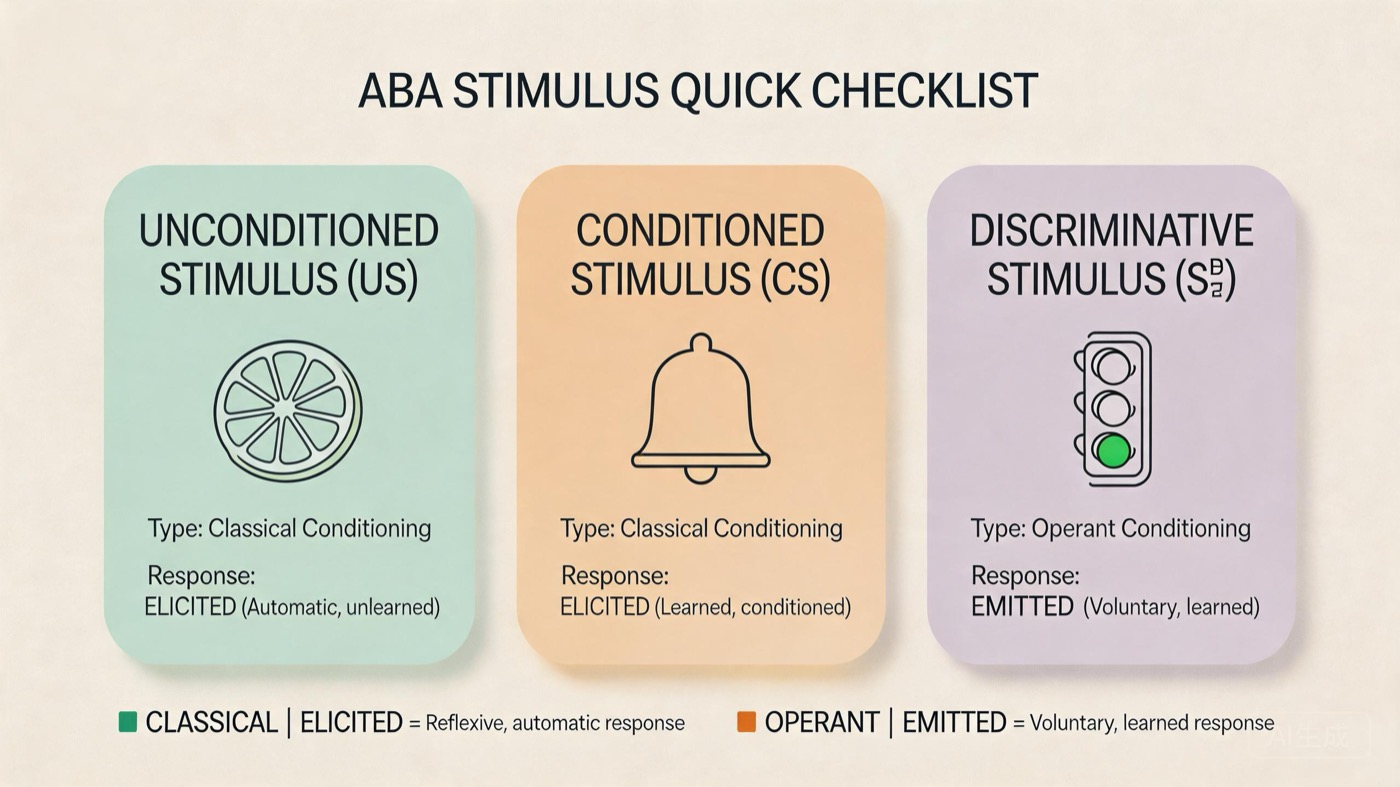
Use this table for last-minute revision. Focus on type of conditioning and whether the response is elicited or emitted.
- Conditioned stimulus (CS): Learned through pairing (respondent). Elicits involuntary response (CR). Example: doorbell that causes salivation.
- Unconditioned stimulus (US): Innate, unlearned (respondent). Elicits involuntary response (UR). Example: food that causes salivation.
- Discriminative stimulus (SD): Signals availability of reinforcement (operant). Evokes voluntary response (operant behavior). Example: red light that signals pressing a lever will deliver food.
For a deeper dive, read about SD vs MO differences on our site.
Summary: Master Conditioned Stimulus for Exam Day
You have learned to define conditioned stimulus as a previously neutral stimulus that elicits a learned response after pairing with an unconditioned stimulus. We covered the respondent conditioning process, provided three ABA therapy examples, highlighted common exam traps, and shared a quick comparison checklist.
To solidify your understanding, practice identifying the CS, US, CR, and UR in mock scenarios. Use our free BCBA mock exam questions to test yourself. Make flashcards for the key terms: CS, US, CR, UR, and SD. Good luck on your exam!



