
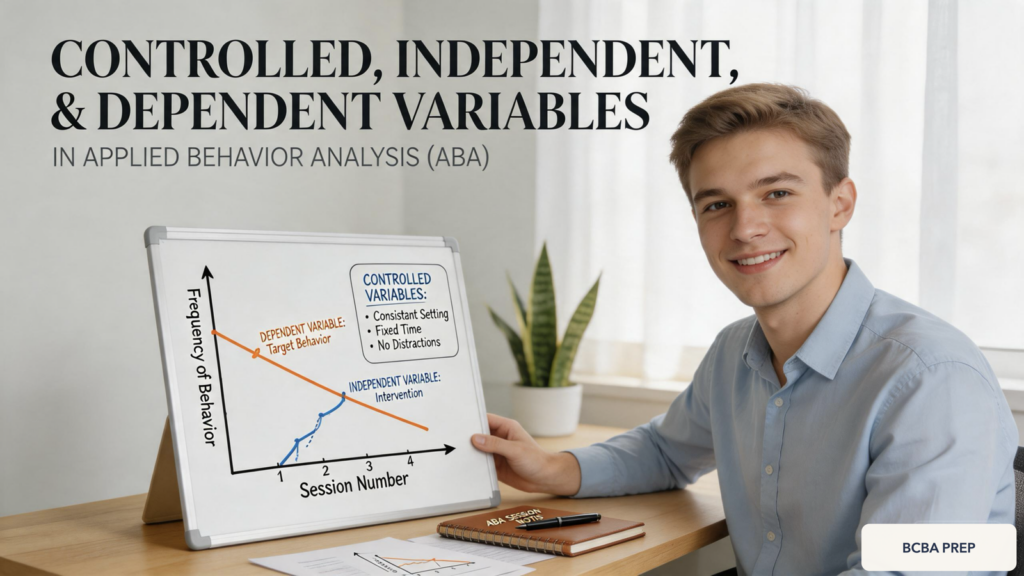
Understanding Controlled, Independent, and De
In ABA experiments, every study revolves around three variable types: the independent variable, the dependent variable, and controlled variables. These concepts form the backbone of experimental design and are essential for demonstrating a functional relation between intervention and behavior change. Mastering them is critical for the BCBA exam and real-world practice.
Table of Contents
- Understanding Controlled, Independent, and De
- ABA Examples of Controlled, Independent, and Dependent Variables
- Exam Relevance & Common Traps for the BCBA Test
- Quick Checklist for Variable Identification
- Putting It All Together: A Fourth Example with Data
- Summary: Mastering Variables for ABA Practice and Exams
- How to Study control dependent and independent variables for BCBA-Style Questions
- How to Study control dependent and independent variables for BCBA-Style Questions
- Take the Free BCBA Mock Exam
- References
The independent variable is what the practitioner manipulates — typically the intervention. The dependent variable is the target behavior being measured. Controlled variables are factors kept constant to ensure that changes in the dependent variable are solely due to the independent variable.
Independent Variable (IV): The independent variable (IV) is the treatment or intervention that the BCBA systematically alters. Examples include a token economy, differential reinforcement, or prompting strategies. The IV is always under the experimenter’s control.
Dependent Variable (DV): The dependent variable (DV) is the measurable behavior of interest, such as frequency of aggression or duration of on-task behavior. The DV is what you track to see if the IV had an effect.
Controlled Variable (CV): Controlled variables (also called constants) are environmental or procedural elements held steady across conditions — same setting, time of day, therapist, materials, or data collection method. They protect internal validity by ruling out alternative explanations.
ABA Examples of Controlled, Independent, and Dependent Variables
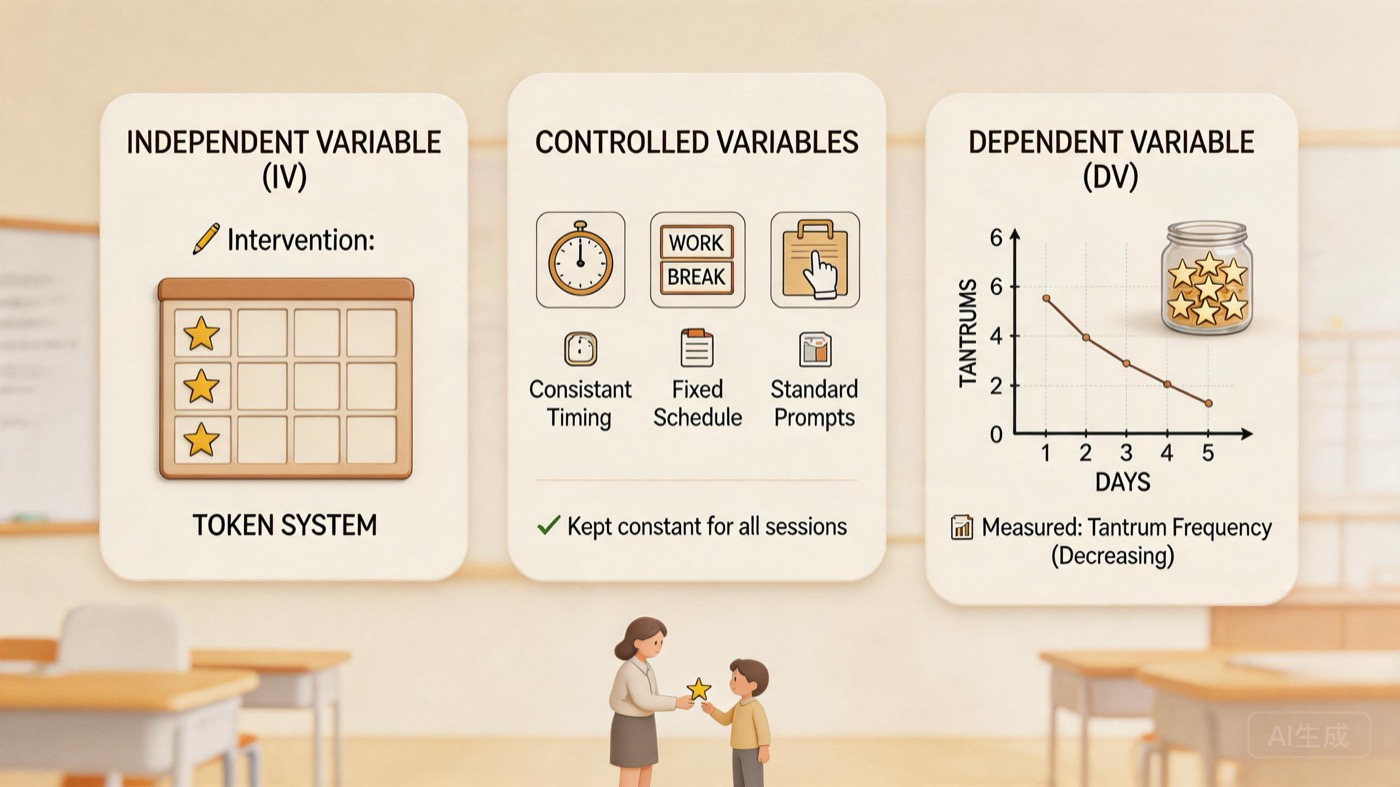
Let’s walk through three realistic ABA scenarios to see how these variables interact in practice. Example 1: Reducing Tantrums with a Token System: Setting: Self-contained classroom. Hypothesized function: Attention-maintained. The child engages in tantrums to gain teacher attention. A token system (IV) is implemented where tokens are delivered for every 5 minutes of task completion without tantrums. The dependent variable is the number of tantrums per session. Controlled variables include the same teacher, same classroom, same time of day (morning), and identical instructional materials. The token system replaces the attention previously provided for tantrums, reducing the DV.
Example 2: Increasing On-Task Behavior Using a Visual Schedule: Setting: In-home therapy. Hypothesized function: Escape-maintained. The client avoids tasks because demands are unclear. The IV is the introduction of a visual schedule presented before each activity. The dependent variable is the percentage of intervals on-task. Controlled variables: same therapist, same session length (30 minutes), same set of tasks, and same room. The visual schedule reduces ambiguity, increasing task engagement.
Example 3: Social Initiations with Peer-Mediated Intervention: Setting: Inclusive preschool. Hypothesized function: Social positive reinforcement (peer attention). The IV is a peer-mediated social stories program combined with modeling from trained peers. The dependent variable is the frequency of social initiations by the target child. Controlled variables include the same peers, same play area (block center), same time (free play), and same adult proximity. The intervention increases initiations by teaching peers to provide attention for appropriate social behavior.
Exam Relevance & Common Traps for the BCBA Test
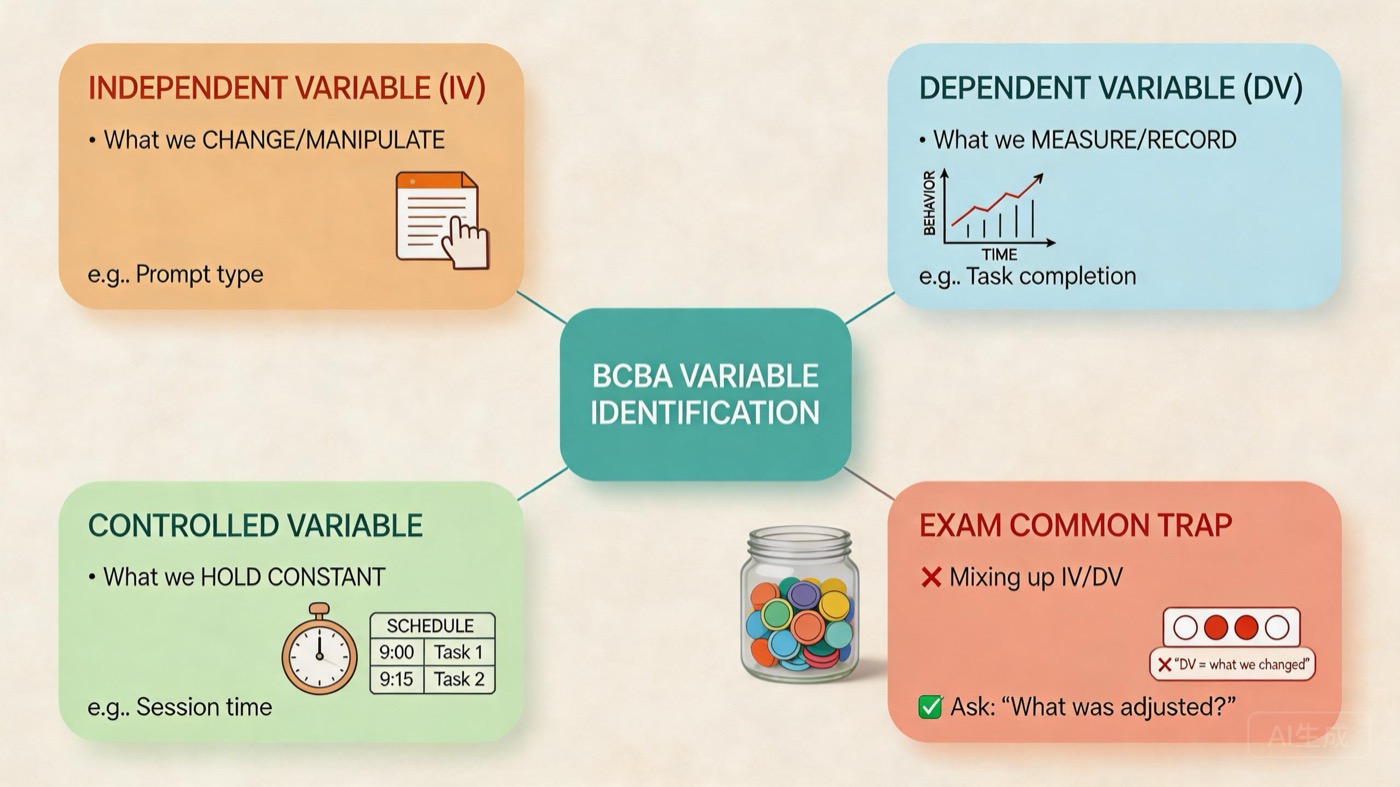
The BCBA exam frequently tests your ability to identify and distinguish among these three variable types. Questions often present a scenario and ask, ‘Which is the independent variable?’ or ‘Which variable was held constant?’ Common Traps: Use the points below as a quick study guide.
- Confusing IV and DV: Some candidates think the target behavior is the independent variable. Remember: the behavior (DV) is measured; the intervention (IV) is manipulated.
- Overlooking controlled variables: When asked about internal validity, examinees sometimes forget to mention constants. Controlled variables are just as important for experimental control.
- Mixing up operational definitions: A vague DV (e.g., ‘aggression’ without a clear definition) makes measurement unreliable. The exam may test whether you can spot a poorly defined DV.
- Assuming the IV is always a single intervention: Some studies compare multiple treatments. The IV can have levels (e.g., no prompt, least-to-most prompt, most-to-least prompt).
Tips to Avoid Traps: Use the points below as a quick study guide.
- Always ask: ‘What am I changing?’ (IV) and ‘What am I measuring?’ (DV).
- Controlled variables are ‘held steady’ across baseline and intervention.
- Define all variables operationally before starting the experiment.
- Practice with mock scenarios from our independent and dependent variables guide.
Quick Checklist for Variable Identification
Use this checklist when analyzing any ABA study or exam scenario:
- Identify the independent variable – What intervention is being applied or manipulated?
- Identify the dependent variable – What specific behavior is being measured?
- List at least three controlled variables – Factors kept constant across conditions.
- Confirm the hypothesized function – How does the IV relate to the DV? (e.g., attention, escape, automatic)
- Check operational definitions – Are both IV and DV defined in measurable, observable terms?
- Consider threats to internal validity – Could any uncontrolled variable affect the DV?
Putting It All Together: A Fourth Example with Data
Let’s examine a brief hypothetical data set to solidify understanding. A BCBA implements a DRA procedure (IV) to reduce screaming (DV). Baseline shows 8–10 screams per session; intervention shows 2–3 screams per session. Controlled variables include same therapist, same room, same duration (10 min), and same reinforcement schedule (FR1 for appropriate requests). The clear reduction in DV supports a functional relation.
Summary: Mastering Variables for ABA Practice and Exams
Understanding controlled, independent, and dependent variables is fundamental to applied behavior analysis. Every experiment requires careful definition and manipulation of these elements to demonstrate effective interventions. For the BCBA exam, a systematic approach to identifying variables will help you avoid common traps and answer questions confidently. Regular review using the checklist above will build fluency. For more practice, see our guide on variable dependency and experimental control.
How to Study control dependent and independent variables for BCBA-Style Questions
When you review control dependent and independent variables, do not stop at the definition. The exam usually tests whether you can apply the concept inside a short scenario, separate it from similar terms, and choose the most behaviorally precise answer. A strong study routine should connect the term to observable behavior, environmental context, measurement, and likely consequences.
- Define the response: identify exactly what the learner or client does, not just the broad skill area.
- Find the context: note the antecedent, setting, materials, people, or condition that makes the concept relevant.
- Check the consequence: ask what changes after the response and whether that change supports the answer choice.
- Compare close terms: write one sentence explaining why the best answer is not a related but different ABA concept.
For practice, turn each example into a quick discrimination exercise. Ask, “What would make this answer wrong?” and then change one detail in the scenario. This builds flexible exam reasoning instead of memorizing a single phrase.
How to Study control dependent and independent variables for BCBA-Style Questions
When you review control dependent and independent variables, do not stop at the definition. The exam usually tests whether you can apply the concept inside a short scenario, separate it from similar terms, and choose the most behaviorally precise answer. A strong study routine should connect the term to observable behavior, environmental context, measurement, and likely consequences.
- Define the response: identify exactly what the learner or client does, not just the broad skill area.
- Find the context: note the antecedent, setting, materials, people, or condition that makes the concept relevant.
- Check the consequence: ask what changes after the response and whether that change supports the answer choice.
- Compare close terms: write one sentence explaining why the best answer is not a related but different ABA concept.
For practice, turn each example into a quick discrimination exercise. Ask, “What would make this answer wrong?” and then change one detail in the scenario. This builds flexible exam reasoning instead of memorizing a single phrase.
Take the Free BCBA Mock Exam
Ready for more practice? Use the free mock exam to keep testing your accuracy with realistic BCBA-style items. Take the Free BCBA Mock Exam



