
What is an ABA assessment and treatment plan? It is the connection between understanding a learner’s current strengths, needs, behavior, and context—and choosing measurable, individualized goals and procedures. An assessment is not a diagnosis, and a treatment plan is not a generic form. For BCBA candidates, the key is to follow the evidence from referral question to baseline, from baseline to goals, and from ongoing data to plan changes.
Table of Contents
- What an ABA Assessment and Treatment Plan Connects
- What Belongs in the Assessment Evidence
- How Assessment Becomes a Treatment Plan
- How to Turn Findings Into Measurable Goals
- Common BCBA Exam Traps
- How to Review and Update the Plan
- How to Study the Topic
- ABA Assessment and Treatment Plan FAQ
- Quick Review Checklist
- Take the Free BCBA Mock Exam
This guide is educational content for BCBA study and professional reasoning. Payer rules, state requirements, service authorizations, and clinical decisions vary. Use the current BACB Test Content Outline, the BACB Ethics Code, and the rules that apply to the case before making a real service decision. Table of Contents
What an ABA Assessment and Treatment Plan Connects
An ABA assessment answers a question about the learner and the environment. The question might involve communication, adaptive skills, social participation, learning readiness, or behavior that creates a safety or quality-of-life concern. A treatment plan answers the next question: given the information gathered, what meaningful outcomes should be targeted, how will they be taught or supported, and how will progress be evaluated?
The two documents are related, but they are not interchangeable. Assessment is the process of gathering and interpreting information. The treatment plan is the individualized decision document that uses that information to organize goals, procedures, measurement, responsibilities, setting, review, and coordination. A diagnosis may be relevant to eligibility or care coordination, but an ABA assessment does not replace a medical or psychological diagnosis.
The phrase individualized is important. A strong plan does not begin with a prewritten list of goals and then search for evidence to justify it. It begins with the referral question, the learner’s priorities and context, direct and indirect information, and a clear description of current performance. The plan should be understandable enough that the team can implement it consistently and revise it when the data show a poor fit.
What Belongs in the Assessment Evidence
Assessment evidence is usually stronger when it comes from more than one source and method. The exact tools depend on the referral question, the learner, the setting, scope of competence, and applicable requirements. In exam scenarios, do not choose a tool because it is familiar; choose the assessment method that answers the question with the least unnecessary risk and the most useful information.
- Record review: relevant history, previous assessments, prior interventions, health or educational information, and the response to earlier supports.
- Interviews and rating scales: the learner’s and caregivers’ priorities, routines, perceived barriers, preferences, and socially important outcomes.
- Direct observation: what happens before, during, and after the target behavior or skill opportunity across relevant people, tasks, and settings.
- Measurement: an operational definition and a measure that fits the response, such as frequency, rate, duration, latency, percentage, or a product measure.
- Skill and preference information: current repertoires, prerequisites, communication options, choice patterns, and conditions that make participation more likely.
- Social validity: whether the goals, procedures, outcomes, and burden are meaningful and acceptable to the learner and stakeholders.
A functional behavior assessment may be part of the larger assessment when the referral question concerns problem behavior and its environmental variables. A functional analysis is a specific experimental assessment, not a synonym for every assessment process. The question, available evidence, safety, and competence determine what is appropriate.
How Assessment Becomes a Treatment Plan
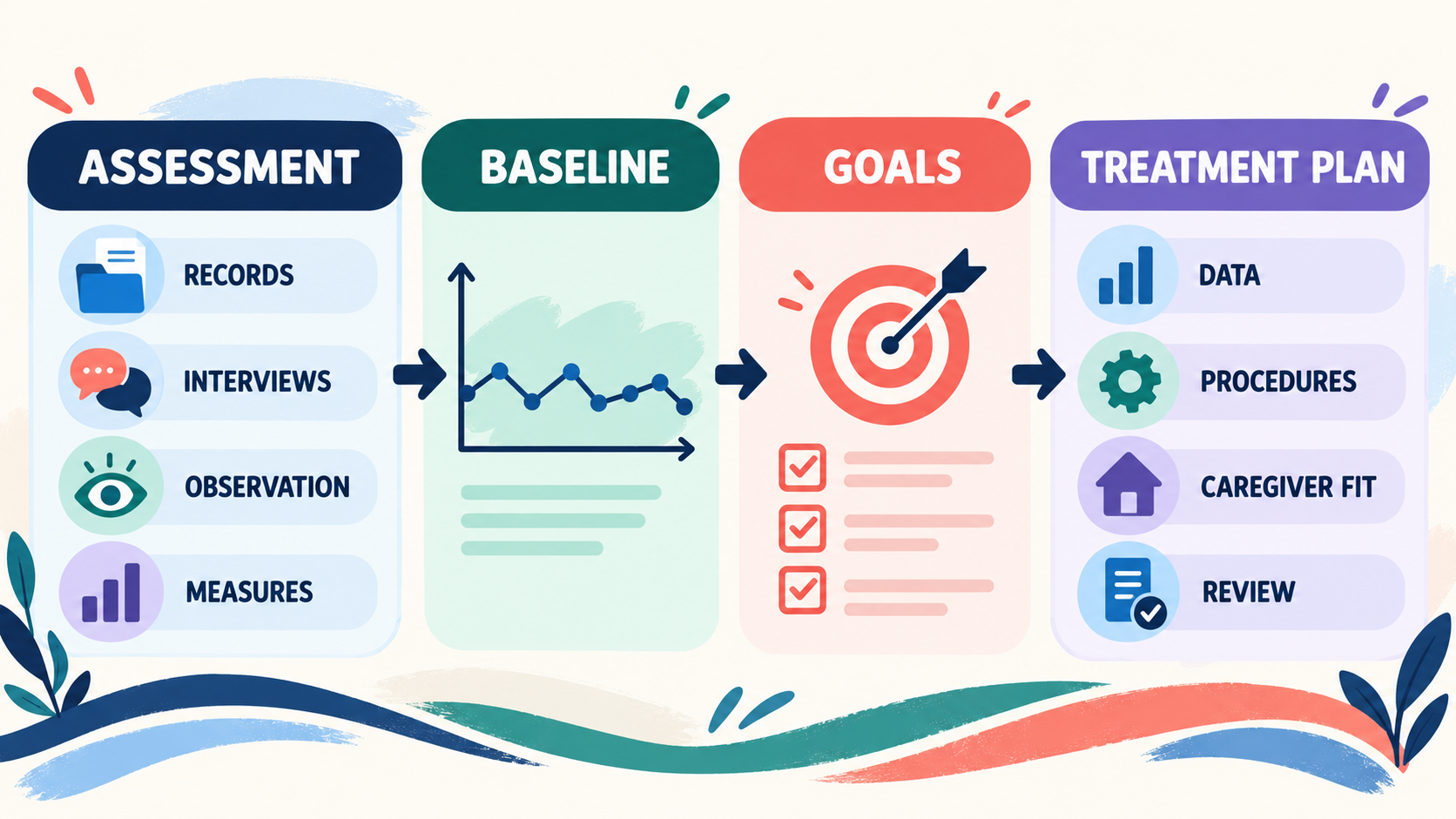
The bridge from evidence to plan should be visible. If a reader cannot explain why a goal follows from the baseline and why the procedure matches the likely variables, the plan is probably too generic.
| Plan component | What it should connect to | BCBA reasoning check |
|---|---|---|
| Present level and baseline | Direct measures, records, interviews, and relevant skill information | Can another person see exactly where performance starts? |
| Prioritized goals | Social significance, safety, independence, communication, and stakeholder priorities | Is the goal meaningful, observable, and appropriately prioritized? |
| Teaching or behavior-change procedures | The skill deficit, behavior function, context, and learner variables | Does the procedure address the assessed reason for the problem or skill gap? |
| Data and decision rules | The goal, response definition, criterion, and review schedule | What data would cause continuation, modification, or referral? |
| Generalization, caregiver fit, and coordination | The settings and people who need the skill to matter in daily life | Can the outcome transfer beyond the teaching room and be implemented reliably? |
| Review and transition | Progress, maintenance, risk, changing priorities, and continued need | When will the team review fit, fade support, or coordinate the next step? |
State and payer documents may add specific forms, tools, timelines, or authorization requirements. For example, the Vermont guidelines describe assessment information as the basis for individualized goals and include state-specific expectations. That is useful evidence of the overall logic, but it should not be copied as a universal rule for every state or payer.
How to Turn Findings Into Measurable Goals
A common exam mistake is jumping from a broad concern to a broad goal. “Improve communication” may be meaningful, but it is not yet a measurement-ready target. The plan needs a behavior or skill that can be observed, a context, a criterion, and a way to decide whether the intervention is working.
Imagine assessment data show that a learner often leaves a group activity when a preferred item is unavailable and rarely requests a break or help. A weak plan might say, “Decrease escape behavior.” A stronger plan would define the response, identify the relevant context, teach a functionally appropriate communication response, specify how opportunities and independent responses will be measured, and state how the team will evaluate generalization across people and settings.
The goal is not stronger merely because it contains a percentage. It is stronger when the percentage represents a meaningful change, the measure is reliable, the criterion is achievable and socially important, and the procedure gives the learner an effective alternative. The treatment plan should also identify what staff or caregivers will do, what prompts or reinforcement are planned, and how prompt dependence, side effects, or lack of progress will be addressed.
Common BCBA Exam Traps
Questions about an ABA assessment and treatment plan often test distinctions rather than isolated definitions. Use the exact facts in the stem before applying a familiar label.
| Tempting shortcut | Better distinction |
|---|---|
| Assessment equals diagnosis | Behavior-analytic assessment answers a referral or service question; it does not automatically establish a medical diagnosis. |
| Baseline equals the goal | Baseline describes current performance. The goal states the meaningful change and criterion the plan is designed to evaluate. |
| Preference equals reinforcer | A preference assessment identifies selection or approach; a reinforcer assessment tests whether a consequence increases behavior. |
| FBA equals functional analysis | FBA is a broader assessment process. Functional analysis experimentally manipulates conditions to test functional relations. |
| A template equals an individualized plan | A template can organize documentation, but it cannot substitute for assessment evidence, clinical reasoning, consent, or ongoing review. |
How to Review and Update the Plan
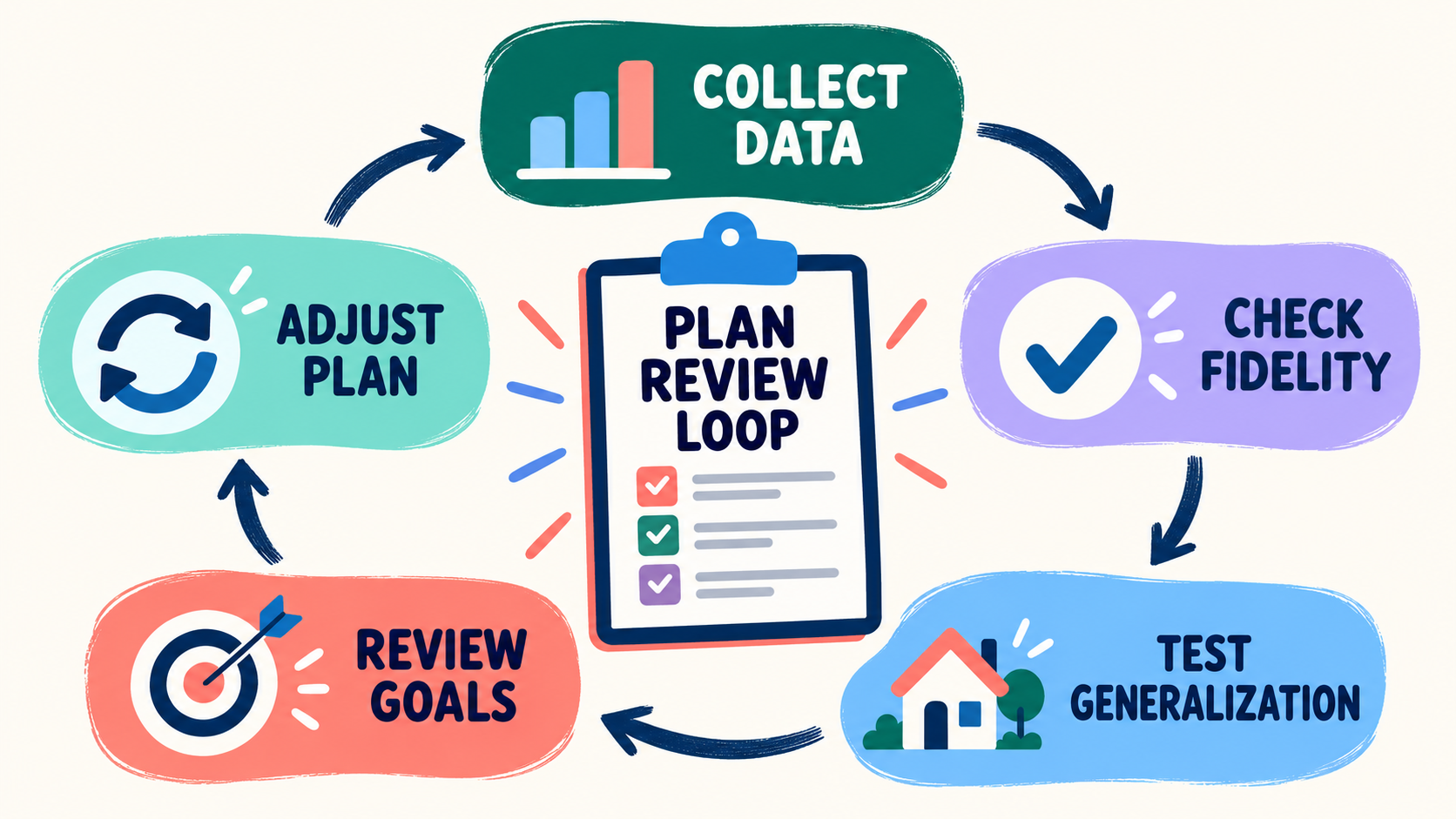
A treatment plan is a working decision system, not a document that becomes correct merely because it was signed. Review the data at the planned interval and sooner when safety, consent, contextual fit, or progress changes.
- Collect and inspect data: look at level, trend, variability, and whether the measure still answers the decision question.
- Check treatment integrity: determine whether the procedures were implemented as written and whether the implementer had the training and resources to do so.
- Check generalization and maintenance: ask whether the change appears with different people, materials, tasks, and settings, and whether it lasts after support changes.
- Review goal fit: consider social validity, learner assent, caregiver priorities, risk, burden, and whether the goal remains meaningful.
- Adjust, coordinate, or refer: modify the plan based on evidence, coordinate with relevant professionals, and seek consultation or referral when the issue exceeds scope of competence.
The Washington rule on stage-two ABA services illustrates why assessment, functional assessment, and treatment-plan development can be described as connected but distinct steps. The NCBI standards overview likewise separates initial assessment and plan development from ongoing assessment and plan revision. The practical lesson for an exam is simple: use new data to test the fit of the current plan instead of defending the plan as if it were permanent.
How to Study the Topic
Use a four-pass method when studying this keyword cluster:
- Map the sequence: referral question → assessment → baseline → goals → procedures → measurement → review.
- Practice distinctions: compare assessment with diagnosis, FBA with functional analysis, preference with reinforcer assessment, and baseline with criterion.
- Work scenarios: before reading the answer choices, identify the evidence available, the decision requested, and the ethical or scope constraint.
- Audit the error: label each miss as a knowledge, discrimination, application, measurement, or pacing problem, then practice that exact gap in a new scenario.
Do not memorize a single state’s authorization timeline as though it were the national definition of a treatment plan. Instead, learn the reasoning pattern and then verify the official rule that applies to the question. If you want a baseline for mixed-domain scenario work, try the free BCBA mock exam and use the results to choose your next review block.
ABA Assessment and Treatment Plan FAQ
What is included in an ABA assessment and treatment plan?: The assessment side may include records, interviews, direct observation, measurement, skill or preference information, and social-validity input. The plan side usually connects the baseline to prioritized goals, procedures, data systems, responsibilities, setting, caregiver or team coordination, safety considerations, and review or transition decisions. The exact requirements vary by jurisdiction, payer, service, and referral question.
Does every ABA treatment plan require a functional analysis?: No. A functional analysis is one experimental assessment option and is not automatically required for every referral or plan. The appropriate assessment depends on the question, the behavior, risk, available evidence, competence, and applicable requirements. Do not treat FBA, functional analysis, and assessment as interchangeable labels.
How often should an ABA treatment plan be updated?: There is no single universal interval for every client or payer. Follow the applicable authorization and professional requirements, while reviewing sooner when data, safety, consent, context, or progress changes. A plan should be revised when the evidence shows that the goals or procedures no longer fit.
What is the most important BCBA exam idea here?: Trace the evidence. The best answer usually connects the referral question, the assessment method, the baseline, the individualized goal, the function or skill need, the measure, and the next data-based decision. A polished template or familiar intervention is not enough if the link to the assessment is missing.
Bottom line: an ABA assessment and treatment plan is a connected chain of decisions, not two generic forms. Gather relevant evidence, define the starting point, choose socially meaningful and measurable goals, match procedures to the assessed need, and keep reviewing the data. That chain is both sound BCBA reasoning and a reliable way to approach scenario-based exam questions.
Quick Review Checklist
Use this final checklist to turn aba assessment and treatment plan into exam-ready reasoning. The goal is not to memorize a label in isolation; it is to identify the relevant evidence and explain why the best answer fits the scenario. Key ideas to review:
- State the central definition or decision point for aba assessment and treatment plan in your own words.
- Identify the detail that makes aba assessment and treatment plan different from its closest related ABA term.
- Separate the observable facts in a scenario from assumptions that are not supported by the facts.
- Write one example and one nonexample so you can recognize the concept in a new setting.
Exam application checks:
- Ask what the question is actually requesting before comparing the answer choices.
- Mark the antecedent, response, consequence, or other evidence that supports the selected answer.
- Look for a distractor that describes a related process but does not answer the specific question.
Final self-check:
- Explain how you would verify the interpretation with clear observations or data.
- Change one detail in the scenario and decide whether your answer should change.
- Give a one-sentence rationale that a supervisor or study partner could evaluate.
Take the Free BCBA Mock Exam
If you want a low-pressure way to check your recall, use the free practice resource below. Take the Free BCBA Mock Exam



