
Verbal analog conditioning ABA is a behavior-analytic concept in which verbal stimuli can alter the function of a previously neutral stimulus without the learner experiencing the usual direct pairing with a reinforcer or punisher. In plain language, what someone says can change how a listener responds to an object, event, or cue—even before the listener has contacted the relevant consequence directly.
Table of Contents
- What Is Verbal Analog Conditioning ABA?
- What Do “Verbal” and “Analog” Mean?
- What Is the Classic Example?
- How Does It Differ From Related Concepts?
- Is It the Same as Direct Pairing?
- How Should You Answer a BCBA Exam Question?
- What Are the Ethical Application Boundaries?
- Verbal Analog Conditioning FAQ
- Quick Review Checklist
- Take the Free BCBA Mock Exam
The term is easy to confuse with an instruction, a rule, direct stimulus pairing, or a conditioned motivating operation. The safest definition focuses on the process: a verbal statement produces an analog, or function-altering, effect that resembles what direct conditioning would have produced.
This guide uses the current BCBA Test Content Outline for exam context and behavior-analytic sources for the conceptual distinction. It is a study guide, not a recommendation to manipulate a person’s preferences or clinical environment without assessment, assent, supervision, and ethical safeguards. Table of Contents
What Is Verbal Analog Conditioning ABA?
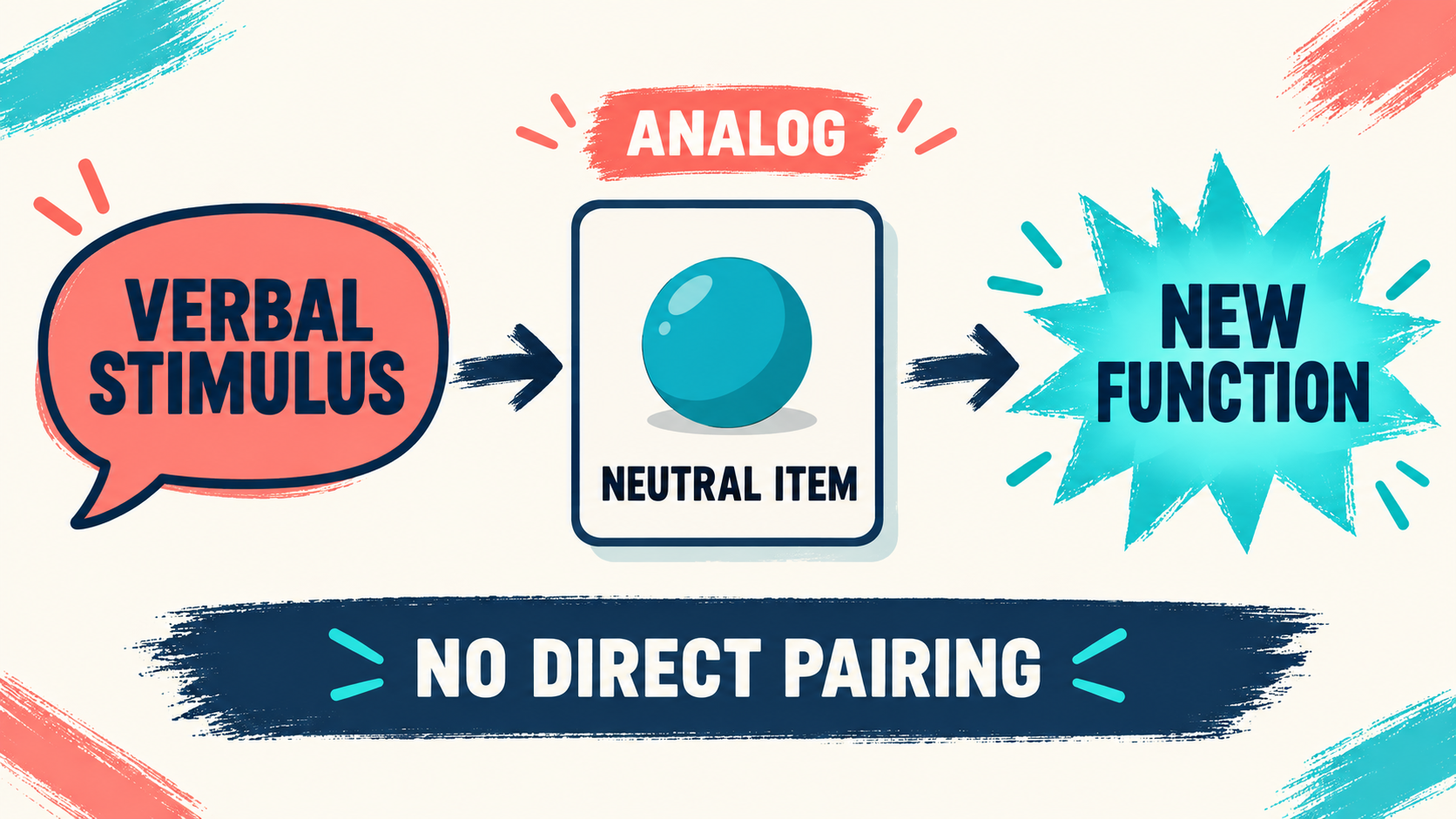
Verbal analog conditioning is a proposed behavior-analytic process in which a verbal stimulus changes the function of another stimulus without the direct stimulus–consequence pairing normally associated with conditioning. The verbal statement acts as a function-altering event for the listener. It may make a neutral item more reinforcing, more punishing, or more discriminative even though the listener has not personally experienced the direct pairing that would ordinarily establish that function.
For example, an adult tells a child that a particular plain piece of paper is highly valuable and that other people want it. If the child begins to work to obtain the paper even though the paper has never been exchanged for food, toys, money, or another established reinforcer, the scenario is commonly used to illustrate verbal analog conditioning. The important feature is not the color of the paper. It is the verbal transformation of its behavioral function without the usual direct pairing.
The term “analog” signals that the verbal process produces an effect that resembles conditioning. It does not mean the verbal statement literally reproduces every feature of a laboratory conditioning procedure. Behavior analysts use the term to discuss how language can alter the evocative or reinforcing functions of stimuli for a listener.
Because the process is conceptual and function-based, do not label every successful instruction as verbal analog conditioning. A direction such as “put the cup on the table” may evoke behavior because of a learned verbal repertoire, a history of reinforcement for following instructions, or the current context. To identify verbal analog conditioning, look for evidence that the verbal stimulus altered the function of another stimulus without direct pairing.
What Do “Verbal” and “Analog” Mean?
Verbal refers to the role of language or another verbal stimulus in changing the listener’s behavior. The source can be a spoken statement, written sentence, social story, rule, or other verbal product, depending on the scenario. The focus is functional—not simply whether the message was spoken aloud.
Analog refers to an indirect resemblance to a familiar conditioning effect. In direct conditioning, a stimulus acquires a function through contact with a consequence or through a direct relation with an unconditioned or already conditioned event. In verbal analog conditioning, language can produce a related function-altering effect without the same direct contact.
This is why the concept often appears near rule-governed behavior, function-altering operations, conditioned reinforcers, and verbal behavior. These are related study areas, but they are not interchangeable labels. A rule can describe a contingency. A verbal analog process emphasizes the function-altering effect of the verbal stimulus on another event or stimulus.
What Is the Classic Example?
The classic study example involves a neutral object that is described verbally as desirable or valuable. Imagine a learner who has never received an exchange, reward, or other direct consequence for a yellow card. An adult says, “Everyone wants these cards; people try hard to get one.” Later, the learner works to obtain the yellow card. If the card’s function changed because of the verbal description rather than a direct pairing, the example illustrates verbal analog conditioning.
Use the example as a reasoning tool, not as a promise that a single sentence will make any object reinforcing for any person. The listener’s verbal repertoire, learning history, culture, current motivation, comprehension, and context matter. A verbal statement may fail to produce the predicted effect, may produce a different effect, or may be understood as a simple instruction rather than a function-altering relation. A strong analysis asks four questions:
- Was the stimulus previously neutral or did it already have a known function?
- What verbal stimulus was presented to the listener?
- What change in responding suggests that the stimulus function changed?
- Was there direct pairing with the relevant reinforcer or punisher before the change?
If the answer to the last question is no and the verbal statement appears to have changed the stimulus function, the verbal-analog interpretation becomes more plausible.
How Does It Differ From Related Concepts?
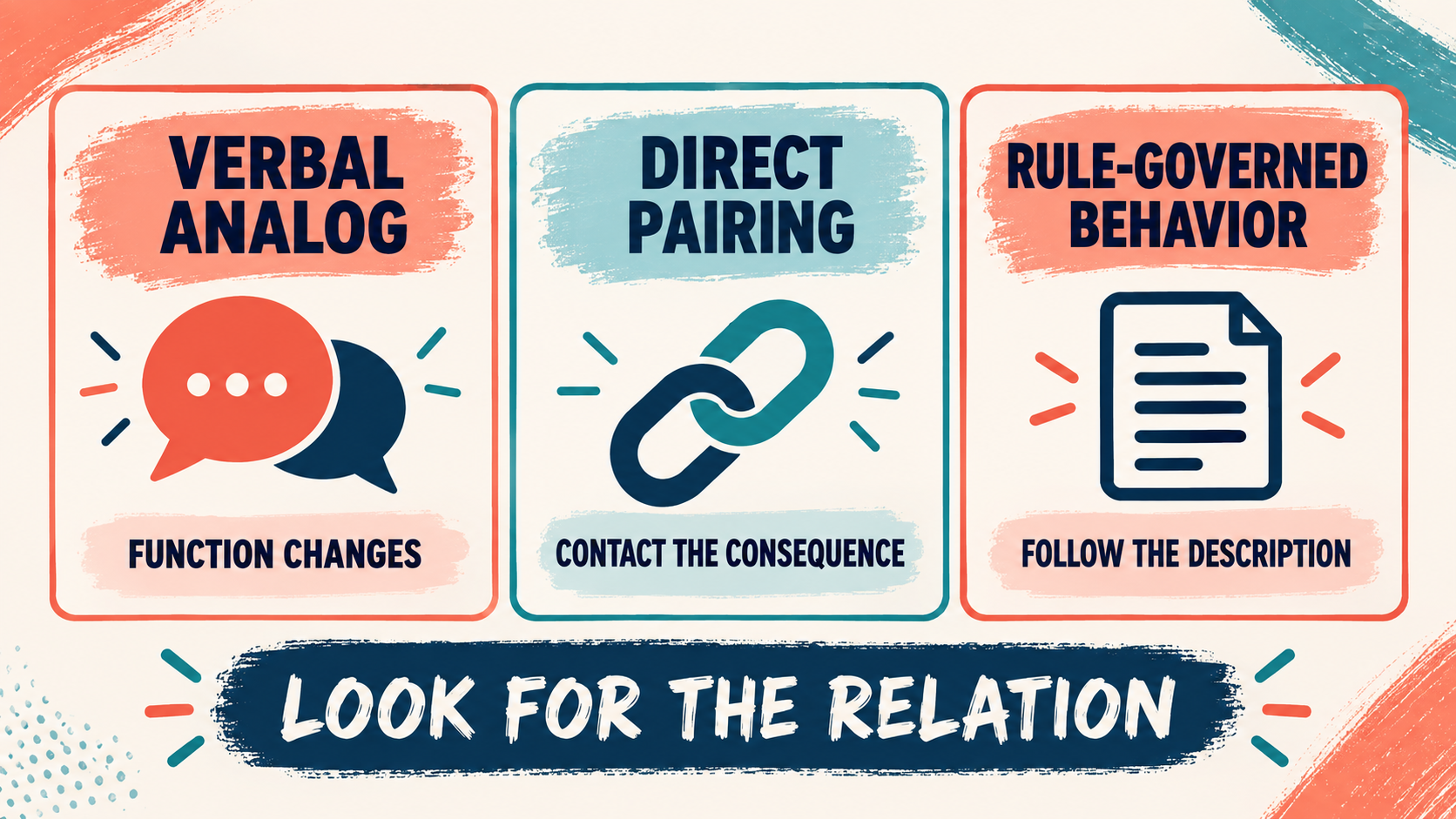
Many BCBA study questions test whether you can separate a process from a broad category. Use the comparison below to identify the feature the item is actually describing.
| Concept | Core feature | Question to ask |
|---|---|---|
| Verbal analog conditioning | Verbal stimuli indirectly alter a neutral stimulus’s function without direct pairing. | Did language create a conditioning-like function change? |
| Direct pairing | A stimulus contacts or is paired with an established reinforcer, punisher, or unconditioned stimulus. | Did the learner experience the direct relation? |
| Rule-governed behavior | Behavior is influenced by a verbal description of contingencies or a rule. | Is the question about following a rule or about a stimulus gaining a new function? |
| Conditioned reinforcer | A stimulus increases behavior because of a learning history or function-altering process. | What evidence shows that the stimulus increases future behavior? |
One scenario can involve more than one concept. For example, a verbal rule may be presented, the listener may follow it, and a previously neutral stimulus may acquire a new function. Identify the question’s target rather than choosing every label that sounds related.
Is It the Same as Direct Pairing?
No. Direct pairing is the key contrast. In a direct-pairing example, a neutral stimulus is repeatedly presented with an established reinforcer or punisher, and the neutral stimulus later functions in a similar way. The learner’s direct contact with the relation is part of the explanation.
In verbal analog conditioning, the verbal stimulus supplies information that can alter the listener’s responding without the same direct history. The learner might be told that an object is valuable, that an event is dangerous, or that a particular cue signals an important outcome. The function change is attributed to the verbal relation, not to the learner’s direct pairing with the relevant consequence.
Do not confuse “no direct pairing” with “no learning history.” The listener still has a verbal history, comprehension skills, and a history that makes verbal stimuli meaningful. “No direct pairing” refers to the specific neutral stimulus and the consequence named in the scenario.
How Should You Answer a BCBA Exam Question?
When you see verbal analog conditioning ABA in a study question, use this sequence:
- Find the neutral stimulus. Identify the object, event, or cue that did not previously have the named function.
- Find the verbal operation. Look for a statement, rule, story, or description that changes how the listener responds.
- Check for direct contact. If the learner received the relevant reinforcer or punisher through direct pairing, the item may be testing direct conditioning instead.
- Identify the new function. Decide whether the stimulus became more reinforcing, punishing, evocative, or discriminative.
- Answer at the right level. If the prompt asks for the process, choose verbal analog conditioning. If it asks for the behavioral pattern, it may be rule-governed behavior or responding to a conditioned reinforcer.
The current BCBA TCO includes content related to instructions and rules and to establishing and using conditioned reinforcers. The exact phrase verbal analog conditioning may appear in commercial study materials or conceptual questions, but the official outline is the safer map for deciding which broader content area the item tests.
A free BCBA mock exam can help you practice discrimination among these terms. Review the explanation and write down the neutral stimulus, verbal stimulus, direct-pairing history, and changed function. That method is more useful than memorizing the yellow-card example alone.
What Are the Ethical Application Boundaries?
In an exam scenario, the concept may sound like a clever way to create motivation. In practice, do not use verbal claims to mislead a learner, manufacture fear, or manipulate access to important resources. A statement that an item is valuable or dangerous should be accurate, culturally responsive, and appropriate to the person’s understanding and context.
Clinical decisions should be tied to assessment, observable goals, data, assent and consent processes, least-restrictive supports, and supervision. If a practitioner believes a verbal stimulus has altered the function of an item or event, the team should measure the relevant response rather than assuming that a preference has changed. The person’s communication, autonomy, and welfare remain more important than making a concept appear in a session.
Also keep verbal analog conditioning separate from promising an outcome. Explaining a contingency is not proof that the learner will follow a rule, and a verbal description is not a replacement for instruction, practice, feedback, or environmental support when those are needed.
Verbal Analog Conditioning FAQ
What is the shortest definition of verbal analog conditioning?: It is a function-altering effect in which verbal stimuli give a previously neutral stimulus a conditioning-like function without the usual direct pairing with a reinforcer or punisher.
Is verbal analog conditioning the same as rule-governed behavior?: No. The concepts overlap, but rule-governed behavior focuses on behavior controlled by a verbal description of contingencies. Verbal analog conditioning focuses on a verbal stimulus changing another stimulus’s function without direct pairing.
What is the yellow-paper example?: It is a commonly taught example in which a learner is told that a neutral yellow paper is valuable or desired. If the paper acquires a reinforcing function without direct pairing, the example illustrates verbal analog conditioning. The color itself is not the defining feature.
Does the learner need to experience reinforcement?: For the verbal-analog interpretation, the relevant point is that the learner did not directly experience the named stimulus–consequence pairing. The learner still needs a verbal repertoire and learning history that allow the verbal statement to affect behavior.
Verbal analog conditioning ABA describes how language can produce a conditioning-like function change without direct pairing. On an exam, look for a verbal stimulus, a previously neutral event, no direct pairing with the named consequence, and evidence that the event acquired a new function. Then distinguish the process from direct conditioning, ordinary rule-following, and the broader category of conditioned reinforcement.
Quick Review Checklist
Use this final checklist to turn verbal analog conditioning aba into exam-ready reasoning. The goal is not to memorize a label in isolation; it is to identify the relevant evidence and explain why the best answer fits the scenario. Key ideas to review:
- State the central definition or decision point for verbal analog conditioning aba in your own words.
- Identify the detail that makes verbal analog conditioning aba different from its closest related ABA term.
- Separate the observable facts in a scenario from assumptions that are not supported by the facts.
- Write one example and one nonexample so you can recognize the concept in a new setting.
Exam application checks:
- Ask what the question is actually requesting before comparing the answer choices.
- Mark the antecedent, response, consequence, or other evidence that supports the selected answer.
- Look for a distractor that describes a related process but does not answer the specific question.
Final self-check:
- Explain how you would verify the interpretation with clear observations or data.
- Change one detail in the scenario and decide whether your answer should change.
- Give a one-sentence rationale that a supervisor or study partner could evaluate.
Take the Free BCBA Mock Exam
If you want a low-pressure way to check your recall, use the free practice resource below. Take the Free BCBA Mock Exam



