
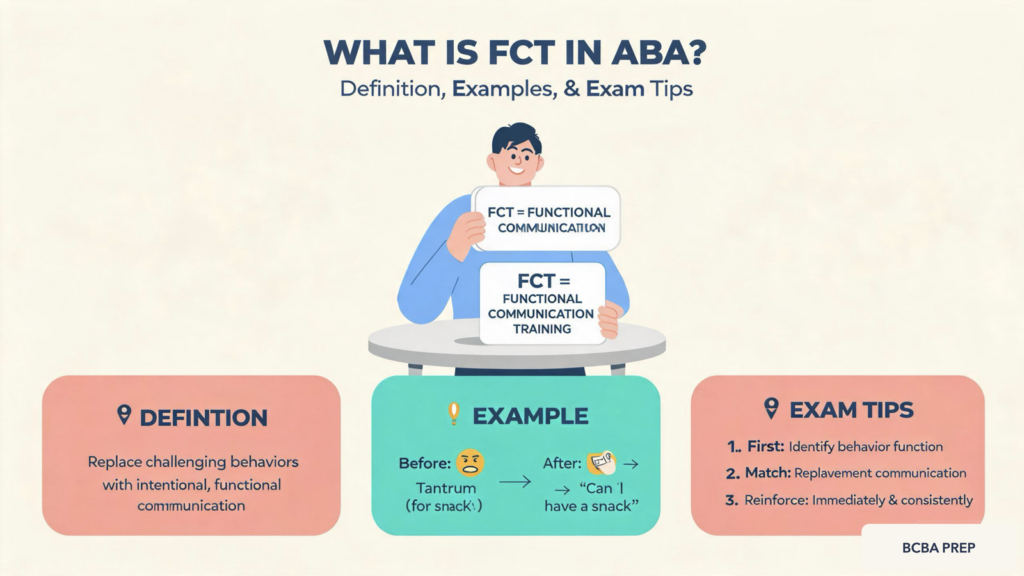
What Is Functional Communication Training (FCT)? A BCBA Candidate’s Definition
Functional Communication Training, or FCT, is a behavioral intervention that replaces a challenging behavior with a socially appropriate communicative response that serves the same function. It is based on a functional behavior assessment (FBA) and uses differential reinforcement: the new communication response is reinforced, while the challenging behavior is placed on extinction.
Table of Contents
- What Is Functional Communication Training (FCT)? A BCBA Candidate’s Definition
- The Four Key Steps of Functional Communication Training
- Worked ABA Examples of FCT with ABC Data and Hypothesized Function
- Exam Relevance and Common Traps When Studying FCT
- Quick Checklist: Applying FCT in Practice and Exams
- Final Summary
FCT is a core procedure on the BCBA exam because it combines assessment, reinforcement, and ethical practice. It directly addresses the function of behavior by teaching an alternative way to get needs met.
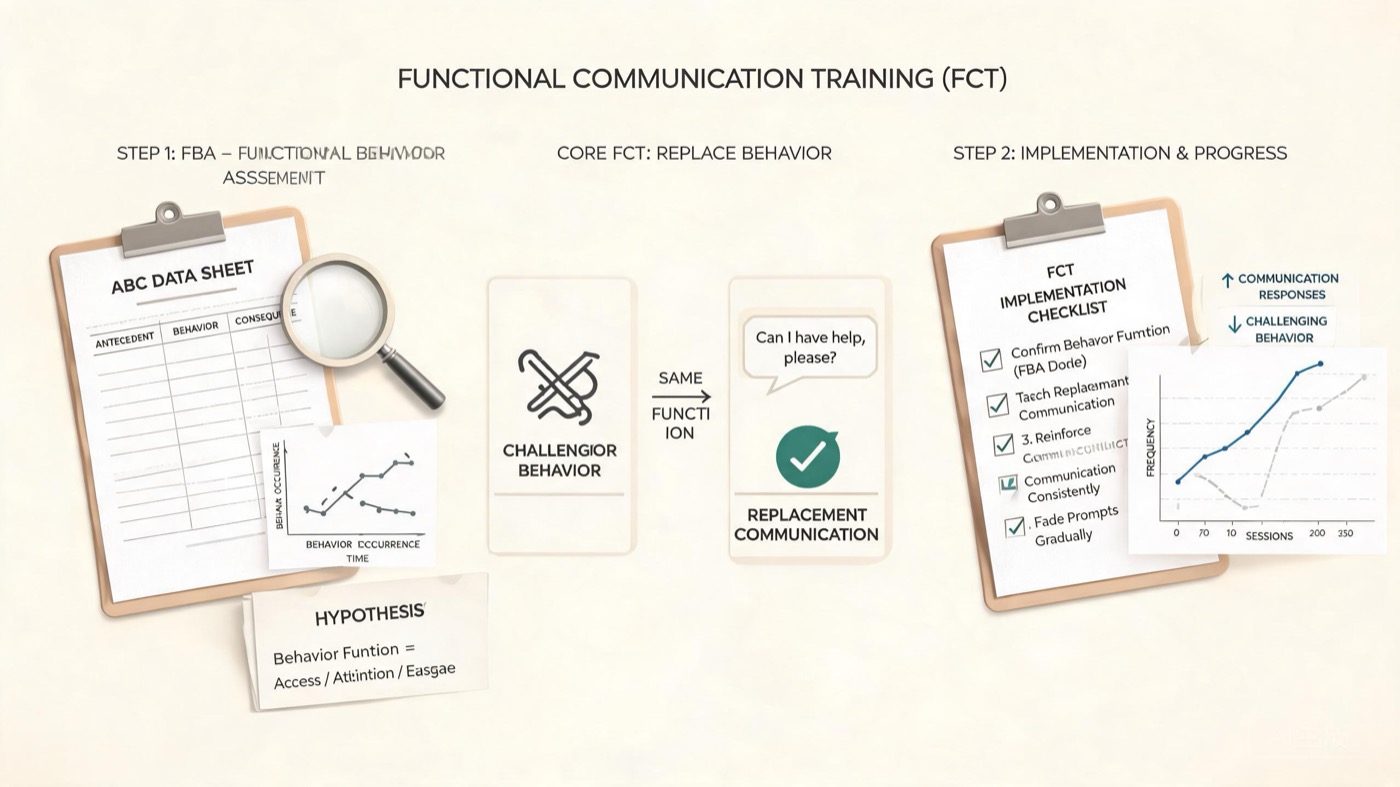
Why FCT Is a Differential Reinforcement Procedure
FCT is a type of differential reinforcement of alternative behavior (DRA). The intervention identifies the function of the problem behavior (e.g., escape, attention, access to tangibles, automatic) and teaches a specific communicative act that produces the same reinforcer. The key is that only the replacement behavior produces reinforcement; the challenging behavior no longer works.
How FCT Differs from DRO, DRL, and DRI
While all differential reinforcement procedures reduce problem behavior, FCT is unique because it teaches a new functional skill. DRO (differential reinforcement of other behavior) reinforces any behavior except the target. DRL (low rates) reinforces lower rates. DRI (incompatible) reinforces a behavior physically incompatible with the problem. FCT specifically targets a communicative response that serves as a functional equivalent.
The Four Key Steps of Functional Communication Training
Implementing FCT requires a structured process. Here are the essential steps every BCBA candidate should master.
1. Conduct a Functional Behavior Assessment (FBA)
Before teaching a replacement, you must identify the function of the challenging behavior. Use indirect assessments, descriptive observations, and if needed, a functional analysis. Without a clear hypothesis of function, FCT may teach a response that does not compete with the problem behavior.
2. Select a Replacement Communication Response
The new response must be easier to emit than the challenging behavior and should produce the same reinforcer immediately. Consider the learner’s current communication level (vocal, sign, picture exchange, or speech-generating device). For example, if aggression functions to escape a task, teach a request for a break.
3. Teach the New Communication Response
Use prompting and shaping to teach the replacement behavior. Provide immediate reinforcement for each attempt. In early stages, reinforce approximations. Gradually fade prompts so the learner initiates independently.
4. Fade and Generalize the Communication Response
Once the response is stable, thin the reinforcement schedule to natural frequencies. Program generalization across settings, people, and materials. Also, plan for maintenance by ensuring the response contacts natural reinforcement in the environment.
Worked ABA Examples of FCT with ABC Data and Hypothesized Function
These examples mirror exam-style scenarios. Each includes the antecedent, behavior, consequence, and hypothesized function, plus the FCT plan.
Example 1: Aggression Maintained by Escape
Antecedent: Teacher presents a math worksheet.
Behavior: Child hits the table and throws pencil.
Consequence: Teacher removes the worksheet and says, ‘We’ll try later.’
Hypothesized Function: Escape from difficult task.
FCT Plan: Teach the child to say ‘Break please’ or hand a ‘break’ card. When the child requests a break, provide 2 minutes away from the task. For hitting, the task remains present (extinction).
Example 2: Screaming Maintained by Attention
Antecedent: Teacher is working with another student.
Behavior: Child screams loudly.
Consequence: Teacher looks at the child and says, ‘Quiet please.’
Hypothesized Function: Attention.
FCT Plan: Teach the child to raise a ‘Talk to me’ card or say ‘Excuse me.’ When the child uses this response, the teacher provides immediate brief attention. For screaming, the teacher ignores (extinction).
Example 3: Property Destruction Maintained by Access to Tangibles
Antecedent: Toy is out of reach on a shelf.
Behavior: Child knocks over a chair.
Consequence: Parent gives the child a different toy.
Hypothesized Function: Access to preferred item.
FCT Plan: Teach the child to point to the desired toy or use a picture exchange. When the child requests the specific toy, it is delivered immediately. For destruction, the parent does not provide any toy (extinction).
Exam Relevance and Common Traps When Studying FCT
FCT frequently appears on the BCBA exam in both definitional and application questions. Avoid these common mistakes.
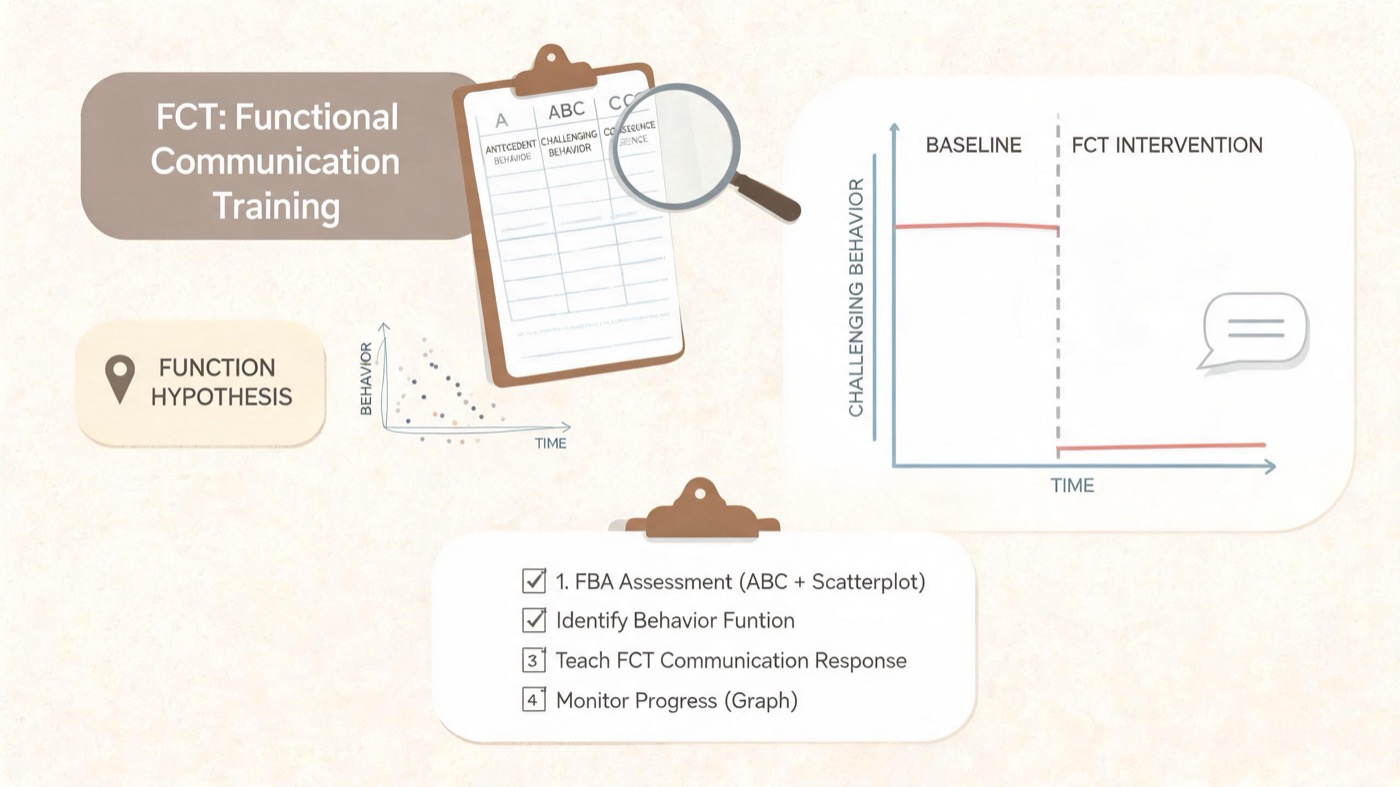
Trap #1: Confusing FCT with Simple Mand Training
While FCT involves teaching a mand (request), it is not equivalent to mand training alone. FCT is a specific intervention that targets a challenging behavior with a known function. The replacement response must be a functional equivalent to the problem behavior, and extinction must be used simultaneously.
Trap #2: Forgetting to Extinguish the Challenging Behavior
A common error is teaching the replacement response but continuing to reinforce the challenging behavior. FCT requires that the problem behavior no longer produces reinforcement. Without extinction, the old behavior may persist. However, ensure extinction is implemented safely and ethically.
Trap #3: Choosing a Response That Is Too Difficult
The replacement must be easier than the problem behavior. If the learner cannot easily perform the new response, they will likely revert to the challenging behavior. Select a response consistent with the learner’s current communication repertoire.
Quick Checklist: Applying FCT in Practice and Exams
Use this checklist to evaluate FCT plans on the exam or in the field.
Before Implementing FCT
- Completed FBA? Confirm the function is identified.
- Identified function? Is it escape, attention, tangible, or automatic?
- Chosen communicative response that is easier than problem behavior?
- Reinforcer matches function? Does the replacement produce the same reinforcer?
During Implementation
- Reinforce replacement behavior immediately? Initial quick reinforcement builds the new skill.
- Withhold reinforcement for problem behavior? Extinction is in place.
- Thin schedule gradually? Move from continuous to intermittent reinforcement as the response becomes stable.
- Plan for generalization? Teach across settings, people, and materials.
Final Summary
FCT is a powerful, function-based intervention that reduces challenging behavior by teaching a communicative alternative. For the BCBA exam, remember that it is a differential reinforcement procedure requiring a functional assessment, selection of an easily emitted replacement, immediate reinforcement, and extinction of the problem behavior. For more ABA exam prep, check out our complete guide on FCT or take a free mock exam to test your knowledge. Implementing FCT with fidelity leads to meaningful communication gains and improved quality of life for learners.
For the ethical and evidence-based application of FCT, refer to the BACB Ethics Code and the original research by Carr and Durand (1985).
Complete BCBA Exam Prep
Turn this topic into exam-day practice
Practice concepts in context with five full-length 6th Edition mock exams, two bonus practice exams, a 6th Edition study guide, and key-term flashcards—all in one $120 USD package.
Get the $120 All-in-One Prep Pack
Review everything included on the product page before ordering. No pass guarantee is implied.



