
Introduction
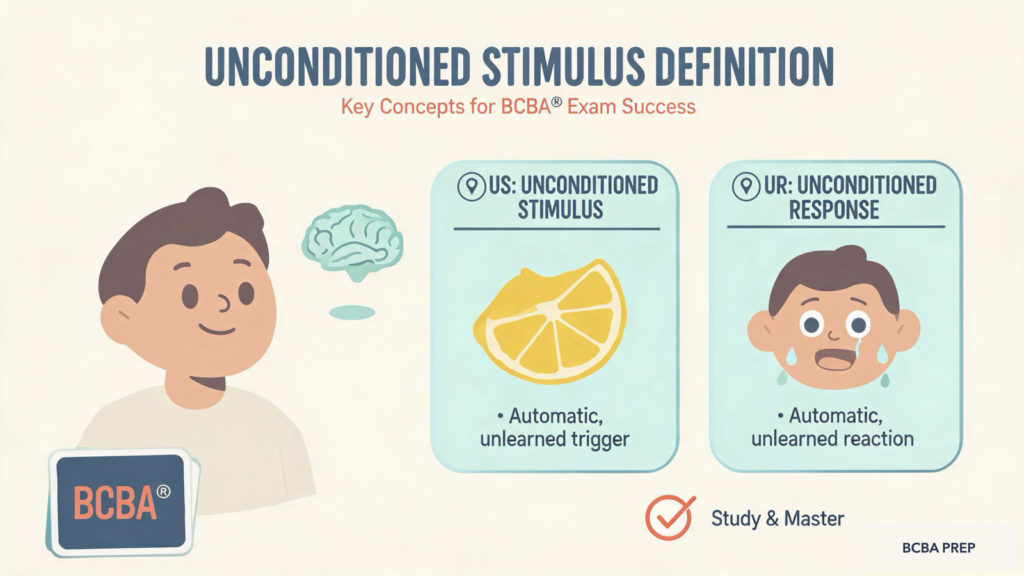
If you are studying for the BCBA® exam, mastering the unconditioned stimulus definition is essential. This concept appears frequently in questions about respondent conditioning and is a building block for understanding more complex learning processes. In this guide, we will break down the definition, walk through real-world ABA examples, highlight common exam traps, and provide a quick checklist for last-minute review. Let’s start with a clear, exam-friendly unconditioned stimulus definition.
Table of Contents
- Introduction
- What Is an Unconditioned Stimulus? A Clear Definition
- Real-World ABA Examples of Unconditioned Stimulus
- Why the Unconditioned Stimulus Matters for the BCBA® Exam
- Quick Checklist: Unconditioned Stimulus Essentials
- Summary: Mastering the Unconditioned Stimulus
What Is an Unconditioned Stimulus? A Clear Definition
An unconditioned stimulus (US) is any stimulus that naturally and automatically triggers an unconditioned response (UR) without any prior learning. In other words, it is an innate, biologically relevant event that elicits a reflexive behavior. For example, food is an unconditioned stimulus because it naturally causes salivation in a hungry organism. No pairing or conditioning is required for this relationship to exist.
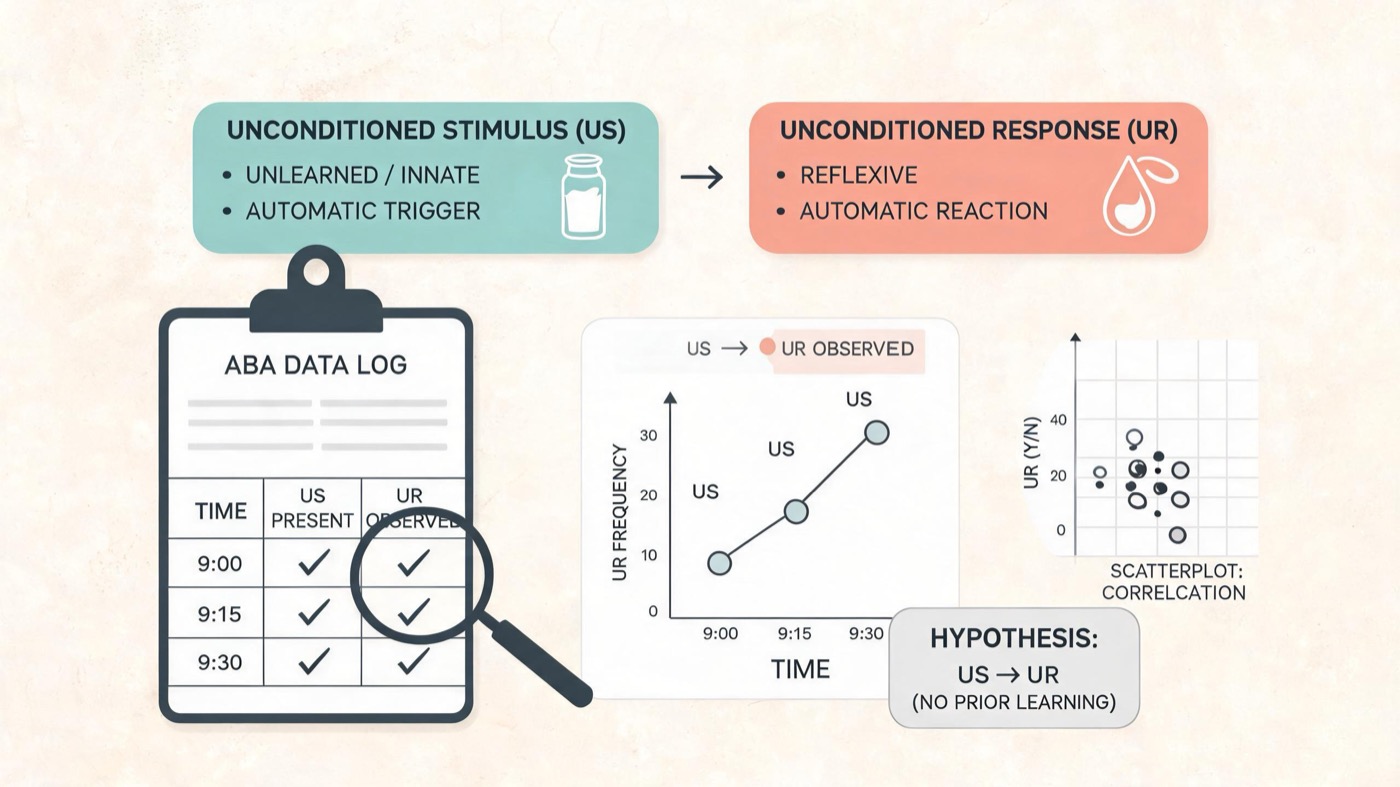
The Role of the Unconditioned Stimulus in Respondent Conditioning
The unconditioned stimulus is the foundation of respondent (classical) conditioning. In Pavlov’s famous experiment, food (US) automatically elicited salivation (UR). Then, the researcher paired a neutral stimulus (a bell) with the food repeatedly. Eventually, the bell alone produced salivation, becoming a conditioned stimulus (CS). The US never changes; it always retains its ability to evoke the UR. Understanding this unlearned relationship is critical for the exam because it distinguishes respondent conditioning from operant conditioning, where consequences shape voluntary behavior.
Unconditioned Stimulus vs. Conditioned Stimulus: Key Differences
Here are the essential contrasts:
- Unconditioned stimulus (US): Naturally elicits a reflexive response; no learning needed. Example: poking an eye (US) causes a blink (UR).
- Conditioned stimulus (CS): Previously neutral stimulus that acquires the ability to elicit a response after being paired with a US. Example: a tone paired with food eventually triggers salivation.
- Response type: US produces an unconditioned response (UR); CS produces a conditioned response (CR), which is often similar but may differ in magnitude.
- Stability: US remains effective across the lifespan; CS can extinguish if the pairing stops.
Many exam questions ask you to identify which stimulus is unlearned. Always look for a stimulus that has a biological or reflexive effect on the organism.
Real-World ABA Examples of Unconditioned Stimulus
Seeing the unconditioned stimulus definition applied to everyday scenarios will solidify your understanding. Here are three concrete examples relevant to ABA practice.
Example 1: Startle Response to Loud Noise
Imagine a child in a therapy room. A sudden loud noise (e.g., a door slam) causes the child to flinch and look up. Here, the loud noise is the US; the flinch is the UR. No previous conditioning made the child flinch; it is a natural reflex. In ABA, therapists must recognize such reflexive behaviors to avoid confusing them with operant behaviors maintained by consequences.
Example 2: Eye Blink to Puff of Air
In a controlled experiment, a puff of air directed at a person’s eye produces an immediate blink. The air puff is the US, and the blink is the UR. This reflex is often used in research on respondent conditioning. If a light flash is repeatedly paired with the air puff, the light can become a CS and elicit a blink. Knowing that the air puff is unconditioned is key to answering test items about stimulus pairings.
Example 3: Salivation to Food (Pavlov’s Experiment)
This classic example remains the hallmark of respondent conditioning. Food placed in a dog’s mouth triggers salivation. The food is the US; salivation is the UR. After repeated pairings with a bell, the bell becomes a CS. However, the food never loses its status as an unconditioned stimulus. On the exam, you may see vignettes where a novel item (like a smartphone notification) is paired with an aversive stimulus (like a loud alarm). Identify the innate stimulus as the US to answer correctly.
Why the Unconditioned Stimulus Matters for the BCBA® Exam
The BCBA® exam tests your ability to distinguish between respondent and operant conditioning, and the unconditioned stimulus is a cornerstone of that distinction. Questions often present a scenario and ask you to identify the US, UR, CS, or CR. Without a firm grasp of the unconditioned stimulus definition, you risk confusing it with reinforcers or other environmental events.
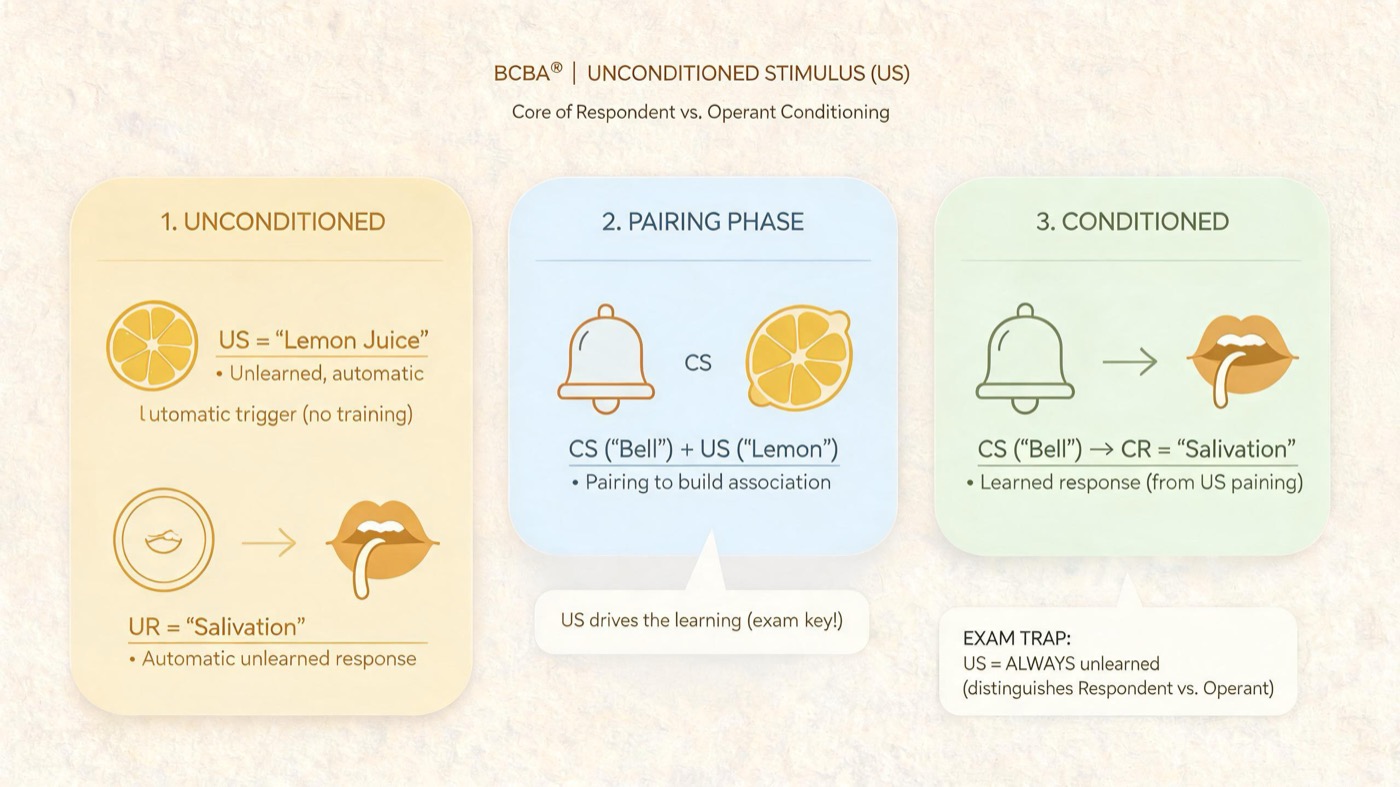
Common Exam Traps Involving the Unconditioned Stimulus
Here are three traps that frequently trip up test-takers:
- Trap 1: Confusing US with reinforcers. Remember, a US is an unlearned stimulus that elicits a reflexive response. A reinforcer is a consequence that increases the future likelihood of an operant behavior. For example, food can function as both a US (eliciting salivation) and a reinforcer (strengthening a lever press). The context matters: if the response is reflexive, it’s respondent; if it’s voluntary, it’s operant.
- Trap 2: Thinking US always requires pairing. Some stimuli are unconditioned because they have biological significance. For example, a painful stimulus (like a needle prick) naturally elicits withdrawal. No pairing is needed. If a question describes a stimulus that produces a response on the first presentation, it is likely a US.
- Trap 3: Misidentifying US in vignettes. When reading a vignette, look for the stimulus that occurs before the reflexive behavior and is naturally effective. For instance, if a child cries after a loud noise, the loud noise is the US. Do not confuse the crying (UR) with the US. Practice breaking down scenarios into antecedent (US) → behavior (UR).
Test Your Knowledge: Practice Prompts
Try these sample questions to check your understanding:
1. Which of the following is an unconditioned stimulus?
- A) A bell that has been paired with food
- B) A bright light that naturally causes a pupil to constrict
- C) A token that is exchanged for a snack
- D) A praise statement from a therapist
Answer: B. A bright light naturally causes pupil constriction; no learning needed.
2. In respondent conditioning, the unconditioned stimulus (US) is paired with a neutral stimulus. What is the result if the US is repeatedly presented alone after conditioning?
- A) The conditioned response increases
- B) The neutral stimulus becomes a CS
- C) The US continues to elicit the UR
- D) The US loses its effectiveness
Answer: C. The US always retains its ability to elicit the UR; extinction occurs when the CS is presented without the US.
Quick Checklist: Unconditioned Stimulus Essentials
Use this checklist to review before the exam:
- Define US: A stimulus that naturally elicits a reflexive response without prior learning.
- Identify examples: Food, pain, loud noise, air puff, bright light, temperature extremes.
- Distinguish from CS: US is unlearned; CS is learned through pairing.
- Remember the pairing process: US + neutral stimulus → CS elicits CR.
- Beware of reinforcer confusion: US triggers reflexes; reinforcers increase operant behavior.
- Practice with vignettes: Is the response reflexive? Then the antecedent is likely a US.
For more practice on respondent conditioning, check out our guide on respondent conditioning examples and strengthen your understanding of respondent vs. operant behavior.
Summary: Mastering the Unconditioned Stimulus
The unconditioned stimulus definition is straightforward: a naturally effective stimulus that elicits an unconditioned response. However, applying it accurately on the BCBA® exam requires practice. We covered the definition, three real-world ABA examples, key differences from conditioned stimuli, and common traps that lead to mistakes. Remember to differentiate US from reinforcers, avoid assuming all stimuli need pairing, and always break down vignettes into US → UR. With this foundation, you will answer respondent conditioning questions with confidence. For additional exam prep, explore our free BCBA mock exam questions. For an authoritative source, refer to the BACB’s Behavior Analyst Certification Board guidelines on terminology.



