
What Is Extinction in ABA? A Quick Refresher
In applied behavior analysis, extinction refers to a procedure in which reinforcement that previously maintained a behavior is no longer delivered. This leads to a gradual decrease in that behavior over time. It is not the same as ignoring or punishing; it requires identifying the specific maintaining consequence and withholding it consistently.
Table of Contents
- What Is Extinction in ABA? A Quick Refresher
- Example 1: Extinction of a Tangibly-Maintained Tantrum
- Example 2: Extinction of Attention-Maintained Whining
- Example 3: Extinction of Automatically-Maintained Hand Flapping
- Exam Relevance: Common Traps and Practice Prompts
- Quick Checklist for Implementing Extinction
- Summary: Why Extinction Is a Core ABA Tool
Key contrasts: extinction removes reinforcement, while punishment adds a stimulus or removes a stimulus to decrease behavior. Negative reinforcement strengthens behavior by removing an aversive, whereas extinction weakens behavior by eliminating the reinforcer. Understanding these differences is crucial for the BCBA exam.
Extinction vs. Other Procedures
Analogies help: if a light switch used to turn on a lamp (reinforcement) but now does nothing (extinction), the behavior of flipping the switch will eventually stop. However, if you get shocked when you flip it (punishment), the behavior may stop faster but with side effects. Extinction is often combined with differential reinforcement to teach alternative behaviors.
Example 1: Extinction of a Tangibly-Maintained Tantrum
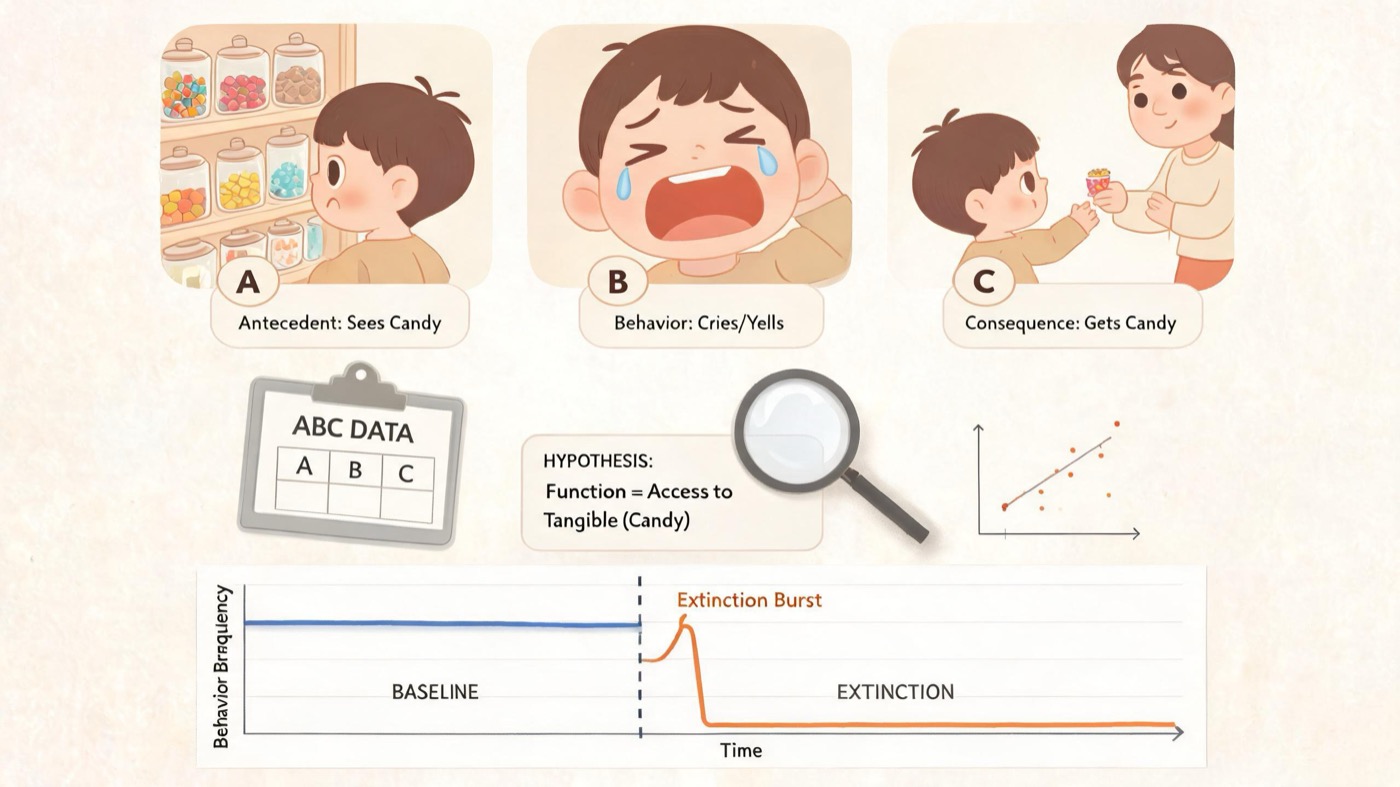
A classic scenario: a child cries and yells in a store when they see candy. The ABC analysis is: Antecedent (seeing candy), Behavior (crying, yelling), Consequence (parent gives candy). The hypothesized function is access to a tangible item. In extinction, the parent no longer provides candy, no matter the intensity of crying.
ABCD Analysis and Hypothesized Function
- Antecedent: Child sees candy on shelf.
- Behavior: Child cries, screams, falls to floor.
- Consequence: Parent gives candy (reinforcement).
- Function: Access to tangible (candy).
- Extinction: Parent ignores crying; no candy given.
Potential Extinction Burst and Spontaneous Recovery
An extinction burst is common: crying may immediately worsen in intensity. The parent must remain consistent. After a period of calm, the behavior may suddenly reappear (spontaneous recovery); this does not mean extinction failed. The plan must be followed without exception. For exam purposes, always plan for the burst and rehearse data collection.
Example 2: Extinction of Attention-Maintained Whining
In a classroom, a student whines to get the teacher’s attention. The ABC model: Antecedent (teacher busy), Behavior (whining), Consequence (teacher looks, says ‘What?’). Function: attention. Extinction here is planned ignoring; the teacher does not provide any reaction to whining. However, it is critical to reinforce appropriate requests (e.g., raising hand) so the student learns an alternative.
Using Extinction with Differential Reinforcement
Combining extinction with differential reinforcement of alternative behavior (DRA) is a standard exam topic. For example, the teacher ignores whining but immediately attends to the student when they raise their hand. This pairing speeds up the reduction of whining and teaches a socially acceptable replacement. Study this combination because exam questions often ask: “What procedure is being used?” Answer: extinction plus DRA.
Example 3: Extinction of Automatically-Maintained Hand Flapping
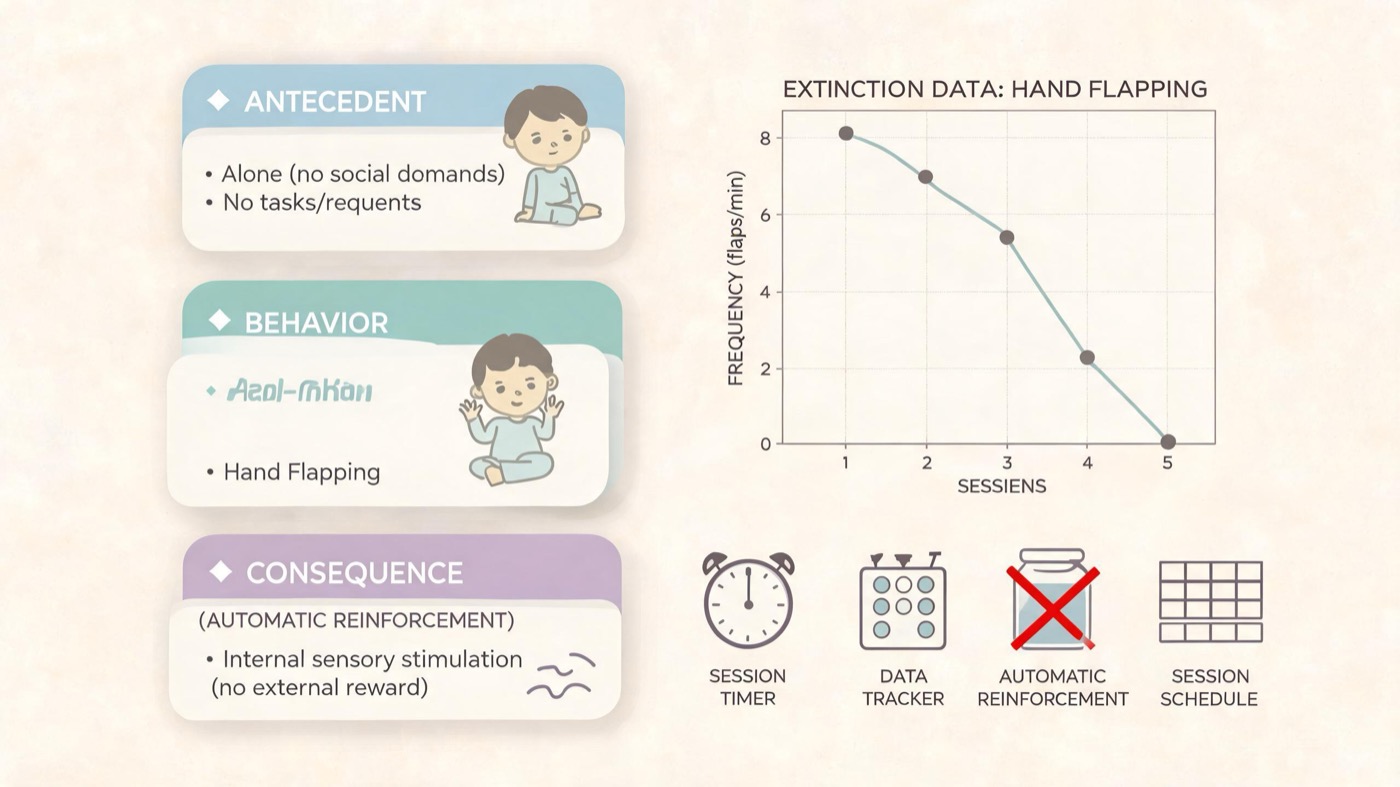
This is a trickier example. A child flaps their hands when alone, with no social demands. ABC analysis: Antecedent (alone, no demands), Behavior (hand flapping), Consequence (sensory stimulation). The function is automatic reinforcement, meaning the behavior itself produces the reinforcer. Extinction becomes challenging because you cannot easily remove the sensory consequence. Sensory extinction may involve wearing gloves to reduce tactile feedback, but this is often not practical.
Challenges with Automatic Reinforcement
The BCBA exam tests whether you understand that automatically maintained behaviors are difficult to extinguish. Clinicians often use redirection to competing stimuli (e.g., a fidget toy) or modify the environment. Do not assume extinction will work easily. In exam scenarios, look for the maintaining consequence: if it’s sensory, extinction options are limited. Practice recognizing this to avoid common mistakes.
Exam Relevance: Common Traps and Practice Prompts
Extinction appears frequently on the BCBA exam in multiple-choice questions and scenario-based problems. You must identify the procedure, anticipate bursts, and know when to combine with other interventions. Here are common traps to be aware of:
Common Exam Traps
- Confusing extinction with punishment – extinction does not add or remove an aversive.
- Forgetting to identify the maintaining consequence before implementing extinction.
- Not planning for a extinction burst – an initial increase in behavior.
- Implementing extinction inconsistently (e.g., giving in sometimes) which strengthens the behavior via intermittent reinforcement.
- Assuming extinction works immediately – it often takes time and data collection.
Practice Prompts
Try these mini scenarios to test your knowledge:
- A child screams for juice; in the past, juice was given. What is the extinction procedure? (Answer: no juice given, regardless of screaming.)
- A student taps a pencil to get peer attention. Teachers ignore the tapping but praise when the student writes quietly. What combination of procedures is this? (Answer: extinction + DRA.)
- A client hums for auditory stimulation. Can you use extinction? (Answer: difficult; need to identify and block sensory consequence or use redirection.)
Quick Checklist for Implementing Extinction
Use this checklist when designing an extinction plan. It is especially helpful for exam questions that ask about procedural integrity.
- Identify the maintaining consequence based on functional behavior assessment.
- Ensure consistency: everyone involved must withhold reinforcement every time.
- Reinforce alternative appropriate behaviors (e.g., DRA, DRI, DRO).
- Monitor for extinction bursts and spontaneous recovery; plan for escalation safely.
- Collect data on the target behavior to evaluate effectiveness.
- Assess ethical considerations: ensure extinction does not cause harm or undue distress.
Summary: Why Extinction Is a Core ABA Tool
Extinction reduces problem behavior by withholding the maintaining reinforcer. It is evidence-based and widely used in behavior intervention plans. The key is knowing the function: for tangibles, withhold the item; for attention, ignore; for automatic, block or compete. Always pair extinction with differential reinforcement to teach replacement behaviors. For the BCBA exam, practice identifying extinction scenarios, avoiding common traps, and planning for bursts. With a solid understanding of extinction in ABA, you will be prepared for both the test and real-world practice.
For more BCBA exam preparation, visit our extinction in ABA guide and check out differential reinforcement strategies. Also refer to the BACB handbook for ethical guidelines.
Next step for BCBA exam prep
Turn this topic into exam-day practice
Use this topic as a focused review, then test it in exam-style conditions with a free mock before deciding whether five full-length mocks are the right next step.
Start the Free BCBA Mock Exam
Continue with Five Full-Length Mocks — $99
Review the included materials and access details before ordering. No pass guarantee is implied.



